
Best Wiper Blades for the Hyundai Palisade in Australia

The right wiper blades for a Hyundai Palisade are the ones that fit your exact model, clear a wide windscreen evenly and cope with Australian sun. For most owners that means vehicle-specific natural rubber blades with the fitment confirmed before you buy. Our Hyundai Palisade wiper blades are built around that idea: pick your vehicle, get the matching set, fit it at home.
TL;DR
- The Palisade has a large, upright windscreen and a rear wiper, so a correct pair at the front and a correct blade at the back both matter.
- Independent 2026 US tests put beam-style blades with synthetic or natural rubber elements at the top for wipe coverage and noise.
- Australian heat and UV break rubber down faster than milder climates, so plan on replacing blades every six to twelve months.
- Our vehicle selector matches blades to your make, model and year, and the Palisade 2020-2023 page lists the set for that generation.
- Every order ships free across Australia, with a 30-day money-back guarantee and a 12-month warranty.
Table of Contents
- What a Palisade needs from its wiper blades
- How the main options compare for a Palisade
- Rubber or silicone for Australian heat
- How often to replace them in Australia
- Palisade blade sizes and the rear wiper
- Fitting new blades on a Palisade
- Keeping the glass clear between replacements
- Do more expensive blades make a difference?
- Our view on Palisade wipers
- Get the Palisade set that fits
- FAQ
- Sources
What a Palisade needs from its wiper blades
The Palisade is a big three-row SUV, and that shapes what you should look for. The windscreen is tall and wide, the driver’s blade is much longer than the passenger’s, and there is a separate blade on the rear window. A universal kit that treats both front blades as the same length is a common mistake on a vehicle like this.
Four things decide whether a blade is a good match:
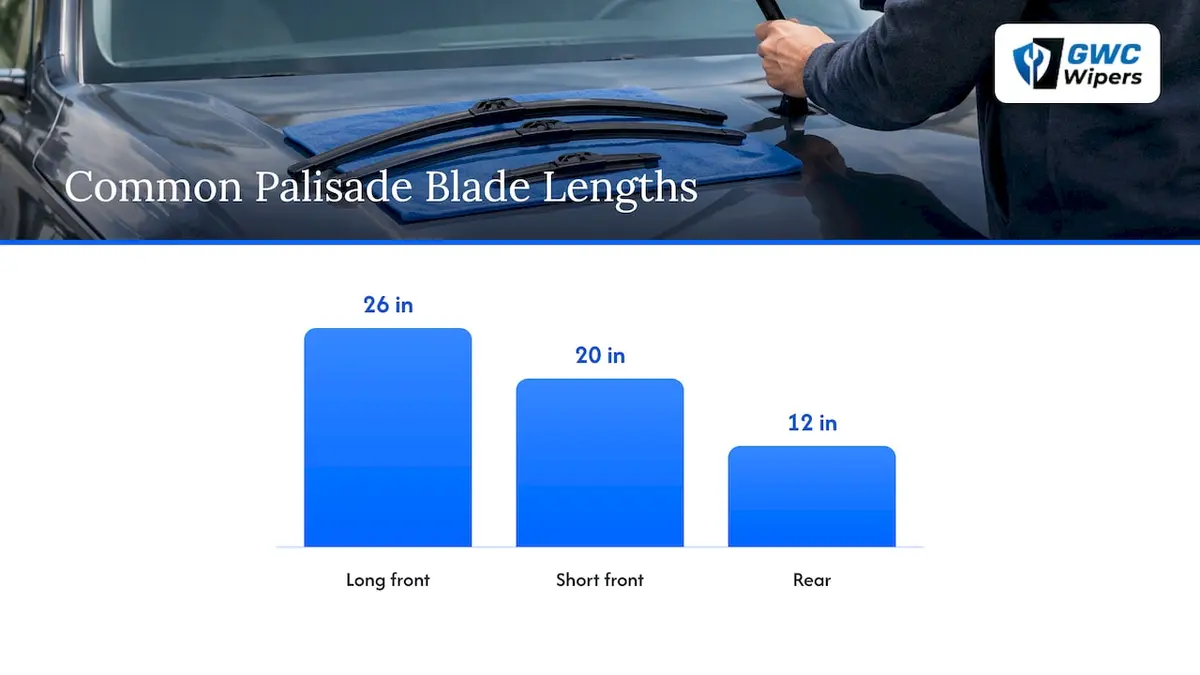
- Correct length for each position. Front blades are commonly listed at 26 inches on the driver’s side and 20 inches on the passenger’s side, with a 12-inch rear blade, but fitment databases do not always agree. Confirm against your own year and trim in the selector rather than relying on a forum post.
- Correct connector. The blade must lock onto your arm. A blade that is the right length but the wrong attachment will not sit properly.
- Even pressure along the blade. On a curved, wide windscreen, a blade that lifts at the ends leaves streaks or a missed strip of glass. Beam and segmented designs spread pressure more evenly than old-style framed blades.
- A rubber that handles heat. A car parked outdoors in summer takes a lot of UV and heat. That is the main reason blades fail early in Australia.
That last point is also why a fitment guarantee matters more than a brand name on the box. A blade that does not fit cannot perform, whatever it scored in a test.
How the main options compare for a Palisade
There is no single Palisade-specific shootout. The most useful independent evidence comes from large 2026 tests in the United States, which tell you how each blade type behaves rather than how it fits your car. Read the results as a guide to design and rubber quality, then check fitment for your vehicle.
| Option | What the evidence says | Fit for a Palisade |
|---|---|---|
| GWC Wipers (vehicle-specific) | Natural rubber, segmented pressure distribution, aerodynamic design, corrosion resistance, preassembled adapters | Matched to your make, model and year, with a fitment guarantee |
| Bosch Icon | Top scorer in MotorTrend’s 2026 test | Check the listing for your year and position |
| Rain-X Latitude | Car and Driver’s best overall pick for water repellency | Check the listing for your year and position |
| Trico Flex | Car and Driver’s budget pick | Check the listing for your year and position |
| Valeo Silencio | Factory-style range with front and rear options | Check the listing for your year and position |
What the 2026 tests found
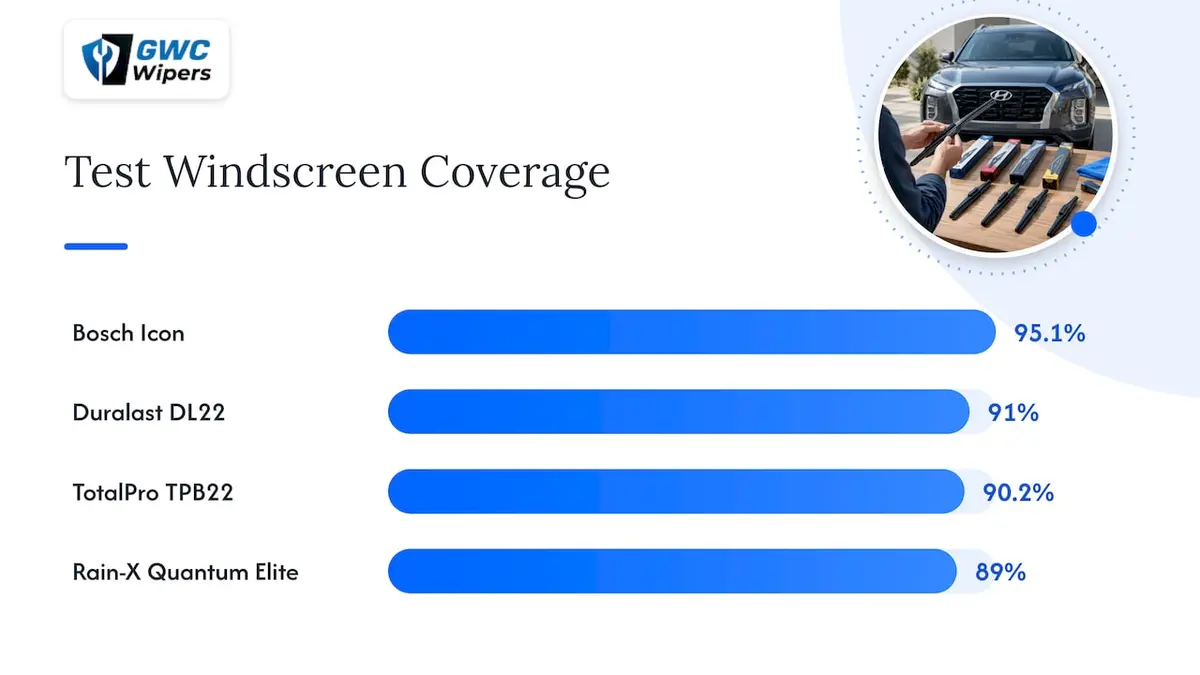
In MotorTrend’s 2026 wiper blade test, published on 30 April 2026, the Bosch Icon cleared 95.1% of the test windscreen at 50.7 dB. The team said it was surprised that a rubber blade topped the table, and credited the even pressure of the beam design. The same test recorded 91% for the Duralast DL22, 90.2% for the TotalPro TPB22 and 89% for the Rain-X Quantum Elite, with install times from one to a little over one and a half minutes.
Car and Driver’s 2026 tested picks took a different angle. They rated Rain-X Latitude best overall for its water-repellent coating, Aero Voyager best value, Bosch Icon the premium choice and Trico Flex the budget choice.
What this tells a Palisade owner:
- Wipe coverage and noise come from design and rubber, not price alone. The top results were all beam-style or tensioned designs with good pressure control.
- Install time varies. Blades with a simple, clear attachment go on faster, which matters if you are doing it in a driveway.
- A coating helps in light rain but does not replace a well-fitted blade. Beading on the glass only works when the blade also wipes cleanly.
Where our blades fit in
We design and manufacture our blades for Australian weather, from heavy rain to extreme heat. They use natural rubber, advanced segmented pressure distribution and an aerodynamic profile, with corrosion resistance and preassembled adapters so you can fit them at home. The selector covers more than 2,500 models, and each set comes with a perfect fit guarantee. For a Palisade owner choosing on fit, durability and ease, that combination is why we put our own set first.
Rubber or silicone for Australian heat
Owners often ask whether silicone is worth it. The research on this is mixed and mostly comes from US consumer sites, so it is worth looking at what Australian trade sources say.
Trade Mechanic, an Australian trade publication, recommends 100% natural rubber blades with graphite and Teflon treatment for local conditions. Its argument is that constant friction combined with big temperature swings is hard on other materials. It also advises buying only blades listed for your specific vehicle by a reputable manufacturer.
That lines up with how we build ours. Natural rubber is soft enough to follow the curve of a Palisade windscreen, and our vehicle-specific listing means the length and connector are right from the start.
How often to replace them in Australia
Heat does the damage. One Australian buying guide, citing Trico, notes that summer heat can deform the tension strip in a blade. It suggests a car parked outside sits at the short end of a six-to-twelve-month replacement window. It also says beam blades hold up better than framed ones after the first year, because framed blades’ pressure points spread and begin to skip.
In practice, replace your Palisade blades when you see any of these:
- Streaks or a hazy film that does not clear after a wash
- Chatter or skipping across the glass
- Squeaking on a wet windscreen
- Split, cracked or flattened rubber on the edge
- A visible gap between the blade and the glass at the ends
If your Palisade lives outdoors in Queensland, Western Australia or the Northern Territory, check the blades more often than the calendar suggests. Rubber that looks fine from a distance can already be hard along the edge.
Palisade blade sizes and the rear wiper
The Palisade has a front pair and a single rear blade. Sizes commonly listed for the front are 26 inches and 20 inches, and 12 inches for the rear, though some sites list slightly different figures for the same years. That disagreement is exactly why a vehicle-based lookup beats a size chart.
Use the selector on our site and enter make, model and year. The Hyundai Palisade page shows the sets for the model, and the 2020-2023 SUV page covers that generation. You can also browse the full wiper blade range by make if you own more than one vehicle, for example a Palisade alongside a Santa Fe or a Kona.
A few tips when you check:
- Know the year the vehicle was built, not just when you bought it. The compliance plate or registration papers show it.
- Treat the driver’s and passenger’s blades as two different parts.
- Order the rear blade at the same time, as rear blades often wear out at the same pace as the front ones in sun-exposed cars.
Fitting new blades on a Palisade
This is a ten-minute job in the driveway. Our blades arrive with preassembled adapters and detailed guides, so there is no need to piece parts together.
- Lay a towel on the bonnet or windscreen base. An arm that snaps back can crack the glass. This is the most common way a simple job goes wrong.
- Lift the arm away from the glass until it locks upright.
- Release the old blade. Press the tab or clip where the blade meets the arm, then slide it down and off the hook.
- Slide the new blade on until it clicks. Tug gently to confirm it is locked.
- Lower the arm slowly onto the glass. Do not let it drop.
- Repeat for the other side and the rear blade. Keep the old blades side by side with the new ones if you are unsure which position is which.
- Test with washer fluid. Run a few wipes and check that the blade sweeps to the edge of the glass without chatter.
If you buy from us and the blade does not fit, our 30-day money-back guarantee applies, and the set also carries a 12-month warranty.
Keeping the glass clear between replacements
Blades can only clear what they are given. Road film, bugs and tree sap build up on the glass and drag across the rubber, which causes streaks even with a new blade. Wash the windscreen and wipe the blade edge with a damp cloth when you wash the car. A spray and rinse coating is one way to help keep a panel streak-free after washing, and the same care on the glass helps the blades glide.
Also top up the washer reservoir regularly. Running blades dry on a hot windscreen wears the edge quickly.
Do more expensive blades make a difference?
Part of it is real. The MotorTrend results show blades from the same test can differ by several percentage points in wipe coverage, and the quietest blade was nearly four decibels below the loudest. Lifespan is harder to prove. Figures from user communities, such as a 14 to 24 month range for the Bosch Icon before streaking starts, come from owner reports rather than controlled tests, and heat in Australia will shorten any of them.
What you can control is fit and care. A correctly sized, vehicle-specific blade that you replace on schedule will outperform an expensive blade that is the wrong length. Our approach is to give Palisade owners a premium, vehicle-matched set with free delivery, so you are not paying extra to find out whether it will fit.
Our view on Palisade wipers
Most wiper problems on big SUVs start with fit, not with the rubber. A driver’s blade that is a couple of centimetres out, or a connector that nearly fits, leaves a strip of glass uncleared right where you look through.
That is why we built our range around the vehicle. You choose your make, model and year, and we match the blade. We make our blades for Australian conditions, with natural rubber, segmented pressure distribution and corrosion resistance, so they hold up through heavy rain and long summers.
For a Palisade, we would pick the vehicle-specific set, fit it yourself with the guide, and replace it before the heat wears it out. Clear visibility is a safety matter, and it should not depend on guesswork.
Faisal
Get the Palisade set that fits
Our Palisade wiper blades come with free shipping across Australia, a 30-day money-back guarantee and a 12-month warranty. Pick your year in the selector and you will see the set matched to your vehicle, with guides for fitting.
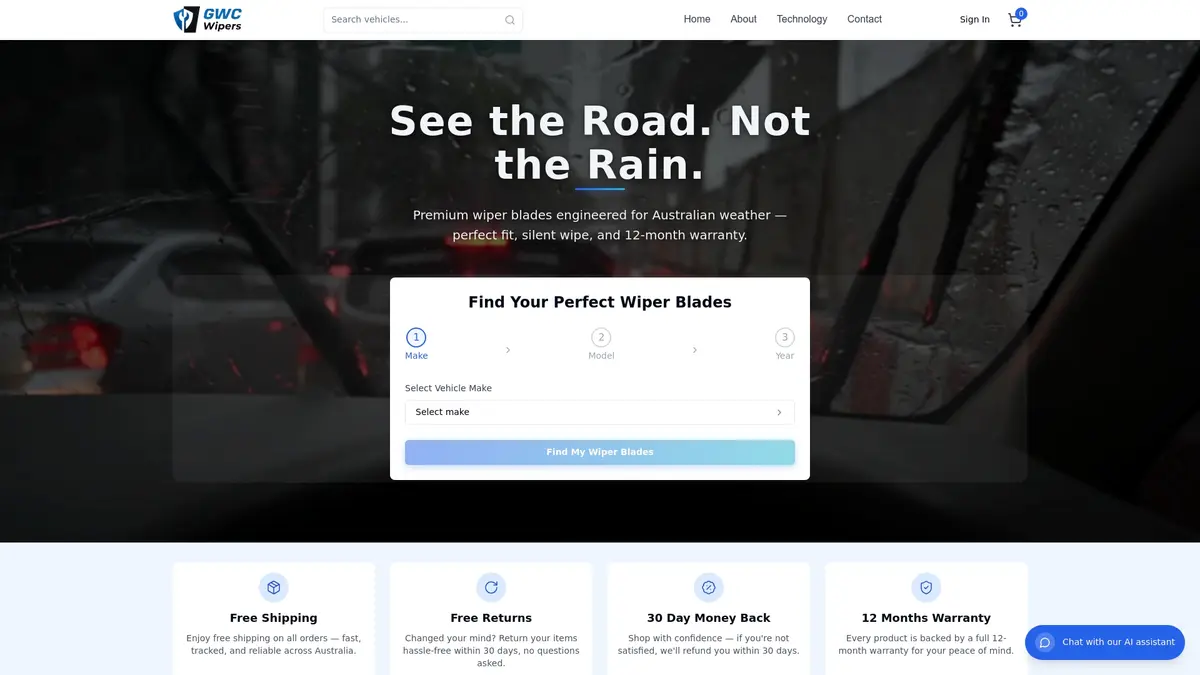
If you want to see everything we offer, start at GWC Wipers and choose your vehicle.
FAQ
What size wiper blades does a Hyundai Palisade use?
Front blades are commonly listed as 26 inches for the driver’s side and 20 inches for the passenger’s side, with a 12-inch rear blade. Listings do vary between sites, so confirm your year in our vehicle selector before ordering.
Which is better for a Palisade, rubber or silicone?
For Australian conditions, an Australian trade publication recommends natural rubber with a graphite and Teflon treatment. Our blades use natural rubber, which follows the curve of a wide windscreen and is matched to your exact vehicle.
How often should I replace Palisade wiper blades?
Every six to twelve months is a common interval in Australia, and the short end applies if the car is parked outside in summer. Replace them sooner if you notice streaks, chatter, squeaking or split rubber.
Do I need to replace the rear wiper too?
Yes, the rear blade is worth changing with the front pair. It sits in the same sun and gets the same wear, and a smeared rear window is a safety issue when reversing or changing lanes.
Can I fit the blades myself?
Yes. Our blades come with preassembled adapters and detailed guides, so most owners can do it at home in a few minutes. Protect the glass with a towel and lower the arm gently.
Sources
- The Best Wiper Blades For 2026: Tested Picks (MotorTrend)
- Best Windshield Wiper Blades for 2026, Tested (Car and Driver)
- Understanding how Wiper Blades Work, and Why They Fail (Trade Mechanic)
- Best Wiper Blades Australia: What Fits and What Lasts (Home Muse)
- Bosch ICON Wiper Blade (CarCareTruth)