
What defines heavy-duty wipers for Australian vehicles

Most drivers assume any wiper blade will do the job when the rain hits hard. That assumption gets tested fast on Australian roads, where conditions can swing from a dry, dusty outback highway to a torrential coastal downpour within hours. Standard blades are built for average conditions, and average conditions are not what Australia serves up. Heavy-duty wiper blades are engineered differently, from the frame to the rubber compound, and understanding those differences could be the reason you see clearly when it matters most. This guide walks you through everything you need to know to choose, compare, and fit the right heavy-duty wipers for your vehicle.
Table of Contents
- What makes a wiper blade heavy-duty
- Key materials and technologies in heavy-duty wipers
- Comparing heavy-duty versus standard wiper blades
- How to choose and install heavy-duty wipers for your vehicle
- Find the perfect heavy-duty wiper blades for your car
- Frequently asked questions
Key Takeaways
| Point | Details |
|---|---|
| Reinforced design | Heavy-duty wipers offer stronger construction for extreme Australian weather and high-speed environments. |
| Advanced materials | Premium rubber compounds and technologies extend the lifespan and improve efficiency of heavy-duty blades. |
| Pressure distribution | Beam-style and hybrid designs ensure consistent contact and prevent wind lift at highway speeds. |
| Suitable for all drivers | Heavy-duty wipers are ideal for any vehicle owner prioritising reliability, not just for large cars and trucks. |
What makes a wiper blade heavy-duty
Not every wiper blade that claims to be tough actually is. The term “heavy-duty” refers to a specific set of engineering standards, not just a marketing label. Reinforced frames, robust rubber compounds, and designs built for larger vehicles like trucks, buses, and RVs are what genuinely separate heavy-duty blades from the rest.
Here is what sets a heavy-duty blade apart from a standard one:
- Reinforced frame construction that resists bending and warping under pressure
- High-grade rubber compounds that maintain flexibility in extreme heat and cold
- Wider blade profiles designed for larger windscreens on commercial and recreational vehicles
- Stronger wiper arm connectors that hold firm at highway speeds
- Resistance to UV degradation, which is critical in Australia’s intense sun
Standard blades use basic steel frames and natural rubber that degrades quickly under UV exposure and temperature swings. Heavy-duty blades are built to handle the kind of stress that Australian conditions deliver daily. Whether you drive a RAM truck across regional Queensland or a family SUV through Sydney’s wet winters, the durability and performance gap between standard and heavy-duty is significant.
Stat to know: Heavy-duty wiper blades can last up to 40% longer than standard blades under equivalent conditions, making them a cost-effective choice over time.
Key materials and technologies in heavy-duty wipers
The materials inside a heavy-duty wiper blade are where the real engineering happens. Modern heavy-duty designs use beam-style or hybrid designs that distribute pressure evenly across the entire blade length, eliminating the pressure points that cause streaking and skipping on standard frames.
Aerodynamic spoilers are another feature worth understanding. At speeds above 100 km/h, wind lift becomes a genuine problem. A standard blade can lift away from the windscreen, leaving a smeared, dangerous streak. Spoilers press the blade down against the glass, maintaining contact and clarity. This is not a luxury feature. On Australian highways, it is a safety essential.
Material upgrades make a measurable difference too. Silicone rubber outlasts natural rubber by a wide margin, staying pliable in temperatures from freezing alpine conditions to 45-degree summer days. Graphene-infused rubber is the newest development, offering up to 40% longer lifespan and tested durability across 1.5 million wipe cycles. A clean windscreen improves safety significantly, and the right blade material is the foundation of that.
| Feature | Standard blade | Heavy-duty blade |
|---|---|---|
| Frame material | Basic steel | Reinforced steel or composite |
| Rubber compound | Natural rubber | Silicone or graphene-infused |
| Pressure distribution | Uneven, point-based | Uniform across full length |
| Wind resistance | Minimal | Aerodynamic spoiler design |
| UV resistance | Low | High |
| Estimated lifespan | 6 to 12 months | 12 to 24 months |
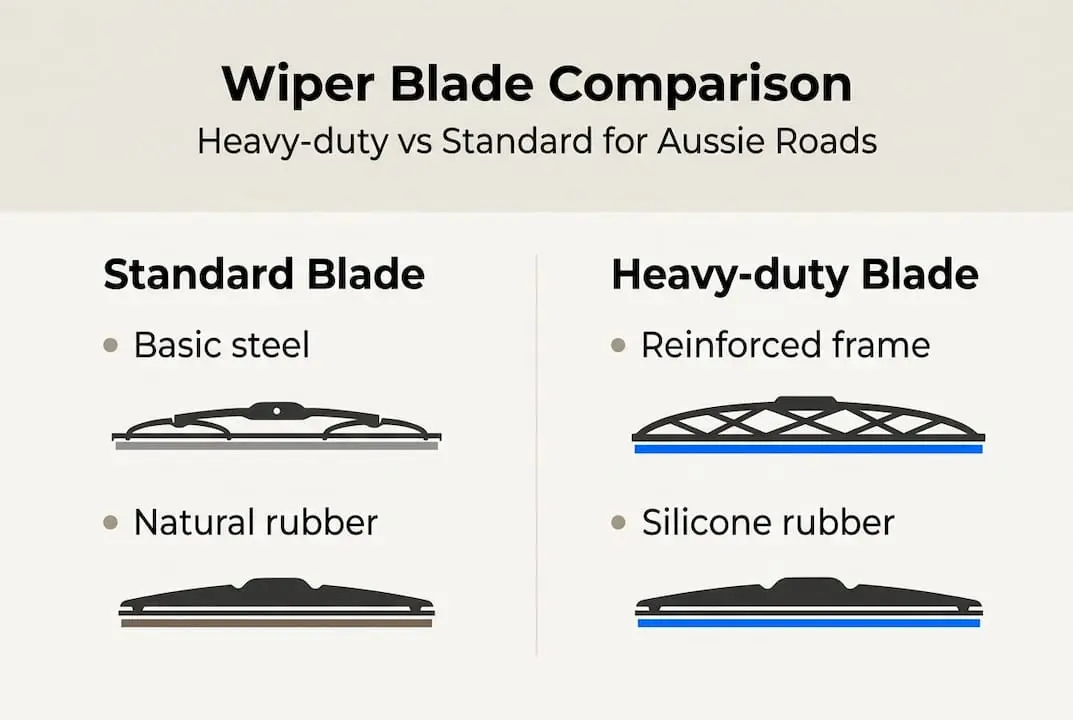
For vehicles like Mercedes-Benz models, which often come factory-fitted with beam-style blades, upgrading to a heavy-duty equivalent maintains that same performance standard without the dealership price tag.
Pro Tip: Check whether your current blades use tension springs inside the frame. Advanced tension springs maintain consistent pressure across the blade as it ages, which is one of the most overlooked factors in long-term wiper performance.
Comparing heavy-duty versus standard wiper blades
Knowing the technology is one thing. Seeing how it plays out in real use is another. The comparison between heavy-duty and standard blades comes down to three practical areas: durability, performance in tough conditions, and overall value.

| Category | Standard blade | Heavy-duty blade |
|---|---|---|
| Durability | 6 to 12 months typical | 12 to 24 months typical |
| Performance in heavy rain | Adequate in light to moderate rain | Reliable in heavy and sustained rain |
| High-speed performance | Wind lift risk above 100 km/h | Aerodynamic design maintains contact |
| Dusty conditions | Rubber degrades faster | Reinforced compounds resist abrasion |
| Cost per blade | Lower upfront | Higher upfront, lower long-term cost |
| Best suited for | City driving, mild weather | All-weather, highway, commercial use |
Heavy-duty wipers prioritise reinforced construction for reliability in extreme conditions. Yes, they cost more upfront. But replacing standard blades twice a year versus heavy-duty blades once every two years often works out cheaper, and the performance difference in a sudden storm is not comparable.
Beam hybrid designs sit in a smart middle ground. They combine the even pressure distribution of a beam blade with the structural support of a traditional frame, making them a strong all-rounder for most Australian drivers.
Here is where heavy-duty blades clearly outperform standard options:
- Sustained heavy rain, where standard blades begin to streak and skip
- Dusty outback roads, where abrasive particles wear down softer rubber quickly
- High-speed highway driving, where wind lift compromises contact
- Extreme temperature swings, where cheaper rubber cracks or stiffens
- Commercial and fleet vehicles, where downtime from poor visibility is not acceptable
For commercial operators running Iveco trucks or fleet managers sourcing Nissan wiper blade options across multiple vehicles, the reliability argument for heavy-duty blades is straightforward. Fewer replacements, fewer visibility failures, and less risk on the road.
“Reliability is not just about the blade lasting longer. It is about knowing it will perform when conditions are at their worst.” This is the standard heavy-duty wipers are built to meet.
How to choose and install heavy-duty wipers for your vehicle
Choosing the right heavy-duty wiper is not complicated, but getting it wrong means poor fit and poor performance. Follow these steps to get it right the first time.
- Check your vehicle’s wiper specifications. Look in your owner’s manual or use an online vehicle selector tool to find the correct blade length for both driver and passenger sides. These are often different lengths.
- Decide on the blade design. Beam-style suits most passenger vehicles. Hybrid designs work well for SUVs and light commercial vehicles. Traditional heavy-duty frames are best for trucks, buses, and RVs.
- Choose your rubber compound. Silicone is the best all-rounder for Australian conditions. Graphene-infused rubber is the premium option for maximum longevity.
- Confirm the connector type. Most modern vehicles use a hook-style arm, but some use pin or pinch-tab connectors. Heavy-duty blades with universal adapters cover most vehicles.
- Install with care. Lift the wiper arm away from the windscreen, align the blade connector with the arm, and click it into place. Never let the arm snap back onto the glass without a blade fitted.
- Test before you drive. Run the wipers through a full cycle with washer fluid to confirm even contact and no skipping.
Heavy-duty designs are particularly well suited for recreational vehicles and Australian drivers who need all-weather reliability across varied terrain. Whether you drive a Toyota RAV4 through coastal Queensland or a Jaguar through Melbourne’s unpredictable winters, the installation process is the same and typically takes under five minutes.
Pro Tip: After fitting new heavy-duty blades, clean the windscreen thoroughly with a glass cleaner before the first use. Residue from old blades can cause new blades to skip and streak, making you think the blade is faulty when the glass is actually the problem.
For ongoing longevity, lift your blades away from the windscreen during extended periods of direct sun or when frost is expected. This prevents the rubber from bonding to the glass and extends the life of even the toughest heavy-duty compound.
Find the perfect heavy-duty wiper blades for your car
Now that you know exactly what separates a heavy-duty wiper from a standard one, the next step is finding the right fit for your specific vehicle. GWC Wipers stocks a wide range of all wiper blade options across hundreds of makes and models, with heavy-duty solutions for everything from family SUVs to commercial fleets.
Every blade comes with a perfect fit guarantee for Australian vehicles, free shipping across the country, a 30-day money-back guarantee, and a 12-month warranty. The vehicle selector tool makes it simple to find the exact blade for your make, model, and year in seconds. If you drive a Mercedes-Benz A-Class or anything in between, GWC Wipers has a heavy-duty solution ready to go. No guesswork, no wrong fits, just clear visibility in every condition Australia throws at you.
Frequently asked questions
Are heavy-duty wipers suitable for all vehicles?
Yes. While engineered for larger vehicles and harsh environments, heavy-duty wipers are an excellent choice for any driver who wants extra durability and reliability, particularly in Australia’s variable weather conditions.
What makes heavy-duty wipers last longer?
Silicone or graphene-infused rubber combined with reinforced frames and beam-style pressure distribution reduces wear significantly, delivering up to 40% longer service life compared to standard blades.
How do I know if my vehicle needs heavy-duty wipers?
If you regularly drive at highway speeds, through heavy rain, dusty outback roads, or simply want a blade you can rely on year-round, heavy-duty wipers suit your needs better than standard options.
Is installation of heavy-duty wipers difficult?
Not at all. Heavy-duty blades include easy-fit tension springs and universal adapters that make fitting straightforward, with most installations completed in under five minutes without any tools.
Recommended
- Why regular wiper blade replacement matters for drivers | GWC Wipers
- Understanding wiper blade performance testing for safer driving in 2026 | GWC Wipers
- Premium Wiper Blades for Mercedes-benz | GWC Wipers
- Premium Wiper Blades for Holden | GWC Wipers
- The Top Players In The Wiper Market A Comprehensive Overview - ReportPrime