
What is a vehicle selector tool and how does it work?

TL;DR:
- A vehicle selector tool is a digital filter that helps users find compatible automotive parts by entering vehicle details. It reduces errors, saves time, and increases confidence by displaying only parts guaranteed to fit specific models and trims. Modern tools incorporate AI and personal data to offer personalized recommendations and instant updates, enhancing the shopping experience for both consumers and retailers.
A vehicle selector tool is a digital filter that narrows a product catalogue down to only the parts or accessories guaranteed to fit your specific vehicle. You enter your vehicle’s year, make, model, and engine, and the tool removes everything incompatible from view. For anyone shopping for automotive parts or accessories online, this is the difference between ordering with confidence and guessing. At GWC Wipers, the vehicle selector is the first thing you use, and for good reason.
What is a vehicle selector tool and why does it matter?
A vehicle selector tool is defined as a compatibility filter built into automotive retail websites that restricts catalogues to compatible parts by year, make, model, trim, and engine. Without it, a catalogue of tens of thousands of products becomes an obstacle rather than a resource. The tool solves a real problem: most drivers incorrectly assume that parts are universal across vehicles, when in reality fitment varies significantly even between model years of the same car.
The industry term for this technology is a “fitment filter” or “vehicle fitment tool,” though “vehicle selector” is the phrase most commonly used by shoppers and retailers alike. Both terms describe the same function. The core purpose is compatibility matching, not product browsing.
For wiper blades specifically, this matters enormously. A blade that fits a 2019 Toyota Camry may not fit a 2021 model with a different wiper arm attachment. Getting it wrong means a wasted purchase, a return, and a car sitting in the driveway without working wipers.
How does a vehicle selector tool work?
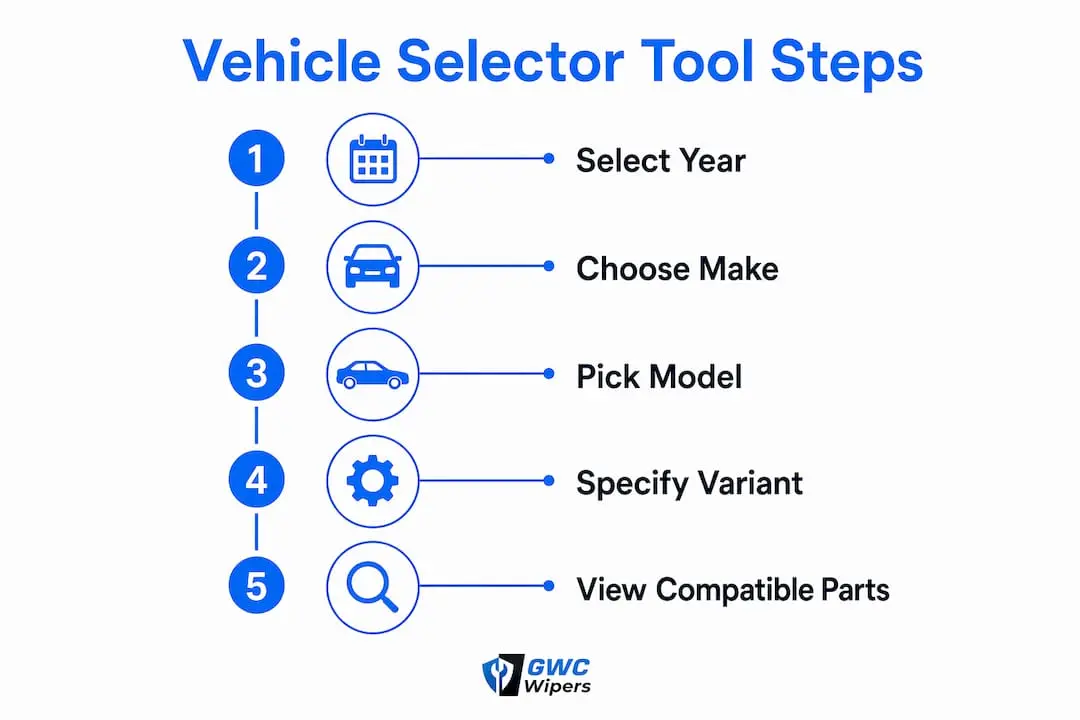
The process follows a clear sequence. Most vehicle selectors require 3–5 input steps, and each step narrows the results further.
- Select the year. You choose your vehicle’s manufacture year from a dropdown. This is the first filter and eliminates parts designed for other model generations.
- Select the make. You choose the manufacturer, such as Toyota, Ford, or Mercedes-Benz. This narrows the database to that brand’s vehicle range.
- Select the model. You choose the specific model, such as Corolla, Ranger, or GLE-Class. Many makes have dozens of models with entirely different fitment requirements.
- Select the sub-model or trim. This step catches the most errors. A “Ranger” can be an XL, XLS, XLT, or Wildtrak, each potentially requiring different parts.
- Select the engine variant. For mechanical parts, engine size and type determine compatibility. For accessories like wiper blades, this step is sometimes optional but still worth confirming.
Once you complete these steps, the tool returns only the products confirmed to fit your vehicle. The backend technology making this possible is more complex than it appears. Fitment data involves hierarchical many-to-many relationships between parts and thousands of vehicle configurations. A single wiper blade model might fit 200 different vehicles. A single vehicle might accept 3 different blade sizes. Simple product tags cannot manage this at scale. Specialised fitment databases handle the mapping, cross-referencing every product against every vehicle variant in the system.
Many vehicle selectors also save your vehicle details to a profile or “garage.” This means you do not need to re-enter your information on every visit. For fleet operators or households with multiple vehicles, this feature saves considerable time.

Pro Tip: Before you start, locate your vehicle’s compliance plate or registration papers. These confirm your exact build year, engine code, and trim level, which are the details most likely to trip you up during selection.
What benefits do vehicle selector tools offer?
Vehicle selector tools deliver clear advantages for both shoppers and retailers. The benefits are not marginal. They address the most common and costly problem in online parts shopping: ordering the wrong part.
For shoppers, the gains are direct:
- Fewer errors. You only see parts confirmed to fit, so the chance of ordering an incompatible product drops significantly.
- Less time wasted. Filtering a catalogue of thousands down to a handful of relevant products saves real time, especially for less experienced buyers.
- Greater confidence. Knowing a product is listed as compatible with your exact vehicle removes doubt at the point of purchase.
- Easier returns avoidance. Returning automotive parts is inconvenient and sometimes costly. Correct fitment from the start prevents the problem entirely.
For retailers, vehicle selector tools reduce return rates and improve customer satisfaction. Fewer returns mean lower logistics costs and less strain on customer service teams. Better satisfaction means repeat purchases and stronger reviews.
There is also a less obvious benefit. Vehicle selectors built around clear decision points reduce cognitive load for the shopper. Instead of scrolling through an undifferentiated list, you move through a structured sequence. Each step feels manageable. The result is a shopping experience that feels guided rather than overwhelming. For automotive retailers managing large catalogues, this structured approach also improves inventory management. When fitment data is accurate, stock can be matched to demand by vehicle type rather than by generic product category.
How AI and personal data are improving vehicle selectors
Modern vehicle selection tools are moving beyond simple compatibility filtering. AI-driven selectors now incorporate driving habits, family size, and commuting patterns to generate personalised recommendations. This goes beyond “does it fit” and into “is this the right choice for how you actually use your vehicle.”
The practical implications are significant:
- A tool might recommend a longer-lasting silicone wiper blade to a driver who logs high annual kilometres, factoring in replacement frequency and total cost.
- A selector could surface all-weather blades for drivers in regions with heavy seasonal rainfall, such as tropical Queensland or southern Victoria in winter.
- Cost calculations can include depreciation and maintenance projections over time, helping buyers make decisions based on total ownership value rather than upfront price alone.
“Vehicle selectors now act as a digital concierge, guiding buyers through complex automotive product choices rather than simply presenting a filtered list.” — Vehicle Configurator UX Expert Analysis
Real-time visual and price feedback is another meaningful advancement. The best tools update product images, specifications, and pricing instantly as you change your selection inputs. This keeps you oriented and reduces the chance of committing to a product without fully understanding what you are buying.
That said, AI-driven recommendations are not infallible. The data powering these tools reflects the information fed into them, and that information is not always neutral. Cross-checking any recommendation against manufacturer specifications remains good practice, particularly for safety-critical components.
Common pitfalls when using a vehicle selector tool
Knowing how to use a vehicle selector correctly is just as important as knowing what it does. Several common mistakes reduce the accuracy of results and lead to the same errors the tool is designed to prevent.
Know your exact trim and engine variant. Missing sub-model or engine details leads to wrong parts, even when year, make, and model are correct. This is the most frequent source of fitment errors in online parts shopping. A Ford Falcon XR6 and a Ford Falcon XR8 share a model name but have different engine bays and, in some cases, different accessory fitment requirements.
Watch for commercial bias in tool outputs. Some selector tools may reflect merchant inventory priorities rather than purely objective fitment data. If a retailer is overstocked on a particular product, their algorithm may surface it prominently even when alternatives are equally compatible. Cross-checking with manufacturer fitment guides or independent automotive databases is a sensible habit.
Additional best practices worth following:
- Save your vehicle profile after your first search. Most platforms store this for future visits, saving you from re-entering details each time.
- Use the selector on multiple reputable sites if you are unsure. Consistent results across platforms increase confidence in the fitment match.
- Check the tool’s last update date if it is listed. Fitment databases require regular updates as new vehicle variants enter the market.
- For correct part fitment, confirm the result against your vehicle’s owner manual or the manufacturer’s parts catalogue before purchasing.
Pro Tip: If the selector returns zero results, do not assume the part does not exist for your vehicle. Try entering your details again with a different trim or engine variant. Fitment databases sometimes list the same vehicle under slightly different sub-model names.
Key takeaways
A vehicle selector tool is the most reliable way to match automotive parts to your specific vehicle, and using it correctly requires knowing your exact trim and engine variant, not just your make and model.
| Point | Details |
|---|---|
| Core function | A vehicle selector filters catalogues to show only parts confirmed to fit your year, make, model, and trim. |
| Input accuracy matters | Entering the correct sub-model and engine variant prevents the most common fitment errors. |
| Retailer and shopper benefits | Correct fitment reduces returns, saves time, and increases buyer confidence for both parties. |
| AI enhancements add depth | Modern tools factor in driving habits and cost projections, not just basic compatibility. |
| Verify independently | Cross-check tool results against manufacturer data, especially for safety-critical parts. |
Vehicle selectors have changed how I think about parts shopping
I have watched vehicle selector tools evolve from basic dropdown menus into genuinely useful decision aids, and the shift has been more significant than most people realise. A decade ago, buying wiper blades online meant consulting a paper fitment chart, squinting at a product description, and hoping for the best. Now, a well-built selector does that work in seconds.
What I find most interesting is not the technology itself but the behaviour change it produces. Shoppers who use a vehicle selector are more decisive. They spend less time second-guessing and more time completing a purchase. That is not a small thing in a category where uncertainty has historically driven people back to the service station or dealership, where they pay a premium for the convenience of having someone else figure it out.
The AI layer being added to modern tools is genuinely promising, but I would caution against treating any algorithm’s output as final. I have seen tools surface products that were technically compatible but clearly not the best choice for a given climate or usage pattern. The tool does not know that you drive through dust storms in outback New South Wales or that your car sits outside through a Hobart winter. You do. Use the selector as a starting point, then apply your own knowledge of how and where you drive.
The future I am most interested in is tighter integration between vehicle selectors and automotive retail guides. When a selector not only confirms fitment but also surfaces installation instructions, maintenance intervals, and performance comparisons for your specific vehicle, the value proposition becomes hard to beat. We are close to that being standard, not exceptional.
— Faisal
Find the right wiper blades for your vehicle with GWC Wipers
GWC Wipers’ vehicle selector tool is built for Australian drivers and takes the uncertainty out of buying wiper blades online. You enter your vehicle’s year, make, and model, and the tool returns only the blades confirmed to fit your car, ute, or SUV.
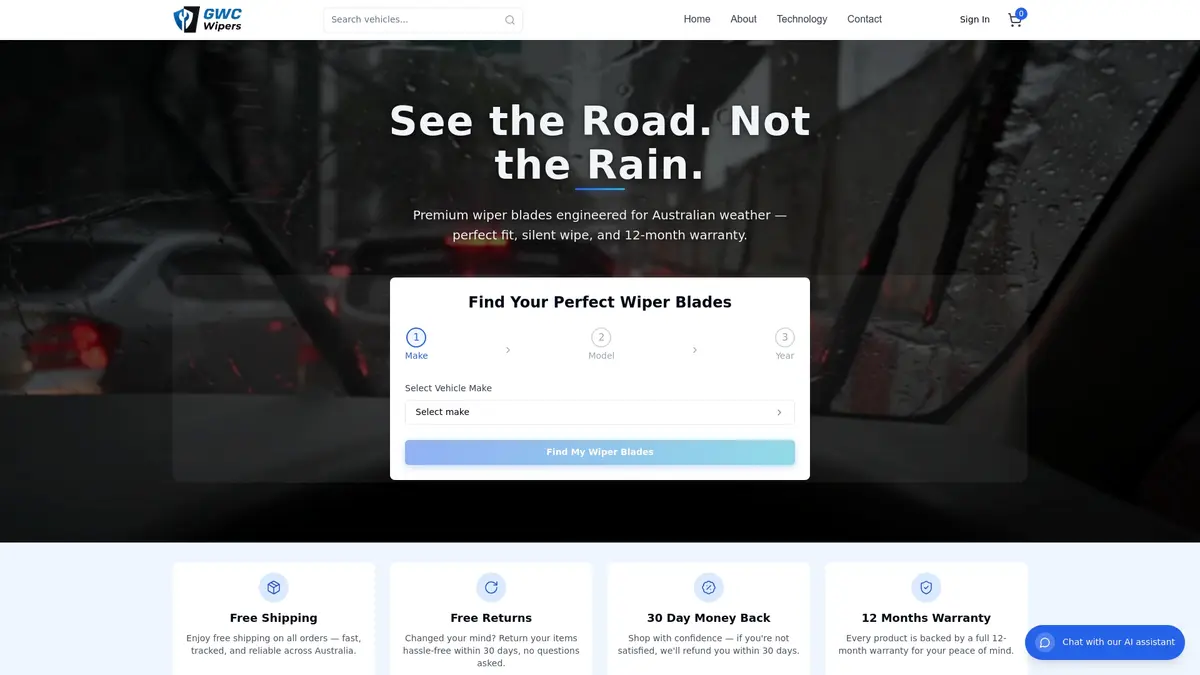
Whether you drive a Toyota, a Mercedes-Benz GLE-Class, or a Mitsubishi, GWC Wipers stocks premium blades built for Australian conditions, from tropical downpours to UV-heavy summers. Every purchase includes free shipping across Australia, a 12-month warranty, and a 30-day money-back guarantee. Use the selector, find your fit, and get clear visibility back on the road.
FAQ
What is a vehicle selector tool used for?
A vehicle selector tool filters an online part catalogue to show only products compatible with your specific vehicle. You enter your year, make, model, and trim, and the tool removes incompatible items from view.
How do I use a vehicle selector correctly?
Enter your vehicle’s year, make, model, sub-model, and engine variant in sequence. Knowing your exact trim and engine code prevents the most common fitment errors.
Are vehicle selector tools always accurate?
Most tools are reliable, but some may reflect commercial priorities rather than purely objective fitment data. Cross-checking results against manufacturer specifications is recommended for safety-critical parts.
Can a vehicle selector save my car details?
Yes. Most vehicle selectors save your vehicle information to a profile or “garage” after your first search, so you do not need to re-enter details on future visits.
Do vehicle selector tools work for wiper blades?
Yes. Wiper blade fitment varies by vehicle make, model, year, and wiper arm attachment type. A vehicle selector confirms the correct blade size and connector type for your specific car, preventing incompatible purchases.