
Why car accessory retailers offer wiper guides

TL;DR:
- Wiper guides are essential tools that help customers select the correct wiper blades based on vehicle-specific size and connector type, preventing costly returns. Accurate fitment, including blade length and connector type, is critical for optimal visibility and safety, especially in varying Australian weather conditions. Digital tools and detailed installation instructions enhance customer confidence and reduce return rates by ensuring proper fitting and performance.
Wiper guides are fitment tools that car accessory retailers publish to help customers select the correct replacement wiper blade by matching blade length, connector type, and blade geometry to their specific vehicle. Windshield wipers are not universal, and choosing the wrong size or connector causes streaking, blind spots, and premature hardware failure. That is precisely why car accessory retailers offer wiper guides: to prevent costly purchase errors before they happen. Brands like Firestone and Topex have built fitment tools and detailed guides into their retail experience because the consequences of a mismatch extend well beyond inconvenience. For Australian drivers facing everything from tropical downpours in Queensland to icy mornings in the Snowy Mountains, getting the right blade is a safety matter, not just a preference.
Why car accessory retailers offer wiper guides
Correct wiper blade fitment is the single most important factor in windshield visibility, and retailers publish guides specifically to prevent the errors that occur when customers guess. Incorrect wiper sizing can create dangerous blind spots, impair vision in wet conditions, and place unnecessary strain on the wiper arm mechanism. These are not minor inconveniences. On a wet highway near Melbourne or during a sudden storm on the Pacific Highway, a smearing blade is a genuine hazard.

Most vehicles require different blade lengths for the driver and passenger sides. A Toyota Camry, for example, typically uses a 26-inch driver blade and a 16-inch passenger blade. Installing two identical blades because they “looked the same” is one of the most common mistakes guides are designed to prevent. Fitment charts and OEM recommendations remove the guesswork entirely.
Here is what a reliable wiper guide covers for sizing:
- Driver vs passenger blade length — listed separately for each vehicle make, model, and year
- Rear wiper size — often overlooked, especially on SUVs and hatchbacks common in Australia
- Blade curvature — certain vehicles require pre-curved blades that follow the windshield contour
- OEM length vs aftermarket equivalent — guides clarify when a slight variation is acceptable
| Vehicle type | Common driver blade size | Common passenger blade size |
|---|---|---|
| Compact sedan (e.g. Toyota Corolla) | 24–26 inches | 14–16 inches |
| Mid-size SUV (e.g. Mazda CX-5) | 26 inches | 16 inches |
| Large SUV (e.g. Ford Everest) | 28 inches | 18 inches |
| Hatchback (e.g. Volkswagen Golf) | 24 inches | 18–19 inches |
Knowing your exact blade sizes before you purchase is the difference between a five-minute installation and a frustrating return trip to the retailer. A good guide gives you those numbers upfront, tied to your specific vehicle. You can also measure your wiper blades directly from your car if your vehicle documentation is unavailable.
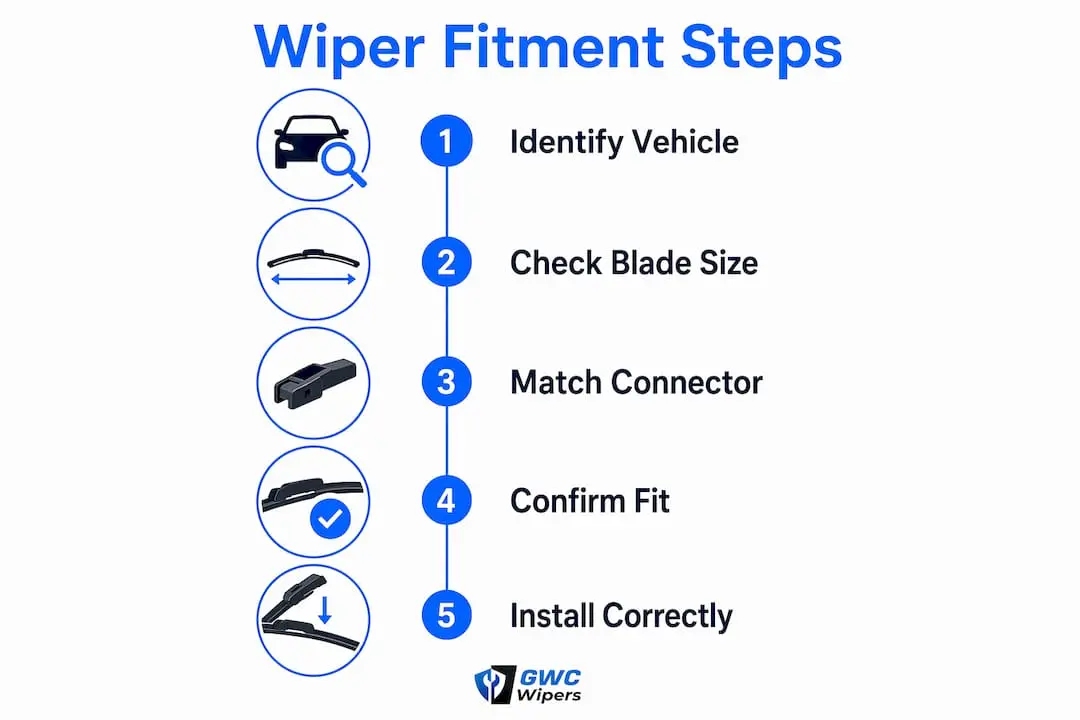
How do connector types cause wiper blade returns?
Connector mismatch is the leading cause of wiper blade returns, and it is a problem that catches even experienced car owners off guard. Wrong connector selection causes 30 to 50% of wiper blade returns because blades that do not click or lock securely onto the wiper arm will either fall off or wipe unevenly. This is the core reason wiper guides dedicate significant space to connector identification.
There are six connector types in common use across Australian vehicles:
| Connector type | Description | Common vehicles |
|---|---|---|
| J-hook (standard hook) | Most common globally; hook clips over a pin | Toyota, Mazda, Holden |
| Bayonet (pin-type) | Blade slides onto a pin on the arm | Older European models |
| Pinch tab | Side-release tab; requires pinching to remove | Ford, Mitsubishi |
| Side lock | Locks from the side of the arm | Some Hyundai, Kia models |
| Top lock | Locks from the top of the arm | BMW, Mercedes-Benz |
| Pin arm | Blade pins directly to a small post | Renault, some Peugeot |
The challenge is that two vehicles from the same manufacturer can use different connector types across model years. A 2018 Hyundai Tucson may use a different connector than a 2022 model. Without a guide that specifies connector type by year, customers frequently order the wrong blade. Connector choice drives more returns than blade quality, which means a premium blade purchased without connector verification is still likely to be returned.
Retailers reduce this problem through visual aids showing each connector type alongside photos of the actual wiper arm. Many quality guides also include multi-adapter blades that accommodate several connector types, reducing the risk of a mismatch entirely.
Pro Tip: Before purchasing, lift your wiper arm away from the windshield and photograph the connection point where the blade meets the arm. Compare this image against the connector diagrams in the retailer’s guide to confirm compatibility before you buy.
What role do digital tools play in modern wiper guides?
Digital fitment tools have transformed the wiper guide from a printed pamphlet into an interactive resource that significantly reduces purchase errors. Retailers who upgrade their fitment information and visuals see return rates drop below 5%, compared to industry averages that sit considerably higher. That is a measurable business outcome driven entirely by better information.
The most effective digital wiper guides combine several elements:
- Year, make, and model lookup tools — customers enter their vehicle details and receive a confirmed blade size and connector type, removing all guesswork
- High-resolution product images — showing the blade profile, connector adapter, and packaging so customers can visually verify their selection
- QR-linked installation videos — combining fitment tools with installation cues like QR codes to video walkthroughs improves first-time installation success
- Fitment confirmation prompts — some platforms ask customers to confirm their connector type before completing a purchase
For Australian customers in regional areas who cannot easily return a product to a physical store, these digital tools are particularly valuable. A driver in Broken Hill or Cairns ordering blades online relies entirely on the retailer’s fitment data to get it right the first time. Visual and fitment information provide offline assistance to remote customers who cannot rely on in-store staff to verify compatibility.
Installation support is equally important. Incorrect installation causes poor wiping and premature wiper failure, even when the blade size and connector are correct. A guide that stops at product selection but ignores installation leaves customers exposed to performance problems that will be attributed to the product rather than the fitting process. Step-by-step installation instructions, with photos or video, complete the guide’s purpose. You can follow a detailed step-by-step installation guide to avoid the most common fitting errors.
Practical tips for using wiper guides correctly
Reading a wiper guide effectively takes less than five minutes when you approach it with the right information at hand. Follow these steps to get the most accurate result:
-
Locate your vehicle’s exact year, make, and model. Do not estimate the year. A one-year difference can change both blade size and connector type, particularly on vehicles that underwent a mid-cycle refresh.
-
Identify your wiper arm connector type. Lift the wiper arm, look at the connection point, and match it against the connector diagrams in the guide. If the guide includes a visual selector, use it.
-
Record both driver and passenger blade sizes separately. Do not assume they are the same length. Check the correct blade sizes for your specific vehicle before adding anything to your cart.
-
Check the rear wiper if your vehicle has one. Rear blades are frequently forgotten and are often a different size and connector type from the front pair.
-
Read the installation instructions before you open the packaging. Understanding the removal and fitting process before you start prevents forced connections that can damage the wiper arm or the blade adapter.
-
Verify the blade geometry. Some vehicles, particularly European models and certain Japanese SUVs, require pre-curved or beam-style blades. A flat traditional blade on a curved windshield will leave unwiped sections at the edges.
Pro Tip: If you are a fleet operator managing multiple vehicle types, create a simple spreadsheet recording the driver blade size, passenger blade size, and connector type for each vehicle in your fleet. Cross-reference this against the retailer’s fitment chart once, and you will never need to look it up again.
Fitment issues alone account for nearly half of all wiper blade returns, with an additional 20 to 25% coming from packaging or transit damage. That means a customer who reads and follows a wiper guide correctly eliminates the single largest cause of return frustration before it occurs. For automotive professionals servicing multiple vehicles per day, this efficiency gain is significant.
Key takeaways
Wiper guides exist because fitment errors, not product quality, are the primary cause of wiper blade returns and poor on-road performance.
| Point | Details |
|---|---|
| Fitment guides prevent returns | Nearly half of all wiper blade returns result from incorrect size or connector selection, which guides prevent. |
| Connector type matters as much as size | Wrong connector selection causes 30 to 50% of returns; always verify connector type before purchasing. |
| Digital tools improve accuracy | Year, make, and model lookup tools combined with installation videos reduce return rates to below 5%. |
| Driver and passenger sizes differ | Most vehicles require different blade lengths per side; always check both before ordering. |
| Installation instructions complete the guide | Correct parts fitted incorrectly still perform poorly; installation support is part of every reliable guide. |
Wiper guides are more important than most retailers realise
I have spent years working with automotive products and watching the same pattern repeat. A customer buys a blade that looks right, fits it incorrectly or onto the wrong connector, and then blames the product. The blade gets returned. The retailer absorbs the cost. The customer drives away with reduced confidence in the brand. And the root cause was never the blade at all.
What strikes me most about well-built wiper guides is that they do something most retail content does not: they actively discourage a sale if the product is wrong for the customer. A good fitment tool will tell you that the blade you selected does not match your vehicle. That kind of honesty builds more long-term trust than any promotional copy ever could.
The gap I still see in 2026 is installation support. Retailers invest heavily in helping customers select the right blade and almost nothing in helping them fit it correctly. I have seen perfectly matched blades installed with the connector seated at the wrong angle, producing a chattering noise and uneven contact across the glass. The customer assumes the blade is faulty. A thirty-second installation video would have prevented the entire situation.
The future of wiper guides is not augmented reality or artificial intelligence, though those tools will arrive. The immediate opportunity is simpler: combine accurate fitment data with clear, vehicle-specific installation instructions and make both available before the customer completes their purchase. That combination, more than any product feature, is what separates a retailer customers trust from one they return products to.
— Faisal
Get the right fit with GWC Wipers
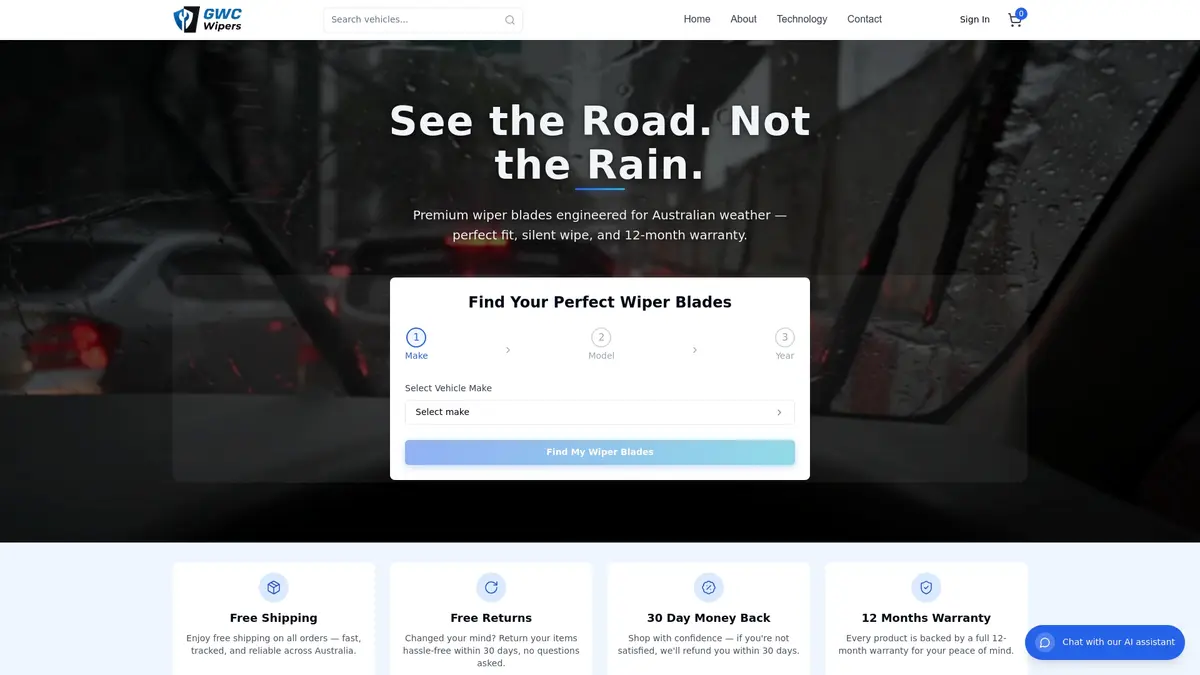
GWC Wipers takes the complexity out of wiper blade selection for Australian drivers. The vehicle selector tool on the GWC Wipers website confirms the correct blade size and connector type for your specific make, model, and year, so you purchase with confidence the first time.
Whether you drive a Toyota, Mercedes-Benz, or anything in between, GWC Wipers offers premium replacement blades built for Australian conditions, from coastal humidity to outback heat. Every order includes detailed installation instructions, and the range covers both OEM-style and beam blades with the connector options your vehicle requires. Browse Toyota wiper blades or explore the full range of Mercedes-Benz GLE-Class wipers with free shipping across Australia and a 12-month warranty included.
FAQ
What are wiper guides and why do retailers provide them?
Wiper guides are fitment tools that confirm the correct blade size, connector type, and blade design for a specific vehicle. Retailers provide them because windshield wipers are not universal and incorrect selection is the leading cause of returns and poor performance.
How do I find the right wiper blade size for my car?
Use your vehicle’s year, make, and model in a retailer’s fitment chart or vehicle selector tool, and record the driver and passenger blade sizes separately. You can also measure your existing blades directly from the wiper arm before purchasing.
Why does connector type matter when buying wiper blades?
The connector is the physical attachment point between the blade and the wiper arm, and a mismatch means the blade will not lock securely or wipe evenly. Wrong connector selection accounts for 30 to 50% of wiper blade returns, making it the most critical compatibility check beyond blade length.
Can I use the same wiper blade on both the driver and passenger sides?
Most vehicles require different blade lengths for each side, so using identical blades on both sides is a common fitment error. Always check your vehicle’s specifications in a fitment chart before purchasing, as the difference can range from two to ten inches depending on the model.
How do installation instructions reduce wiper blade problems?
Correct parts fitted incorrectly still produce poor wiping, chattering, and premature wear. Retailers who include mounting instructions and installation videos with their guides give customers the information needed to complete the job correctly, not just select the right product.