
Role of warranties for fleet maintenance: 2026 guide

TL;DR:
- Proper warranty management can recover up to 70% of eligible repair costs and reduce budget volatility. Fleets that systematically track warranties avoid silent expirations and improve maintenance planning, leading to cost savings. Implementing digital dashboards and a structured claim workflow is essential for maximizing warranty recovery and operational efficiency.
Fleet warranties are manufacturer or third-party guarantees that cover the cost of specific repairs or part replacements, making them one of the most underutilised financial tools in fleet management. For fleet vehicle operators and maintenance managers, understanding the role of warranties for fleet maintenance means the difference between predictable budgets and costly surprises. Warranty-recoverable costs represent 8–20% of fleet repair spend, yet fleets without structured systems recover less than 30% of what they are owed. That gap is not a minor inefficiency. It is a significant and preventable financial loss.
How warranties impact fleet maintenance budgets and efficiency

Warranties are a direct financial lever, not a passive safety net. When managed well, effective warranty capture saves 5–10% of annual maintenance budgets. For a fleet spending $500,000 per year on repairs, that translates to $25,000–$50,000 recovered annually without reducing service quality.
The warranty impact on fleet maintenance goes beyond direct cost savings. Warranties convert unpredictable mechanical failure costs into fixed, manageable expenses. Smart warranty planning transforms reactive panic repairs into data-driven maintenance planning, stabilising budgets across the financial year. Insurance covers catastrophic events. Warranties cover the everyday mechanical failures that quietly drain your maintenance budget month after month.
Downtime is where warranty benefits become most visible. A vehicle sitting idle while a manager debates whether a repair is covered costs far more than the repair itself. Fast-tracking warranty-covered repairs, by verifying coverage before the job starts, keeps vehicles on the road and commitments to customers intact. Warranty acts as an operational safety net that prevents costly chain reactions of downtime and missed delivery schedules.
The benefits of fleet warranties also include better budget forecasting. When you know which repairs fall under coverage, you can separate warranty-recoverable costs from out-of-pocket spend. That separation gives maintenance managers a clearer picture of true fleet operating costs and supports more accurate financial planning.
Key financial benefits of structured warranty management include:
- Reduced repair cost volatility across budget cycles
- Predictable maintenance spend, separate from warranty-recoverable costs
- Faster repair turnaround through pre-authorised coverage
- Improved cash flow protection, particularly for small or mixed-age fleets
- Reduced reliance on emergency repair funds
What types of warranties do fleets need to manage?
Modern commercial vehicles carry multiple warranty types simultaneously, and each one operates under different rules. Commercial vehicles may carry up to eight overlapping warranty types, each with separate mileage limits, time limits, and coverage terms. Managing these without a system leads to silent expirations and unclaimed benefits.
The most common warranty types in a fleet include:
| Warranty type | What it covers | Typical trigger |
|---|---|---|
| Basic or bumper-to-bumper | Most components excluding wear items | Time or mileage, whichever comes first |
| Powertrain | Engine, transmission, drivetrain | Time or mileage |
| Emissions | Emissions control components | Regulatory minimums, often longer terms |
| Tyre | Tread depth, manufacturing defects | Mileage or years |
| Aftermarket parts | Replacement parts fitted post-sale | Varies by supplier |
| Extended service contract | Covers repairs beyond factory warranty | Purchased separately, activates after factory cover ends |
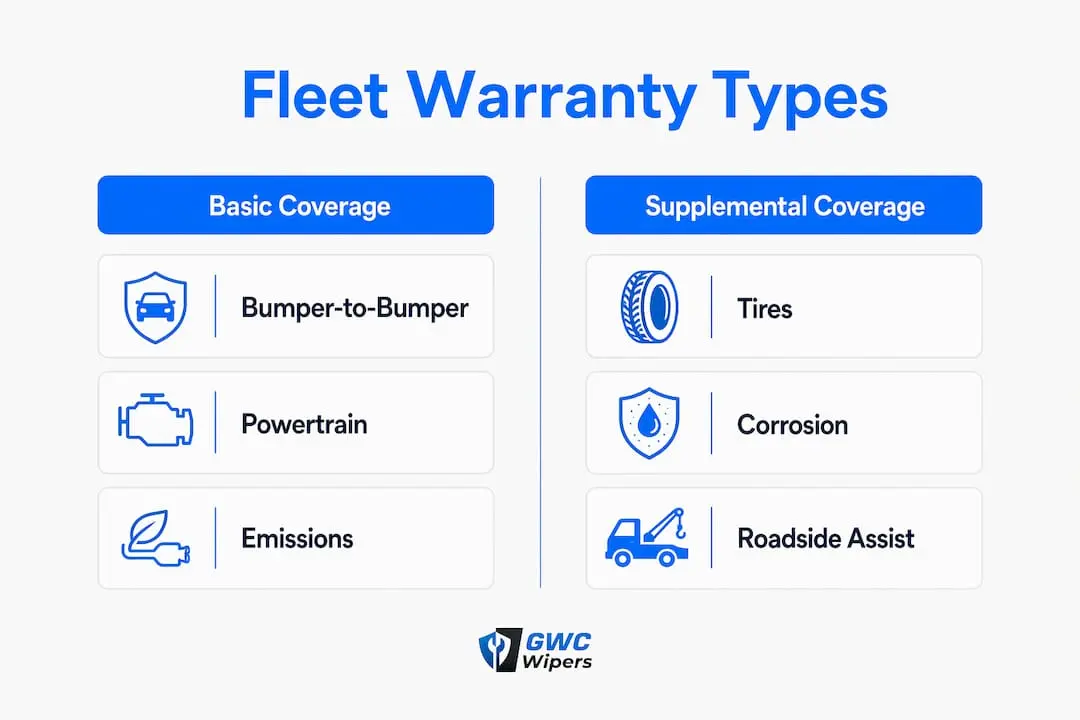
The complexity grows when vehicles in your fleet are at different ages and mileage points. A vehicle bought two years ago may still hold powertrain coverage while its basic warranty has expired. A recently fitted aftermarket component may carry its own separate coverage. Without centralised tracking, these overlaps become liabilities rather than assets.
Pro Tip: Set calendar alerts in your fleet management system 60 days before each warranty expiration date. That window gives you time to schedule a pre-expiry inspection and submit any outstanding claims before coverage lapses.
Centralised digital dashboards are the standard solution for managing overlapping coverage. They consolidate expiration dates, coverage terms, and claim histories into a single view, preventing the silent expirations that cost fleets thousands in unclaimed repairs.
What does an effective warranty claim workflow look like?
A warranty claim is a five-stage process, and missing any single stage reduces your recovery rate. The five stages are: coverage verification before repair, documentation, claim submission, follow-up, and reimbursement. Proactive coverage verification before the repair begins is the highest-leverage step in the entire process.
Here is how each stage works in practice:
-
Coverage check before repair. Before any technician touches the vehicle, confirm whether the fault falls under an active warranty. Check the vehicle’s mileage, age, and the specific component against your warranty records. This step alone prevents the most common reason for claim denial: repairs completed before coverage is verified.
-
Documentation. Record the fault code, technician observations, parts used, and labour time. Photographs of the failed component strengthen the claim. Incomplete records are the primary reason warranty claims are denied, even when the part failure is genuinely covered.
-
Claim submission. Submit the claim to the relevant OEM or aftermarket supplier within their required timeframe. Late submissions are rejected regardless of the validity of the claim. Build submission deadlines into your work order system as mandatory fields.
-
Follow-up. Track the status of every open claim. Unresolved claims that sit without follow-up are frequently written off by suppliers. Assign responsibility for follow-up to a specific team member, not a general inbox.
-
Reimbursement and recording. Log the recovered amount against the original repair cost. This data feeds your recovery rate metrics and identifies which OEMs approve claims consistently and which require escalation.
Pro Tip: Integrate warranty status alerts directly into your digital work order system. When a technician opens a job for a vehicle with active coverage, the system should flag it automatically. Manual checks are too easily skipped under time pressure.
Key metrics for tracking warranty performance include the percentage of warranty-eligible repairs identified, the ratio of claims submitted versus claims approved, and recovery rates broken down by OEM. These three numbers tell you whether your process is working or where it is leaking money.
Common pitfalls in fleet warranty management and how to avoid them
Warranties are often misunderstood as unconditional guarantees. They are not. Maintenance history and complete documentation are the foundation of every successful claim. A fleet that skips scheduled services or records them inconsistently will find its claims denied, even when the part failure is legitimate.
The most frequent mistakes fleet managers make include:
- Skipping pre-repair coverage checks. Technicians under time pressure often start work before verifying coverage. The repair is completed, the warranty window is missed, and the cost falls on the fleet.
- Incomplete service records. Aftermarket and extended contract claims require strict adherence to preventive maintenance schedules with full documentation. A single missed service entry can void an entire claim.
- Late claim submissions. Every warranty has a submission deadline. Missing it by even one day results in rejection. Build submission deadlines into your workflow as non-negotiable steps.
- No end-of-warranty inspections. Scheduling a thorough inspection 30–60 days before a warranty expires lets you identify and document developing faults while coverage is still active.
- Untrained staff. Service writers and technicians who cannot identify warranty-eligible repairs are a direct source of revenue leakage. Regular training on coverage terms pays for itself quickly.
Pro Tip: Create a one-page warranty reference card for each vehicle in your fleet. Include the expiry dates for each warranty type, the relevant supplier contact, and the documentation checklist. Laminate it and keep it in the vehicle file.
The importance of warranties in fleet management is especially pronounced for smaller fleets. A single major powertrain failure on an unwarranted vehicle can represent a significant portion of a small operator’s annual maintenance budget. Warranty protects cash flow and operational continuity in ways that no other financial tool replicates at the same cost.
Key takeaways
Warranties are a core financial and operational tool for fleet management, not a passive benefit. Fleets that build structured warranty processes recover significantly more repair costs and operate with greater budget predictability.
| Point | Details |
|---|---|
| Warranty recovery gap | Fleets without structured systems recover less than 30% of eligible repair costs. |
| Budget savings potential | Effective warranty capture saves 5–10% of annual maintenance budgets. |
| Overlapping coverage complexity | Commercial vehicles can carry up to eight warranty types requiring digital tracking. |
| Documentation is non-negotiable | Incomplete maintenance records are the primary reason warranty claims are denied. |
| Five-stage claim process | Coverage verification before repair is the single highest-leverage step in the workflow. |
Warranties as a financial strategy, not an afterthought
Fleet managers I have spoken with over the years consistently underestimate how much money sits unclaimed in their warranty entitlements. The attitude tends to be: “We’ll deal with it if something goes wrong.” That approach costs real money, every month.
The shift I have seen in well-run fleets is treating warranty management the same way they treat fuel costs or tyre spend. It gets a line in the budget, a dedicated process, and someone accountable for the numbers. When that happens, the recovery rates climb fast. Digital platforms that integrate warranty alerts into work orders are not a luxury for large fleets. They are the standard that any fleet serious about cost control should be using.
What I find most telling is that the fleets with the best warranty recovery rates also tend to have the best preventive maintenance records. The two are inseparable. You cannot claim on a warranty you cannot prove you maintained. The discipline required to keep clean service records is the same discipline that keeps vehicles reliable and on the road longer. Warranty management, done properly, is not a separate programme. It is the natural outcome of running a tight maintenance operation.
— Faisal
GWC Wipers: reliable wiper blades backed by a 12-month warranty
Fleet operators know that visibility is a safety requirement, not a preference. Every vehicle in your fleet needs wiper blades that perform reliably across Australian conditions, from heavy summer downpours to dusty outback roads.
Com stocks premium wiper blades designed for durability and all-weather performance, with a 12-month warranty that gives fleet managers genuine coverage confidence. Whether you run Land Rovers, Mercedes-Benz vehicles, or mixed makes, Com’s vehicle selector tool identifies the correct blade for each model in your fleet. Browse the full range for vehicles including Land Rover Range Rover Sport wiper blades and Mercedes-Benz GLE-Class wiper blades, with free shipping across Australia and a 30-day money-back guarantee included.
FAQ
What is the role of warranties for fleet maintenance?
Warranties are manufacturer or third-party guarantees that cover specific repair and replacement costs. They reduce repair cost volatility, support budget predictability, and protect cash flow across fleet operations.
How much can fleet warranty management save annually?
Effective warranty capture saves 5–10% of annual maintenance budgets. Fleets using digital tracking systems recover 85–95% of eligible repair costs, compared to less than 30% for fleets without structured processes.
Why are fleet warranty claims denied?
Most claim denials result from incomplete maintenance documentation or late submission. Warranties require consistent, recorded service histories to validate that the vehicle was maintained according to the manufacturer’s schedule.
How many warranty types does a commercial vehicle carry?
Modern commercial vehicles can carry up to eight overlapping warranty types, including basic, powertrain, emissions, tyre, aftermarket parts, and extended service contracts, each with separate mileage and time limits.
When should a fleet manager schedule a pre-expiry inspection?
Schedule a pre-expiry inspection 30–60 days before any warranty expires. This window allows time to identify developing faults, document them properly, and submit claims before coverage lapses.