
What is OEM fitment? A guide for Australian car owners
TL;DR:
- OEM fitment ensures a replacement part precisely matches the vehicle manufacturer’s specifications for size, tolerances, and performance, which is vital for safety and reliability. It differs from aftermarket parts by offering a factory guarantee of fit and function, though it comes at a higher cost, especially for safety-critical components. Proper identification and selection of OEM parts prevent fitment issues that can lead to vehicle damage or safety failures.
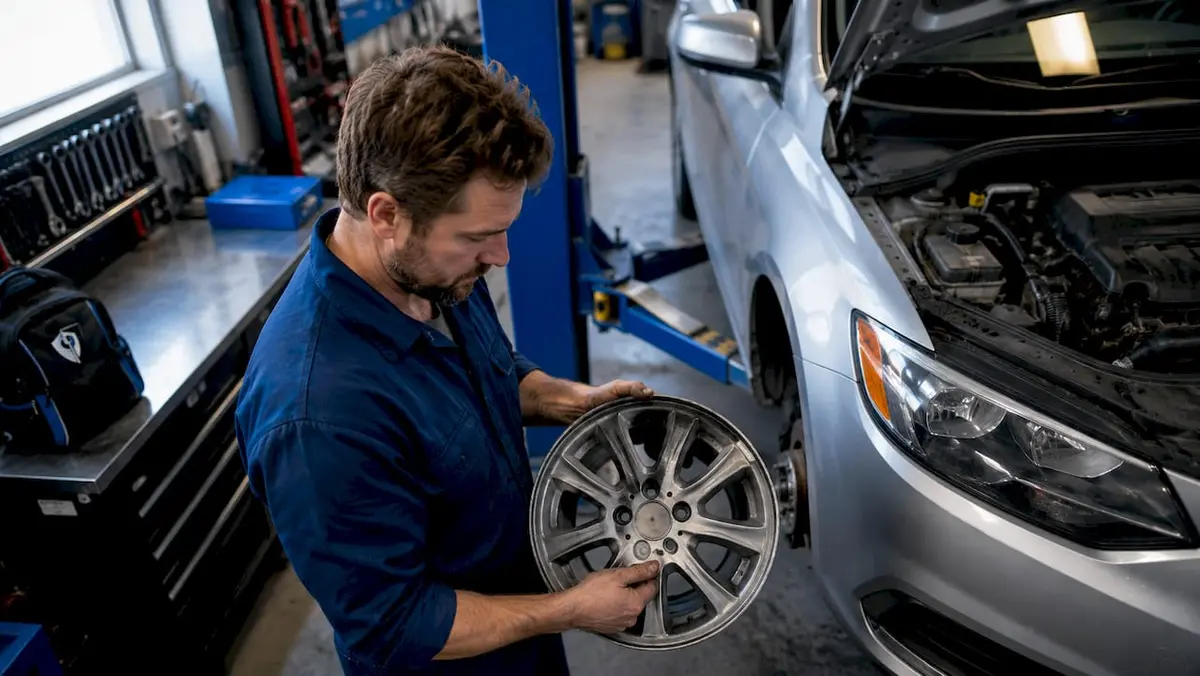
OEM fitment is defined as the precise matching of a replacement part to the original equipment manufacturer’s exact specifications for your vehicle. The term stands for Original Equipment Manufacturer, and fitment refers to whether a part physically and functionally integrates with your car as the factory intended. Getting this right matters for safety, performance, and maintaining your vehicle’s warranty. Whether you’re replacing wiper blades, wheels, or brake components, understanding OEM fitment meaning protects you from costly mistakes on Australian roads.
What is OEM fitment and why does it matter?
OEM fitment means a part meets the exact dimensions, tolerances, and performance standards set by the vehicle manufacturer. It is not just about whether a part physically attaches. The part must also behave the way the factory designed it to behave, from load distribution to aerodynamic clearance.
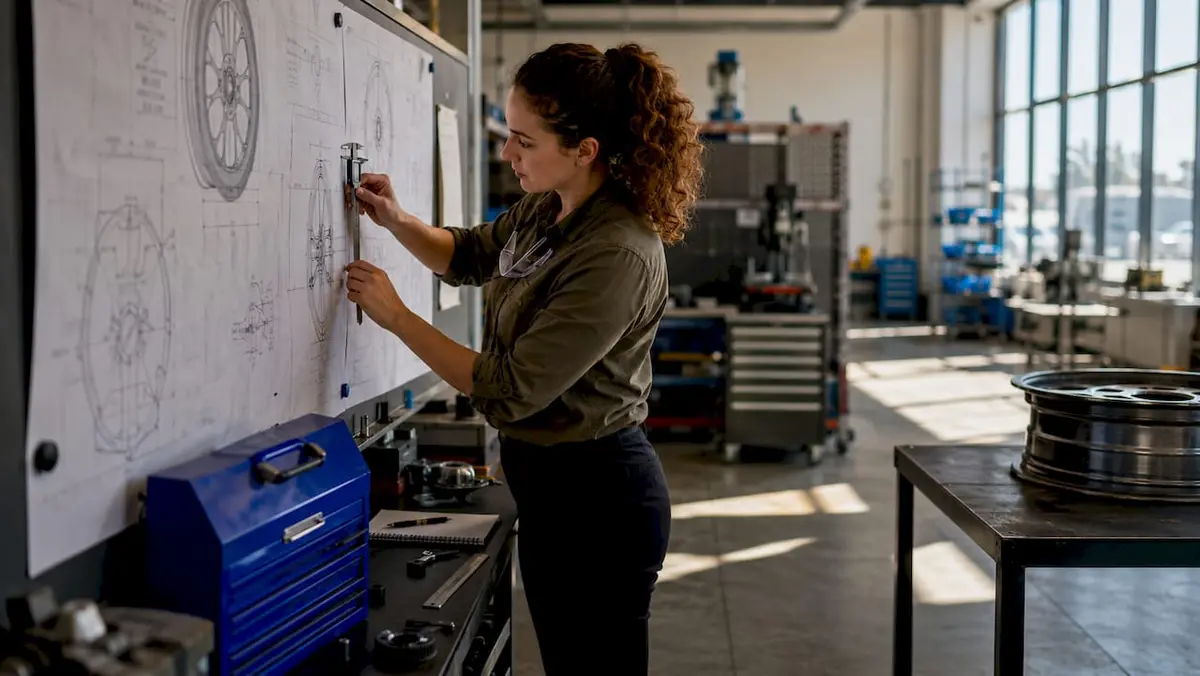
Consumers often misunderstand OEM, treating it as a label rather than a guarantee of precise manufacturer specifications and safety compliance. That misunderstanding leads to poor purchasing decisions. A part that looks right on the shelf may still cause handling problems, premature wear, or void your warranty if it falls outside factory tolerances.
For Australian drivers, this matters even more. Our roads range from urban freeways to corrugated outback tracks, and our climate swings between tropical downpours in Queensland and freezing alpine conditions in Victoria. Parts that meet OEM specifications perform reliably across that full range. Parts that don’t can fail when conditions get tough.
What are the key specifications in OEM fitment?
OEM fitment covers several measurable technical parameters. For wheels, the three most critical are bolt pattern, offset, and centre bore. Each one must match the factory specification within tight tolerances.
Bolt pattern refers to the number of wheel studs and the diameter of the circle they form. A mismatch here means the wheel simply will not mount. Offset is the distance between the wheel’s mounting face and its centreline. Replacement wheels must sit within ±3mm of the factory offset specification to maintain safe handling and suspension geometry. Even a small deviation changes how load transfers through the suspension, which affects tyre wear and steering response. Centre bore is the diameter of the hole at the wheel’s centre. If it is too large, the wheel sits off-centre under load, causing vibration.
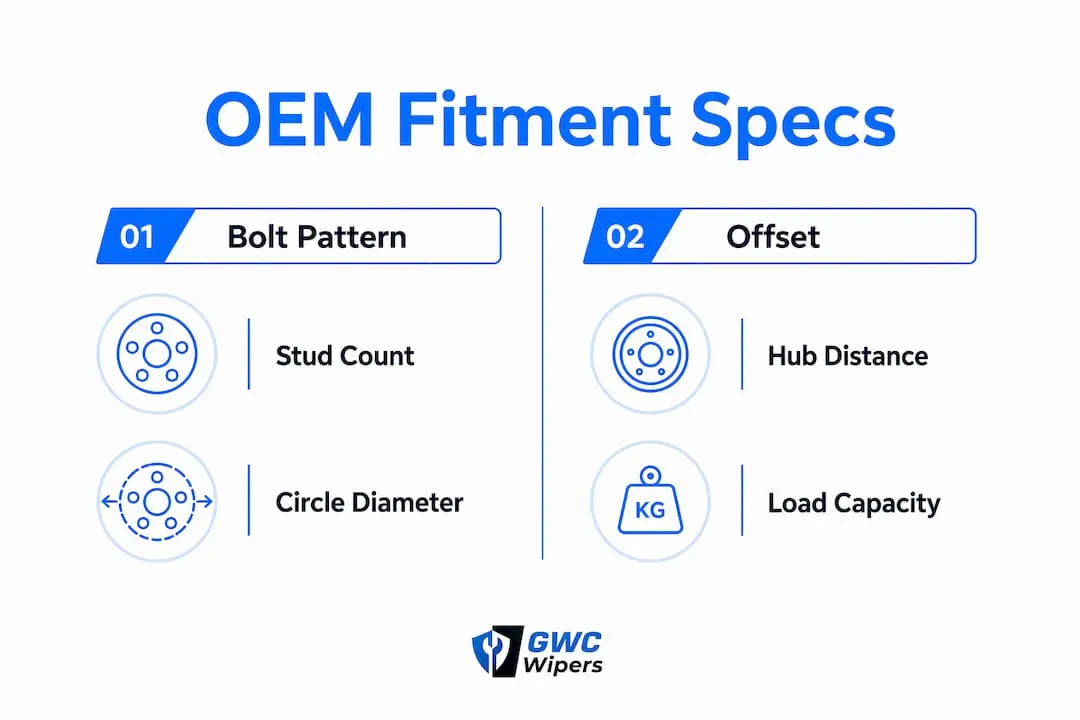
| Specification | What it measures | Consequence of mismatch |
|---|---|---|
| Bolt pattern | Stud count and circle diameter | Wheel cannot mount safely |
| Offset | Mounting face to centreline distance | Altered handling and suspension wear |
| Centre bore | Central hub hole diameter | Vibration and uneven load distribution |
| Load rating | Maximum weight the part can carry | Structural failure under load |
The scale of OEM wheel fitment is significant. Leading OEM wheel suppliers stock over 15,000 unique SKUs, which reflects just how vehicle-specific these specifications are. That number tells you there is no universal shortcut. Each make, model, and year combination has its own fitment requirements.
OEM parts also meet tight dimensional standards that cover more than just size. They account for heat management, load cycling, and material fatigue. These are the factors that determine whether a part lasts the life of the vehicle or fails prematurely.
Pro Tip: Always cross-reference your vehicle’s build plate or owner’s manual against the part’s specification sheet before purchasing. The build plate is usually found on the driver’s door jamb and lists the factory wheel and tyre specifications.
How does OEM fitment differ from aftermarket parts?
OEM parts carry a factory guarantee of exact fit and manufacturer validation. Aftermarket parts are not inherently lower quality, but they lack that factory guarantee. They are designed to fit a broad range of vehicles rather than one specific model, which means tolerances can vary.
The price difference is real and significant. OEM parts cost roughly 60% more on average than comparable aftermarket alternatives. That premium reflects the cost of vehicle-specific engineering, proprietary testing, and manufacturer certification. Whether that premium is worth paying depends on the part and its role in vehicle safety.
For safety-critical components, OEM fitment is the safer choice. Brake callipers, suspension components, and steering parts all operate within tight tolerances where a small deviation can have serious consequences. For non-critical parts like cabin air filters or floor mats, quality aftermarket options often deliver acceptable performance at a lower price.
Replica and OEM-spec wheels illustrate this distinction clearly. Replica wheels may match OEM dimensions but lack the proprietary safety and fatigue testing that factory components undergo. They fit the size but may not survive the same load cycles. That gap matters on long highway drives or when carrying heavy loads.
| Factor | OEM parts | Aftermarket parts |
|---|---|---|
| Fit guarantee | Exact factory specification | Broad compatibility range |
| Safety testing | Manufacturer-certified | Varies by supplier |
| Price | Higher (approx. 60% premium) | Lower on average |
| Variety | Vehicle-specific | Wide range of options |
| Warranty impact | Typically preserved | May vary by insurer |
Aftermarket parts do offer genuine advantages in some situations. They often provide more variety and can incorporate performance enhancements not available in the factory catalogue. For automotive enthusiasts building a performance vehicle, quality aftermarket components can be the right choice. The key is knowing which parts demand OEM precision and which ones offer flexibility.
Pro Tip: For parts that affect steering, braking, or suspension, always choose OEM or OEM-equivalent parts that carry the vehicle manufacturer’s part number. The cost of a fitment failure far exceeds the price difference.
For a deeper look at how this applies to wiper blades specifically, the OEM vs aftermarket comparison guide from Com covers the key differences for Australian drivers.
How to identify and select genuine OEM-fit parts
Identifying genuine OEM-fit parts starts with the packaging and branding. Genuine OEM parts show distinct manufacturer branding and batch or serial numbers that aftermarket alternatives rarely replicate. If a part arrives in plain packaging with no part number, treat that as a warning sign.
Follow these steps to select the right OEM-fit part for your vehicle:
- Locate your vehicle’s factory part number. Check the owner’s manual, the manufacturer’s online parts catalogue, or ask your dealership. The factory part number is the most reliable reference point.
- Verify the key specifications. For wheels, confirm bolt pattern, offset, and centre bore against your build plate. For wiper blades, confirm arm connector type, blade length, and mounting style.
- Check the supplier’s fitment database. Reputable suppliers maintain vehicle-specific fitment databases. Enter your make, model, and year to confirm compatibility before purchasing.
- Inspect the part on arrival. Compare the part number on the packaging against the factory number. Check for manufacturer branding and a batch or serial number.
- Test fit before full installation. Offer the part up to the mounting point before committing. A correct OEM-fit part should seat without force or modification.
For custom or specialised parts, specialists use 3D scanning to reduce fitment errors and avoid costly physical test-fitting cycles. This technology captures the exact geometry of a mounting surface and compares it against CAD data, catching deviations before a part is manufactured. It is a best practice in high-precision OEM fitment work.
The cost of getting fitment wrong is not just the price of a replacement part. A poorly fitted wheel can damage wheel bearings, suspension bushings, and brake components. A wiper blade that does not match the arm connector can strip the mounting point or fail to clear the screen in heavy rain.
Common applications where OEM fitment is critical
OEM fitment applies across a wide range of automotive parts, but some applications demand it more than others.
- Wheels and tyres. Bolt pattern, offset, and centre bore must all match factory specifications. A deviation in any one of these affects handling, tyre wear, and suspension longevity.
- Wiper blades. The arm connector type, blade length, and spring tension must match the factory design. A blade that sits too high or too low on the screen leaves blind spots. One with the wrong spring tension either skips across the glass or presses too hard and wears out prematurely. Com’s OE spec wiper blades are engineered to meet these exact requirements for Australian vehicles.
- Brake components. Calliper brackets, rotor diameters, and pad thicknesses are all vehicle-specific. An incorrectly sized rotor changes braking distances and heat dissipation.
- Suspension components. Strut mounts, control arm bushings, and sway bar links are engineered to specific load ratings and geometry. Aftermarket substitutes that fall outside these tolerances alter the vehicle’s handling characteristics.
- Aerodynamic panels and covers. Precise fitment affects aerodynamics and heat management, not just appearance. An engine undertray that does not seal correctly allows heat to build up in ways the factory cooling system was not designed to manage.
Newer vehicles add another layer of complexity. Advanced driver assistance systems, including lane-keeping cameras and radar sensors, are often mounted to or calibrated against specific body panels and glass. Replacing these components with parts that fall outside OEM tolerances can affect sensor alignment and system performance. This is a growing consideration as more Australian vehicles carry these technologies as standard equipment. Understanding the benefits of OEM fitment becomes even more relevant as vehicle technology advances.
Key takeaways
OEM fitment is the single most reliable way to guarantee that a replacement part performs exactly as the vehicle manufacturer intended, protecting both safety and long-term reliability.
| Point | Details |
|---|---|
| OEM fitment defined | Parts must match factory specifications for dimensions, tolerances, and performance, not just physical shape. |
| Offset tolerance matters | Replacement wheels must sit within ±3mm of factory offset to maintain safe handling and suspension geometry. |
| Price premium is real | OEM parts cost roughly 60% more than aftermarket alternatives, reflecting vehicle-specific engineering and testing. |
| Identification is straightforward | Genuine OEM parts carry manufacturer branding and batch or serial numbers that aftermarket parts typically lack. |
| Safety-critical parts demand OEM | Brakes, suspension, and steering components leave no margin for fitment error. |
Why I think most drivers underestimate OEM fitment
Most drivers think about OEM fitment only when something goes wrong. A vibration at highway speed, a wiper blade that chatters across a wet screen, a brake pedal that feels different after a pad swap. By that point, the fitment error has already done some damage.
What I have observed over years of working with Australian vehicle owners is that the problem usually starts with price. A driver sees a wiper blade or a set of wheels at a significantly lower price and assumes the savings are straightforward. They are not. The price difference between OEM and aftermarket parts exists because OEM parts carry vehicle-specific engineering costs. When you skip that, you are not just saving money. You are accepting an unknown tolerance.
The part that surprises most people is how far OEM fitment extends beyond wheels and mechanical components. A wiper blade that does not match the factory arm connector type can strip the mounting point after a few weeks of use. In a heavy summer storm on the Hume Highway, that is not a minor inconvenience. It is a safety failure.
I also think the aftermarket gets unfairly dismissed in some conversations. Quality aftermarket parts from reputable suppliers can perform well in non-critical applications. The OEM spec engine comparison from Engine Zone makes a useful point about where factory specifications genuinely matter versus where flexibility is acceptable. The answer is not always OEM. But for anything that affects braking, steering, visibility, or structural integrity, the factory specification is the baseline you should not compromise.
The evolving complexity of modern vehicles makes this more important, not less. Sensor calibration, aerodynamic management, and thermal systems all depend on parts sitting exactly where the factory designed them to sit. Getting fitment right the first time is always cheaper than fixing the consequences of getting it wrong.
— Faisal
Premium OEM-fit wiper blades for your vehicle
Knowing what OEM fitment means is one thing. Finding parts that actually deliver it is another.
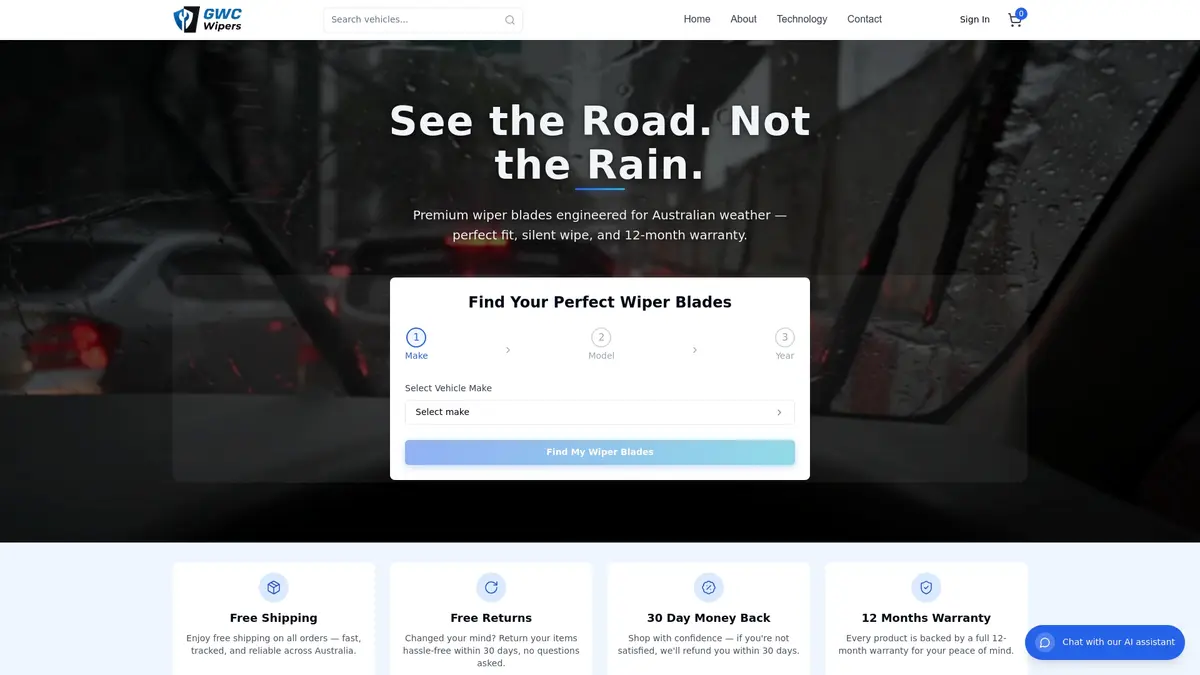
Com supplies premium wiper blades engineered to OEM specifications for Australian vehicles, covering a wide range of makes and models. Every blade is matched to your vehicle’s arm connector type, blade length, and spring tension requirements. The vehicle selector tool on the Com website lets you confirm the correct fitment by entering your make, model, and year before you buy. Com also backs every purchase with free shipping across Australia, a 30-day money-back guarantee, and a 12-month warranty. If you drive a Toyota, browse the Toyota wiper blade range for your exact model. Mercedes-Benz owners can find the full Mercedes-Benz wiper blade catalogue with fitment confirmed by vehicle year.
FAQ
What does OEM fitment mean?
OEM fitment means a part matches the original equipment manufacturer’s exact specifications for your vehicle, including dimensions, tolerances, and performance standards. It guarantees the part fits and functions as the factory intended.
Are OEM parts always better than aftermarket parts?
OEM parts carry a factory fit guarantee that aftermarket parts lack, but aftermarket parts are not inherently lower quality. For safety-critical components like brakes and suspension, OEM fitment is the safer choice. For non-critical parts, quality aftermarket options can be acceptable.
How much more do OEM parts cost than aftermarket?
OEM parts cost roughly 60% more on average than comparable aftermarket alternatives. That premium reflects vehicle-specific engineering, proprietary testing, and manufacturer certification.
How do I identify a genuine OEM-fit part?
Genuine OEM parts carry distinct manufacturer branding and batch or serial numbers. Cross-reference the part number on the packaging against your vehicle’s factory part number to confirm authenticity.
Does fitting non-OEM parts void my warranty?
Fitting parts that fall outside OEM specifications can affect your vehicle warranty, particularly for safety-related systems. Always check your warranty terms and confirm fitment specifications before replacing any component.