
OEM vs aftermarket wipers: a guide for Australian drivers
TL;DR:
- OEM wiper blades are manufactured to exact factory specifications, ensuring perfect fit and compatibility for your vehicle.
- Quality aftermarket wipers range from economical rubber designs to premium silicone beam blades that outperform OEM options in harsh Australian conditions.
When it comes to replacing wiper blades, most Australian drivers assume the answer is simple: stick with OEM and you’re covered. But defining OEM vs aftermarket wipers reveals a more nuanced picture. OEM doesn’t automatically mean superior performance, and aftermarket doesn’t mean inferior quality. The reality depends on your vehicle, your budget, and the conditions you’re driving in — whether that’s a Melbourne downpour, a dusty outback road, or a Queensland summer with relentless UV exposure. This guide breaks down both options with the detail you need to make a confident, informed choice.
Table of Contents
- Key takeaways
- Defining OEM vs aftermarket wipers: what each term actually means
- Aftermarket wiper options: variety, technology, and what to look for
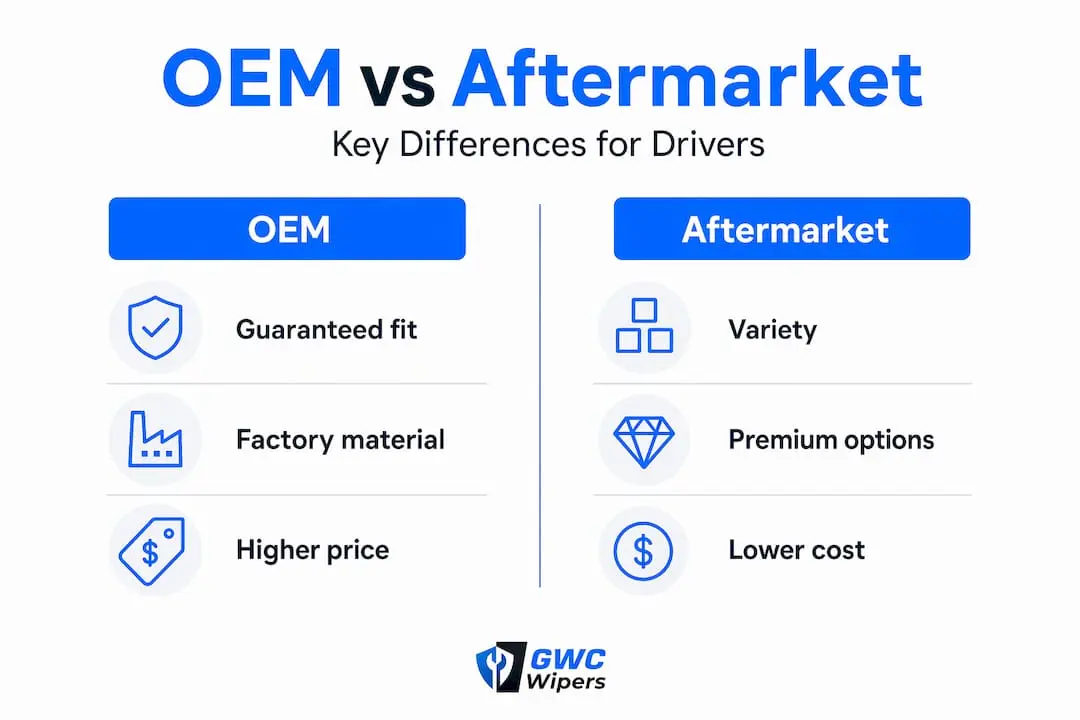
- OEM vs aftermarket differences: a direct comparison
- Buying guide for Australian drivers
- Common myths about OEM and aftermarket wipers
- My honest take on OEM versus aftermarket
- Find your perfect wiper blades at GWC Wipers
- FAQ
Key takeaways
| Point | Details |
|---|---|
| OEM guarantees exact fit | OEM wiper blades are made to factory specifications, removing guesswork around sizing and connector type. |
| Aftermarket spans a wide range | Quality and price vary significantly, from economy rubber to premium silicone beam blades with longer service life. |
| Climate shapes your best choice | Australian UV, heat, and rainfall patterns favour premium beam or silicone designs regardless of brand origin. |
| Fitment matters more than brand | Matching the correct connector type and blade size is the single most important factor for reliable performance. |
| Maintenance extends blade life | Cleaning rubber edges regularly with rubbing alcohol can significantly extend the life of both OEM and aftermarket blades. |
Defining OEM vs aftermarket wipers: what each term actually means
OEM stands for Original Equipment Manufacturer. OEM wiper blades are either produced directly by the vehicle manufacturer or by a contracted supplier who builds to the exact factory specification for your specific make, model, and year. When your car rolled off the production line, it had OEM blades fitted as standard. Replacing them through a dealership typically means getting the same blade, or one very close to it.
The core advantages of OEM blades are consistency and compatibility. You get a guaranteed fit, predictable performance, and in most cases, coverage under the manufacturer’s warranty. For newer vehicles still under warranty, using OEM parts can also help protect your warranty entitlements.
That said, OEM blades carry notable trade-offs:
- Price premium. OEM blades are sold through dealerships and authorised distributors, which means controlled supply chains and branding costs are factored into the price. Aftermarket parts pricing reflects more competition, which generally keeps costs lower.
- Material limitations. Many OEM blades still use traditional rubber or EPDM compounds. These are reliable but may degrade faster under Australia’s intense UV exposure compared to silicone alternatives.
- Limited selection. Dealerships rarely stock multiple styles or materials. You get what your vehicle was originally specced with, full stop.
- Availability issues. For older or less common vehicles, OEM blades can be difficult to source through the standard dealer network.
OEM remains a solid choice for new vehicles, warranty repairs, and drivers who simply want a plug-and-play replacement without any research required.
Aftermarket wiper options: variety, technology, and what to look for
Aftermarket wiper blades are manufactured by third-party companies, often reverse-engineered from OEM designs or purpose-built to fit a broad range of vehicle applications. This category spans an enormous spectrum, and that’s both its strength and its complication.
At the lower end, economy aftermarket blades use standard rubber compounds and traditional metal-frame designs. These are inexpensive and functional but typically wear faster, especially in harsh conditions. At the upper end, premium aftermarket options use advanced silicone compounds, beam-style construction, and aerodynamic designs engineered for high-speed performance and weather resistance.
Here’s how the two ends of the aftermarket spectrum compare:
| Feature | Economy aftermarket | Premium aftermarket |
|---|---|---|
| Material | Standard rubber or EPDM | Silicone or hybrid compound |
| Blade design | Traditional metal frame | Beam or hybrid frameless |
| Service life | 6 to 12 months | Up to 2 to 3 years |
| UV resistance | Low to moderate | High |
| Price range | $10 to $20 per blade | $25 to $50 per blade |
| Performance in heavy rain | Adequate | Excellent |
Beam blades now account for roughly 60% of total unit sales as the market moves away from older metal-frame designs. This shift reflects genuine performance improvements, not just marketing. Beam blades apply consistent pressure across the entire wiper length, which reduces streaking and improves contact on curved windscreens.
Premium aftermarket blades are also where you’ll find the most innovation in terms of materials suited to Australian conditions. Silicone compounds handle UV degradation far better than rubber, resist cracking under heat, and perform well in both light drizzle and heavy downpours.
One consideration for aftermarket blades is fitment compatibility. Not all aftermarket blades include every connector type in the box, and quality between brands varies significantly. Choosing a reputable supplier with a vehicle-specific selector tool removes most of this risk.
OEM vs aftermarket differences: a direct comparison
Understanding the OEM vs aftermarket differences across five key dimensions helps you prioritise what matters most for your situation.
Fitment and compatibility
OEM blades offer a guaranteed plug-and-play fit with no adapter guesswork. Premium aftermarket blades from established brands come close, particularly when you use a vehicle selector tool to confirm compatibility. The risk comes with generic or unbranded aftermarket blades where fitment is inconsistent.
Material technology and longevity
This is where aftermarket has a genuine edge at the premium level. Silicone blades deliver roughly 200% the service life of standard rubber or EPDM blades. OEM blades, while reliable, typically use rubber compounds that can crack or harden within 12 to 18 months under Queensland or Northern Territory conditions. For drivers in high-UV areas, premium aftermarket silicone is often the smarter long-term investment.

Price
OEM blades cost more, and the gap is not always justified by performance. The price difference primarily reflects controlled supply chains and branding rather than materially better components. Replacing a pair of OEM blades at a dealership can cost two to three times the price of a premium aftermarket equivalent.
Warranty coverage
OEM parts come with the vehicle manufacturer’s warranty, which provides clear, consistent protection. Aftermarket warranty coverage varies widely between brands. Some premium aftermarket suppliers offer 12-month warranties that are comparable to OEM, while economy brands may offer little or no coverage.
Maintenance and longevity
OEM blades can last 3 to 5 years when maintained properly, including cleaning the rubber edge with rubbing alcohol once or twice a year. The same maintenance routine extends aftermarket blade life considerably. Perceived streaking is often caused by residue buildup rather than actual blade failure, so regular cleaning can save you an unnecessary replacement.
Pro Tip: Wipe down both sides of the rubber blade with isopropyl alcohol every few months, particularly after driving on dusty or heavily treated roads. It takes two minutes and can add months to your blade’s useful life.
Buying guide for Australian drivers
Choosing the right blade comes down to matching your vehicle, your conditions, and your priorities. Here’s a practical process for getting it right:
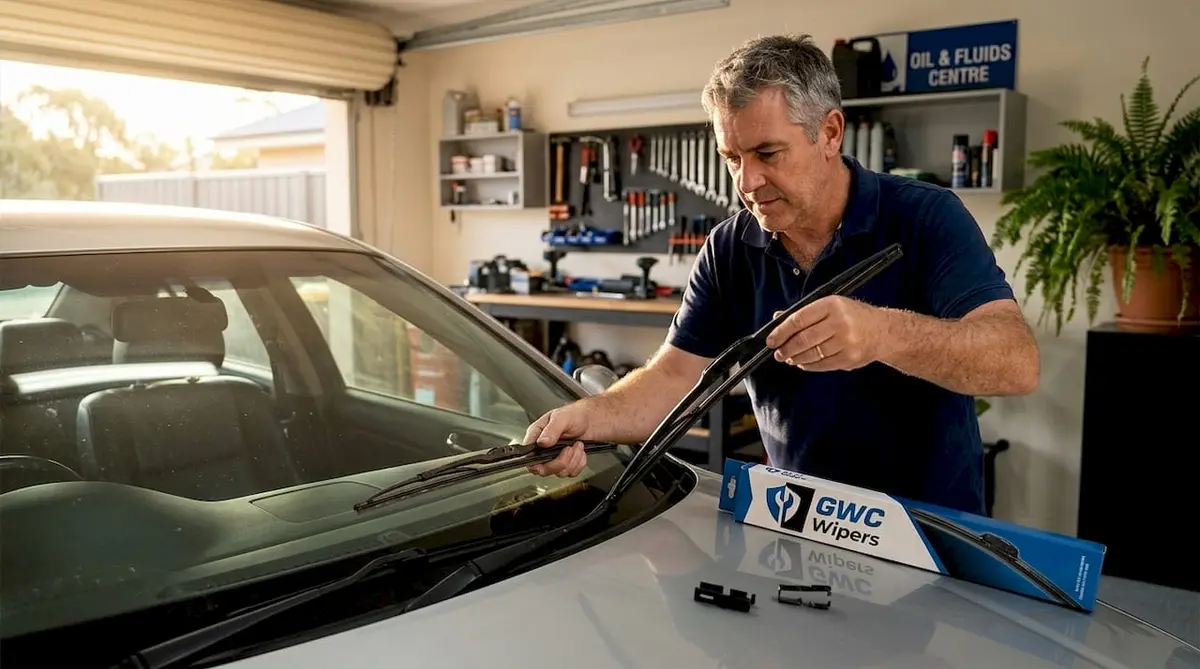
- Confirm your blade size and connector type. Check your vehicle’s owner manual or use a vehicle-specific selector tool. The three main arm connector types are J-hook, bayonet, and pin. Matching the connector type accurately is non-negotiable. The wrong adaptor causes rattling, poor contact, and potential arm damage. Our guide on wiper blade sizes walks through this in detail.
- Consider your climate. Drivers in coastal Queensland, the Northern Territory, or Western Australia should prioritise silicone or beam-style blades for UV and heat resistance. Local environmental demands justify premium beam or hybrid designs regardless of whether you choose OEM or aftermarket. For more guidance on materials suited to Australian weather, see wiper blade types for Australian drivers.
- Weigh up DIY versus professional installation. Basic blade swaps are straightforward. But DIY versus professional installation is now roughly 45:55 as sensor-integrated wiper systems in newer vehicles increasingly require calibration after replacement. If your car has rain-sensing wipers, consider professional fitting or consult a detailed step-by-step installation guide first.
- Set a budget aligned with value, not just price. A $15 economy blade may cost you more over 12 months if it requires two replacements. A $35 silicone beam blade that lasts three years is frequently the better value. Premium aftermarket blades are priced typically between $15 and $35 per blade, putting them within reach for most drivers.
- Clean your windscreen before fitting. Silicone blades in particular perform best on a clean, wax-free surface. A quick wipe with alcohol before installation prevents the chattering and skipping that many people wrongly attribute to a defective blade.
Pro Tip: If your new blades skip or chatter immediately after fitting, the issue is almost always windscreen contamination rather than the blade itself. Clean the glass thoroughly with an alcohol-based glass cleaner and re-test before returning the product.
Common myths about OEM and aftermarket wipers
A few persistent misconceptions lead Australian drivers to make avoidable purchasing mistakes.
- “OEM always means best quality.” Not necessarily. OEM guarantees compatibility, not superior materials. Many OEM blades use standard rubber that degrades faster than premium aftermarket silicone under Australian conditions.
- “All aftermarket blades are the same.” This is the other extreme, and equally wrong. Economy and premium aftermarket blades differ enormously in material quality, construction, and longevity. Treating them as interchangeable leads to disappointment.
- “A higher price always means better performance.” Price correlates with quality within a category, not across them. A $50 OEM blade does not automatically outperform a $35 premium silicone aftermarket blade. The materials and design matter more than the price tag alone.
- “Fitment is obvious.” Most drivers overlook checking the exact wiper arm connector type, which is the most common cause of fitment issues. Never assume your old blade’s connector matches a new one without verifying.
- “New blades don’t need maintenance.” Regardless of whether you buy OEM or premium aftermarket, regular cleaning with rubbing alcohol extends blade life and prevents premature streaking.
My honest take on OEM versus aftermarket
In my experience working with Australian vehicle owners, the OEM versus aftermarket debate is often framed as brand loyalty rather than practical decision-making. That framing does drivers a disservice.
I’ve seen plenty of drivers spend dealership prices on OEM rubber blades that harden and streak within 12 months, while a quality silicone beam blade from a reputable aftermarket supplier would have lasted three times as long. I’ve also seen economy aftermarket blades bought purely on price cause smearing so bad the driver had to pull over in heavy rain. Both outcomes are avoidable with the right information.
My view is this: if your vehicle is new and under warranty, OEM is the safe and sensible choice for peace of mind and warranty compliance. But for most Australian drivers replacing blades on vehicles more than two years old, the best value sits with premium aftermarket silicone or beam blades from a supplier who verifies fitment by vehicle make, model, and year.
What I find undervalued in almost every wiper-related conversation is maintenance. A blade that is cleaned every few months and kept free of road grime, insect residue, and wax overspray will outlast a neglected premium blade every time. The choice of OEM or aftermarket matters, but the discipline of regular maintenance matters just as much.
View your wiper purchase as a value decision based on your specific vehicle, your climate, and how long you want to go between replacements. Not as a brand choice.
— Faisal
Find your perfect wiper blades at GWC Wipers
GWC Wipers stocks a broad range of both OEM-equivalent and premium aftermarket wiper blades, covering hundreds of Australian vehicle makes and models. Whether you drive a Mercedes-Benz GLE-Class, a Toyota, or anything in between, our vehicle selector tool confirms the right blade size and connector type for your specific car.
We carry premium silicone beam blades and aerodynamic hybrid designs built to handle Australia’s toughest conditions. Every order includes free shipping across Australia, a 12-month warranty, and a 30-day money-back guarantee. If you need help choosing between OEM-equivalent and premium aftermarket options, our Australian support team is ready to assist. Shop with confidence and keep your line of sight clear no matter what the weather brings.
FAQ
What is the main difference between OEM and aftermarket wiper blades?
OEM wiper blades are manufactured to the vehicle’s original factory specification and guaranteed to fit, while aftermarket blades are produced by third-party manufacturers and range from economy rubber to premium silicone beam designs that can outperform OEM in specific conditions.
Are aftermarket wiper blades safe to use on my car?
Yes, quality aftermarket wiper blades are safe and reliable. Premium aftermarket blades from reputable suppliers often use more advanced materials than OEM equivalents and are engineered to meet or exceed original performance standards.
Do aftermarket wiper blades void my car’s warranty?
Fitting aftermarket blades generally does not void your vehicle warranty in Australia unless the blades directly cause damage. However, if your car is still under the manufacturer’s warranty, checking your warranty terms first is a reasonable precaution.
How long do silicone wiper blades last compared to rubber OEM blades?
Silicone wiper blades offer approximately 200% the service life of standard rubber or EPDM blades, making them a cost-effective choice over multiple replacement cycles, particularly in high-UV Australian conditions.
How do I know which wiper blade fits my car?
Check your owner’s manual for blade size and arm connector type, or use a vehicle-specific selector tool on a reputable wiper retailer’s website. Confirming both the blade length and connector style (J-hook, bayonet, or pin) prevents fitment failures before they happen.
Recommended
- Why OEM-fit wiper blades are the smart choice for Australian cars | GWC Wipers
- Best windshield wiper blade types for Australian drivers | GWC Wipers
- How Australian weather impacts your wiper blades: 6-month guide | GWC Wipers
- Upgrade your windshield visibility: expert guide for Australian drivers | GWC Wipers