
Measure your wiper blades for perfect fit and clarity

TL;DR:
- Proper measurement ensures effective, streak-free wiper performance and prolongs blade lifespan.
- Use a tape measure, check both sides, and confirm connector type before purchasing.
- Regular maintenance and timely replacement are vital for safety in Australia’s demanding climate.
Driving through a sudden downpour on a Sydney motorway with streaky, skipping wiper blades is one of the most unsettling experiences any Aussie driver can face. Poor visibility is not just frustrating; it is genuinely dangerous. The wrong blade size leaves dry patches, causes rubber to skip across the glass, and puts you and other road users at risk. This guide walks you through exactly how to measure your wiper blades correctly, what tools you need, the most common mistakes to avoid, and how to choose blades that suit your vehicle and Australia’s demanding climate. Follow these steps and you will never guess at blade size again.
Table of Contents
- Why wiper blade measurement matters in Australia
- Tools and preparation: What you need before measuring
- Step-by-step: How to measure your wiper blades
- Troubleshooting: Common mistakes and how to fix them
- What to expect: Performance after proper measurement and fitting
- The uncomfortable truth about wiper blades most Aussies ignore
- Get a perfect fit with premium blades for your vehicle
- Frequently asked questions
Key Takeaways
| Point | Details |
|---|---|
| Correct size is safety | Measuring wiper blades accurately ensures maximum vision and road safety in all Australian conditions. |
| Replace regularly | Replace your blades every 6 to 12 months, or when visibility drops, to guard against streaks and damage. |
| Check fit details | Consider connector type and windscreen curve besides just blade length for best results. |
| Clean and verify | Cleaning and monthly checks extend blade lifespan and keep your vision clear year-round. |
Why wiper blade measurement matters in Australia
Your wiper blades play a crucial role in keeping your line of sight clear, and in Australia, that job is harder than almost anywhere else. The country’s climate swings from scorching outback heat to tropical downpours, coastal salt air, and even alpine hail. Each of these conditions accelerates blade wear and makes correct sizing more important than ever.
A blade that is even a few centimetres too short leaves a dry arc across your windscreen, right in your sightline. One that is too long can collide with the windscreen frame, bend the wiper arm, or produce that irritating juddering sound. Neither outcome is acceptable when you are navigating a flooded road or driving into a low winter sun.
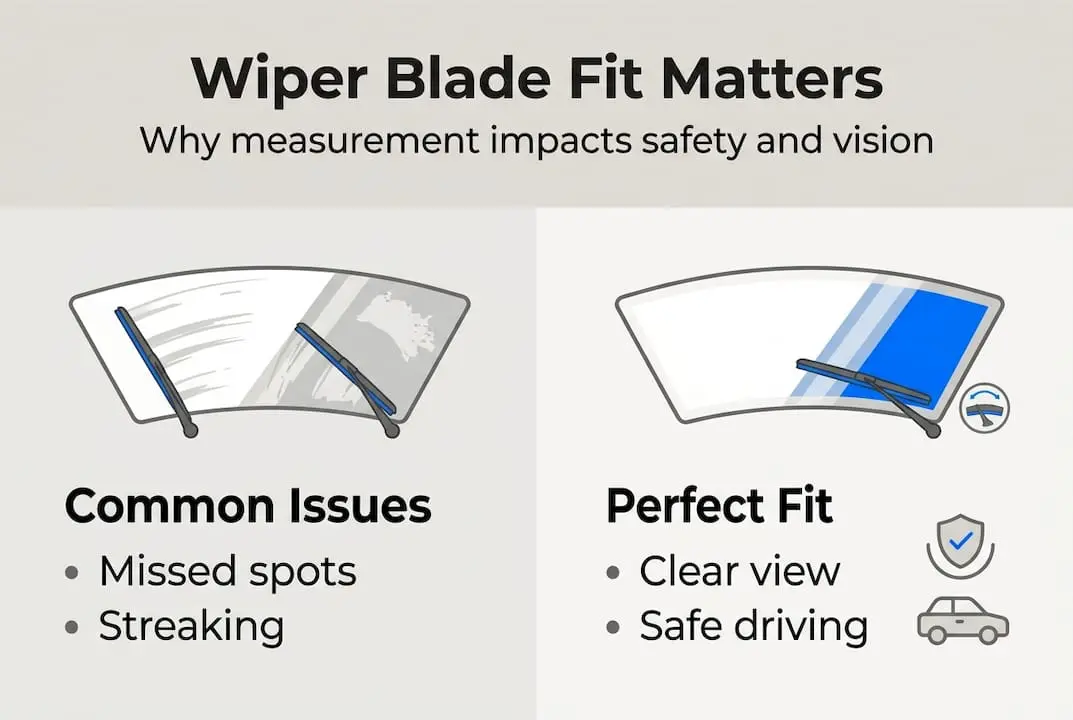
Understanding wiper blade replacement importance is the first step to staying safe. In Australia, harsh climate conditions mean you should expect to replace blades more frequently than drivers in milder countries.
Here is what the data says: beam blades last 12 to 18 months, while conventional rubber blades typically last just 6 to 12 months under Australian conditions. UV exposure, road grime, and temperature extremes all shorten that window.
Key reasons correct measurement matters:
- Streak-free performance: A correctly sized blade maintains full contact across the glass.
- Frame and arm protection: Oversized blades stress the wiper arm and can crack the windscreen surround.
- Full cleaning coverage: The right length ensures no missed patches in your field of vision.
- Connector compatibility: Sizing also involves matching the correct connector type to your vehicle’s arm.
- Cost efficiency: Fitting the right blade first time avoids wasted purchases and repeat trips to the parts store.
Think of it this way: a wiper blade is only as good as its fit. Premium materials mean nothing if the blade is the wrong length for your car.
Tools and preparation: What you need before measuring
Before you grab a tape measure and start pulling at your wipers, a little preparation goes a long way. Getting set up properly means your measurements will be accurate and your replacement selection will be spot on.
What you will need:
- A flexible tape measure or a rigid ruler (at least 60 cm)
- Your vehicle owner’s manual
- A notepad or your phone to record measurements
- A clean, dry cloth to wipe down the blades before measuring
Safety and setup tips:
- Park on flat, level ground so the wiper arms sit in their natural resting position.
- Make sure the ignition is off and the wiper switch is in the off position.
- Avoid measuring on a hot windscreen; heat can cause the rubber to expand slightly and affect your reading.
- Wipe the blades clean before measuring. Dirt and grime can add bulk and throw off your numbers.
Pro Tip: Clean your blades with a damp cloth before measuring. Grit and road residue can make a blade appear thicker or longer than it actually is, leading to a slightly inaccurate reading.
One often overlooked step is checking your connector type. Connector types like J-hook and side pin must match your vehicle’s wiper arm exactly. Buying the right length blade with the wrong connector is a surprisingly common mistake.
| Connector type | Common vehicles | Key feature |
|---|---|---|
| J-hook (standard) | Most passenger cars | Universal, easy to swap |
| Side pin | Some European models | Requires adaptor or specific blade |
| Pinch tab | Toyota, Holden models | Releases with a pinch mechanism |
| Top lock | Certain Fords | Slides in from the top |
You can find a detailed example of J-hook and side pin connector matching to understand how this works for specific vehicles. Knowing your connector type before you shop saves time and avoids the frustration of an incompatible purchase.

Also take note of your windscreen’s curvature. Highly curved windscreens, common on modern vehicles, require blades designed to flex along that curve for consistent contact from edge to edge.
Step-by-step: How to measure your wiper blades
With your tools ready and your car parked safely, here is how to get an accurate measurement every time.
- Lift the wiper arm away from the windscreen. Most arms have a locking position at roughly 90 degrees. Hold it steady so it does not snap back.
- Locate the rubber wiper element. This is the part you are measuring, not the metal arm or the plastic end cap.
- Place your tape measure at one end of the rubber element and extend it to the other end. Record the measurement in centimetres.
- Repeat for the opposite blade. Many vehicles use different lengths on the driver and passenger sides. Never assume they are the same.
- Cross-check with your owner’s manual or an online vehicle selector. This confirms your measurement and accounts for any shrinkage in worn blades.
- Note the connector type on each arm before you shop.
Pro Tip: If your current blades are heavily worn, they may have shrunk slightly. Worn blades can measure shorter than the original specification. Add 1 to 2 cm to your reading and verify against your manual to get the correct replacement size.
For vehicles with a curved windscreen, check the manufacturer’s recommendation for blade flex. You can see how this applies to specific models by looking at fitment guides for curved windscreen vehicles.
| Method | Pros | Cons |
|---|---|---|
| Measure old blade | Quick, no manual needed | Worn blades may be shorter than spec |
| Use owner’s manual | Accurate, manufacturer confirmed | Manual may not be handy |
| Online vehicle selector | Fast, model-specific results | Requires internet access |
| Ask a parts specialist | Expert advice included | Takes more time |
For most drivers, combining your own measurement with a quick check against a wiper replacement guide gives the most reliable result. Two data points are always better than one.
Troubleshooting: Common mistakes and how to fix them
Even with the best intentions, a few common errors can trip you up during the measuring process. Knowing what to watch for saves you a return trip to the shop.
Common mistakes to avoid:
- Measuring only one blade: As mentioned, driver and passenger blades are often different lengths. Always measure both, even if they look the same at a glance.
- Measuring the arm instead of the rubber: The wiper arm is not the part doing the cleaning. Only the rubber element length counts.
- Ignoring connector type: Connector types must match your wiper arm. A blade with the wrong connector will not attach securely, regardless of length.
- Overlooking curved or frameless blade requirements: Flat or beam blades are designed for curved windscreens and provide better contact. Fitting a conventional framed blade to a highly curved screen leaves gaps at the edges.
- Relying solely on a worn blade’s measurement: Worn rubber shrinks. If your blades look cracked or brittle, always cross-reference with your manual or a fitment tool.
For vehicles with specific fitment requirements, such as European makes, a dedicated fitment check like the one available for Volkswagen Passat blades shows how much variation exists between models.
Safety reminder: After fitting new wiper blades, always test them on a wet windscreen before driving. Run your washers and check that both blades make full, even contact across the glass. A blade that lifts at the edges or skips in the centre is not correctly seated and should be re-fitted before you head out.
Take a moment after installation to press each blade gently against the glass and confirm it lies flat. This 30-second check can prevent a dangerous situation the next time rain hits.
What to expect: Performance after proper measurement and fitting
Fitting correctly sized, high-quality wiper blades transforms your driving experience in wet conditions. Here is what you should notice immediately.
Signs of a correctly fitted, premium blade:
- No streaks or smearing across the windscreen during wiping
- Quiet, smooth operation with no chattering, skipping, or squealing
- Full coverage from edge to edge with no dry arcs
- Consistent pressure across the blade’s length, even on curved glass
Premium blades, particularly silicone and beam-style designs, offer more than just a clean wipe. Silicone blades transfer a hydrophobic layer to the glass over time, causing water to bead and roll off even between wiper strokes. This is a genuine safety advantage in heavy rain.
Tested performers like the Bosch Aerotwin offer quiet, UV-resistant performance, while Trico Silicone blades are recognised for long-term durability. Rain-X Latitude blades are noted for water repellency and streak-free results. These benchmarks give you a useful reference point when comparing options.
To extend blade life, clean blades monthly with soapy water or alcohol and lift the wiper arms away from the glass during extreme heat or hail events. These simple habits can add months to your blade’s service life.
In Australian conditions, well-maintained premium blades typically last 12 to 18 months. Standard rubber blades, even when correctly fitted, will need replacing every 6 to 12 months. Tracking your replacement date and doing a quick visual check each month keeps you ahead of any deterioration.
The uncomfortable truth about wiper blades most Aussies ignore
Here is what we see time and again: drivers know their wiper blades are past their best, but they put off replacing them because it feels like a minor job. Then a storm rolls in and suddenly those streaky, chattering blades are the most important thing on the car.
The reality is that measuring and replacing wiper blades takes less than 20 minutes. The risk of delaying is not just an inconvenience; it is a genuine road safety issue. A blade that leaves a 10 cm dry arc right in your sightline is not performing its job.
We also find that many drivers skip the monthly wipe-down entirely. Yet cleaning blades monthly and lifting arms in heat are among the simplest and most effective maintenance habits you can build. Pair that with understanding how Australian weather accelerates blade wear and you have everything you need to stay ahead of the problem. Small, consistent habits beat last-minute panic every time.
Get a perfect fit with premium blades for your vehicle
Now that you know exactly how to measure and select the right wiper blades, the next step is finding a set that is built for your specific vehicle and Australian conditions.
At GWC Wipers, we make that process straightforward. Use our vehicle selector to find blades matched to your make, model, and year, whether you drive a European model like an Alfa Romeo Giulietta or need Mercedes-Benz replacement blades. Every blade comes with a fit guarantee, free shipping across Australia, and a 12-month warranty. Head to GWC Wipers and use your measurements to order with complete confidence.
Frequently asked questions
How often should I replace my wiper blades in Australia?
Replace your blades every 6 to 12 months due to Australia’s harsh climate, or sooner if you notice streaking, skipping, or visible cracking in the rubber.
Do both wiper blades need to be the same length?
Not always. Many vehicles use different sizes for the driver and passenger sides, so always measure both blades individually before purchasing replacements.
What if my old wiper blades are very worn or shorter than new ones?
Worn blades can measure shorter than the original spec due to rubber shrinkage. Add 1 to 2 cm to your measurement and cross-check against your owner’s manual or a vehicle fitment tool.
How do I clean and maintain my wiper blades?
Wipe the rubber element monthly with soapy water or isopropyl alcohol, and lift wiper arms in extreme heat or hail to prevent the rubber from bonding to or being damaged by the glass.