
Pass Roadworthy Checks: Wiper Blade Orientation for Australian RHD Cars

On a right-hand-drive car, the passenger-side blade typically overlaps the driver-side blade when both are parked, and left and right are always worked out from your seated driving position, not from someone facing the windscreen. Before you blame orientation for poor wiping, check the rubber and the glass first, since worn inserts or a dirty windscreen cause most smearing regardless of which way the blades sit. The sections below show you how to confirm blade identity and fit them the right way.
TL;DR:
- Measure existing blades and verify their length and curvature with your vehicle’s specifics before purchasing replacements to avoid fitting errors.
- Ensure the leading edge of each blade faces the direction of wipe, and the overlap appears correctly in the parked position to prevent streaking and chatter.
- Confirm that blades are fitted with the correct adapter and seated properly, avoiding forcing or misaligning bayonet, pin, or J-hook arms.
- Clean the windshield thoroughly and check rubber condition before replacing blades, as dirt and worn rubber often cause streaks and smearing.
- Replacing blades every six to twelve months and inspecting backing claws, rubber edges, and washer jet alignment prolongs blade life and maintains clear visibility.
Table of Contents
- How to tell your driver and passenger blades apart
- Which edge leads, where blades overlap, and the parked position
- Fitting J-hook, pin and bayonet arms without flipping the blade
- Fixing chatter, lift and streaks that look like orientation faults
- How often to replace blades and what to check along the way
- Why correct fitment matters more than guesswork
- What actually matters when you’re fitting wipers yourself
- Ready to fit blades that match your car exactly
- Sources
- FAQ
How to tell your driver and passenger blades apart
The simplest rule is to sit in the driver’s seat and work out left and right from there. The blade nearest you is the driver blade, and the one on the far side, nearest the passenger door, is the passenger blade. This sounds obvious, but a surprising number of installation mistakes happen because someone orients themselves from outside the car, facing the windscreen, which flips everything.
Before fitting anything new, measure your existing blades rather than guessing. Most RHD vehicles use two different lengths, with the driver blade usually longer, though plenty of models use equal lengths on both sides and a few have unique curvature on each side.
- Measure the old blade end to end and note which arm it came from.
- Check your vehicle’s details against a dedicated vehicle selector before ordering replacements.
- Keep the old blades as a size and shape reference until the new ones are confirmed to fit.
Always check the fitment guide for your specific model, since some vehicles have quirks that a generic guess will miss.
Which edge leads, where blades overlap, and the parked position
Every wiper blade has a leading edge and a trailing edge. The leading edge meets the glass first as the blade sweeps, and it needs even pressure along its length to clear water properly. Fit a blade backwards and that edge loses contact, which causes smearing, lifting at speed, or a juddering motion known as chatter.
On most RHD cars, the passenger blade sits slightly higher and overlaps the driver blade in the parked position, near the base of the windscreen. It’s a quick way to sanity-check your fitment: if the overlap looks reversed, or one blade sits awkwardly on top of the other arm, something is fitted the wrong way around.
- Leading edge faces the direction of the wipe stroke, not the resting direction.
- Overlap zone sits at the bottom of the sweep, where both blades park.
- A correctly parked blade should sit flush against the glass with no visible twist.
Vehicle-standard guidance requires wipers to return to their designed parked position and remain operable from the driving seat, a requirement spelt out in the vehicle standard code of practice. This matters at roadworthy inspection time, since a blade sitting outside its park arc can raise a flag even if the wipe itself looks fine.
Fitting J-hook, pin and bayonet arms without flipping the blade
Start with the basics: lift the arm away from the glass carefully, clean the windscreen, and check the rubber for cracking or stiffness before you touch the new blade; for more advice on maintaining your aluminium components and glass, see our guide on care and maintenance for an aluminium ute canopy.
- J-hook arms: slide the adapter onto the hook so the rubber’s curve matches the glass, then engage the retaining clip until it clicks. A common error here is seating the blade with the spine facing the wrong way, which puts the leading edge on the trailing side.
- Pin-type arms: release the small locking tab, slot the blade’s connector over the pin, and press until it seats flush. Check that the blade sits square to the arm, not angled.
- Bayonet and flat arms: look for the small alignment marks or ridges on the adapter, since these only fit one way. Forcing a bayonet connector on upside down is one of the most common wrong-way fits, and it’s usually obvious because the blade sits proud of the glass rather than flush.
- Final check: lower the arm gently onto the glass, run a single low-speed wipe, and watch the overlap zone. Listen for chatter, which often means a reversed or poorly seated blade rather than a worn one.
Pro Tip: Take a photo of the old blade’s orientation on the arm before you remove it, so you have a reference if the new one looks uncertain.
For arm-specific photos and extra detail, our step-by-step installation guide covers adapter types in more depth.
Fixing chatter, lift and streaks that look like orientation faults
Chatter, skipping and streaking can all look like a wrong-way fit, but they’re often caused by something else entirely. Worn or glazed rubber, a dirty windscreen, or uneven arm pressure produce the same symptoms as reversed blades.
- Clean the glass and washer jets first; dirt and old wax residue cause more streaking than people expect.
- Only swap blades side to side if they’re identical model and length, since mismatched curvature makes things worse.
- Check the backing claws haven’t loosened and that the arm still applies even spring pressure across the blade.
RACQ’s guide to changing wiper blades notes that streaking, squeaking, shuddering and skipping are the clearest signs it’s time to look closely at the blade itself, not just the orientation. If reseating the clip and cleaning the glass doesn’t fix it, and the arm itself looks bent or the glass is pitted, that’s a job for a workshop rather than another blade swap.
How often to replace blades and what to check along the way
RACV’s maintenance guidance suggests most blades need replacing every six to 12 months depending on use and sun exposure, while RACQ uses roughly six months as a general guideline. Heat, UV and short trips all shorten blade life faster than distance alone.
- Run a finger along the rubber edge, feeling for cracking, flat spots or a glazed texture.
- Check the backing claws are all present and gripping the insert evenly.
- Confirm washer jets are aimed at the glass, not the bonnet or roofline.
Pro Tip: In frosty conditions, lift the blades off the glass overnight so they don’t freeze to the windscreen and tear on first use.
Use a proper washer fluid rather than plain water, and if the car sits parked for long stretches, a windscreen cover helps protect the rubber from UV damage.
Why correct fitment matters more than guesswork
Fitting a blade the wrong way around rarely shows up straight away. It tends to surface as a faint chatter or a smear that gets worse with speed, by which point the rubber may already be under uneven stress.
- Some blades on the market ship with preassembled adapters built for each listed model, which can remove most of the guesswork around orientation.
- Many suppliers offer guarantees, return policies, and warranties on their wiper blade orders.
Getting the blade length and adapter right from the start avoids most of the reversed or forced fits that cause chatter later.
What actually matters when you’re fitting wipers yourself
The orientation question gets more attention than it deserves on its own. In practice, a wrong-way fit is usually a symptom of buying the wrong blade length or adapter type in the first place, not a separate mistake someone makes while fitting a correct one. Get the fitment right and the orientation mostly sorts itself out, because a properly matched adapter only seats one way.
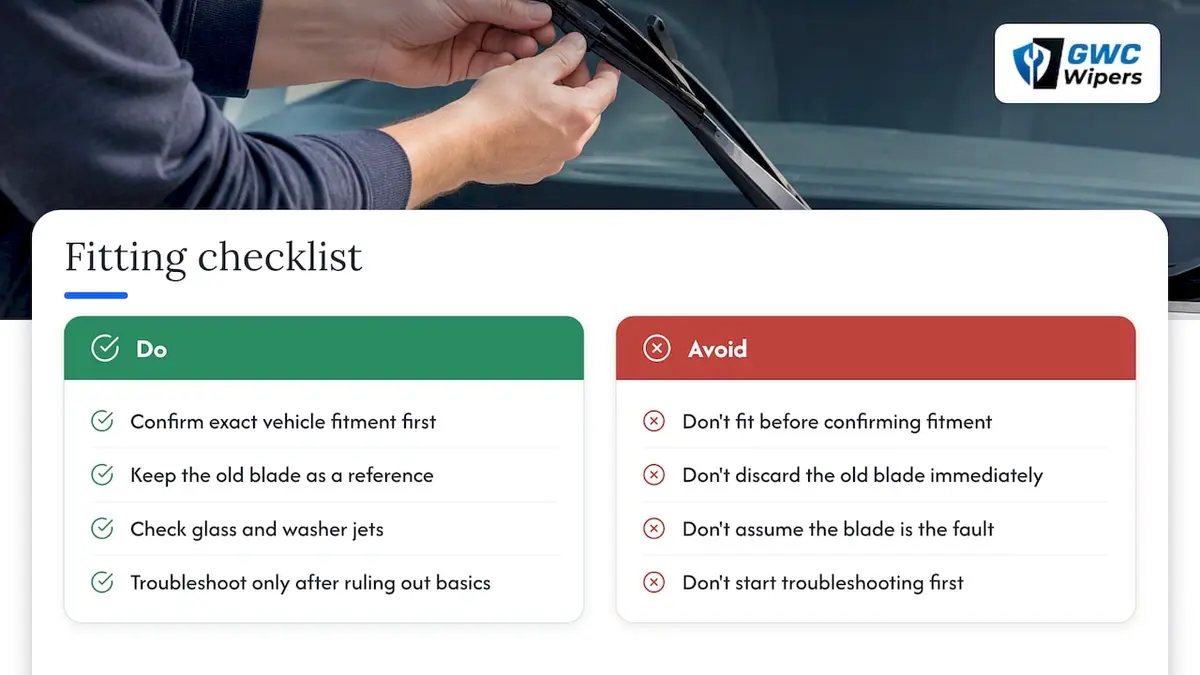
What’s underrated is how often people replace blades when the real issue is a dirty windscreen or a tired washer jet. Chatter and streaking get blamed on the blade almost automatically, when cleaning the glass and checking the jets fixes a good share of complaints without spending a cent.
If you take one thing from this: confirm your vehicle’s exact fitment before you touch the arm, keep the old blade as a reference while you fit the new one, and only start troubleshooting chatter once you’ve ruled out dirty glass and worn rubber.
— Faisal
Ready to fit blades that match your car exactly
Guessing at generic blades, or forcing a mismatched adapter onto your arm, is how most wrong-way fits happen in the first place. The GWC Wipers range is organised by make, model and year, so the adapter and length are already matched to your car before it leaves the warehouse.
- Browse the Toyota Hilux wiper blade range as an example of model-specific fitment done properly.
- Many online retailers offer shipping, return guarantees, and warranties on automotive accessories.
- Still fit the blade carefully and check the overlap once it’s on, since even a correct-size blade needs a proper seat on the arm.
Find your vehicle, order the matching set, and fit with confidence.
Sources
- Vehicle standard code of practice (Queensland)
- How to change wiper blades | RACQ
- Easy DIY car maintenance tips and safety checks | RACV
FAQ
Which way should wiper blades face?
The leading edge should face the direction the blade sweeps, meeting the glass evenly along its length. On most RHD cars, the passenger blade overlaps the driver blade when parked, which is a quick visual check for correct orientation.
Can I switch my windshield wipers from left to right?
Only if both blades are an identical model and length, since many RHD vehicles use different sizes or curvature on each side. Check your vehicle selector or measure the old blades before swapping them between arms.
Does it matter which wiper goes on which side?
Yes, because mismatched length or curvature on the wrong side causes uneven contact, streaking or lift at speed. Fit each blade to the arm it was sized for, using the seated left and right convention to confirm which is which.
Why are my wipers going the wrong way?
This is usually a fitting error rather than a mechanical fault, often an adapter seated backwards or a blade forced onto the wrong arm. Clean the glass first, since dirt and worn rubber cause similar symptoms, then recheck the fit against your vehicle’s fitment guide.