
Is Alcohol Bad for Wiper Blades in Australia? Clean or Replace
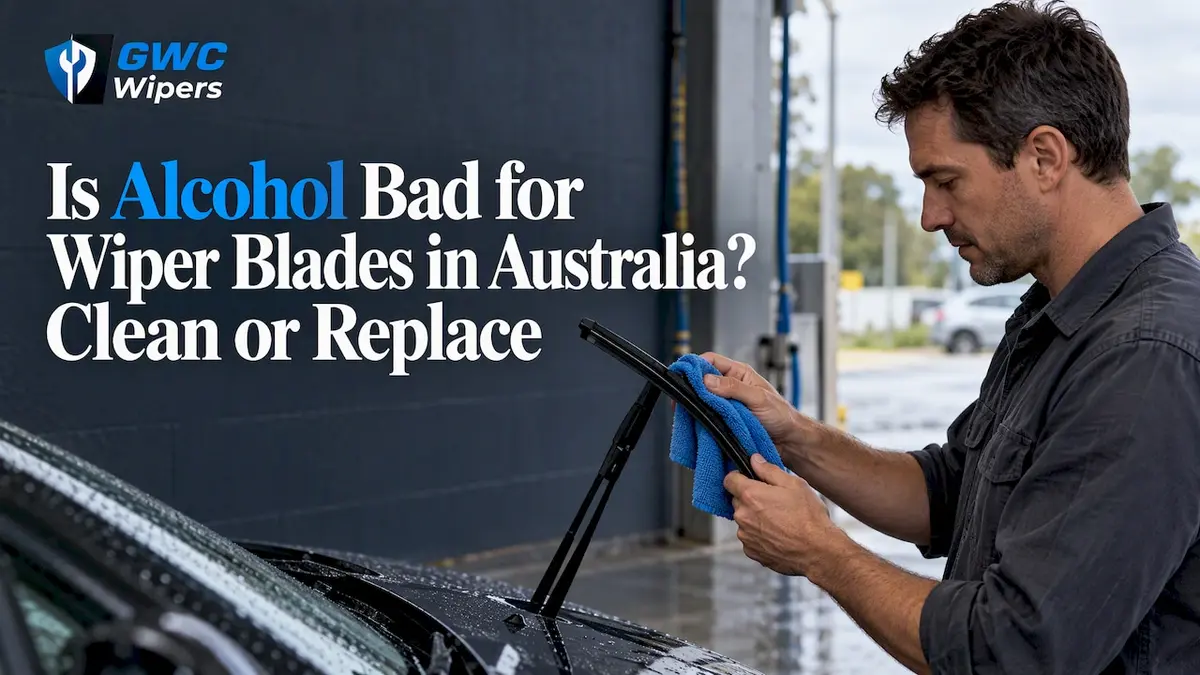
A small, careful wipe with isopropyl alcohol is safe for wiper blades and can lift stubborn grime that water alone won’t shift. Repeated or heavy use is a different story: it dries out the rubber and speeds up cracking. Try one careful clean, then test the wipers on the screen. If streaking continues, it’s time to replace the blades rather than reach for the bottle again.
TL;DR:
- Start with mild dish soap and water; for stubborn sap or oily film, wipe once with alcohol, rinse, and test the blades on wet glass.
- If streaking persists after one cleaning, inspect for cracks, splits, hardened rubber, or skipping; streaks that track the blade point to worn rubber.
- RACV says most blades need replacement every six to 12 months, and recommends replacing them sooner if they squeak, skip, or leave streaks.
- For routine care, choose water, diluted washer fluid, mild soap, or glass cleaner labeled safe for rubber; avoid household detergents, strong solvents, and oils.
Table of Contents
- What rubbing alcohol does to rubber and why it matters
- When alcohol can help (and when it won’t)
- How to clean wiper blades safely, step by step
- When to replace wiper blades and expected lifespan
- Recommended cleaners and what to avoid
- Impact of alcohol concentration levels on wiper blade material compatibility
- Isopropyl alcohol versus ethanol: does the type matter?
- How weather conditions affect alcohol use on wipers
- Alcohol cleaning versus commercial wiper blade cleaners
- Our practical view: cleaning buys time, replacement buys clarity
- Find perfect-fit replacement blades with the vehicle lookup
- FAQ
- Sources
What rubbing alcohol does to rubber and why it matters
Alcohol works as a solvent. It breaks down the oily films, road grime and sap residue that build up on a wiper edge and cause that juddering, streaky wipe you notice on the motorway. A single dab on a cloth can restore contact between the blade and the glass by cutting through whatever is sitting between them.
The trade-off sits in the rubber itself. Wiper blades rely on flexible compounds to hold their shape and seal against the glass, and solvents can strip the plasticisers that keep that rubber supple. Used occasionally, the effect is negligible. Used as a weekly habit, it adds up.
- A single wipe removes contaminants without meaningfully affecting the rubber compound.
- Repeated solvent exposure dries the rubber and makes it more prone to cracking.
- Heat and sun exposure compound the problem, ageing the rubber faster than solvent use alone.
UV exposure is a genuine factor in material ageing, and UV radiation levels across the country are high enough to accelerate the breakdown of rubber and plastic components left exposed on a parked car.
When alcohol can help (and when it won’t)
Alcohol earns its place in the glovebox for specific jobs: oily film from traffic exhaust, tree sap, wax transfer from a recent detail, or sudden streaking after driving through a dusty or contaminated patch of road. A quick wipe clears the contact surface and restores a clean sweep in minutes.
It isn’t a fix for rubber that’s already cracked, split or gone hard with age. No amount of cleaning restores flexibility to a blade that has lost its elasticity, and treating alcohol as a routine maintenance step will only shorten the life of a healthy blade.
- Use it for isolated contamination: sap, wax film, oily residue, sudden streaking.
- Skip it for cracked, split or visibly hardened rubber: that calls for replacement.
- Run a quick test first: if the streak follows the blade across the glass, it’s the rubber; if it’s patchy regardless of blade position, check your washer fluid or blade condition before assuming the worst.
How to clean wiper blades safely, step by step
Before touching anything, lift the wiper arm away from the glass and rest it on a folded towel so the metal doesn’t scratch the paint. Never run the blades back and forth on a dry windscreen. That friction alone wears the rubber edge faster than almost anything else you could do to it.
- Inspect the blade edge for sap, dust build-up or visible damage before you start.
- Wash the blade with warm water and a few drops of mild dish soap on a soft cloth.
- Wipe along the rubber edge in one direction, not back and forth, to avoid dragging grit across it.
- For stubborn residue that soap won’t shift, dampen a clean section of cloth with a small amount of isopropyl alcohol and wipe once along the edge.
- Rinse the blade with clean water and dry it with a lint-free cloth.
- Lower the arm, run the washer fluid, and test the sweep across a wet screen.
- If streaking persists after this single pass, stop cleaning and plan for replacement rather than repeating the alcohol step.
Pro Tip: Clean the glass at the same time you clean the blade. A streak that looks like a wiper problem is sometimes just a dirty windscreen.
For a fuller walkthrough with photos of each stage, our step-by-step cleaning guide covers the same method in more depth.
When to replace wiper blades and expected lifespan
Cleaning only fixes contamination. It does nothing for rubber that has aged past the point of sealing properly against the glass, and knowing the difference saves you from chasing a streak that cleaning will never solve.
- Visible cracks, splits or a jagged edge along the blade.
- Streaking that returns within a day or two of a thorough clean.
- A squeak, chatter or judder that wasn’t there a few months ago.
- Patches of the screen the blade skips over entirely.
RACV advises replacing wiper blades if they squeak, skip across the screen or leave streaks, and notes most blades need replacing every six to 12 months. RACV’s maintenance guidance also points out that wiper rubber deteriorates through everyday use and sun exposure, so a regular visual check matters as much as acting on an obvious fault. Run that check before and after every clean: lift the blade, run a finger along the edge feeling for nicks, and look for any lifting of the rubber from its metal spine. For a full checklist, our clean-or-replace test walks through each sign in order.
Recommended cleaners and what to avoid
For routine care, keep it simple with a proven streak-free method for UK owners. Plain water, diluted windscreen washer fluid or a mild dish soap solution handles most dirt without any risk to the rubber. Automotive glass cleaners labelled safe for rubber components are a reasonable step up when you want something a bit stronger for the glass itself.
- Use: plain water, diluted washer fluid, mild dish soap solution, rubber-safe automotive glass cleaner.
- Avoid: undiluted household detergents, acetone or other strong solvents, and any lubricant or oil wiped onto the rubber edge.
- Dilute cleaning products as directed on the label rather than applying them at full strength.
RACV’s maintenance advice specifically flags household detergents as a cause of blade damage, recommending mild soaps and approved washer fluids instead for everyday cleaning.
Impact of alcohol concentration levels on wiper blade material compatibility
Concentration matters more than most drivers assume. A low-percentage isopropyl alcohol solution, the kind found in some pre-mixed glass cleaners, behaves very differently on rubber than the high-concentration rubbing alcohol sold for disinfecting purposes.
Higher concentrations dissolve plasticisers faster, which means a blade wiped repeatedly with strong, undiluted alcohol loses its flexibility sooner than one treated with a diluted solution used sparingly. The rubber compound itself plays a role too. Most wiper blades use natural or synthetic rubber blends designed to flex thousands of times a week without tearing, and that flexibility depends on retaining the oils and plasticisers built into the compound during manufacture.
A small amount of alcohol on a cloth, applied once and rinsed off, has minimal contact time with the rubber and poses little risk. The same alcohol left to sit, or reapplied every time you clean the car, has far more opportunity to strip those compounds. The practical takeaway is straightforward: treat concentration and frequency as linked variables. A strong solvent used once is far less risky than a mild one used every week.
Isopropyl alcohol versus ethanol: does the type matter?
Both isopropyl alcohol and ethanol are solvents capable of dissolving oily residue, and both appear in household and automotive cleaning products. The practical difference for wiper blades comes down to evaporation rate and typical concentration rather than any dramatic chemical distinction.
Isopropyl alcohol, the more common choice for glass and electronics cleaning, evaporates at a moderate rate and is usually sold in concentrations from around 70% to higher purity grades. Ethanol, found in some hand sanitisers and multipurpose cleaners, tends to evaporate faster and is often blended with other additives, including fragrances or moisturisers, that weren’t designed with rubber components in mind.
Neither solvent is inherently safer for wiper rubber in isolation. What matters is contact time, concentration and how often you use either one. A quick wipe with a diluted isopropyl solution on a cloth, rinsed off afterwards, carries low risk either way. Reaching for a sanitiser or multipurpose ethanol cleaner as a routine wiper treatment introduces the same drying risk, plus whatever additional ingredients are mixed in. If you’re choosing a product specifically for glass and rubber care, an automotive glass cleaner labelled safe for rubber components is a more predictable choice than either alcohol type used on its own.
How weather conditions affect alcohol use on wipers
Hot, sun-exposed conditions change how alcohol interacts with wiper rubber. Heat speeds up evaporation, which shortens the alcohol’s contact time on the blade, but it also means the rubber is already working harder: warm compounds are softer and slightly more vulnerable to solvent penetration than cold ones.
UV exposure compounds this. As noted earlier, UV radiation contributes to material degradation over time, and a wiper blade that spends its life under a harsh sun is already ageing faster than one garaged or shaded regularly. Cleaning with alcohol on a blade that’s already UV-stressed won’t reverse that ageing. It can briefly restore a clean sweep, but the underlying rubber is still on a shorter clock.
Humidity and rainfall patterns matter in a different way. A car that goes weeks without a decent wash in a dry spell accumulates more dust and grime on the wiper edge, which is exactly the build-up that benefits from an occasional alcohol wipe. A car that sees frequent rain tends to self-clean to some extent, reducing how often you’d reach for a solvent in the first place. The practical adjustment is seasonal: expect to clean more often during dry, dusty stretches, and keep an eye on rubber condition more closely through the hottest months when UV ageing is at its worst.
Alcohol cleaning versus commercial wiper blade cleaners
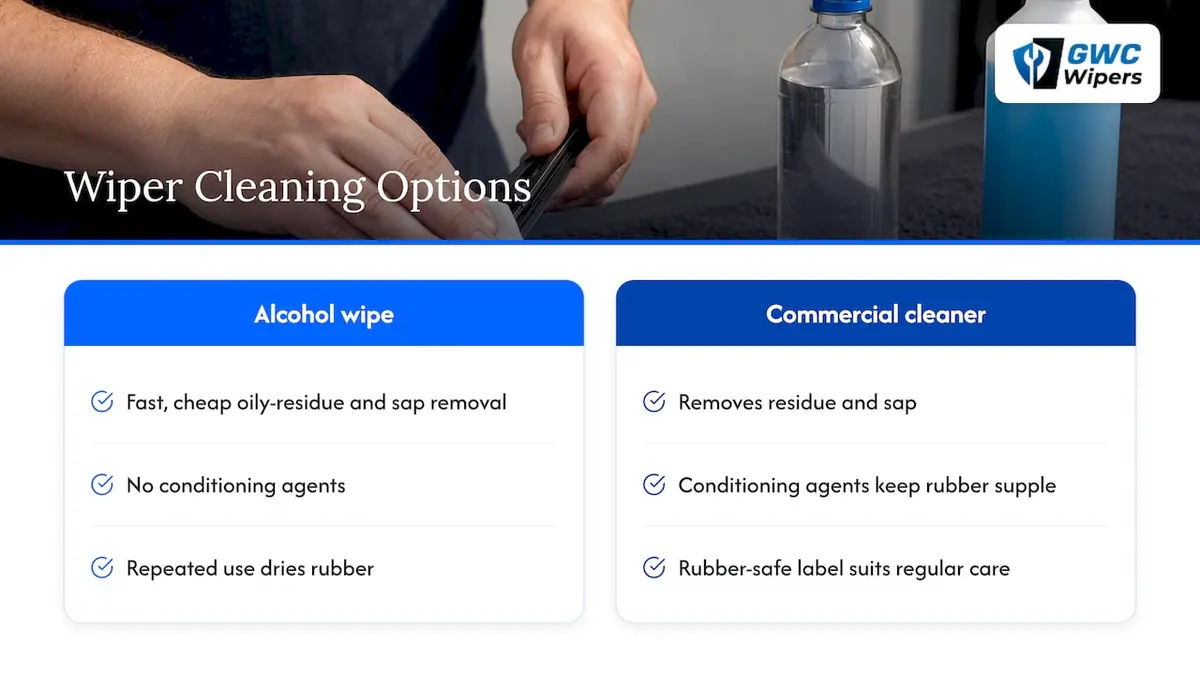
Alcohol wiped on a cloth is fast, cheap and effective at cutting through oily residue and sap, which is why it’s a popular home fix. It has no conditioning agents, though. It strips contaminants and nothing else, which is exactly why repeated use dries the rubber out over time.
Commercial automotive glass and wiper cleaners, by comparison, are formulated specifically for the job. Many include a small amount of alcohol or a comparable solvent alongside conditioning agents designed to leave the rubber supple rather than stripped. That formulation difference is the main safety advantage: a rubber-safe glass cleaner does the same contaminant-removal job as a plain alcohol wipe while reducing the drying side effect.
For occasional, targeted jobs, a dab of alcohol on a cloth is a reasonable and low-cost option. For regular glass and blade care, a cleaner labelled safe for automotive rubber is the safer habit to build, since it reduces the temptation to reach for a stronger solvent every time a streak appears. Either approach is a cleaning solution, not a repair. Once a blade is cracked, hardened or skipping across the glass, no cleaner, alcohol-based or commercial, restores it.
Our practical view: cleaning buys time, replacement buys clarity
Cleaning has its place, and a careful alcohol wipe can rescue a streaky blade that’s otherwise sound. It’s a stop-gap, though, not a repair. Once rubber starts to harden or crack, no cleaning routine brings back the seal you need for a clear screen in heavy rain. Our cleaning guide and fitment tools exist for exactly this handoff: clean what can be cleaned, then check fitment the moment a blade is genuinely done.
— Faisal
Find perfect-fit replacement blades with the vehicle lookup
![CTA image placeholder]

Once a blade has earned its retirement, the fastest path back to a clear screen is a set built for your exact car rather than a generic universal fit. We design and manufacture premium wiper blades engineered for Australian conditions, from harsh sun to sudden downpours, with a perfect fit guarantee backed by a vehicle selector covering more than 2,500 models.
Every set ships free across the country and comes with preassembled adapters for tool-free DIY installation. If you drive a Ford Laser or almost anything else on the road, our lookup tool matches your make, model and year to the right blade in a couple of clicks, so you’re not guessing at sizes in a parts aisle.
Use the GWC vehicle lookup to find wipers guaranteed to fit your exact make, model and year, and get back to a clear, streak-free view through the next rainy drive.
FAQ
Is it okay to clean wiper blades with alcohol?
Yes, a small amount of isopropyl alcohol on a cloth is fine for an occasional clean, particularly for sap, wax or oily residue. Using it as a regular habit can dry the rubber out faster, so keep it as an occasional step rather than your default cleaner.
Is WD-40 good for cleaning wiper blades?
No, lubricants like WD-40 aren’t suited to wiper rubber and can leave a slick film that smears rather than clears the glass. Stick to mild soap, water or a rubber-safe automotive glass cleaner instead.
What is the best thing to clean your wiper blades with?
A warm, mild dish soap solution handles most everyday grime safely, with an occasional dab of isopropyl alcohol on a cloth for stubborn sap or residue. For regular glass care, an automotive cleaner labelled safe for rubber is a solid routine choice.
Can I pour rubbing alcohol on my windshield?
Pouring undiluted alcohol directly onto the windscreen isn’t necessary and risks excess contact with the wiper rubber if it pools near the blade. Apply a small amount to a cloth instead and wipe the blade and glass deliberately rather than flooding the surface.