
Tool Free J Hook Wiper Installation Australia: Fitment Checks & Safety
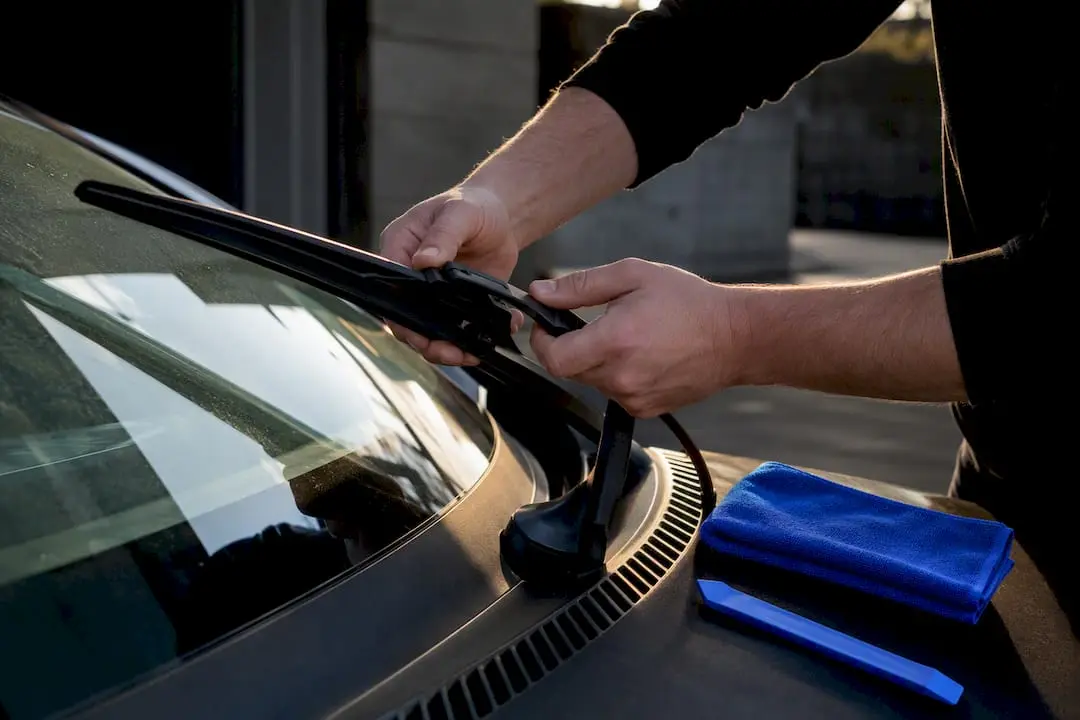
Yes, you can install J hook wiper blades yourself. Most swaps are entirely tool-free once you’ve confirmed the correct size and located the release tab, and both blades usually take a short amount of time together. If a blade has corroded onto the arm, a little lubricant and a steady technique called the safety pivot method will normally free it without any drama.
TL;DR:
- Using the correct size J hook blade is crucial, as even minor measurement errors can result in improper fit and gaps on the windscreen.
- Stuck or corroded adapters often release with lubricant and patient wiggling, but bending or fatigue in the arm require professional inspection.
- Test the new blade’s contact and seating after installation by tugging gently and checking for even pressure or streaking during wipe cycles.
- Proper disposal involves separating rubber from metal and plastic for recycling, avoiding household waste or leaving old blades loose in storage.
- Vehicle-specific tools and preassembled adapters with guarantees can reduce installation errors and ensure a perfect fit for DIYers.
Table of Contents
- What to check before you start a J hook wiper blade install
- Step-by-step installation: removing the old blade and fitting the new J hook blade
- Removing stuck or seized J hook adapters
- Checking, testing and adjusting after installation
- Maintenance tips to make J hook blades last longer
- How to properly dispose of old wiper blades
- Why fitment tools and guarantees matter for DIYers
- GWC Wipers: a straightforward option for a guaranteed fit
- Sources
- FAQ
What to check before you start a J hook wiper blade install
Getting the size wrong is the single biggest reason DIY installs go sideways. Before you touch the arm, measure your old blade end to end or check your owner’s manual, since even a few millimetres out will leave gaps at the edges of the windscreen.
J hook arms aren’t all identical. They come in a couple of common width variants, typically a small 9×3mm hook and a larger 9×4mm hook. This is why most replacement blades ship with universal adapters that snap onto either size. A wiper arm identification guide is worth a quick look if you’re not sure which one is fitted to your car, and our own guide on finding the perfect wiper blade fit walks through measuring properly.
Once you know the size, prep the workspace:
- Park on level ground and switch the ignition off completely.
- Lift both wiper arms to their upright, resting position.
- Lay a folded towel across the base of the windscreen to protect the glass if an arm slips.
- Work in daylight or good light so you can see the release tab clearly.
Step-by-step installation: removing the old blade and fitting the new J hook blade
With the arm up and the towel in place, work through the swap methodically. Rushing this is how people crack a windscreen or bend an arm.
- Unpack and identify. Open the new blades and check which is the driver’s side and which is the passenger’s side. Most kits use different lengths front to back, so don’t assume they’re interchangeable. If an adapter needs preassembling onto the new blade, click it into place now, before the arm is involved.
- Rotate the old blade to 90 degrees. With the arm locked upright, twist the blade so it sits perpendicular to the arm. This exposes the release tab or flip cap underneath the J hook connector.
- Release and slide off. Press the tab (or flip the small locking cap, depending on your brand) and slide the blade down toward the car, away from the arm’s tip. This is the safety pivot method, and it’s the same motion mechanics use because it keeps pressure off the glass rather than levering straight down onto it.
- Fit the new blade’s adapter onto the hook. Line up the J hook opening in the adapter with the curved end of the arm and slide it into position.
- Pull upward until it clicks. You’ll feel (and usually hear) a distinct click when the hook seats fully into the adapter’s channel. If it slides on loosely with no resistance, it hasn’t locked, and it will fly off the first time you run the wipers at speed.
- Lower the arm gently. Don’t let it snap down onto the glass. Guide it down by hand until the blade rests flat against the windscreen.
- Repeat on the other side, then run a test wipe with the washer fluid on to check contact along the full length of the blade.
This sequence lines up with the general consumer steps most manufacturer install guides recommend: lift, release, align, click, test.
Pro Tip: Do the passenger side first. It’s usually easier to reach and gives you a feel for the click before you tackle the driver’s side, where a bad angle can make you second-guess whether it’s seated properly.
Removing stuck or seized J hook adapters
Corrosion is the usual culprit when a blade won’t budge. Road grime, salt air, and months of UV exposure can weld a plastic adapter to a metal hook, especially on cars that live outdoors year-round.
Start gentle and escalate only if you need to:
- Spray silicone lubricant or a penetrating oil like WD40 into the hook joint and leave it 5 to 10 minutes to work in.
- Rotate the blade to the safety pivot position, press the release tab, and slide down while holding the arm steady with your other hand.
- If the release tab has snapped off, use a protected flat tool, wrapped in cloth or tape, to gently pry the plastic adapter away from the hook. Never lever directly against the metal hook itself, since bending it means the whole arm assembly may need replacing.
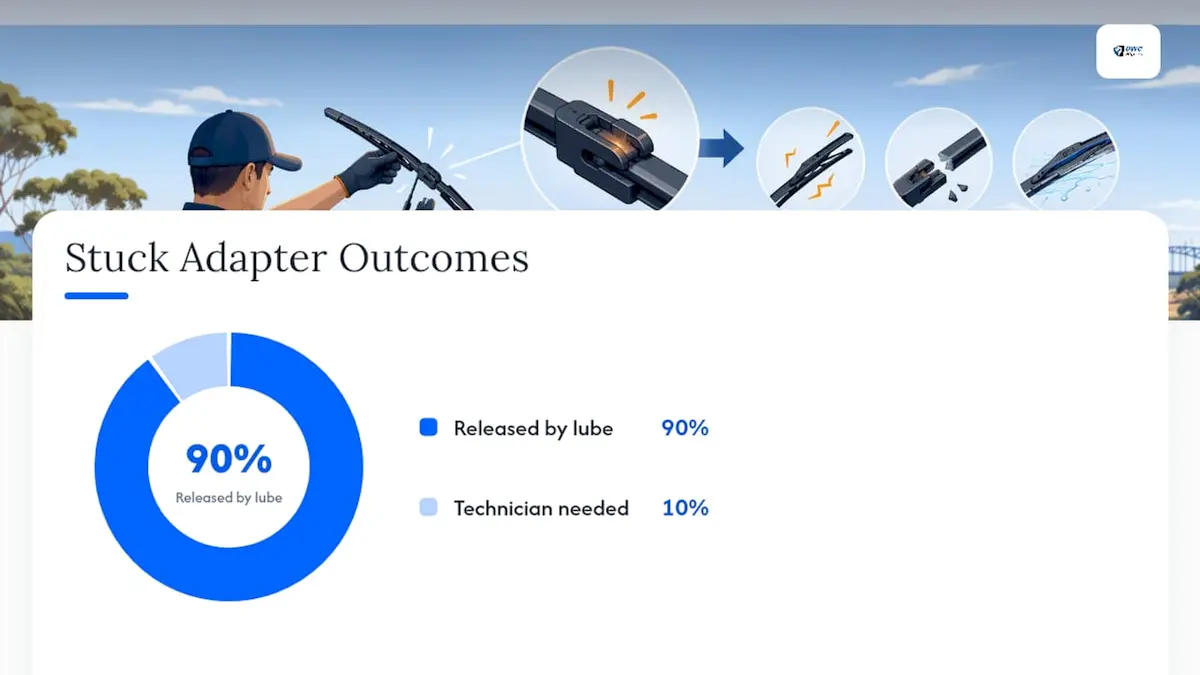
Around 90% of stuck adapters release with lubricant and patient wiggling rather than force. If the arm spring feels fatigued, or you notice the hook has already bent slightly, stop and get a technician to look at the arm rather than risk the windscreen.
Checking, testing and adjusting after installation
A blade that clicks into place isn’t automatically a blade that’s seated correctly. Give it a firm , but gentle tug once fitted; it shouldn’t shift or wobble on the hook.
Run through this quick check:
- Look along the full length of the blade to confirm even contact with the glass, with no gaps or twists.
- Turn on the washer fluid and run the wipers through a few cycles, watching for streaking, lifting at the edges, or chatter.
- If streaking persists on one side only, check that the arm hasn’t been reseated at a slightly different angle than before.
- Persistent chatter across the whole sweep, even with a brand new blade, usually points to a fatigued arm spring rather than the blade itself, and the arm should be replaced.
Maintenance tips to make J hook blades last longer
A wiper blade’s rubber edge degrades faster than most drivers expect, and most of that damage happens sitting still, not while wiping.
- Wipe the rubber edge with a cloth dampened in isopropyl alcohol every month or so to clear grime that causes squeaking and skipping.
- Avoid running wipers on bone-dry, hot glass, since the friction accelerates rubber hardening.
- If the car sits for long stretches in direct sun, lift the blades off the glass to stop the rubber taking a permanent set.
- Check the plastic adapter each season for UV brittleness. Hairline cracks in the adapter are the first sign it’s about to seize onto the hook.
Pro Tip: Set a reminder every six months, roughly when daylight saving changes, to run a hand along the blade edge. If it feels ridged or gritty rather than smooth, it’s already past its best. For broader upkeep, our guide on protecting your windshield wipers covers seasonal care in more depth.
How to properly dispose of old wiper blades
Old wiper blades are a mix of rubber, metal, and plastic, which means they don’t belong in general recycling and shouldn’t just go straight into the household bin without a second thought.
The metal spine and hook fitting inside most blades are usually steel, and many councils accept small metal components at scrap metal drop-off points or through kerbside hard rubbish collections. Some auto parts retailers also run take-back programs for old blades when you purchase replacements, so it’s worth asking at the counter before you leave.
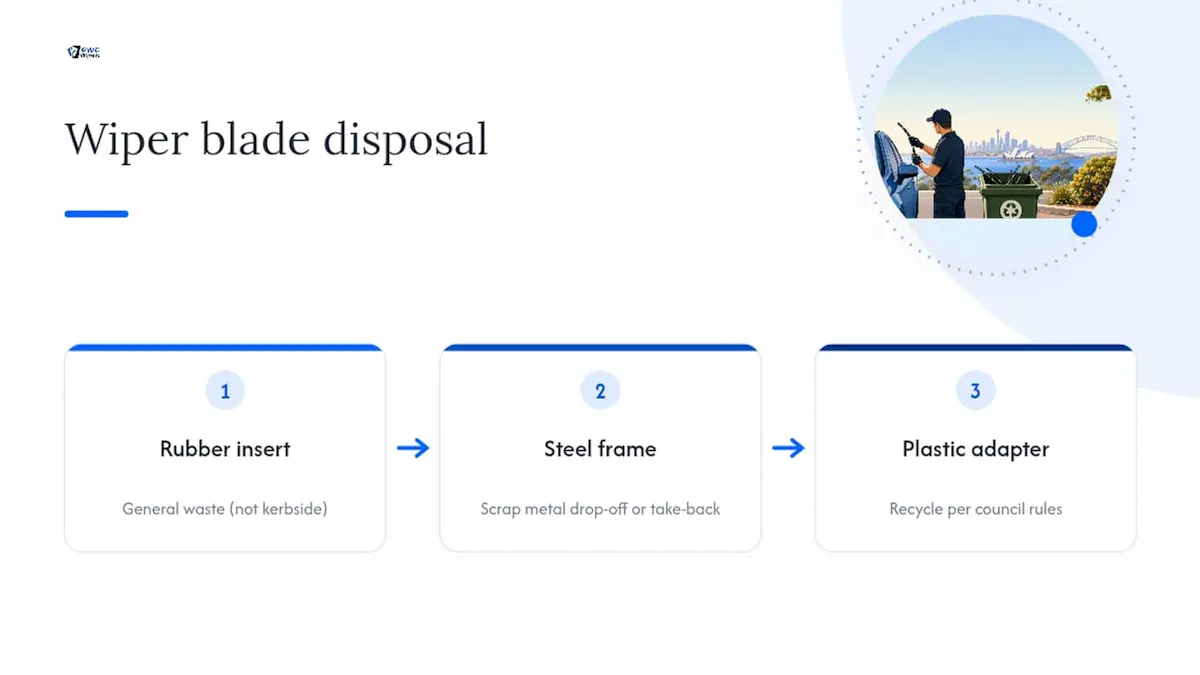
If no metal recycling option is convenient, the safest general approach is to separate what you can. Snap the rubber insert out of the metal frame if the design allows it. Rubber wiper inserts aren’t accepted in most kerbside recycling streams, so that portion typically goes to general waste, while the metal frame and plastic adapter can often be sorted into their respective recycling bins depending on your local council’s rules.
Never leave old blades loose in a garage or shed for years on the assumption you’ll deal with them later. Old rubber degrades and can leach onto other stored items, and loose metal hooks are a genuine cut risk for kids or pets rummaging through a shed. A five-minute sort into the right bins when you finish the install is far easier than a bigger cleanup later.
Why fitment tools and guarantees matter for DIYers
Most people who struggle with wiper blade installs aren’t struggling with the mechanics. They’re struggling because they bought the wrong size in the first place, and no amount of careful pivoting fixes a blade that’s 50mm too long for the arm. A proper vehicle selector tool removes that guesswork entirely by matching blades to your car’s make, model, and year before you ever open the packaging.
Preassembled adapters matter for the same reason. If the adapter is already fitted to the correct J hook size when the blade arrives, there’s one less decision to get wrong on the driveway. A fitment guarantee backed by clear installation guides gives DIYers real confidence going in, rather than hoping a generic universal blade happens to work.
— Faisal
GWC Wipers: a straightforward option for a guaranteed fit
If you’d rather skip the size guesswork altogether, consider a vehicle selector that matches blades to your exact make, model, and year before you buy, so the J hook adapter that arrives is already the right one for your arm.
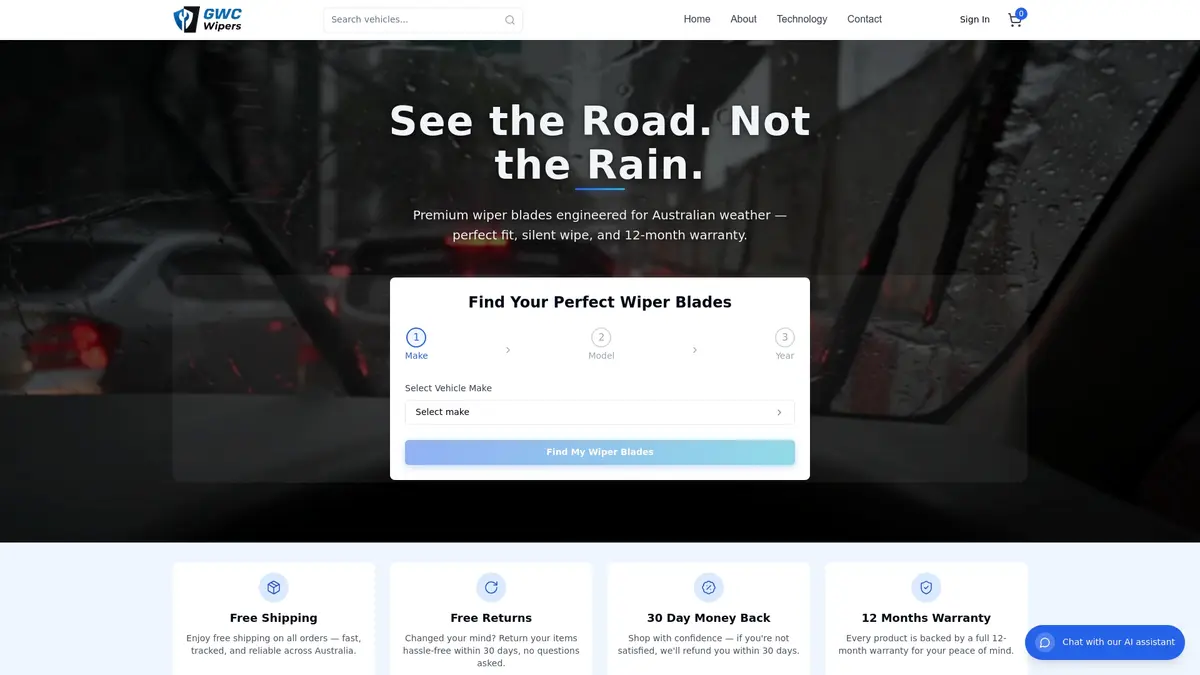
Some blades come with preassembled adapters built for tool-free fitting and may be backed by guarantees and warranties. Shipping may be free in some regions, reducing the risk of ordering the wrong size compared to buying a generic blade from a shelf. Browse the full range of wiper blades to find your vehicle, or head straight to a model page like the Toyota wiper blade range if you already know your make.
Sources
For visual demonstrations, see this
and Rain-X’s J hook removal notes for brand-specific variations.
- Engineerskill
- How to Remove J Hook Windshield Wipers? - Step by Step Instructions - AutoRivet
- How to Install Wiper Blades (Front & Rear Windshields) - wikiHow
- Windshieldwipers
FAQ
How do you attach a J hook windshield wiper?
Slide the new blade’s adapter onto the curved J hook end of the arm and pull upward until you feel or hear a click, confirming the hook has locked into the adapter’s channel.
Are all J hook wipers the same?
No. J hook arms come in different widths, commonly a small 9×3mm and a larger 9×4mm variant, so you need to confirm your arm size before buying a replacement blade.
My J hook wiper blade is stuck. How do I remove it?
Apply silicone spray or penetrating oil, wait 5 to 10 minutes, then use the safety pivot method: rotate the blade to 90 degrees, press the release tab, and slide it down toward the car while holding the arm steady.
How do I remove wiper blades from a Bosch J hook arm?
The process is the same as any standard J hook arm: pivot the blade perpendicular, press the underside release tab, and slide the blade down and off the hook rather than pulling it straight outward.
How much do GWC Wipers J hook blades cost?
Pricing varies by vehicle and blade size, and current prices are listed on the GWC Wipers site once you select your make and model.