
All Climate Wiper Blades for Australia: Fit Beats the Label
The best choice for year-round driving is a premium beam-style, UV-resistant all-climate wiper blade, bought through a vehicle lookup confirming the exact length, curvature and connector for your car. Blade material and fit matter more than price considerations. Start with a vehicle lookup or browse our wiper blades range to find a guaranteed fit.
TL;DR:
- Check driver and passenger lengths separately, then confirm curvature, connector type, included adapter, and a vehicle specific fitment guarantee before ordering.
- For coastal or humid driving, choose a corrosion protected spine; UV treated rubber or silicone helps resist hardening, while beam construction limits debris trapping.
- Older vehicles with framed brackets can use a direct conventional replacement, but choose UV rated rubber; beam blades suit dusty roads and sustained highway speeds.
- Inspect blades every few months and replace them every 6 to 12 months, sooner when outdoor heat exposure brings streaking, chatter, squeaks, or cracked rubber.
Table of Contents
- How weather actually wears out your wiper blades
- What ‘all climate’ wiper blades actually mean
- Beam, conventional or hybrid: which blade type suits your car
- Fitment, sizing and connectors: check these before you buy
- Installing new wiper blades and checking they actually work
- Keeping your wipers working through heat, dust and rain
- Why our fitment tools take the guesswork out of buying
- Why fit still matters more than the climate label
- Get the perfect fit: find your all-climate wipers now
- FAQ
- Sources
How weather actually wears out your wiper blades
Wiper blades fail for predictable reasons, and once you understand them, product labels make a lot more sense. The rubber edge, the tension strip behind it and the metal spine each respond differently to heat, UV, dust and salt, and a blade that handles one stress well might struggle with another.
UV radiation is the biggest long-term enemy. Constant sun exposure causes photo-oxidation, which hardens and cracks the rubber wiping edge over time. Once that happens, the blade can no longer form a flexible seal against the glass, and you start seeing skipped patches and smearing even when the blade still looks intact from a distance.
Heat causes a different kind of damage. On very hot days, dashboard and glass surface temperatures climb well above the surrounding air, and repeated heat cycling can deform the tension strip inside the blade before the wiping edge itself gives out. Technical studies of rubber and coating compounds used in automotive seals confirm that surface coatings can degrade faster than the bulk rubber underneath, and adhesion between the two can fail first under intense UV and thermal cycling, as shown in weathering studies of windowseal compounds. That weakens the spring tension that keeps the blade pressed evenly against the windscreen.
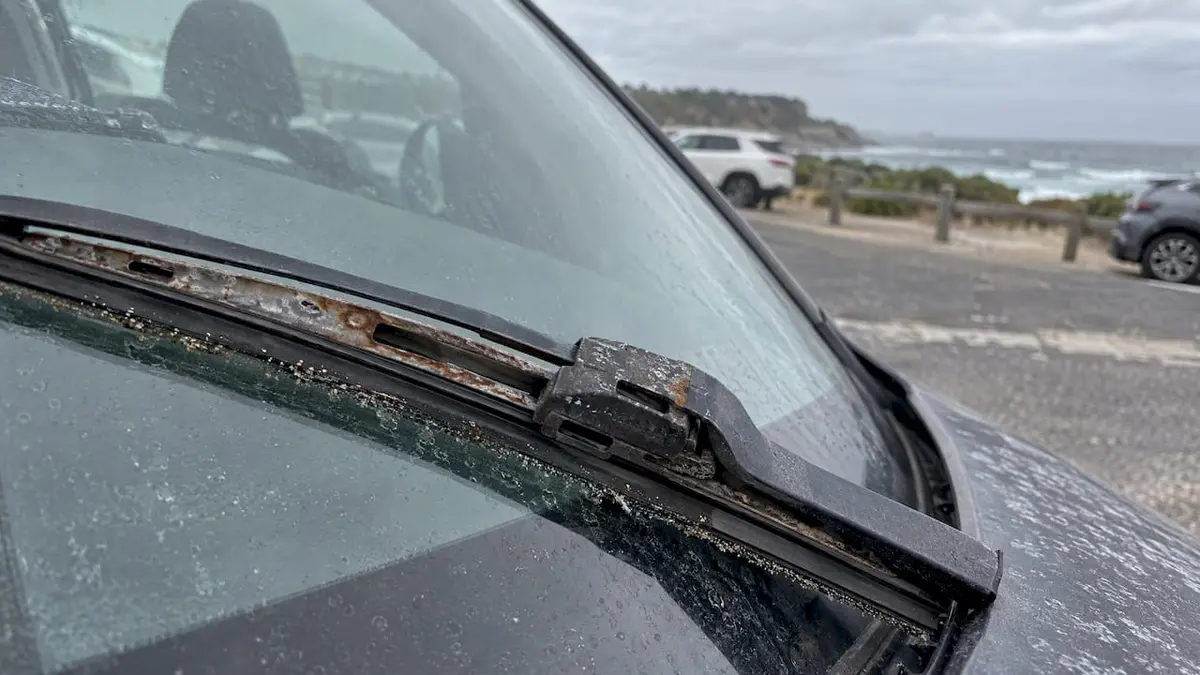
Dust and grit act as an abrasive. Fine particles settle on the glass and get dragged under the blade with every pass, scoring the rubber edge and leaving it uneven. Coastal driving adds a second problem: salt-laden air corrodes exposed metal spines, hinges and connector joints, which is why corrosion resistance matters as much as the rubber compound itself.
Rainfall patterns add a final layer of demand. A blade that barely gets used through a dry stretch, then faces sudden heavy downpours, needs rubber that has not already hardened from sun exposure, plus a design that clears high volumes of water without chatter at speed.
Common failure points to watch for:
- Cracked or hardened rubber edge, usually from cumulative UV exposure rather than age alone.
- Reduced spring tension, often from heat-cycling of the internal tension strip.
- Pitted or scratchy wipe, typically caused by dust and grit trapped under the blade.
- Corroded spine or connector, common in coastal areas with salt exposure.
One documented material science concern: UV and thermal ageing drive surface-level degradation in automotive rubber and coating components, according to thermo-analytical research on automotive seal materials, which means visible cracking is usually a late-stage symptom of damage that started much earlier.
What ‘all climate’ wiper blades actually mean
“All-climate” and “all-weather” aren’t just marketing labels. They describe a specific set of material and design choices built to survive heat, UV, rain and dust without the rapid performance drop you get from a basic economy blade.
The starting point is the rubber compound itself. UV-resistant rubber treatments, and in some cases silicone-based compounds, slow down the hardening and cracking process that ordinary rubber suffers under constant sun. This is the single feature that most affects how long a blade stays flexible and quiet.
Corrosion protection is the second pillar. A coated or stainless spine resists the salt and moisture that eat away at cheaper metal components, which matters most if you’re near the coast or drive through humid, tropical conditions regularly.
Structurally, the features that separate a genuinely all-climate blade from a basic one include:
- One-piece beam construction, which flexes evenly along the windscreen’s curve instead of relying on separate brackets that can trap debris.
- Aerodynamic spoiler profiles, which keep the blade pressed down at highway speed instead of lifting off the glass.
- Segmented pressure distribution, spreading contact force evenly across the blade length so no single section wears faster.
- Preassembled adapters, which simplify fitting the blade to your specific connector type without separate clips.
Our guide to blade types suited to local conditions breaks down how these features perform when beam-style construction is compared against older framed designs, and the pattern holds regardless of climate. Fewer moving parts, less debris trapping and more consistent pressure.
When you’re comparing listings, look past the word “all-weather” itself and check for three concrete signals: a stated warranty period, a fitment guarantee tied to your specific vehicle, and some reference to testing against heat, UV or rain performance. A blade that only says “universal fit” with no other detail is usually the cheaper, less climate-tolerant option.
Pro Tip: Check whether the product page names the rubber type (natural rubber, silicone or a UV-treated compound) rather than just calling it “all-weather”: vague wording is often a sign the blade uses standard rubber with no special treatment.
Beam, conventional or hybrid: which blade type suits your car
Three basic architectures cover almost every vehicle on the road, and the right one depends less on brand and more on how your windscreen is shaped and how hard you drive.
- Beam (flat) blades use a single curved strip of spring steel encased in rubber, with no external frame. They flex continuously along the glass, which avoids the debris-trapping gaps that plague bracket-style designs and keeps pressure even across the full length.
- Conventional framed blades use a jointed metal bracket holding several smaller rubber segments. They’re often cheaper and still common as factory-fit on older vehicles, but the joints are exactly where dust, ice and corrosion first cause problems.
- Hybrid blades combine a beam-style profile with an aerodynamic cover, aiming to get beam performance with a slightly sturdier housing. They suit drivers who want beam-level contact but prefer a more rigid-feeling blade.
For most everyday driving, a beam-style blade is the stronger choice because it copes better with dust, heat and heavy rain without the trapped-grit problem that framed blades develop over a season or two, a point we expand on in our comparison of blade types for local conditions.
A simple way to decide: if you drive mostly in dusty rural areas or at sustained highway speed, prioritise beam blades for their aerodynamic stability. If your vehicle is older and still uses a basic framed bracket, a direct conventional replacement is often fine, provided the rubber itself is UV-rated.
Fitment, sizing and connectors: check these before you buy
Getting the blade length and connector right matters as much as the rubber compound. A blade that’s even slightly too long can hit the windscreen trim or mirror housing, and one with the wrong curvature radius will streak no matter how good the material is.
Driver and passenger blades are frequently different lengths, and sometimes different curvatures too, since windscreens aren’t symmetrical and wiper arms pivot at different points. Never assume both sides take the same size without checking.
Connector type is the other variable that trips people up. Common types include:
- Hook (J-hook) connectors, the most widespread fitting, recognisable by a simple curved hook at the arm end.
- Pin-type connectors, which use a small pin through a hole in the arm, common on some European models.
- Side-pin or push-button connectors, often found on newer vehicles with a button release on the arm itself.
- Bayonet connectors, a flat push-fit style common on certain hatchbacks and SUVs.
Guessing the connector from memory is risky, because manufacturers sometimes change the fitting partway through a model’s production run. The safer approach is to use a vehicle lookup tool that matches length, curvature and connector to your specific make, model and year in one step, which is exactly what our vehicle selector is built to do. Our sizing guide and fitment walkthrough cover measurement basics if you’d rather check manually first.
Before you buy, confirm the product page explicitly states that an adapter is included for your connector type and that the listing carries a fitment guarantee, not just a generic size range.
Installing new wiper blades and checking they actually work
Fitting a new blade takes a few minutes once you know the connector type, and a couple of quick checks afterward will confirm it’s seated properly before you rely on it in wet weather.
- Lift the wiper arm away from the glass and engage the safety clip or prop if your vehicle has one, so the arm doesn’t snap back onto bare glass.
- Release the old blade by pressing the small tab or sliding clip at the connector point, then slide it out along the arm.
- Slide the new blade onto the arm until the connector clicks or locks into place, checking it sits flush and doesn’t wobble side to side.
- Lower the arm gently back onto the glass, rather than letting it drop, to avoid cracking the windscreen or bending the arm.
- Run the wipers at low speed first, checking for a smooth, even sweep with no gaps or juddering.
- Check at highway speed (safely, on a straight stretch) for any lifting or fluttering at the top of the arc, which usually points to incorrect tension or a mismatched curvature.
If you notice streaking straight after fitting, the adapter may not be fully seated: reseat it firmly until it clicks, and if the issue persists, check whether your vehicle needs an alternate connector type before assuming the blade itself is faulty.
Pro Tip: Always test wipers with the windscreen wet, either with washer fluid or a light hose-down: a dry test can hide minor streaking that only shows up under real rain.
Keeping your wipers working through heat, dust and rain
Wiper blades aren’t a set-and-forget part. A routine check every few months catches problems before they affect your visibility in heavy rain.
As a general rule, replace wiper blades on a 6 to 12 month schedule, since rubber components degrade under UV and heat regardless of how many kilometres you’ve driven. Watch for these signs that mean immediate replacement rather than waiting out the schedule:
- Streaking or smearing across the glass, even with plenty of washer fluid.
- Chattering or squeaking, which usually means the rubber has hardened or the tension strip has lost its even pressure.
- Visible cracks or splits in the rubber edge, which won’t seal properly no matter how new the rest of the blade looks.
- Torn or lifting edges, often from a blade left to bake under direct sun for extended periods.
Public safety guidance specifically recommends replacing blades that shudder, streak or show deteriorated rubber, noting that summer heat accelerates the wear that shows up once wet-weather driving increases. Where you can, park under cover during long hot stretches, use a washer fluid rated for your climate rather than plain water, and clean the blade edge with a damp cloth occasionally to clear grit before it scores the rubber. For a streak-free glass finish alongside new blades, Diamondbrite’s glass cleaning guidance covers ceramic-based cleaning products that reduce water-spotting between wiper passes.
There’s also a roadworthiness angle worth knowing. Under vehicle standards guidance, wipers and washers must operate correctly and prevent dirt or moisture from obscuring the driver’s view, which means a failing blade can affect the outcome of a standard vehicle inspection, not just your comfort behind the wheel.
Why our fitment tools take the guesswork out of buying
We built our vehicle lookup specifically so you never have to guess at length, curvature or connector type. Enter your make, model and year, and the result is a blade matched to your exact specifications, the same approach you’ll find on our Toyota fitment hub, one of more than 2,500 vehicle profiles we cover.
We offer a fitment guarantee, a warranty, shipping across the country, and a money-back guarantee if the blade isn’t right. For customers fitting their own blades, our site includes step-by-step installation guides matched to your specific connector type, alongside rubber compounds and spine protection designed around harsh heat, UV and rain.
Why fit still matters more than the climate label
The feature that gets the least attention in most buying advice is also the one that causes the most returns: curvature and connector match. Marketing around UV resistance and beam construction is genuinely useful, but a perfectly engineered blade still streaks if its radius doesn’t suit your windscreen.
Readers also tend to treat replacement timing as fixed, waiting a full year regardless of conditions. Heat exposure and dust load vary enormously between a garaged city car and a vehicle parked outdoors in direct sun daily, so the 6 to 12 month window should shift toward the shorter end if your car bakes outside most of the year.
If you take one thing from this, prioritise fitment accuracy first, material quality second. A slightly less premium rubber compound on a correctly sized, correctly curved blade will outperform a premium compound forced onto the wrong radius.
— Faisal
Get the perfect fit: find your all-climate wipers now
Choosing a premium, UV-resistant beam blade solves most of the problems heat, dust and rain throw at your windscreen, but none of it matters if the length, curvature or connector doesn’t match your car.
That’s why we built a vehicle lookup instead of a generic size chart. Enter your make, model and year, and we’ll show you blades guaranteed to fit, backed by a 12-month warranty and a 30-day money-back guarantee if something’s not right.
- Use the GWC vehicle lookup to match your exact make, model and year.
- Check a specific fitment hub, such as Toyota wiper blades, to see matched products in action.
Orders ship with a guaranteed fit on the blade you choose.
FAQ
What are the best all-weather wiper blades?
The best all-weather blades are beam-style (flat) designs made with UV-resistant rubber and a corrosion-protected spine, since this combination resists cracking from sun exposure and holds consistent pressure through heavy rain. Look for a product that also carries a fitment guarantee for your specific vehicle, not just a generic size claim.
What are the best wiper blades for hot climates?
For hot climates, prioritise blades with UV-treated rubber or silicone compounds, since standard rubber hardens and cracks faster under sustained sun exposure. A one-piece beam design with a protected tension strip also holds up better against the heat cycling that weakens spring pressure over time.
What is the longest lasting wiper blade brand?
No single brand holds a universally agreed title for longest-lasting, since blade life depends heavily on rubber compound, correct fitment and local climate exposure. As a general guide, replacing blades every 6 to 12 months regardless of brand keeps performance consistent, with premium UV-resistant rubber and beam construction extending usable life within that window.
How do I know if my wiper blades need replacing?
Streaking, chattering, squeaking or visible cracks in the rubber edge are all signs that replacement shouldn’t wait for the usual schedule. Public safety guidance also notes that summer heat accelerates wear heading into wetter months, so a check before the rain sets in is worthwhile.
How do I choose the correct wiper blade size and connector?
The safest method is a vehicle lookup that matches length, curvature and connector type to your make, model and year in one step, since connectors like hook, pin, side-pin and bayonet fittings vary even within the same manufacturer’s range. Our vehicle selector checks all three at once, and our sizing guide covers manual measurement if you prefer to check yourself first.
Sources
- How to change wiper blades | RACQ
- VSI 26 - Roadworthiness requirements - Transport Victoria
- Drive safely this winter | Safe Transport Victoria