
Choosing car accessories for rain: what Aussie drivers need

Before you drive into a downpour, three things matter most: your wiper blades, your tyre tread, and your headlights and demister. Get those right and you have addressed the majority of wet-weather risk. Skip them and no amount of floor mats or boot liners will keep you safe.
Check these right now:
- Wiper blades: Inspect for streaking, skipping, or cracked rubber. Replace if they are older than 12–18 months or showing any of those signs. GWC Wipers covers over 2,500 Australian vehicle models with a fitment guarantee.
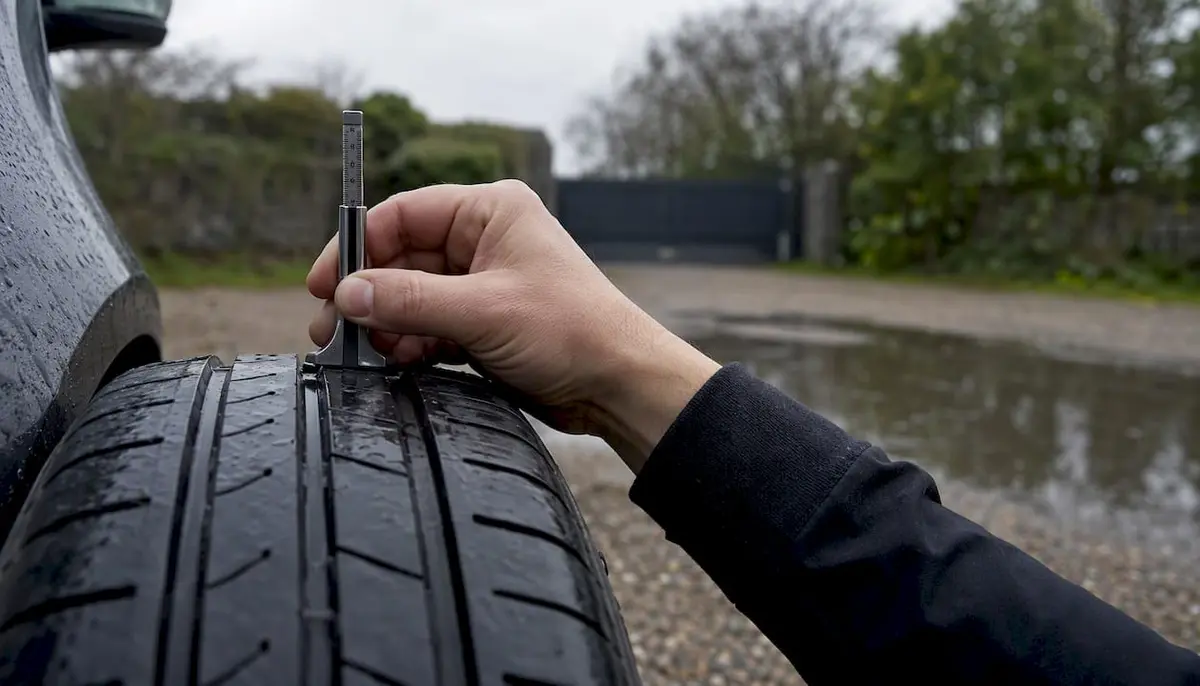
- Tyre tread and pressure: Queensland road safety guidance requires at least 1.5 mm of tread across the full tyre width. Check pressure when tyres are cold.
- Headlights, fog lights, and demister: Test all bulbs and run your demister for 60 seconds before you leave.
Ballpark costs in Australia: quality wiper blades run roughly $30–$80 per pair; a tyre pressure gauge costs under $20; replacement headlight globes start around $15–$40 each.
Key takeaways
Replacing worn wiper blades, maintaining tyre tread above 1.5 mm, and testing your lights and demister before wet weather are the three actions that most reduce wet-weather driving risk for Australian drivers.
| Point | Details |
|---|---|
| Replace wipers regularly | Replace wiper blades regularly or at the first sign of streaking or skipping. |
| Maintain tyre tread | Keep tread above 1.5 mm across the full width; check pressure monthly when tyres are cold. |
| Test lights and demister | Confirm all globes work and the demister clears glass fully before driving in rain. |
| Know when to stop | Pull over when lane markings are obscured or you cannot see past your bonnet. |
| GWC Wipers fitment guarantee | Use the GWC Wipers vehicle selector for correct fitment across 2,500+ Australian models, backed by a 30-day money-back guarantee and 12-month warranty. |
Table of Contents
- Why the right rain accessories matter on Australian roads
- Essential rain-ready accessories: what to buy, what it costs, and how long it lasts
- How to choose the right wiper blades for your car
- Maintenance schedule and a quick pre-trip checklist
- When should you slow down, pull over, or abandon the trip?
- Buying rain accessories in Australia: what to check before you order
- Why wiper quality is the one upgrade worth prioritising
- GWC Wipers: built for Australian rain
- Sources
- FAQ
Why the right rain accessories matter on Australian roads
Australia’s rain is not gentle or predictable. A Brisbane storm can drop 50 mm in under an hour. Coastal drivers deal with salt spray that corrodes fittings. Inland drivers face dust-caked windscreens that smear the moment rain hits. Each of these conditions degrades your accessories faster than the manufacturer’s baseline assumes.
Living Smart’s wet-weather guidance highlights a risk most drivers underestimate: the first few minutes after rain starts following a dry spell are the most dangerous. Oil, dust, and grime rise to the surface and create a slick film before water washes it away. Worn wipers smear that film across your windscreen instead of clearing it.
The practical consequences are real:
- Stopping distances increase significantly on wet roads, and degraded tyres or worn wipers compound that.
- Aquaplaning can occur at highway speeds when tread depth is insufficient to channel water away from the contact patch.
- Poor demister function fogs the inside of your windscreen within minutes of rain starting, cutting forward visibility to near zero.
NSW Government road safety advice recommends turning on headlights or daytime running lights in poor visibility and using demisters proactively, not reactively.
Essential rain-ready accessories: what to buy, what it costs, and how long it lasts
The shortlist for wet-weather readiness is shorter than most people expect: wiper blades, tyres in good condition, working lights and fog bulbs, a rain-repellent windscreen coating, an anti-fog treatment for the interior glass, and a basic emergency kit.
| Accessory | Replace or check when | Minimum standard | Quick-buy priority |
|---|---|---|---|
| Wiper blades | Every 12–18 months or at first streak | AS/NZS-compliant, correct fitment | High |
| Tyres | Tread below 1.5 mm or pressure off spec | 1.5 mm tread across full width | High |
| Headlights/fog bulbs | Any globe out or dim | All globes working | High |
| Rain-repellent coating | Every 3–6 months | Beading visible on glass | Medium |
| Interior anti-fog treatment | Every 2–3 months | No fogging within 2 min of demister | Medium |
| Emergency kit | Check annually | Torch, power bank, hi-vis, first aid | Medium |
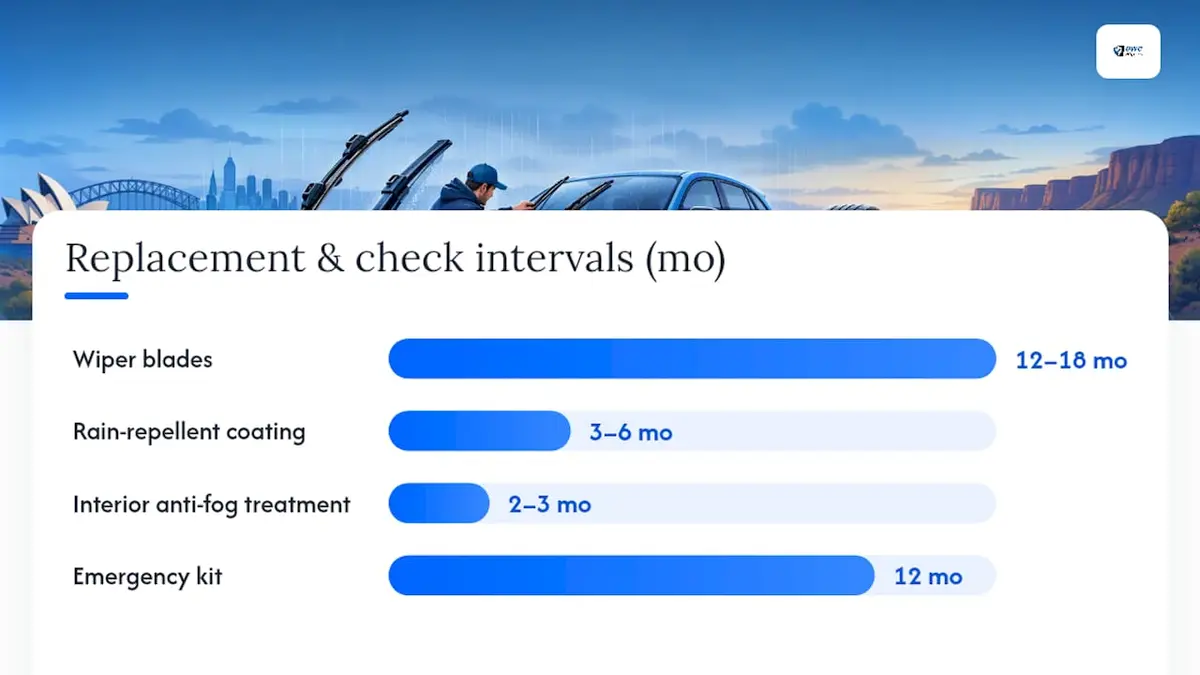
Wiper blades are the highest-priority purchase. AS/NZS-compliant blades with correct fitment are the standard to meet in Australia, where UV and heat degrade natural rubber faster than in cooler climates. Budget $30–$80 for a quality pair; premium blades with aerodynamic housings sit toward the top of that range and hold up better at highway speeds. The lifecycle value of premium wipers is measurable: a blade that lasts 18 months costs less per month than a cheap one replaced every six.
Tyres are not an accessory you buy on impulse, but checking tread and pressure costs nothing and takes two minutes. Properly inflated tyres with adequate tread are the single biggest factor in aquaplaning resistance.
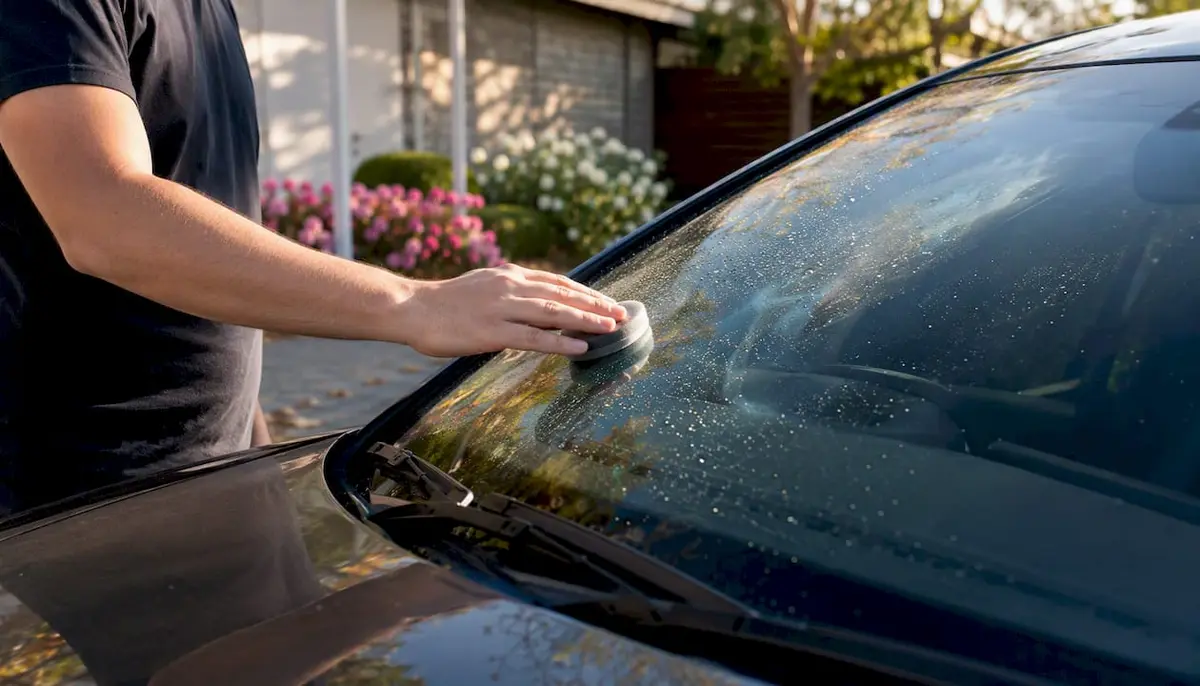
Rain-repellent coatings (products like Rain-X or equivalent) bond to the glass and cause water to bead and roll off at speed. They do not replace wipers but meaningfully reduce how hard wipers have to work. Reapply every three to six months, more often in coastal areas where salt spray breaks down the coating faster.
How to choose the right wiper blades for your car
The most important decision when choosing car accessories for rain is matching wiper blade fitment and type to your specific vehicle. A blade that is 10 mm too long, or fitted with the wrong adapter, will skip, lift at speed, or damage the wiper arm.
Step 1: Confirm your vehicle’s year, make, and model. Use a vehicle fitment selector (GWC Wipers’ selector covers over 2,500 models) to identify the correct blade length for both driver and passenger sides. These are often different lengths.
Step 2: Choose the blade type. Three types are common in Australia:
- Conventional (framed) blades suit older vehicles and are the most affordable. They can accumulate grit under the frame in dusty conditions.
- Beam (bracketless) blades use a pre-tensioned curve to maintain even pressure across the windscreen. They perform better in heavy rain and resist clogging with debris.
- Hybrid blades combine a protective shell with an internal frame, offering good all-weather performance and reasonable durability against UV.
Step 3: Check adapter compatibility. Modern vehicles, particularly those with ADAS safety systems, require precise blade positioning. Preassembled adapters that click directly onto your wiper arm remove the guesswork and reduce the risk of installation errors that could affect sensor calibration.
Step 4: Verify the fitment guarantee. A fitment guarantee means the supplier will replace or refund a blade that does not fit your vehicle as specified. That is the safety net that makes online purchasing reliable.
Pro Tip: Replace both blades at the same time, even if only one is visibly worn. Blades age at the same rate, and a new blade paired with an old one will produce uneven clearing. Run a quick walk-around test after fitting: spray the windscreen and run the wipers through three full cycles, checking for streaks, skipping, or lifting at the edges.
For more on clear visibility in rain, the GWC Wipers expert advice blog covers blade selection and maintenance in detail.
Maintenance schedule and a quick pre-trip checklist
The simplest habit that improves wet-weather safety is a monthly wiper and tyre check. Most blade failures are predictable: rubber hardens, splits, or lifts at the edges weeks before it stops clearing properly.
Monthly checks:
- Run wipers on a wet windscreen and watch for streaks or skipping.
- Check tyre pressure (cold) and inspect tread depth visually or with a gauge.
- Test all exterior lights including fog lights.
- Run the demister for 60 seconds and confirm it clears the glass fully.
Seasonal checks (before storm season):
- Top up windscreen washer fluid with a quality concentrate, not plain water.
- Reapply rain-repellent coating to the windscreen and side windows.
- Inspect wiper blades for cracking or hardening, and replace if in doubt.
- Check the winter car care checklist for a full pre-season run-through.
Pre-trip checklist (under 60 seconds):
- Wipers: run a quick test on a damp windscreen.
- Tyre pressure: visually check for any obviously flat or low tyre.
- Lights: walk around the car and confirm all lights are working.
- Demister: switch on and confirm it is clearing.
- Washer fluid: check the reservoir level.
Emergency kit for storm season (based on Living Smart’s recommendations): torch, phone power bank, first-aid kit, hi-vis vest, compact umbrella, and a towel. Keep them in the boot year-round.
When should you slow down, pull over, or abandon the trip?
If you cannot see lane markings or the road ahead past your bonnet, stop at a safe place immediately. That is the clearest threshold Australian road authorities consistently apply.
Immediate actions in deteriorating conditions:
- Reduce speed progressively; do not brake hard on a wet surface.
- Switch to low-beam headlights (not high beam, which reflects off rain and reduces your own visibility).
- Increase following distance. RACV recommends adding at least one second to your normal following distance in rain, and more in heavy downpours.
- Turn on hazard lights only when stationary or moving dangerously slowly, not as a general rain indicator.
- Pull off the road completely if visibility drops to near zero. Wait for conditions to improve.
- Never drive through floodwater. The depth is impossible to judge from inside a vehicle.
NRMA advises switching off cruise control the moment rain starts. The system cannot detect grip loss and may hold speed through a puddle that causes aquaplaning.
Safety note: Queensland road safety guidance recommends doubling your following distance in wet conditions and maintaining at least 1.5 mm of tread across the full tyre width to reduce aquaplaning risk.
Buying rain accessories in Australia: what to check before you order
Prioritise fitment guarantee, AS/NZS compliance, and clear returns terms when buying rain accessories online. Those three criteria separate reliable suppliers from ones that leave you with a blade that does not fit and no easy path to a refund.
Buying safeguards checklist:
- Use a vehicle fitment selector before adding anything to your cart.
- Confirm free shipping thresholds (GWC Wipers ships free across Australia).
- Check for a 30-day money-back guarantee and a 12-month warranty on wiper blades.
- Read the returns process for wrong fitment specifically, not just general returns.
- For remote areas, confirm stock is held locally or that express shipping is available before storm season.
Regional considerations: Coastal drivers should choose blades and fittings with corrosion-resistant housings. Salt spray accelerates metal fatigue in conventional framed blades, which is one reason beam or hybrid designs often outlast conventional blades in Queensland, WA, and NSW coastal zones. In northern Australia, UV exposure is intense enough to degrade rubber in under 12 months; inspect blades every six months rather than annually.
On delivery, check: packaging is intact, the correct adapters are included, and an installation guide is present. GWC Wipers includes preassembled adapters and a guide with every set.
Before fitting new blades, it is worth inspecting your windscreen for chips or cracks. A damaged screen affects how cleanly a blade wipes and may need attention first; signs your windscreen needs replacement are worth reviewing if you have any doubt.
Why wiper quality is the one upgrade worth prioritising
High-quality wiper blades are the single best purchase you can make to improve your wet-weather survival odds. The reasoning is straightforward: visibility is the first thing that fails in heavy rain, and wipers are the only active system dedicated to maintaining it. Tyres and lights matter enormously, but they are passive or static. Wipers are working continuously, clearing the one surface you depend on to see the road.
Cheap blades skip, streak, and lift at highway speeds, precisely when you need them most. A blade built with natural rubber, advanced segmented pressure distribution, and an aerodynamic housing maintains contact across the full sweep even at 110 km/h in a downpour. GWC Wipers’ fitment guarantee and 12-month warranty mean you are not gambling on whether the blade suits your vehicle.
GWC Wipers: built for Australian rain
GWC Wipers is the practical choice for Australian drivers who want reliable wet-weather performance without the uncertainty of generic blades. Every set is designed and tested for Australian conditions, from coastal salt spray to inland UV and dust, and covers over 2,500 vehicle models with a perfect-fit guarantee.
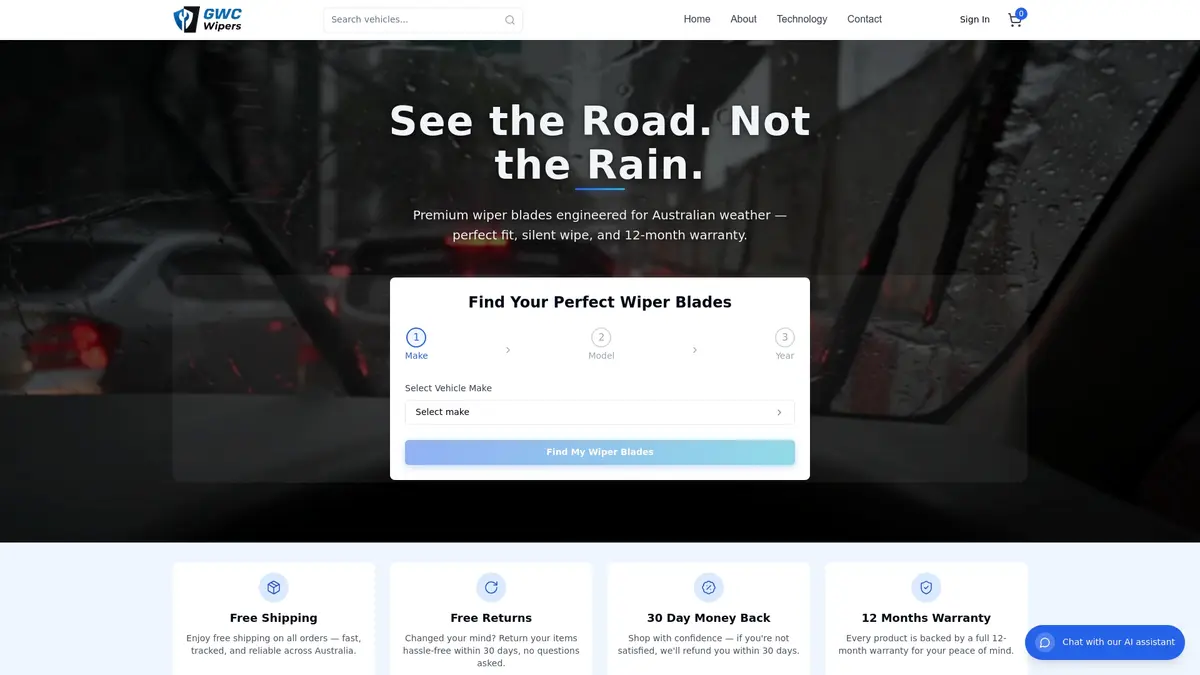
The vehicle selector on the GWC Wipers site identifies the correct blade length and adapter for your make, model, and year in seconds. Blades arrive preassembled with adapters and an installation guide, so fitting them yourself takes under five minutes. Every purchase includes free shipping across Australia, a 30-day money-back guarantee, and a 12-month warranty.
Whether you drive a Land Rover Discovery Sport or a Toyota, the right blade is listed and ready to ship. Check your fitment and order at GWC Wipers before the next storm arrives.
Sources
- Qld
- Driving in poor visibility conditions: safety tips for rain, fog, snow and sun glare | RACV
- Welcome to the Living Smart Program | Welcome to the Living Smart Program
- Tips for driving safely in the rain
For vehicle fitment, use the selector at Gwcwipers. For urgent flood or road closure information, contact your state road authority or check Live Traffic NSW, Queensland Traffic, or VicRoads.
FAQ
How often should I replace my wiper blades in Australia?
Replace wiper blades every 12–18 months in Australian conditions. UV, heat, and dust degrade rubber faster here than in cooler climates, so inspect blades every six months if you live in a northern or coastal region.
Do rain guards and repellent coatings actually work?
Yes. Rain-repellent coatings cause water to bead and roll off the glass at speed, reducing how hard your wipers have to work. They do not replace wipers but noticeably improve visibility in light to moderate rain.
What should I do if visibility drops suddenly while driving?
Slow down, switch to low-beam headlights, increase your following distance, and pull over safely if you cannot see lane markings. RACV advises pulling over and waiting rather than driving through near-zero visibility.
What is the minimum legal tyre tread depth in Australia?
The legal minimum is 1.5 mm across the full width of the tyre, as specified by Queensland road safety guidance and consistent with national standards. Below that threshold, wet-weather traction and aquaplaning resistance drop sharply.
Can I fit wiper blades myself?
Yes. Most modern wiper blades, including those from GWC Wipers, come preassembled with adapters and an installation guide. Fitting takes under five minutes and requires no tools for the majority of Australian vehicles.