
Replace Wipers in 15–30 Minutes: Cyclone Season Car Prep in Australia
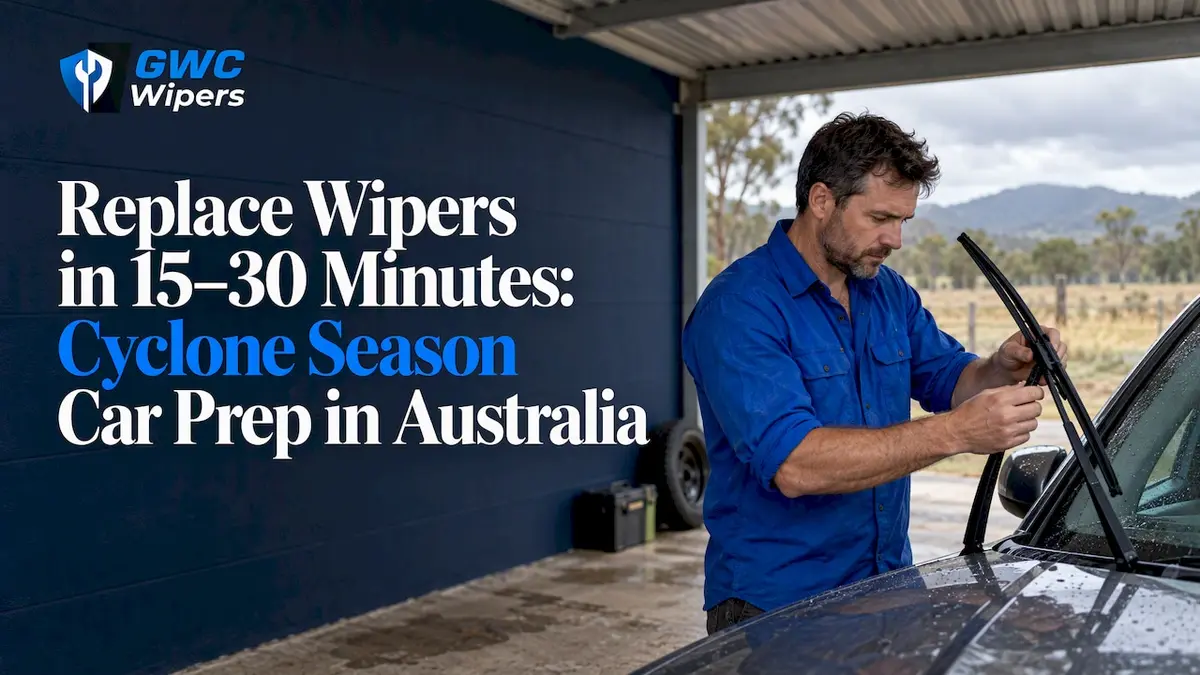
Clear visibility, sound tyres and avoiding floodwater are the three priorities for cyclone season car prep, and none of them cost much time to sort. Australia’s official tropical cyclone season runs from 1 November to 30 April, with the Bureau of Meteorology tracking watches and warnings throughout. Before any of that matters, remember the simplest rule going: if it’s flooded, forget it.
TL;DR:
- Replace both wiper blades together, confirm the correct fit for your vehicle, and clear interior mist with air conditioning and cold air.
- RACQ recommends at least 3 millimeters of tread to reduce aquaplaning risk; wet roads can increase stopping distances by more than 20%.
- Just 15 centimeters of flowing water can move a small car, and 60 centimeters can float one away; never drive through floodwater.
- Use a garage or solid carport; if neither is available, avoid trees, powerlines, and low ground, moving the car uphill before water rises.
- Comprehensive policies often cover storm damage, but flood exclusions vary; photograph the car before and after a cyclone, and keep repair and towing receipts.
Table of Contents
- Quick pre-cyclone checklist you can complete in 15 to 30 minutes
- Visibility first: windscreens, wipers and demisting for heavy rain
- Tyres, brakes and aquaplaning: avoid losing grip in heavy rain
- Battery, fuel and fluids: what to top up and test before a storm
- Parking and physical protection: where and how to shelter your car
- On the road during a cyclone or severe storm: safety-first driving rules
- Vehicle emergency kit: what to pack for cyclone season
- How to pick the right wiper blades for storm season using the GWC vehicle lookup
- Post-cyclone safety checks before you drive again
- Insurance considerations for cyclone damage and what to document
- Alternative transport and evacuation planning if your car can’t be used
- Protecting your car’s exterior from heavy rain and debris
- Everyday steps fleet and private drivers can adopt
- Perfect-fit wiper blades and quick fitment with GWC Wipers
- FAQ
- Sources
Quick pre-cyclone checklist you can complete in 15 to 30 minutes
Most of what keeps you safe on the road during storm season takes less time to check than it does to read about. Walk around your car with this list before the first warning lands.
- Replace worn or streaking wiper blades and top up washer fluid.
- Check tyre tread, pressure and overall condition, including the spare.
- Test headlights, brake lights and battery charge.
- Top up fuel so you’re not caught short if roads close.
- Park under cover where possible and secure anything loose nearby.
- Pack a basic emergency kit and save local emergency numbers in your phone.
Each of these gets its own closer look below, starting with the one that affects every other decision you make behind the wheel in heavy rain: whether you can actually see.
Visibility first: windscreens, wipers and demisting for heavy rain
Everything else in a storm, your speed, your following distance, your reaction time, depends on being able to see the road. RACQ’s storm-season guidance puts windscreen wipers and headlights at the top of its pre-season checklist, and for good reason: a worn blade turns heavy rain into a smeared, strobing mess exactly when you need clarity most.
- Run a finger along each blade’s edge, checking for cracks, splitting rubber or a bent frame, then do a sweep test with the washers on to spot streaking or skipping.
- Confirm your blades are the correct length and fitment for your exact vehicle, since an ill-fitting blade chatters, lifts at speed or leaves dry patches no matter how new it is.
- Use the GWC vehicle lookup to match your make, model and year automatically, which removes the guesswork that leads most drivers to buy the wrong size.
- Top up washer fluid with a proper screenwash mix rather than plain water, and consider a rain repellent or anti-fog treatment on the inside of the glass, applied as described in anti-fog application guidance for best results.
- When the inside of the windscreen starts misting up, switch the air conditioning on, point vents at the glass and use cold air rather than heat to clear it fastest.
If you drive a common Australian ute or SUV, model-specific fitment pages such as the Toyota HiLux wiper blades hub take the guesswork out of sizing entirely. For more on keeping glass clear once you’re moving, our car visibility checklist covers the broader routine.
Pro Tip: Replace both wiper blades together, even if only one looks worn. Rubber degrades at a similar rate on both sides once it’s exposed to the same UV and heat.
Tyres, brakes and aquaplaning: avoid losing grip in heavy rain
Tyres are your only contact with the road, and in a downpour that contact shrinks fast. State guidance recommends a minimum tread depth of 1.5 to 3 millimetres for safe wet-weather driving, while RACQ goes further, recommending at least 3 millimetres to meaningfully reduce aquaplaning risk. You can check this yourself with a tread depth gauge, or the simpler coin test: insert a coin into the tread groove and see how much of it stays hidden.
- Check tread depth on all four tyres, including the spare, and replace any tyre below the recommended minimum.
- Worn tyres lose their ability to channel water away from the contact patch, which is what causes aquaplaning at speed.
- Test your brakes in a safe, empty area, listening for grinding or feeling for pulling to one side, and act on either sign immediately.
- Drop cruise control in wet conditions, reduce your speed and increase your following distance, since stopping distances can increase by more than 20% on wet roads, reaching around 85 metres at 80 km/h.
Battery, fuel and fluids: what to top up and test before a storm
A car that won’t start is no help during an evacuation, so the mechanical basics deserve a proper look before storm season sets in.
- Check your battery’s age and terminal condition, and have it load-tested if it’s more than three or four years old or showing slow cranking.
- Keep your fuel tank topped up through the season rather than running low, since fuel stations can lose power or close entirely during a cyclone.
- Check coolant, brake fluid and washer fluid levels, topping each up to the marked line with the correct fluid type for your vehicle.
- If you notice unusual electrical faults, warning lights or fluid leaks, get a mechanic to look at it before the season starts rather than during a warning.
Parking and physical protection: where and how to shelter your car
Where you park matters just as much as how well you’ve prepped the car itself. Trees, powerlines and low-lying ground all turn ordinary parking spots into hazards once wind and rain pick up.
- Park in a garage or solid carport whenever you can, since this is the safest option against falling branches, hail and flying debris.
- Never park under or near trees or powerlines, as state emergency guidance warns that both pose a serious risk during high winds.
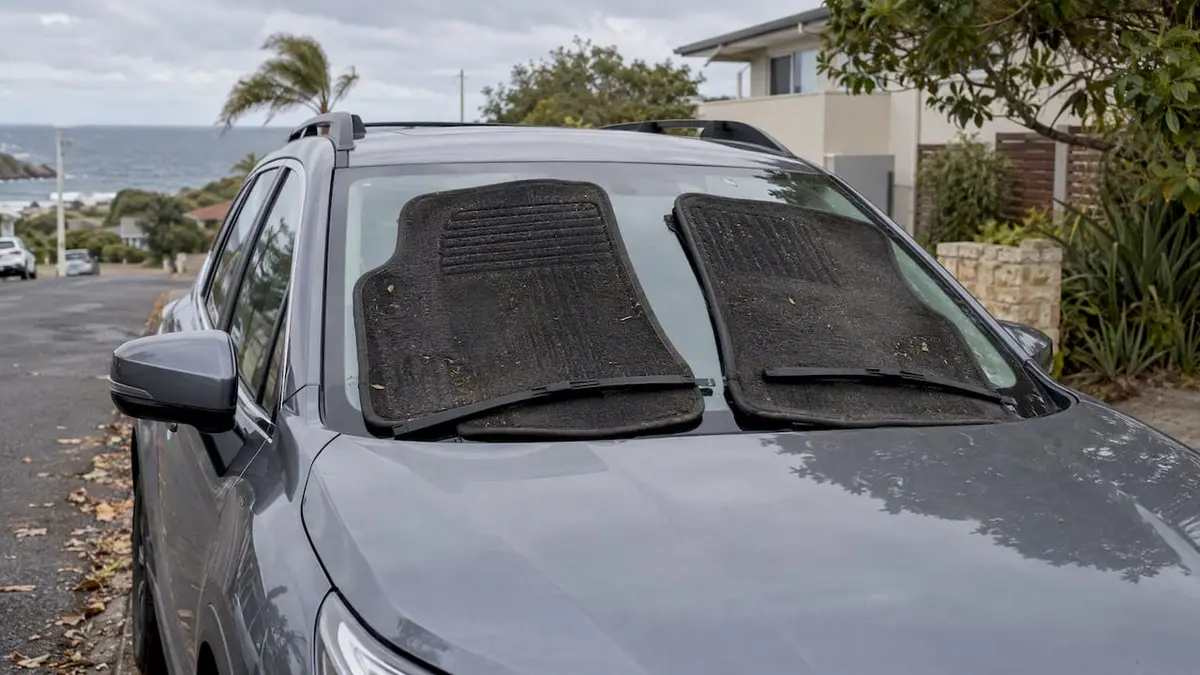
- When solid shelter isn’t available, heavy blankets, tarps or floor mats secured over the windscreen can reduce hail and debris damage, as Get Ready Queensland’s vehicle guidance notes.
- Avoid parking in flood-prone areas or low ground, and move your car to higher ground early rather than waiting until water is already rising.
- Walk your property beforehand and secure or store loose items such as bins, outdoor furniture and garden tools that could become projectiles in high wind.
On the road during a cyclone or severe storm: safety-first driving rules
Check Bureau of Meteorology watches and warnings before you leave, and if a warning is active for your area, the safest trip is the one you don’t take.
- Floodwater is far more dangerous than it looks: just 15 centimetres of flowing water can move a small car, and 60 centimetres can float one away entirely.
- RACQ points out that even a 4WD can’t safely judge a submerged road’s condition, since the surface underneath may already be washed away.
- If you must drive in heavy rain, use low-beam headlights, demist the windscreen with cold air, slow down and increase your following distance to at least four seconds.
- If you become stranded, stay with the vehicle, call emergency services, conserve your phone battery and leave your hazard lights on so you’re visible to others.
Our guide to safe driving in heavy rain walks through these behaviours in more depth if you want a closer look before the season starts.
Vehicle emergency kit: what to pack for cyclone season
A basic kit in the boot means you’re not caught out if you’re delayed on the road or stuck at home without power.
- Torch with spare batteries, bottled water and non-perishable food.
- A basic first-aid kit and a warm blanket.
- A tarp, tow rope, spare tyre and a basic toolkit, as state emergency guidance recommends.
- Copies of important documents such as registration, insurance details and identification, kept in a sealed bag.
- Download the Bureau of Meteorology app and your state’s emergency alert app, and save local emergency numbers before the season starts.
Check perishable items and batteries at the start of each season, since a kit packed two years ago isn’t much use if the water’s gone stale and the torch is dead.
How to pick the right wiper blades for storm season using the GWC vehicle lookup
Getting the right blade fitted properly is one of the fastest, cheapest upgrades you can make before a storm hits.
- Enter your make, model and year into the GWC vehicle lookup, which matches you to the correct blade length and adapter for your exact vehicle.
- Fit the blades following the included guide, then run a sweep test with the washers on to check for even contact across the glass.
- Listen for chatter or squeaking and check for any dry streaks, both signs the blade isn’t seated correctly or is the wrong size.
- Take a short drive in light rain to confirm clean, even wiping before you need the blades in a genuine downpour.
Post-cyclone safety checks before you drive again
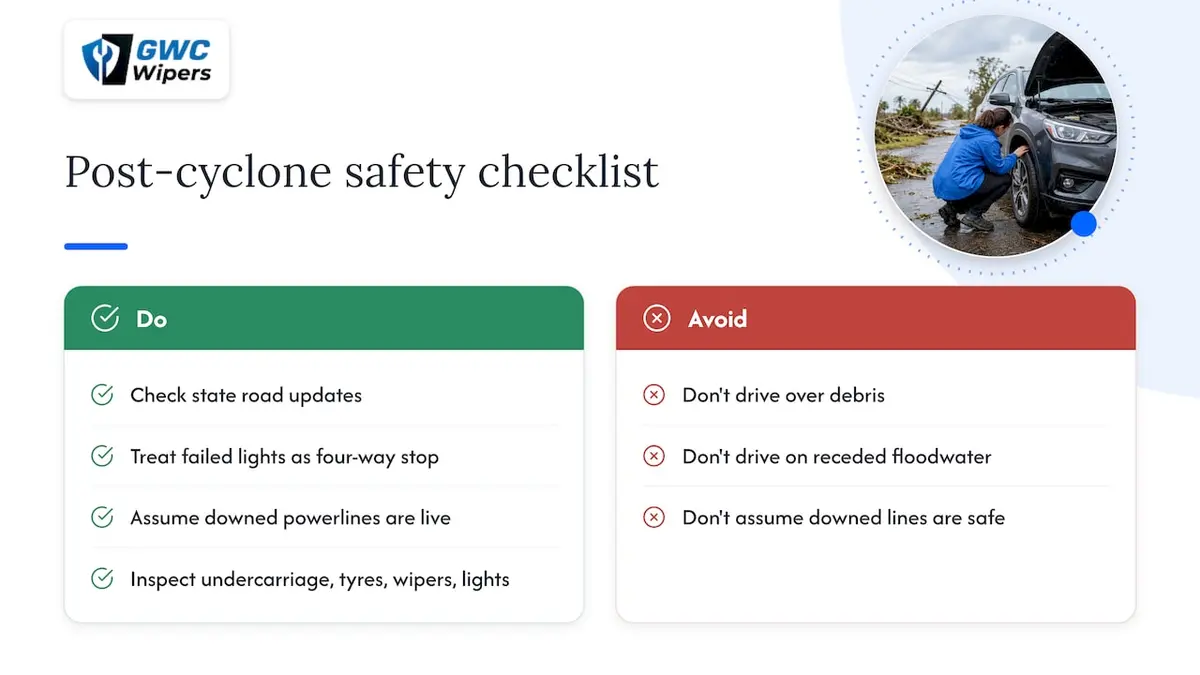
Once the worst has passed, the roads themselves can still be dangerous, even if the rain has stopped. Fallen trees, downed powerlines and washed-out sections of road are common in the hours and days after a cyclone, and many won’t be visible until you’re close to them.
Check your state’s road and traffic authority updates before setting out, since closures are often posted well before a road is physically cleared. Treat any intersection with a non-functioning traffic light as a four-way stop, and assume powerlines on the ground are live until authorities confirm otherwise. Avoid driving over debris where possible, since nails, broken glass and twisted metal are common after high winds and can damage tyres that otherwise passed every pre-season check.
If a road has been underwater, don’t assume it’s safe once the water recedes. The surface beneath may be eroded, undermined or simply gone, and the same buoyancy risks that apply during a flood can apply to standing water left behind. Give your own car a quick visual check too: look underneath for debris caught in the undercarriage, check tyres for cuts, and confirm your wipers and lights still work before you get back on the road.
Insurance considerations for cyclone damage and what to document
Most comprehensive car insurance policies in Australia cover storm and cyclone damage, but the details of what’s included, and any flood-specific exclusions, vary by insurer and policy. It’s worth checking your own policy wording before the season starts rather than during a claim, since some policies distinguish between storm damage and flood damage in ways that affect your cover.
Before a cyclone hits, take dated photos of your car from all angles, including the number plate and any existing damage, so there’s a clear record of its condition beforehand. Store these photos somewhere other than your phone if possible, such as cloud storage or email, in case your phone is damaged or lost.
After the event, photograph any damage before you move or attempt to clean the vehicle, and keep receipts for any emergency repairs or towing. Note the date, time and circumstances of the damage while it’s fresh, since insurers often ask for this detail when processing a claim. If the car has been submerged, even briefly, have it assessed by a mechanic before driving it again, as electrical and fluid systems can be compromised in ways that aren’t obvious from the outside.
Alternative transport and evacuation planning if your car can’t be used
Sometimes the safest option is to leave the car behind entirely, particularly if roads are flooded, your street is cut off, or an evacuation order is in place. Planning for that possibility before the season starts is far easier than working it out under pressure.
Know your local evacuation routes and the location of your nearest designated shelter, both of which are usually listed on your state emergency service’s website. If you live in a flood-prone or cyclone-exposed area, talk with neighbours or family about shared transport options in case one vehicle isn’t available or safe to use.
Keep a charged power bank, a list of emergency contacts and any medications you need in a bag you can grab quickly, separate from whatever you’ve packed in the car. If public transport, a ride share or a lift from someone nearby is realistic in your area, treat that as your backup plan rather than assuming the car will always be an option. The goal isn’t to replace driving, it’s to make sure a flooded road or a car that won’t start doesn’t leave you stuck with no plan at all.
Protecting your car’s exterior from heavy rain and debris
A car left exposed through a cyclone can pick up damage well beyond what the rain itself causes. Hail, flying debris and prolonged exposure to driving rain all take a toll on paintwork, seals and glass.
If solid shelter such as a garage isn’t available, a heavy-duty car cover, secured blankets or even floor mats over the windscreen can reduce the impact of hail and small debris, as state emergency guidance suggests. Make sure any cover is properly secured, since a loose one can flap in high wind and cause scratches of its own.
Check window and door seals for gaps before the season starts, since worn seals let water into the cabin during driving rain and can lead to mould or electrical issues later. If you notice a seal has perished, professional glass and seal care guidance is worth following, or have it looked at by a windscreen specialist before the season gets underway. For broader protection against rain damage generally, our guide to rain accessories covers covers, mats and repellents in more detail.
Everyday steps fleet and private drivers can adopt
The simplest habit worth building into cyclone season is checking visibility first, every season, before anything else. A correctly fitted wiper blade is cheap, takes minutes to fit, and makes a bigger difference to how safely you drive in heavy rain than most of the other items on a pre-storm list. Beyond that, treat tyre and battery checks as a seasonal ritual rather than a one-off task.
— Faisal
Perfect-fit wiper blades and quick fitment with GWC Wipers
We built our vehicle lookup specifically so you’re never guessing at blade length or adapter type before a storm. Enter your make, model and year, and we’ll match you to the exact blade engineered for your windscreen, with a fit guarantee behind it.
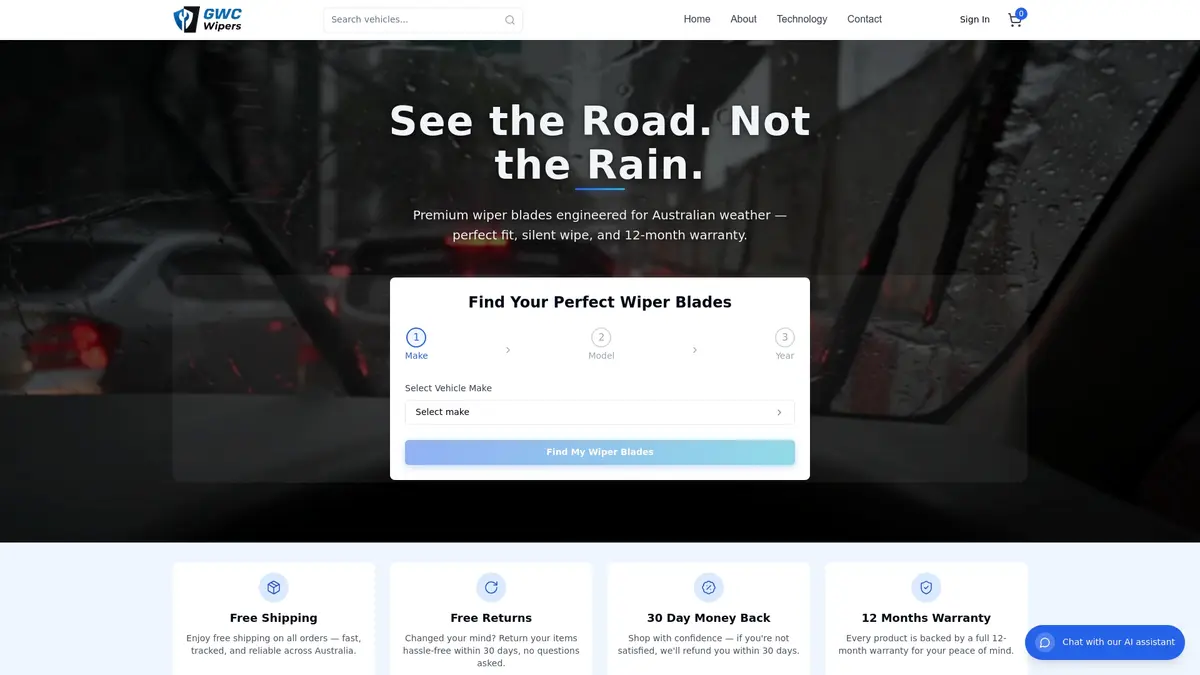
- Every order ships to locations across Australia.
- We offer a return policy and warranty on our blades.
- Fitting takes minutes with the included guide, no tools or workshop visit needed.
If you drive a model with its own fitment hub, such as our Toyota HiLux wiper blades page, you’ll find the exact match listed directly. Otherwise, start at our wiper blades page, run your vehicle through the lookup, and order the correct set now so it’s fitted well before the next cyclone warning lands.
FAQ
What are the cyclone predictions for Australia in 2026?
Specific seasonal forecasts for upcoming years aren’t something we track or publish, and the most reliable source for current outlooks is the Bureau of Meteorology, which issues seasonal and short-term tropical cyclone advice. Check BoM directly for the latest watches, warnings and outlook statements before the season begins.
How do I prepare for floods in Australia?
Flood preparation starts with knowing your evacuation route, packing an emergency kit and never driving through floodwater, since even 15 centimetres of flowing water can move a small car. Move vehicles to higher ground early, secure loose outdoor items and keep important documents in a sealed, accessible bag.
What is the cyclone season in Australia?
Australia’s official tropical cyclone season runs from 1 November to 30 April, though cyclones can occasionally form outside that window. Peak activity typically falls between November and April, so it’s worth staying alert to Bureau of Meteorology warnings throughout that stretch.
What should I expect during a cyclone?
Expect heavy rain, strong wind gusts, reduced visibility and the possibility of flooding, downed trees and power outages. Roads can close with little notice, so checking Bureau of Meteorology warnings before travelling and avoiding floodwater entirely are the two most important precautions.
What’s the quickest way to improve visibility before a storm hits?
Checking and replacing worn wiper blades is usually the fastest, cheapest fix, since a correctly fitted blade clears rain evenly instead of streaking or skipping. Using the GWC vehicle lookup to confirm the right size for your exact make and model removes the main cause of poor fitment.