
Safe driving in heavy rain: essential steps for drivers
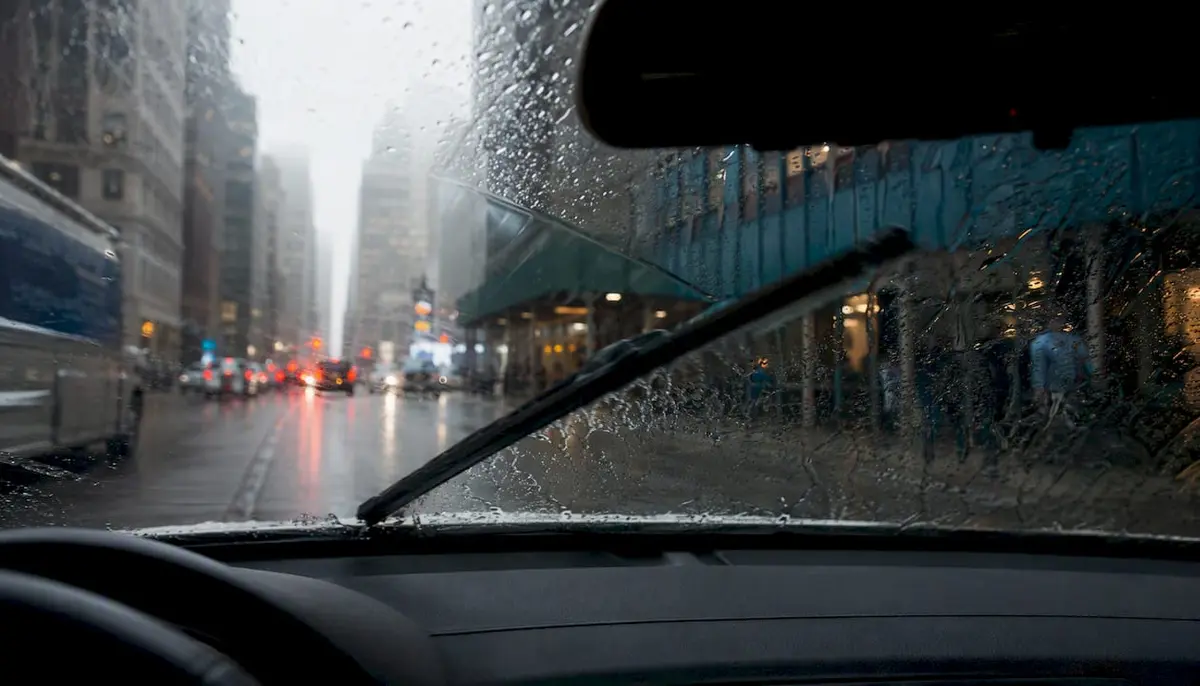
Slow down, increase your following distance to at least four seconds, and pull over if you cannot see the road clearly. Those three actions alone reduce your crash risk more than any other adjustment you can make. Around 1 in 3 Australian drivers report fear of driving in the rain, and that instinct is well-founded: wet roads reduce friction and visibility, raising both crash frequency and injury severity compared with dry conditions.
When heavy rain hits, do this immediately:
- Switch headlights to low beam (not high beam, which reflects off rain and reduces your sight line)
- Turn off cruise control and manage speed manually
- Switch on the air conditioning with the rear demister to clear internal fogging
- Open a small gap in a window if the screen fogs faster than the demister clears it
- Increase following distance to at least four seconds
Do not: brake suddenly, make sharp steering inputs, or drive through any floodwater. NSW SES is clear: floodwater is always dangerous. Turn around, find a safer way.
Pro Tip: If you can’t see the car ahead clearly, you are already too close. Increase your gap before conditions worsen, not after.
Key takeaways
Safe driving in heavy rain comes down to three non-negotiable habits: slow down below the speed limit, keep at least a four-second gap, and stop if you cannot see clearly.
| Point | Details |
|---|---|
| Slow down and increase gap | Stopping distances double on wet roads; maintain a safe following distance that allows for longer stopping times in wet weather. |
| Lights and demist on | Use low-beam headlights and run AC with demist to maintain clear vision front and rear. |
| No cruise control | Turn it off in rain; it cannot react to sudden traction loss and can worsen a skid. |
| Never cross floodwater | Even shallow fast-moving water can move a car; turn around and find an alternate route. |
| Check tyres and wipers | Tyre tread must meet the recommended minimum depth to ensure wet-weather grip; replace wiper blades every 6–12 months. |
| GWC Wipers fitment | GWC Wipers supplies vehicle-specific blades for over 2,500 Australian models with a 12-month warranty. |
Table of Contents
- 1. How to drive safely in heavy rain: speed, spacing and control
- 2. What to do if you aquaplane, skid or meet floodwater
- 3. When should you pull over and where is it safe to stop?
- 4. Pre-trip vehicle checks and route planning
- 5. Why your wiper blades matter more than you think
- A note on visibility and safety from our team
- Clear vision starts with the right wiper blades
- Sources
- FAQ
1. How to drive safely in heavy rain: speed, spacing and control
Driving to conditions means adjusting your speed below the posted limit when rain reduces grip and visibility. The speed limit is set for dry roads; in heavy rain, it can be far too fast for safe stopping.
Speed and following distance
A practical way to measure a four-second gap: pick a fixed point on the road (a sign, a bridge post). When the car ahead passes it, count “one-thousand-one, one-thousand-two, one-thousand-three, one-thousand-four.” If you reach that point before you finish counting, you are too close. Queensland Government guidance confirms that stopping distances roughly double on wet roads, so that four-second buffer is the minimum, not the target.
Lights and visibility
Use low-beam headlights in rain, even during daylight (recommended by government transport authorities). High beam reflects off rain and spray, cutting your sight line rather than extending it. Rear fog lights are for severely reduced visibility only; leaving them on in moderate rain blinds the driver behind you. NSW Government advice recommends low beam, demist and the air conditioner as a standard wet-weather combination.
Steering and braking
Smooth, gradual inputs are the rule. Sudden braking, sharp steering or a hard acceleration can break traction on a wet surface in a fraction of a second. Brake in a straight line before a corner, not through it. NRMA training guidance also recommends following the tyre tracks of the car ahead, where the road surface is slightly drier, and watching brake lights well ahead for early warning.
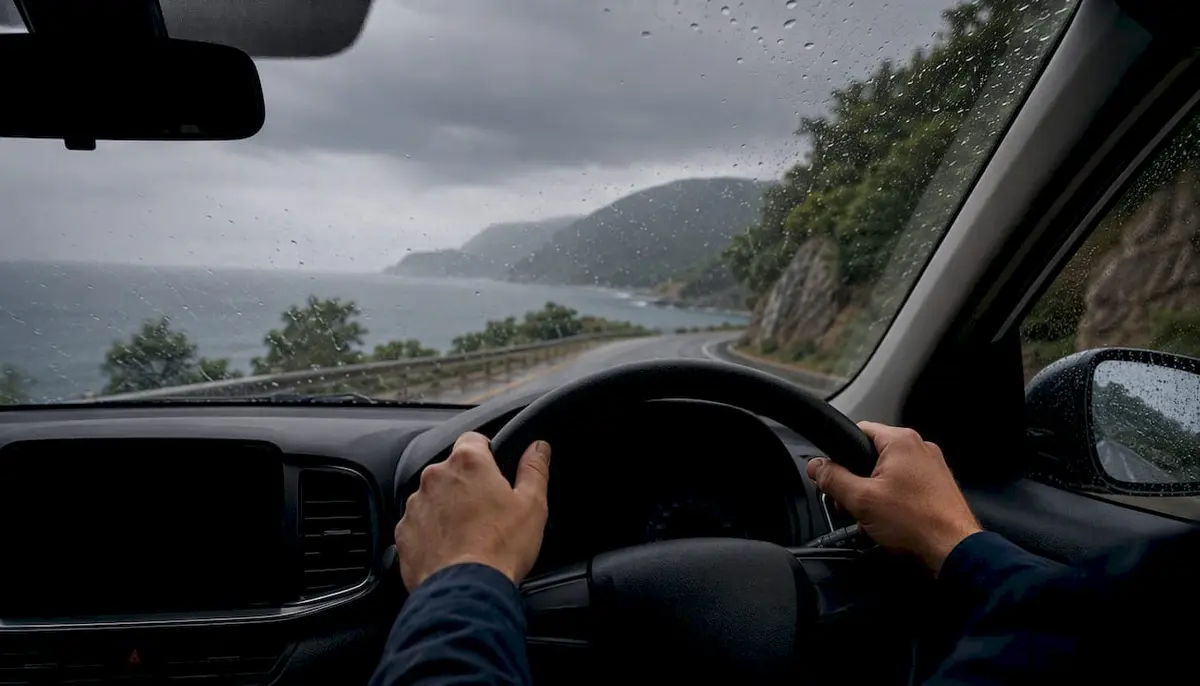
Cruise control
Turn it off. Cruise control holds a fixed speed without sensing traction loss. If a wheel begins to slip, the system may actually increase throttle to maintain speed, making a skid worse. NRMA is direct on this point: manual speed control is the only safe option in wet conditions.
After a long dry spell
The first rain after a prolonged dry period can be the most dangerous. Oil and grime that have built up on the road surface mix with water to create a slick film. Treat the first 20–30 minutes of rain after a dry stretch with extra caution, and reduce speed further.
Pro Tip: Position your car slightly to the left of your lane to use the natural camber of the road, which channels water away from your tyres.
2. What to do if you aquaplane, skid or meet floodwater
Aquaplaning recovery
Aquaplaning happens when a layer of water builds between your tyres and the road, causing the steering to feel light or unresponsive. If it happens:
- Ease off the accelerator gradually. Do not stamp on the brakes.
- Keep the steering wheel straight and steady.
- Hold your course until you feel grip return.
- Only once grip is restored, brake gently if needed.
Skid recovery
Rear-wheel skid (oversteer): Steer gently in the direction the rear is sliding. Ease off the accelerator. Do not brake.
Front-wheel skid (understeer): Ease off the accelerator and reduce steering input slightly. Let the front wheels regain grip before steering again.
ABS-equipped cars: Brake firmly and hold. The ABS modulates pressure automatically. You will feel a pulsing through the pedal; that is normal. Cars without ABS: Apply light, progressive brake pressure. Pumping the pedal prevents wheel lock.
Engine stall in water
If your engine stalls while crossing water, do not attempt to restart it immediately. Water in the intake can cause catastrophic engine damage. Assess the depth. If water is rising inside the cabin, unlock the doors, release your seatbelt and exit when you can open the door safely. Move to higher ground.
Floodwater decisions
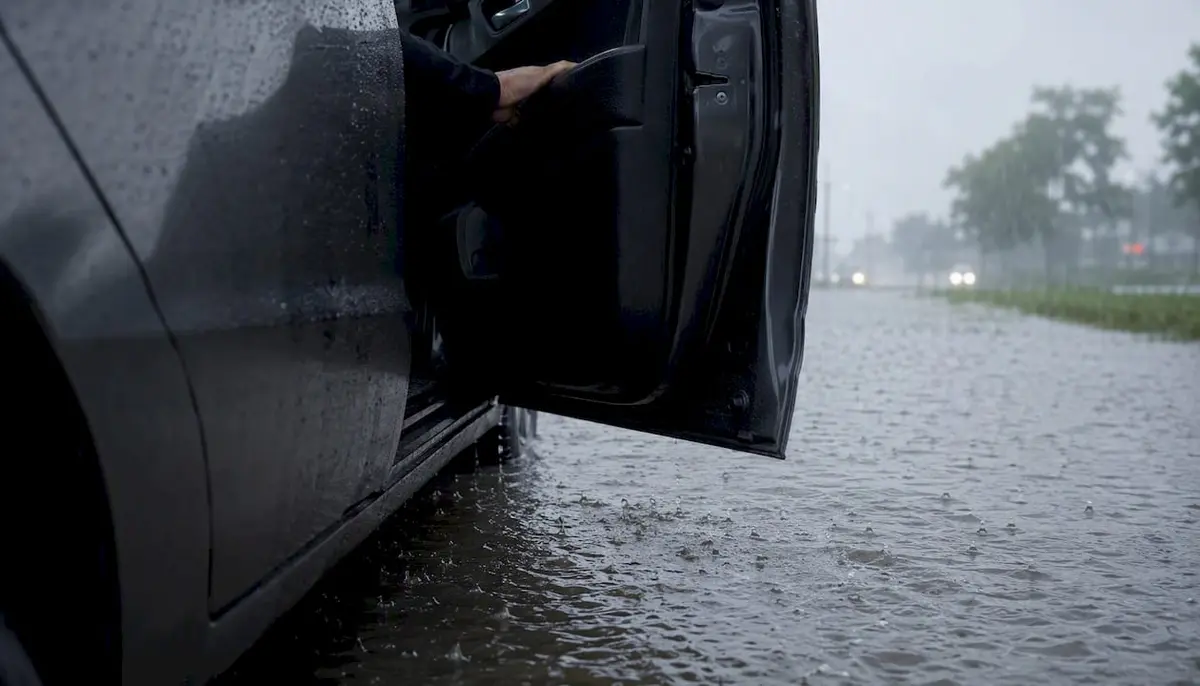
NSW SES records that a large proportion of flood rescues involve vehicles. Even 15 centimetres of fast-moving water can move a small car. Floodwater hides washed-out road surfaces, debris and deep channels. The rule is absolute: turn around, don’t drown. If you have already driven through a puddle, apply the brakes lightly once you are clear to dry the rotors before you need them in an emergency.
RACV advises that when visibility drops significantly, collision risk rises sharply. That same principle applies at floodwater crossings: the urge to push through is a psychological response to wanting to get home, not a rational assessment of the risk.
3. When should you pull over and where is it safe to stop?
Pull over when any of these apply:
- You cannot see the road surface or lane markings ahead
- Other vehicles are not visible at a safe distance
- Spray from passing trucks is reducing your forward sight to near zero
- You feel your hands tightening on the wheel from stress or fatigue
Where to stop safely
Rest areas and service stations are the best option. A wide, sealed shoulder is acceptable if you can pull fully clear of the travel lane. Avoid stopping on soft verges (you may become bogged), under bridges (flash flooding risk), or near drainage channels.
Once stopped:
- Switch on hazard lights immediately
- Keep your seatbelt on
- Stay in the vehicle unless it is unsafe to do so
- Check Live Traffic NSW, VicRoads, or your state’s road authority app for road closure updates before moving off
Pro Tip: Tell someone your route and expected arrival time before you leave. If you are delayed by weather, a quick message prevents unnecessary concern and ensures someone knows to call for help if needed.
4. Pre-trip vehicle checks and route planning
A few minutes before you leave can prevent a serious problem on the road. Work through this checklist before driving in wet weather.
| Check item | Pass indicator | Action if it fails |
|---|---|---|
| Tyre tread depth | A minimum depth sufficient to maintain grip in wet conditions | Replace tyres before driving in rain |
| Tyre pressure | Matches manufacturer spec (door placard) | Inflate or deflate to correct pressure |
| Wiper blades | No streaking, chattering or skipping | Replace blades; check tread measurement guides |
| Headlights and tail lights | All globes working, lenses clear | Replace globes or clean lenses |
| Demister and AC | Clears screen quickly | Check fuse, refrigerant or blower motor |
| Brakes | No grinding, pulling or sponginess | Have brakes inspected before travel |
Queensland Government guidance specifies the 1.5mm tread minimum across the full tyre width as the threshold for acceptable wet-weather grip.
Route planning
Check the Bureau of Meteorology (BOM) forecast and your state’s Live Traffic service before leaving. If a road is listed as closed or flooded, treat that as final.
Emergency kit to carry:
- Torch with fresh batteries
- High-visibility vest
- Phone charger or power bank
- First aid kit
- Warm blanket
- Bottled water
A vehicle protection checklist can also help you cover weather-related preparation beyond the basics above.
5. Why your wiper blades matter more than you think
Clear vision is your first line of defence in heavy rain. A wiper blade that streaks, chatters or skips across the screen is not just annoying; it creates a distorted view at exactly the moment you need clarity most. Wiper blades typically last several months; replacing them regularly helps maintain clear vision in rain, and many drivers push well past that before replacing them.
Signs your blades need replacing:
- Streaking or smearing across the screen
- Chattering or skipping on the upstroke
- A squeaking noise on a wet screen
- Visible cracking or lifting of the rubber edge
Maintenance steps that extend blade life:
- Wipe the rubber edge with a damp cloth at each fuel stop to remove road film
- Use a quality washer fluid rather than plain water; it reduces the surface tension that causes streaking
- Lift the blades away from the screen during extended parking in direct sun to prevent rubber bonding to the glass
Using air conditioning together with the rear demister is the most effective way to clear internal fogging. AC supplies drier air that removes moisture faster than heat alone. For a step-by-step approach to defogging your windows quickly, the process takes less than two minutes when done correctly.
Fitting the right blade
Vehicle-specific fitment matters. A blade that does not match your car’s arm attachment or curvature will leave pressure gaps, causing streaks and reducing sweep coverage. GWC Wipers covers fitment for over 2,500 Australian vehicle models, with preassembled adapters that make DIY installation straightforward. For more on wiper technologies that improve wet-weather visibility, the differences between blade types are worth understanding before you buy.
Pro Tip: Replace your wiper blades before the wet season, not after the first heavy downpour. A worn blade increases glare and reaction time under heavy spray, when you can least afford it.
A note on visibility and safety from our team
At GWC Wipers, our focus is on one outcome: keeping Australian drivers safe by keeping their view of the road clear. The advice in this guide draws on official sources from the NRMA, RACV, NSW SES and state transport authorities. The wiper section reflects our hands-on experience fitting blades across thousands of Australian vehicles. If the safety steps above are what you needed, that is enough. If you also want to check whether your blades are up to the job, we are here to help.
Clear vision starts with the right wiper blades
If your wipers are streaking, chattering or older than 12 months, they are a liability in heavy rain. GWC Wipers supplies premium, vehicle-specific wiper blades built for Australian conditions, from coastal humidity to inland dust and heavy summer downpours. Every blade comes with a 12-month warranty, a 30-day money-back guarantee, and free shipping across Australia.
The fitment guarantee means you get the correct blade for your exact make, model and year, with preassembled adapters for easy DIY installation. If you drive a Toyota, check the Toyota wiper blade range to find your fit in seconds. For Mercedes-Benz owners, the GLE-Class fitment page covers the full range. Replacing worn blades before the next downpour is one of the simplest, lowest-cost safety upgrades you can make. Remember: new wipers improve your view, but if you cannot see the road, the right call is still to pull over and wait.
Sources
Official guidance used in this article:
- Tips for driving in wet weather — NRSPP
- Steer clear — NSW SES
- Road safety during wet weather — Queensland Government
Check live road closure warnings via your state’s Live Traffic service or the Bureau of Meteorology before travelling in severe weather.
FAQ
What is the safest way to drive in heavy rain?
Reduce your speed below the posted limit, increase your following distance to at least four seconds, use low-beam headlights, and turn off cruise control. Pull over in a safe location if visibility drops to the point where you cannot see lane markings or the car ahead.
What should a driver do if they encounter floodwater?
Never drive through floodwater. NSW SES guidance is clear: turn around and find a safer route, because even shallow fast-moving water can shift a vehicle and hide washed-out road surfaces beneath it.
Is driving in heavy rain genuinely more dangerous?
Yes. NRSPP research confirms that wet weather reduces road surface friction and visibility, increasing both crash frequency and injury severity compared with dry conditions.
Does rain clean your car’s windscreen?
Rain removes some surface dust but often leaves a greasy film from road oils and pollutants, which can cause streaking and reduce wiper effectiveness. Cleaning the windscreen manually and using quality washer fluid gives far better results than relying on rain alone.