
What to do when you dispose wiper blades responsibly
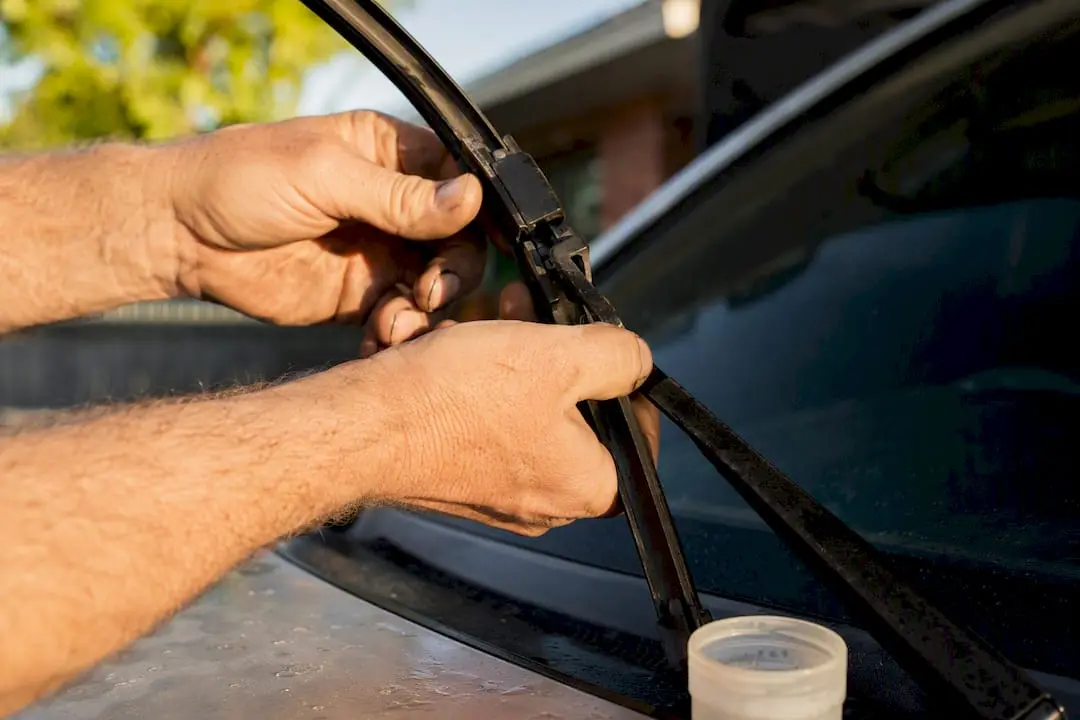
You can usually separate a wiper’s metal frame for recycling. Rubber inserts rarely go in kerbside recycling bins, so check a council A–Z listing or a retailer take-back scheme before you bin anything. Most council waste guides classify metal wiper arms as scrap metal and treat rubber blade inserts as residual waste unless a specialist programme exists locally.
Two things to do right now, before you even pull the blades off your car:
- Separate metal from rubber as soon as you remove the old blades. Frames go to scrap; inserts usually go to general waste.
- Protect the windscreen with a towel while you work. A spring-loaded arm that snaps back is the fastest way to crack your glass.
Key Takeaways
Separating the metal frame for scrap recycling and checking a council A–Z listing or retailer take-back scheme before binning rubber is the single most effective disposal habit for wiper blades.
| Point | Details |
|---|---|
| Separate before you dispose | Split the metal frame from the rubber insert; frames go to scrap, rubber usually goes to residual waste. |
| Protect the glass first | Use a towel and service mode where available to stop the arm snapping back onto the windscreen. |
| Check local rules | Council A–Z pages and retailer take-back programmes vary, so confirm before assuming kerbside recycling applies. |
| Reuse when recycling isn’t local | Metal frames suit garden clips or hooks; rubber strips make workshop squeegees, never vehicle reuse. |
| Replace on a schedule | Swap both blades every six to 12 months and dispose of the pair together to simplify the process. |
Table of Contents
- How to remove and prepare wiper blades for disposal
- Where to recycle or drop off old wiper blades
- Creative ways to reuse old frames and rubber strips
- What to do if there’s no recycling option nearby
- How often should you actually replace your wipers?
- Making disposal easier from the start
- Choosing your next set makes disposal simpler later
- Why the “just bin it” habit costs more than it saves
- Sources
- FAQ
How to remove and prepare wiper blades for disposal
Removing a wiper blade takes less than five minutes once you know the sequence. The trick is doing it without cracking your windscreen or mangling the arm.
- Lift the wiper arm away from the glass. If your car has a service mode, switch it on first so the arm locks upright.
- Place a folded towel or rag over the windscreen under the arm, just in case it slips.
- Find the small release tab where the blade meets the arm and press it in.
- Slide the rubber insert or full blade assembly off the hook.
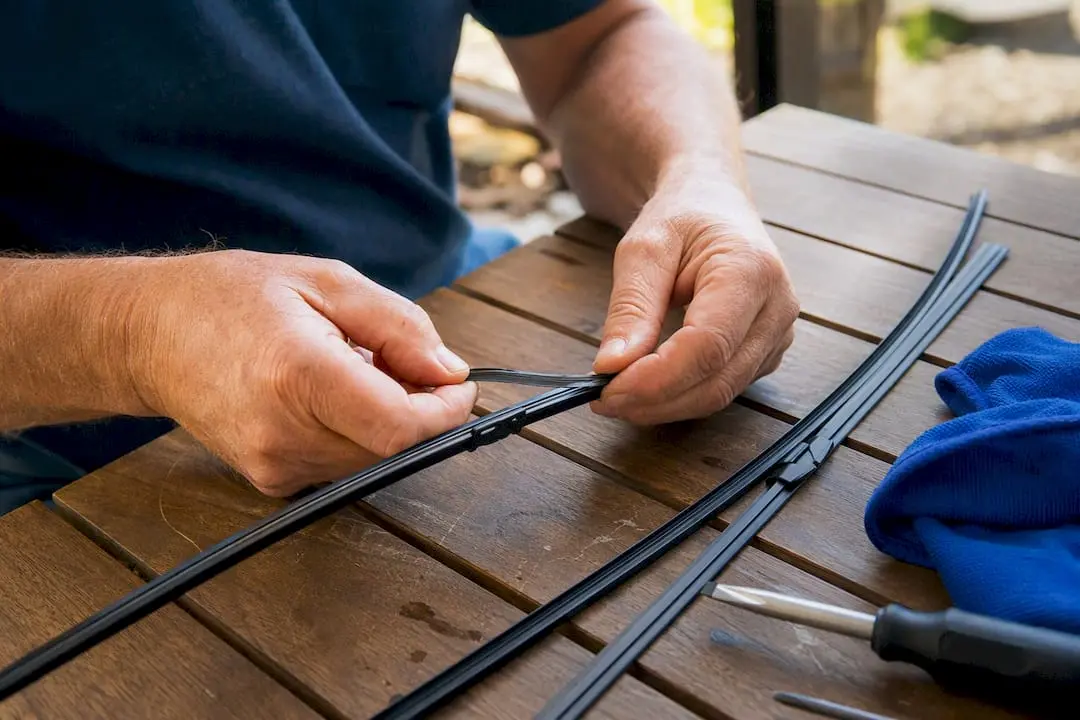
- If you want to separate materials further, pop the rubber strip out of the plastic or metal spine using a flathead screwdriver.
Pro Tip: If the arm won’t lift clear of the glass, don’t force it. Check your owner’s manual for a service position that holds the wipers mid sweep, so you can work on them safely without straining the linkage.
Corroded or seized blades are more stubborn. A squirt of penetrating oil on the hinge point usually loosens things up, but if the arm still won’t budge, a mechanic can remove it in seconds during your next service rather than risk snapping a mounting spline.
Where to recycle or drop off old wiper blades
Once you’ve separated the parts, three routes cover almost every situation.
- Scrap metal yards take steel frames without fuss. Strip the rubber out first and bag several old frames together. Small individual pieces are more likely to be waved through than a single loose spine.
- Retailer take-back programmes exist in some markets. Halfords in the UK, for example, collects old wiper blades in store, which shows the model to look for. Call your local auto parts store or the shop that fitted your last set of blades and ask whether they run anything similar, and what limits or packaging rules apply.
- Council recycling centres vary block by block. A council A–Z waste guide will tell you whether your local facility accepts mixed wiper parts or wants metal and rubber kept apart.
If you’re not sure where to start, search your council’s website directly using terms like “wiper blade disposal” or “windscreen component recycling,” alongside your suburb name. Most Australian councils publish an alphabetical waste directory, and wiper components often sit under “car parts,” “metal,” or “windscreen” entries. Guides on recycling wiper blades responsibly also back this pattern: separated materials are far more likely to be accepted than a blade left fully assembled.
Creative ways to reuse old frames and rubber strips
Recycling isn’t always available, and that doesn’t mean the parts are worthless.
- Metal frames make handy garden clips for staking soft-stemmed plants, provided you file down any sharp edges first.
- The steel spine can be bent into a simple hook or hanger for light garage tools.
- Rubber inserts work well as a workshop squeegee for cleaning benches or as a gutter scraper for clearing leaf debris.
- Never refit an old rubber strip to a vehicle, even temporarily. Worn rubber loses its edge and smears rather than clears.
- Community repair groups and local makerspaces sometimes want offcuts for small projects, so it’s worth asking before you toss them out.
What to do if there’s no recycling option nearby
Not every postcode has a scrap yard or a council facility set up to take mixed car parts. If that’s your situation, you still don’t need to bin the whole blade as one lump.
- Pull the metal frame out and hold onto it. Even without a formal recycling stream, scrap yards will often take a bag of small parts dropped off in person.
- Whatever’s left, mainly the rubber and any plastic housing, goes into residual or general waste following your council’s standard guidance.
- Don’t leave loose blades rattling around in your bin. Tape the rubber to the frame or bag the pieces together so nothing sharp catches a waste worker off guard during collection.
Separating the metal first still pays off even when the rubber ends up in landfill. It keeps at least one component out of general waste and gives the frame a genuine second life as scrap.
How often should you actually replace your wipers?
Most manufacturers and workshop guides recommend swapping wiper blades every six to 12 months, depending on how much sun and grit they cop. Streaking, chattering across the glass, or visible cracks in the rubber are your cue to stop waiting and change them.
- Replace both blades at the same time, even if only one looks worn. Mismatched wipers clear unevenly and one will fail again soon after.
- Dispose of the old pair together rather than one at a time, so you’re not repeating the sorting process twice.
- Time the swap to a scheduled service where possible. Some workshops recycle wiper components as part of routine maintenance, saving you a separate trip.
Making disposal easier from the start
A few small habits make the whole process faster next time round.
- Always protect the glass with a towel and use service mode if your vehicle has it, no matter how quick the job seems.
- Blades built with a simple push-tab insert release, rather than a fully bonded rubber-to-frame design, separate for recycling in seconds rather than minutes.
- If you’re removing blades near the edge of the glass, a product like windscreen skin protection adds another layer of defence against accidental scratches or chips during the swap.
- For the exact removal steps on your specific vehicle, our step-by-step installation guide walks through fitting and removal side by side.
Choosing your next set makes disposal simpler later
Every wiper blade you fit today is one you’ll eventually need to take off and dispose of again, so it’s worth thinking a step ahead. GWC Wipers builds its blades with natural rubber inserts that separate cleanly from the frame, which means less fiddling with a screwdriver when the time comes to recycle. Our guide to replacing wiper blade inserts covers exactly how that separation works model by model.
If you’re due for a change now, our vehicle selector matches you to the right fit across popular ranges, including Toyota and Mercedes-Benz models. Every order ships free across Australia, backed by a 30-day money-back guarantee and a 12-month warranty, so you can fit, test, and know exactly what you’re working with when disposal rolls around again.
Why the “just bin it” habit costs more than it saves
Most drivers treat old wiper blades the same way they treat a dead battery: chuck it and move on. That instinct is understandable but it skips a genuinely easy win. Separating the steel spine takes thirty seconds with a screwdriver, and scrap yards will almost always take a handful of them even without a formal wiper recycling scheme.
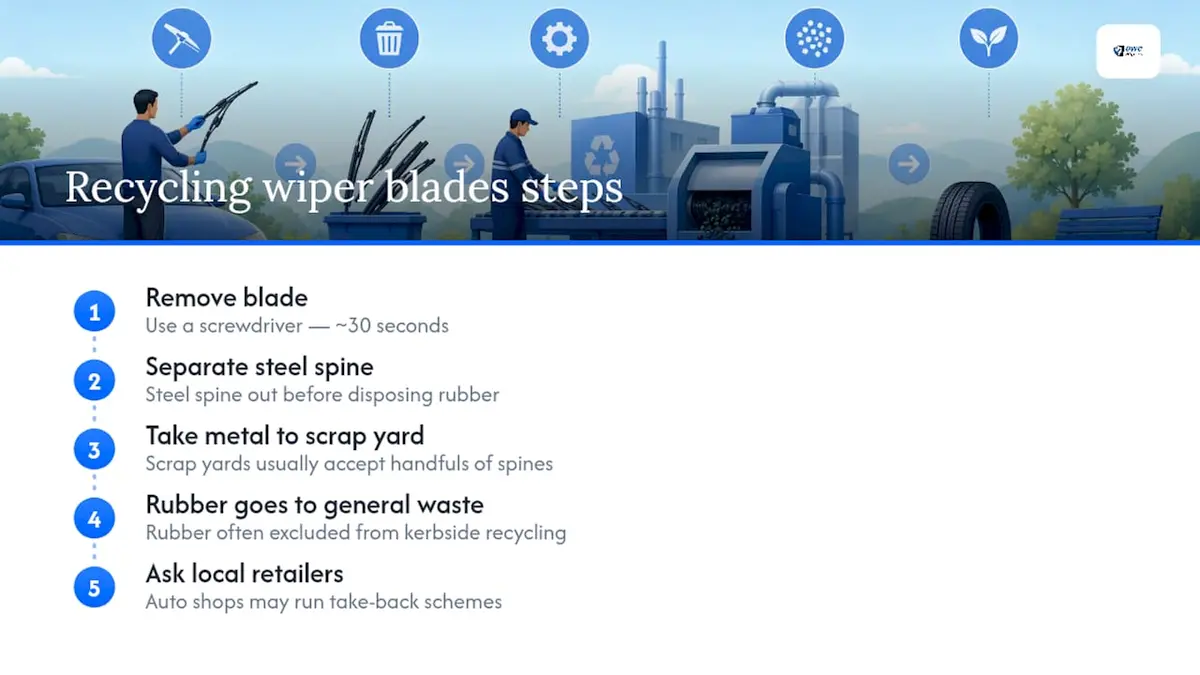
Where I think the conventional advice falls short is in overselling kerbside recycling. Plenty of well-meaning guides tell readers to “check if your blades are recyclable” without mentioning that rubber inserts are routinely excluded from mixed recycling bins because they contaminate the stream. That’s not a failure of the reader, it’s a gap in council infrastructure. The honest answer is that rubber mostly ends up in general waste, and pretending otherwise sets people up to bin the wrong thing in the wrong bin.
What actually moves the needle is prioritising the metal separation step and asking your local auto parts retailer directly whether they take blades back. Retailer schemes exist overseas and there’s a genuine chance a local shop does something similar if you simply ask.
— Faisal
Sources
FAQ
What should I do with old wiper blades?
Separate the metal frame from the rubber insert. Take the metal to a scrap recycler and check your council’s A–Z guidance or a retailer take-back scheme for the rubber before putting it in general waste.
How do I dispose of used wiper blades if there’s no recycling nearby?
Pull out the metal frame and hold onto it for a scrap metal drop-off, then place the remaining rubber and plastic parts in your residual waste bin, bagged so nothing sharp is exposed to waste collectors.
How do I take off old wiper blades?
Lift the arm away from the glass, cover the windscreen with a towel, press the release tab where the blade meets the arm, and slide the blade off. Use your vehicle’s service mode if the arm won’t lift clear.
Can I put aluminium foil or metal wiper parts in the recycle bin?
Small clean metal items like foil are often accepted in kerbside recycling depending on your council, but wiper frames are usually better suited to a dedicated scrap metal drop-off rather than the household recycling bin.