
3 to 5 Year Lifespan: EPDM vs Rubber Wipers for Australian Drivers
For most drivers, EPDM wiper blades offer the best balance of price and durability, natural rubber wins only on upfront cost, and silicone wins outright if you want the longest service life and a hydrophobic finish. Check your current blades now for streaking or a hardened, glassy edge. If you see either, replace them before the next heavy rain rather than waiting for a wet, blind windscreen to force the decision.
TL;DR:
- EPDM blades generally last 1 to 2 years outdoors, offering better ozone and UV resistance compared to natural rubber, which typically lasts 6 to 12 months.
- Silicone blades can last 3 to 5 years with proper use, especially in sun-heavy climates, thanks to their hydrophobic finish and inert silicon backbone.
- The lifespan of a wiper blade heavily depends on parking habits, climate, and washer fluid chemistry, with outdoor exposure and strong UV accelerating degradation.
- Correct fitment is crucial; even the best material fails if the blade does not match your vehicle’s arm mechanism, making vehicle-specific options preferable.
- Natural rubber remains the cheapest upfront but often requires more frequent replacement, leading to higher long-term costs compared to EPDM or silicone options.
Table of Contents
- EPDM vs rubber wipers: what the material actually changes
- EPDM vs silicone wipers: performance in heat, cold and city ozone
- Do rubber wipers last longer than EPDM or silicone?
- How wiper blades fail (and when to actually replace them)
- How to choose between EPDM, natural rubber and silicone
- Why fitment and warranty matter as much as material
- The verdict: pick the material that matches your parking habits, then replace it before it fails
- Does washer fluid affect how long your wipers last?
- Is EPDM more environmentally friendly than natural rubber?
- What this comparison gets wrong in most buying guides
- Get the right blade fitted the first time with Com
- Sources
- FAQ
EPDM vs rubber wipers: what the material actually changes
The difference between EPDM and natural rubber comes down to chemistry you can’t see but will absolutely feel through a streaky windscreen. Every wiper blade material comparison eventually reduces to one question: how much of the polymer’s structure is exposed to attack from oxygen, ozone and UV light?
EPDM (ethylene propylene diene monomer) has a saturated polymer backbone, meaning there are no vulnerable double bonds running along its main chain. That structure is precisely why EPDM resists ozone and UV so much better than natural rubber, and why vehicle manufacturers fit it as standard equipment on new cars. It’s not the toughest compound in absolute terms, but it holds up in the sun and around the low-level ozone that hangs over most cities.
Natural rubber is built on isoprene chains full of carbon double bonds. Those bonds give natural rubber excellent flexibility and grip when new, but they’re also exactly what atmospheric ozone attacks. Ozone molecules cleave those double bonds one by one, and the result is the fine web of surface cracking you’ll spot on an old blade if you bend it against the light. This is the mechanism behind ozone-driven rubber degradation, and it’s largely unavoidable with unprotected natural rubber left outdoors.
Silicone plays a different game entirely. Its backbone is silicon and oxygen, not carbon, which is why UV light and ozone barely touch it. Silicone is also naturally hydrophobic, so water beads and sheets off the glass rather than smearing, an effect you’ll notice within the first few wipes of a new blade.
A few practical distinctions matter when you’re comparing products on a shelf or online:
- Full-silicone blades are inert to UV and ozone and carry the strongest hydrophobic effect, but they cost more to manufacture.
- Silicone-coated blades (a rubber core with a thin silicone layer) get some short-term smoothness, but the coating wears off within weeks of regular use, taking the benefit with it.
- EPDM compounds vary by manufacturer. Not every EPDM blade has the same tear or abrasion resistance, which is why blade makers tune specific compound recipes rather than treating “EPDM” as one fixed material.
- Hybrid or composite blades combine a silicone body with a harder EPDM or rubber wiping lip, an approach documented in wiper blade patent literature as a way to cut sliding friction without sacrificing edge durability.
Read a label carefully before assuming “silicone” means full silicone. That single word can describe two very different products with very different lifespans.
EPDM vs silicone wipers: performance in heat, cold and city ozone
Climate and parking habits decide which material’s strengths actually matter to you. A blade that performs beautifully in a mild, shaded garage might behave completely differently on a car parked outdoors in direct sun all day.
Hot, sun-heavy climates favour silicone. Because its backbone doesn’t degrade under UV exposure, silicone resists the long-term stiffening and cracking that carbon-based rubbers eventually suffer. Natural rubber left in strong sun for months will harden and lose contact with the glass, which is when you start hearing chatter on the upstroke.
Cold climates are where EPDM and good-quality rubber compounds shine. EPDM stays comparatively flexible at low temperatures, which matters because a stiff blade skips over ice and frost instead of clearing it. Silicone can also be engineered for cold-weather flexibility, but not every silicone blade on the market is formulated for it, so cold-climate buyers should check the temperature rating on the packaging rather than assuming.
Urban ozone and coastal salt air are the quiet killers of natural rubber blades. Traffic-heavy cities generate ground-level ozone that speeds up the cracking process, and salt-laden coastal air adds a corrosive edge. Both EPDM and silicone resist this kind of chemical attack far better than natural rubber, which is one reason natural rubber blades typically only last six to twelve months in exposed conditions.
The nuance most drivers miss: it’s not really about how hot your climate is on average, it’s about how much direct UV the blade itself absorbs while parked. Two identical cars in the same suburb, one garaged and one left in a driveway all day, will show very different blade condition after a year, even though they experience the same weather.
- Garage or carport parking extends the service life of any rubber-based blade.
- Coastal and industrial areas accelerate degradation regardless of material, though EPDM and silicone cope noticeably better than natural rubber.
- Cold-weather buyers should look specifically for a stated low-temperature flexibility rating.
Pro Tip: If you park outdoors and can’t avoid direct sun, angle the wiper arms up slightly off the glass when the car is parked for extended periods. It’s a five-second habit that keeps the blade edge from baking flat against hot windscreen glass.
Do rubber wipers last longer than EPDM or silicone?
Not usually, and the gap is bigger than most drivers expect. Natural rubber wins on sticker price and loses everything else on the value ledger over a two or three year ownership window.
Typical lifespan bands look like this:
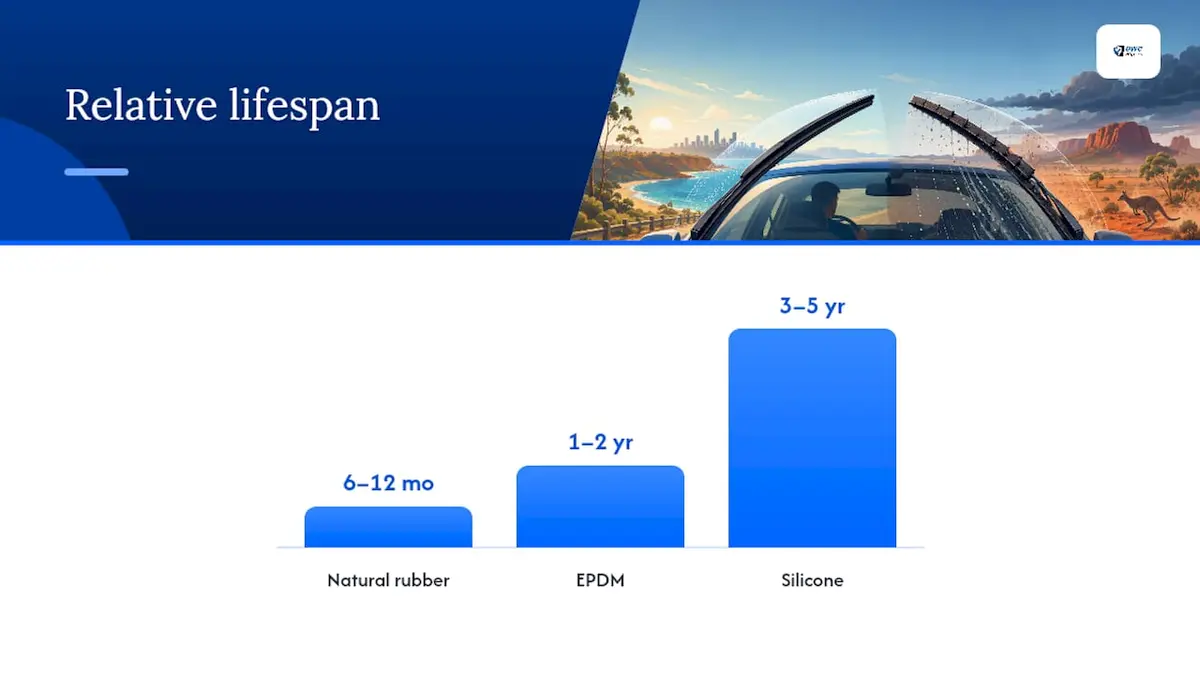
- Natural rubber: roughly 6 to 12 months under normal outdoor exposure.
- EPDM: roughly 1 to 2 years in typical driving and parking conditions.
- Silicone (full silicone): roughly 3 to 5 years with proper installation.
Run the numbers on a simple two-year comparison and the cost picture shifts noticeably. A natural rubber blade priced low but replaced twice a year can cost more over two years than a single silicone blade bought once, even though silicone carries a $5 to $15 premium per blade at purchase. EPDM sits in the middle: a typical beam blade runs $15 to $25 and needs replacing roughly once a year, which puts its two-year cost close to buying two sets of natural rubber blades but with far better mid-season performance.
Cost isn’t the only variable worth weighing. Silicone’s hydrophobic film means less streaking and a quieter wipe cycle for most of its service life, a real quality-of-drive benefit that doesn’t show up on a price tag. Modern silicone blades also often incorporate graphite or PTFE additives to cut friction and chatter, addressing the old complaint that silicone squeaks against glass.
These figures assume typical conditions. A blade garaged overnight and cleaned regularly will outlast the same product left outdoors in a high-UV, high-ozone environment, sometimes by a wide margin, so treat every lifespan figure as a starting point rather than a guarantee.

How wiper blades fail (and when to actually replace them)
Every blade failure traces back to one of four causes, and spotting which one you’re dealing with tells you whether cleaning will fix it or whether it’s time to buy a new set.
- Streaking usually means the rubber edge has hardened or picked up a fine crack line invisible from a distance. Run a finger gently along the edge; if it feels ridged rather than smooth, the wiping edge is compromised.
- Chatter (that juddering, skipping motion on the upstroke) often points to a blade that’s lost flexibility, or a frame that’s no longer applying even pressure across the glass. Uneven contact pressure is a common driver of chatter independent of material choice.
- Skipping or gaps in the wipe typically signal ozone cracking on natural rubber, or a build-up of road film and contaminants that a clean won’t fully remove.
- Brittle, cracked edges are the clearest sign of UV or ozone damage and mean replacement, not cleaning, is the answer.
Before assuming the worst, try a proper clean. Wipe the blade edge with a microfibre cloth and a mild glass cleaner, and clean the windscreen itself with a streak-free method to rule out contaminated glass rather than a failing blade. If streaking persists after a genuine clean, the rubber itself has degraded and no amount of wiping will fix it.
Pro Tip: Test a blade by running two fingers along the wiping edge. A healthy edge feels smooth and slightly rounded. If you feel any flat spots, nicks or a sticky, tacky residue, that blade is past its useful life regardless of how new it looks from the driver’s seat.
How to choose between EPDM, natural rubber and silicone
Match the material to how and where you actually drive, not to whichever blade happens to be cheapest on the shelf that day.
- Climate: hot and sun-exposed favours silicone; cold and frost-prone favours EPDM or a cold-rated silicone.
- Parking: garaged cars can get more life from any material; outdoor-parked cars benefit most from EPDM or silicone.
- Budget: natural rubber suits drivers happy to replace blades twice a year; EPDM suits drivers wanting one annual replacement at a reasonable price.
- Frame type: beam blades distribute pressure more evenly than older bracket-style frames, which reduces uneven wear regardless of material.
- Rear wipers: these see far less UV exposure than front blades, so a cheaper natural rubber rear blade is often perfectly reasonable even when you choose silicone or EPDM up front.
| Priority | Best material | Why |
|---|---|---|
| Lowest upfront cost | Natural rubber | Cheapest to buy, shortest lifespan |
| Balanced value | EPDM | Moderate cost, solid UV/ozone resistance, OEM standard |
| Longest service life | Silicone | 3 to 5 years, hydrophobic finish, higher upfront cost |
| Best for extreme cold | EPDM or cold-rated silicone | Retains flexibility at low temperatures |
| Best for coastal/urban ozone | EPDM or silicone | Resists chemical cracking better than natural rubber |
Why fitment and warranty matter as much as material
Choosing the right material only pays off if the blade actually fits your car’s arm mechanism and clears the glass properly across its full arc. Com is an Australian wiper blade specialist that designs and manufactures blades matched to over 2,500 vehicle models, using a vehicle selector tool so you enter your make, model and year and get a confirmed fit before you buy.
That fitment focus matters more than it sounds. A blade made from the best compound in the world still streaks and chatters if the arm adapter is even slightly wrong for your vehicle, which is a common problem with generic universal wipers bought on price alone. Com backs every purchase with a fitment guarantee, a 30-day money-back guarantee and a 12-month warranty, and includes detailed DIY installation guides so fitting the correct blade at home takes minutes rather than a trip to a mechanic.
The verdict: pick the material that matches your parking habits, then replace it before it fails
If you want one default answer, choose EPDM. It’s what most vehicle manufacturers fit as standard for good reason: solid ozone and UV resistance at a moderate price, with roughly a year of reliable service in typical conditions. If you park outdoors in strong sun, or you’d rather buy once every few years than think about it every twelve months, silicone is worth the extra cost for its longer life and hydrophobic finish. Natural rubber remains defensible only as a genuine budget option, or for a rear blade that sees minimal UV exposure.
The action step is simple: inspect your current blades now for hardened edges, cracking or streak lines, and don’t wait for the next downpour to discover they’ve failed. Replace them with a material suited to how your car is actually parked and driven, not whatever was cheapest at the last servicing.
Does washer fluid affect how long your wipers last?
Washer fluid chemistry has more influence on blade lifespan than most drivers assume. Alcohol-based and strong solvent formulas, common in some concentrated screen wash concentrates, can dry out and gradually degrade rubber compounds over repeated use, softening the surface or accelerating the same cracking process ozone causes on natural rubber.
EPDM and silicone tolerate a wider range of washer fluid chemistry than natural rubber does, simply because their backbones resist chemical attack as well as UV and ozone. That doesn’t mean any fluid is safe for any blade indefinitely. Strongly concentrated de-icing fluids used undiluted in winter, for instance, are harsher on all rubber compounds than a properly diluted summer screen wash.
Silicone-specific washer fluids exist and are formulated to preserve the hydrophobic coating rather than strip it, which matters if you’ve paid the premium for a full-silicone blade and want that beading effect to last its full service life. Using a generic, heavily detergent-based fluid on a silicone blade can shorten the effective life of that hydrophobic surface, even if it doesn’t damage the underlying material structure.
The practical rule: dilute concentrated washer fluids to the manufacturer’s stated ratio rather than running them stronger for “better” cleaning, and avoid pouring undiluted alcohol-based de-icer directly onto the blade edge itself. A blade that survives three summers of UV exposure can still be undone in a single winter of undiluted de-icer misuse.
Is EPDM more environmentally friendly than natural rubber?
Neither EPDM nor natural rubber wiper blades are widely recyclable through standard kerbside collection, and both typically end up in general waste once removed from the vehicle. The more meaningful environmental comparison isn’t about recyclability at the end of life, it’s about how often each material needs replacing in the first place.
A natural rubber blade replaced every six to twelve months generates two to four times the manufacturing and packaging waste of an EPDM blade lasting one to two years, and considerably more than a silicone blade lasting three to five years. Fewer replacements means fewer blades manufactured, packaged, shipped and discarded over the life of a vehicle, which is a genuine environmental advantage for the longer-lasting materials even without a formal recycling pathway.
Natural rubber does have one advantage worth noting: it’s derived from a renewable plant source (the rubber tree), whereas EPDM and silicone are petrochemical-derived synthetics. That renewability argument matters less in practice than it sounds, though, given how frequently natural rubber blades need replacing compared with the alternatives.
Some blade manufacturers now design composite constructions, combining a silicone body with a harder wiping lip rather than a single solid material, partly to extend service life and reduce the frequency of full blade replacement. Whether that composite approach improves the overall environmental footprint depends on the specific materials and proportions used, but the underlying logic tracks with the broader pattern: a blade that lasts longer, regardless of its exact composition, typically means less waste over the vehicle’s lifetime.
What this comparison gets wrong in most buying guides
Most advice on this topic treats “best material” as a fixed ranking, silicone at the top, EPDM in the middle, natural rubber at the bottom, and stops there. That’s not wrong exactly, but it skips the variable that actually decides outcomes for most drivers: where the car is parked and how it’s used, day to day.
The conventional wisdom undersells EPDM. It gets treated as the compromise pick between a “premium” silicone and a “budget” natural rubber, when in reality it’s the material vehicle manufacturers trust as original equipment for good reason. For most driving patterns, EPDM’s balance of ozone resistance, cold flexibility and moderate cost make it the sensible default, not the middle-of-the-road settlement.
What buyers should prioritise first isn’t the material at all. It’s checking whether a blade is genuinely fitted to their specific vehicle before comparing compounds. A perfectly engineered silicone blade with the wrong arm adapter will underperform a correctly fitted EPDM blade every time. Get the fitment right, then choose the material that matches your climate and parking habits, in that order.
— Faisal
Get the right blade fitted the first time with Com
Com solves the problem this whole comparison points to: even the best material fails if the blade doesn’t fit your specific car properly. Rather than guessing at a generic size off a shelf, Com’s vehicle selector tool matches you to the correct fitment across more than 2,500 models, so the blade you order clears your glass and locks onto your arm without adapters that half-fit.
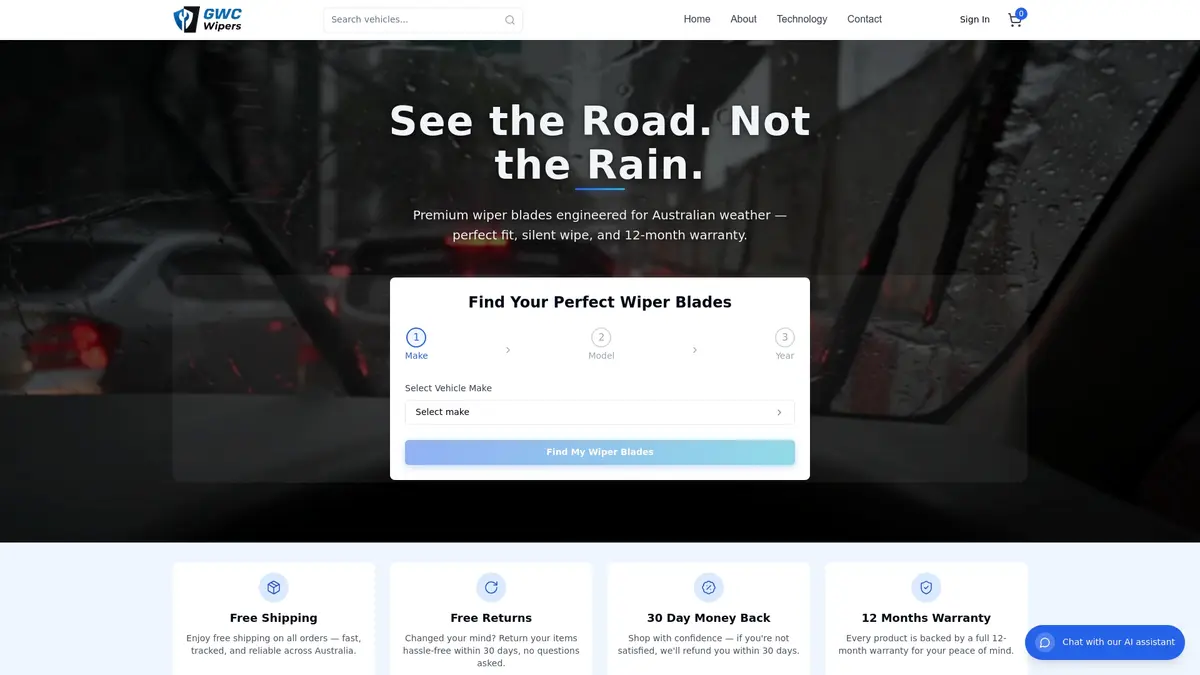
Every order ships free across Australia and comes with a fitment guarantee, a 30-day money-back guarantee and a 12-month warranty, so if a blade doesn’t perform as expected, you’re covered without a drawn-out claims process. If you drive a Toyota or a Mercedes-Benz, Com stocks vehicle-specific blade sets built from durable rubber compounds designed for local conditions, hot summers and heavy downpours included. Enter your rego or vehicle details on the site now to find your exact fit and get a set ordered before the next storm catches you with a streaky windscreen.
Sources
- Silicone vs Rubber Wiper Blades: material science & longevity — Windshield Advisor
- EPDM vs natural rubber — Qualiform Rubber Moulding
- Wiper blade materials: silicone vs natural vs synthetic — Topex Wiper
- Wiper blade rubber with silicone outer surface and EPDM wiping layer — patent
FAQ
What is the best material for wiper blades?
EPDM offers the best all-round balance of cost and durability for most drivers, while silicone is the better pick if you want the longest possible lifespan and a hydrophobic finish. Natural rubber remains the cheapest option but needs replacing most often.
Which is better, rubber or silicone wiper blades?
Silicone generally outperforms natural rubber on both lifespan and weather resistance, lasting roughly 3 to 5 years compared with 6 to 12 months for natural rubber, though it costs more upfront. EPDM sits between the two, offering better resistance than natural rubber at a lower price than full silicone.
Which type of wiper blades is best?
There’s no single best type for every driver. Choose EPDM as a balanced default, silicone if you park outdoors in strong sun and want minimal maintenance, and natural rubber only if upfront cost matters more than longevity to you.
Are synthetic rubber wiper blades better than natural rubber?
Yes, in almost every measurable way. Synthetic compounds like EPDM have a saturated backbone that resists ozone and UV attack far better than natural rubber’s double-bond structure, which translates directly into a longer service life before streaking or cracking sets in.
Do rubber wipers last longer than EPDM wipers?
No. Natural rubber blades typically last 6 to 12 months, while EPDM blades typically last 1 to 2 years under the same conditions, largely because EPDM resists the ozone cracking that degrades natural rubber.