
Budget $20–$50 per Pair: Fleet Wiper Blade Costs for Australian Fleets
A fleet buying wiper blades in Australia should budget roughly $20 to $50 per pair at retail, with bulk fleet pricing typically landing lower per unit once order volume passes standard minimums. The single biggest lever on your total spend isn’t the unit price at all. It’s standardising fitment across your fleet and buying against a fixed SKU list, which cuts admin, reduces returns, and stops you paying retail prices out of desperation when a driver reports a failed blade the night before a wet-weather run.
TL;DR:
- Bulk purchasing discounts can significantly reduce per-unit costs, especially when ordering large quantities across multiple vehicle types.
- Standardizing fitment and using fixed SKU lists cut administrative costs and prevent expensive last-minute replacements.
- The total cost of ownership considers replacement frequency, inventory, labor, and operational risks, not just the initial purchase price.
- High-performance features like silicone coating or aerodynamic designs offer value only when matched with operating conditions, such as heavy UV exposure or high-speed routes.
- Proper fitment and supplier guarantees minimize returns, reduce downtime, and lower the risks associated with wrong parts or urgent spot purchases.
Table of Contents
- What drives fleet wiper blade cost in Australia right now
- How bulk purchasing changes your unit cost
- Modelling total cost of ownership across your fleet
- Choosing the right blade type and fitment strategy
- Procurement checklist: what to ask every supplier
- Guarantees, freight and support that change your real cost
- Environmental and disposal costs for used wiper blades
- Do premium features like heated blades or aerodynamic designs pay off?
- How climate and driving conditions affect blade life and cost
- Why fitment discipline matters more than the invoice line
- How GWC Wipers supports fleet procurement
- Sources
- FAQ
What drives fleet wiper blade cost in Australia right now
Retail pricing for a single pair of wiper blades on a passenger vehicle in Australia typically runs from $20 to $50, depending on brand, blade length and coating. Truck and specialist commercial blades sit higher, often around $50 or more per pair, because of longer blade lengths, heavier-duty rubber compounds and lower production volumes.
Several factors push a quote toward the top or bottom of that range:
- Blade length and vehicle class. Light commercial vans and utes usually take standard passenger-length blades. Heavy trucks and buses need longer, reinforced blades that cost more per pair.
- Coating and material. Natural rubber blades sit at the lower end. Silicone-coated and hybrid designs cost more upfront but often last longer in harsh sun and heavy rain.
- Aerodynamic and spoiler designs. Blades built with an integrated spoiler to reduce wind lift at highway speed carry a price premium over a basic straight blade.
- Order channel. A single pair bought over the counter at a servo or auto shop costs more per unit than the same blade bought through a dedicated online fitment specialist or a bulk supply arrangement.
Pro Tip: Ask any supplier for their price by vehicle category, not just a single blanket “wiper blade” figure. A ute and a heavy truck in the same fleet can have a $30 gap in per-pair cost, and lumping them together in a budget forecast will throw your numbers out.
Fleets running mixed vehicle types (passenger cars, light commercial, and one or two heavy trucks) should expect a blended average somewhere in the middle of these bands, weighted toward whichever vehicle type dominates the fleet.
How bulk purchasing changes your unit cost
Volume changes the maths in three ways: discount tiers, minimum order quantities (MOQs), and freight allocation. A supplier quoting on 10 pairs behaves very differently to one quoting on 200.
- Tiered discount bands. Most suppliers offer a lower per-unit price once you cross a volume threshold, commonly structured in bands (say, 1 to 24 pairs, 25 to 99, and 100-plus). The percentage saved between the entry band and the top band can be substantial, so always ask for the full tier table rather than one blended quote.
- MOQ impact on effective cost. A low MOQ keeps you flexible but often locks you into the entry-level price tier. A higher MOQ unlocks better unit pricing but ties up cash and storage space in blades you might not need for months.
- Packaging and freight. Wholesale bulk packaging (loose pairs in a carton) is cheaper per unit than individually boxed retail packs, but freight is usually charged per pallet or per consignment weight, not per pair, so a small order can carry a disproportionate freight cost.
Pro Tip: Always ask suppliers to break a quote into four separate lines: unit price, freight, handling fees, and returns/restocking terms. A supplier that won’t unbundle these numbers is usually hiding a worse deal in the freight line.
Modelling total cost of ownership across your fleet
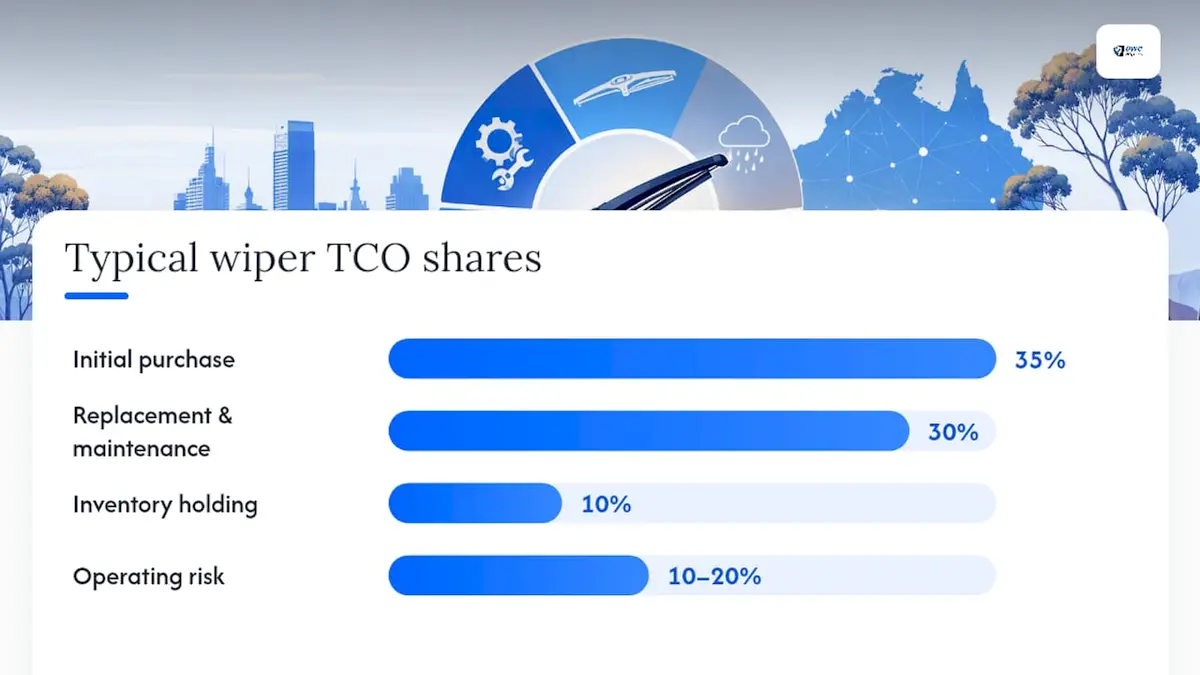
Unit price only tells part of the story. What matters for a budget line is the total cost of ownership (TCO), which folds in replacement frequency, labour, inventory, and the operational risk of a blade failing mid shift.
A simple worked example makes the gap clear. If a fleet replaces blades once a year at an average retail price per pair, the total spend for a medium-sized fleet can be several thousand dollars annually. Replacement frequency and fleet size drive this cost, becoming meaningful in aggregate before labour or freight are added.
| Cost component | Typical share of wiper TCO |
|---|---|
| Initial purchase | 35% |
| Replacement and maintenance | 30% |
| Inventory holding | 10% |
| Operating risk (downtime, failed inspections) | 10–20% |
That breakdown comes from bulk wiper sourcing analysis for urban bus fleets, and the proportions hold up reasonably well for smaller commercial fleets too. A blade swap itself is quick, typically a few minutes per vehicle, but that labour time still needs folding into your hourly workshop rate when you’re modelling the real cost of a fleet-wide replacement cycle.
Three things push the real cost above the sticker price:
- Inventory holding. Stock sitting in a storeroom ties up capital and space, even at a discounted bulk rate.
- Downtime and failed inspections. A truck pulled from service over a wiper defect costs far more in lost hours than the blade itself.
- Rushed spot purchases. Buying one pair at retail because nobody planned ahead almost always costs more than a scheduled bulk order.
Specifying and standardising early in the vehicle lifecycle locks in lower whole-of-life costs, and wiper blades are a small but telling example of that principle in action. A higher-grade blade that lasts twice as long can genuinely beat a cheaper one on TCO, even though it costs more at the checkout.
Choosing the right blade type and fitment strategy
Not every vehicle in your fleet needs the same blade spec, and buying the same product line across the board usually means overpaying on some vehicles and underspecifying on others.
- Standard rubber blades are the cheapest option and perform well for vehicles garaged overnight or running mostly city kilometres with moderate sun exposure.
- Silicone-coated blades cost more per pair but shed water more effectively and resist UV degradation better, which suits vehicles parked outdoors or running long stretches in direct sun. Independent fleet maintenance guidance backs this: the longer service life and lower failure risk of premium blades can offset the higher unit cost for fleets operating in harsh conditions.
- Hybrid blades combine a rigid frame with a rubber or silicone element, offering a middle ground for fleets that want more durability than standard rubber without stepping up to a full silicone spec.
- Refill inserts suit fleets with newer vehicles where the blade frame and arm assembly are still in good condition. Swapping just the rubber element is cheaper per replacement, though it only works where the frame design supports it.
Grouping vehicles by arm type and blade length, rather than by make and model individually, is the fastest way to cut your SKU count and simplify ordering. Our guide on choosing wiper blades that actually fit walks through matching arm connectors correctly, which matters even more at fleet scale where a mismatched fitment means a return, a delay, and an admin headache.
Procurement checklist: what to ask every supplier
Before signing off on a supplier, request a written quote covering all of the following:
- Unit price by vehicle category, not a single blended figure.
- Full bulk discount tier table, including MOQ thresholds for each price band.
- Freight cost structure, whether charged per pallet, per consignment or built into unit price.
- Lead time and backorder policy, especially for less common truck or European vehicle fitments.
- Returns, restocking fees and warranty terms, in writing.
- Expected service life under normal use, so you can model replacement frequency accurately.
Involve your workshop or maintenance team in this process early, alongside procurement. Buyer guidance from the fleet sector recommends scoring suppliers against safety, cost, fit-for-purpose and environmental criteria rather than simply repeating last year’s order out of habit. Drivers are also a useful, underused source of intel: they’ll tell you which blades are failing early long before it shows up in a maintenance log.
Guarantees, freight and support that change your real cost
A fitment guarantee, a 30-day returns window and a 12-month warranty aren’t just customer-service extras. They directly reduce the hidden cost of ordering the wrong part at scale, because a mismatched batch of blades sent to twelve depots is a genuinely expensive mistake to unwind.
- A vehicle selector tool that confirms fitment by make, model and year before you order cuts return rates significantly, especially across a mixed fleet with dozens of vehicle variants.
- National freight coverage matters if your fleet operates across states. Ask whether pricing assumes pallet freight to a single depot or drop-shipment to multiple sites.
- Backorder policy and lead times should be spelled out before a shortage hits, not discovered mid crisis.
Pro Tip: A dedicated account contact for fleet orders, rather than a generic sales inbox, tends to shave days off resolving a fitment query or a warranty claim. That responsiveness is worth factoring into your supplier score, not just the unit price.
Environmental and disposal costs for used wiper blades
Wiper blades are small, but a fleet running through hundreds of pairs a year generates a real waste stream that most procurement plans overlook. Blade rubber and the plastic or metal frame components aren’t broadly accepted in standard kerbside recycling, and most depots end up sending them to general waste unless someone actively sets up an alternative.
A handful of automotive parts recyclers and some workshop supply chains accept used blades for material recovery, particularly where the frame is metal. If your fleet has an established relationship with an auto parts recycler for other components (batteries, tyres, filters), it’s worth asking whether they’ll take wiper blades in the same collection run rather than setting up a separate stream.
The disposal cost itself is usually negligible in dollar terms compared to purchase and labour costs. The bigger consideration is fleet-wide policy consistency: if your organisation reports on waste diversion or has sustainability targets, a documented disposal pathway for wiper blades is a small, easy item to tick off. Building this into your existing maintenance disposal process, rather than treating it as a separate initiative, keeps the administrative overhead close to zero while still closing the loop on a genuinely disposable consumable part.
Do premium features like heated blades or aerodynamic designs pay off?
Premium features add real cost per pair, and whether they’re worth it depends entirely on your operating profile rather than a blanket rule.
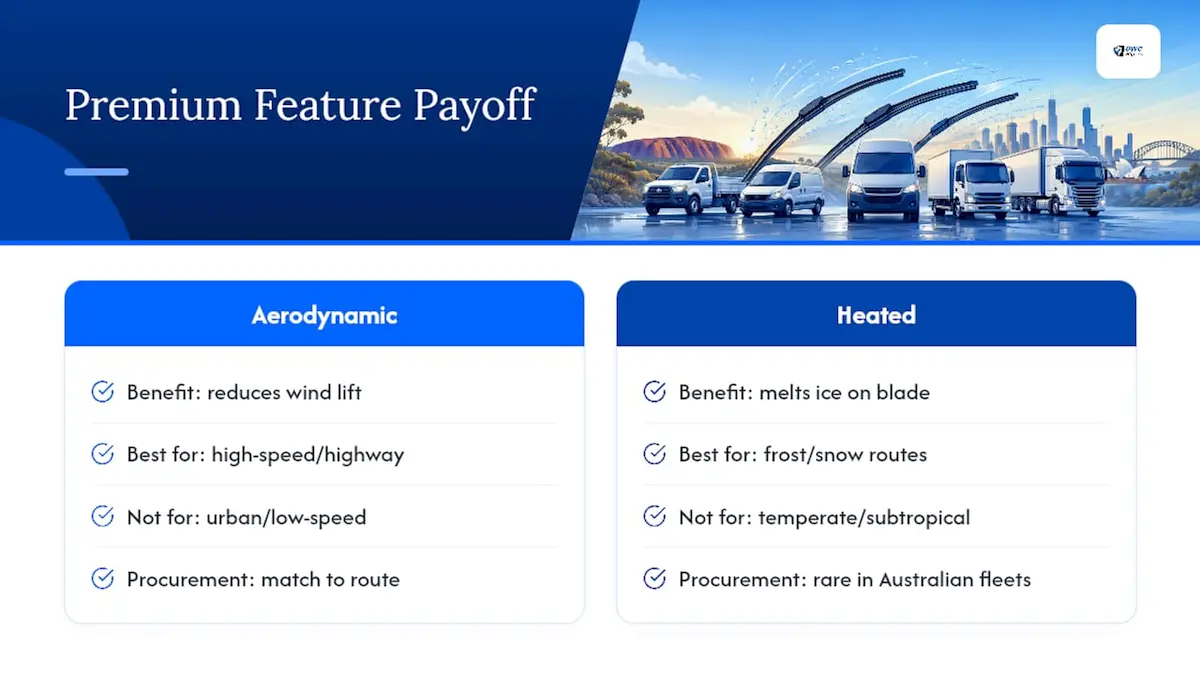
Aerodynamic, spoiler-integrated designs reduce wind lift at highway speed, which matters for fleets running long-haul or high-speed routes where a lifting blade at 100km/h leaves a driver with a smeared windscreen at the worst possible moment. For fleets doing mostly urban, low-speed work, this feature adds cost without much practical benefit.
Heated wiper blade systems are a genuine premium category, built for vehicles that regularly encounter frost, ice or snow on the blade edge itself, rather than just on the glass. These are rare in Australian fleet applications outside alpine-region operators or fleets running regularly into the Snowy Mountains or Tasmanian highlands in winter. For most fleets operating in temperate or subtropical zones, the added cost of heated systems isn’t justified by the conditions they’re built to solve.
The practical rule for procurement: match the feature to the route profile, not the vehicle badge. A premium highway-spec blade on a depot runabout that never leaves the city is money spent on a feature nobody will ever use. Conversely, skipping an aerodynamic or silicone-coated option on a vehicle doing 800 highway kilometres a week to save a few dollars per pair is a false economy once you factor in the failure risk and the driver safety implications of a blade that streaks at speed.
How climate and driving conditions affect blade life and cost
Australia’s climate range means two fleets buying the identical blade can get wildly different service life from it. A vehicle garaged overnight in Hobart faces a different wear profile to one parked outdoors all day in Alice Springs or Darwin.
UV exposure is the biggest single driver of rubber degradation in Australian conditions. Blades left exposed to direct sun for long stretches, common for depot vehicles and long-haul trucks parked outdoors between runs, harden and crack faster than the same blade garaged or shaded. This is where silicone-coated blades earn their higher price, since they resist UV breakdown more effectively than standard rubber.
Heavy, sustained rain in tropical and subtropical regions accelerates wear on the blade edge itself through constant flexing, while dust and grit in outback and regional operating areas can embed in the rubber and cause streaking well before the blade physically fails.
Fleets should also plan around seasonal risk rather than treating replacement as a flat annual event. Batch failures tend to cluster around seasonal weather shifts, when the first heavy rain of the season exposes blades that degraded quietly over a dry summer. Scheduling a proactive replacement pass before the wet season starts, backed by a small safety stock of common sizes, avoids the scramble and the higher spot prices that come with an urgent unplanned order.
Why fitment discipline matters more than the invoice line
The mistake I see most often in fleet procurement isn’t overpaying for blades. It’s buying reactively, vehicle by vehicle, without ever locking a fitment standard. Get maintenance into the conversation before the first order goes out, not after the third mismatched delivery.
— Faisal
How GWC Wipers supports fleet procurement
An Australian-based option built around exactly the problem this guide covers: fitment accuracy at scale. A vehicle selector tool that checks fitment across many models before an order goes out, which matters when placing one purchase order across a mixed fleet of utes, vans and passenger cars rather than shopping one vehicle at a time.
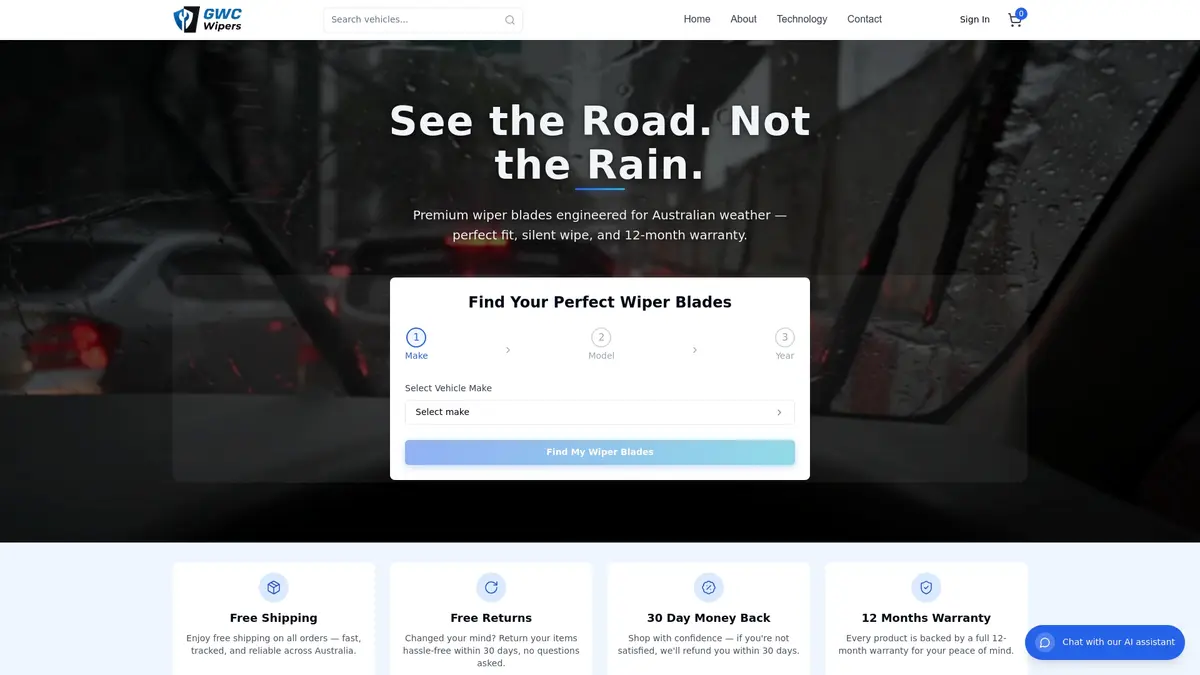
Every order carries a fitment guarantee, a 30-day money-back window, and a 12-month warranty, backed by free shipping across Australia, whether to a single depot or multiple sites. For fleet buyers, that combination reduces the admin cost of a wrong-fit return and gives procurement a consistent set of terms to write into a supply agreement rather than negotiating fresh guarantees with every quote.
If you’re mapping fitment across a fleet with a heavy Toyota component, our Toyota wiper blade range is a practical place to start pricing a bulk order and confirming fitment before you commit to volume.
Sources
NHVR’s heavy vehicle purchasing guide and FleetOps Club’s replacement cost breakdown informed the procurement and pricing detail above.
- Replace windshield wipers — FleetOps Club
- Don’t overlook wiper blades in your fleet maintenance program — Fleet Auto News
FAQ
How much do wiper blades usually cost?
A pair of quality wiper blades for a passenger vehicle in Australia typically costs $20 to $50 at retail, with truck and specialist blades often running $50 or more per pair.
What are the best wiper blades for fleets in Australia?
The right choice depends on operating conditions: silicone-coated blades suit vehicles facing heavy UV exposure or harsh rain, while standard rubber blades are adequate for garaged, low-mileage vehicles. Some suppliers offer fitment-guaranteed options across many vehicle models, which simplifies standardising across a mixed fleet.
How much do car wiper blades typically cost in bulk?
Bulk fleet pricing typically comes in below single-pair retail rates once orders cross a supplier’s minimum order quantity, though the exact saving depends on the volume tier and freight structure negotiated with each supplier.
Is it worth buying more expensive wiper blades for a fleet?
Often, yes. Premium silicone-coated blades tend to last longer and reduce maintenance frequency and failure risk in harsh conditions, which can lower total cost of ownership even though the unit price is higher.