
Why proper blade length matters for your car

TL;DR:
- Using the correct wiper blade length ensures full windscreen coverage and prevents streaking during heavy rain. Incorrect sizing puts stress on wiper motors, damages rubber, and risks contact with vehicle panels, leading to costly repairs. Always verify blade length according to manufacturer specifications and check condition regularly, especially in Australian conditions.
Correct wiper blade length is defined by your vehicle manufacturer to deliver full windscreen coverage and protect the wiper system from mechanical strain. Getting this wrong is not a minor inconvenience. Improper blade sizing reduces visibility by 15–25% during heavy rain, which is exactly the condition where you need your wipers most. Understanding why ensure proper blade length is the right question to ask before your next replacement could genuinely keep you safer on Australian roads.
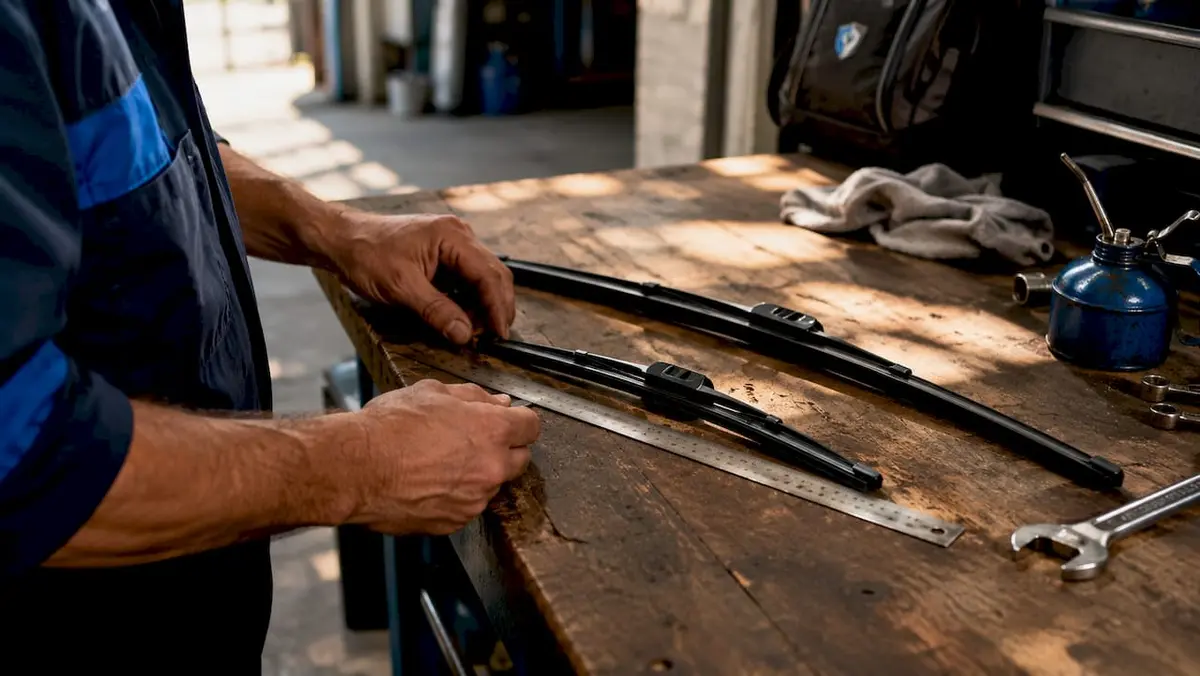
How does blade length affect wiping performance and visibility?
Blade length directly controls how much of your windscreen gets cleaned with each sweep. A blade that is too short leaves uncleaned patches at the edges and corners of your field of view. A blade that is too long reduces the contact pressure across the rubber, causing streaking and dry spots rather than a clean wipe.
The physics here are straightforward. Blade length deviations of 10–20mm reduce contact pressure by over 30%, which means even a small sizing error produces a noticeably worse result. That loss of pressure is what causes the smearing you see on a wet windscreen when wipers are worn or incorrectly sized.
Your windscreen is not flat. It has a specific radius of curvature, and your wiper blade is designed to match that curve exactly. When the blade length is wrong, the rubber cannot follow the glass properly. The result is uneven contact, which leaves dry arcs or streaks across your line of sight.
In Australian conditions, this matters more than most drivers realise. A summer storm in Queensland or a sudden downpour on the Hume Highway demands instant, full-width visibility. Streaking or missed patches in those moments are not just annoying. They reduce your reaction time and increase the risk of a serious incident.
- Blades too short leave uncleaned patches at the outer edges of your windscreen, reducing your effective field of view.
- Blades too long spread contact pressure too thin, causing streaking and lifting at highway speeds.
- Correct length mirrors the windscreen’s curvature and maintains uniform pressure across the full sweep arc.
- Even a 10–20mm error is enough to cause dry spots and inconsistent cleaning, particularly in heavy rain.
Pro Tip: If you notice a persistent streak running parallel to the wiper’s path, the blade may be too long for your windscreen rather than simply worn out. Check the length before buying a replacement.
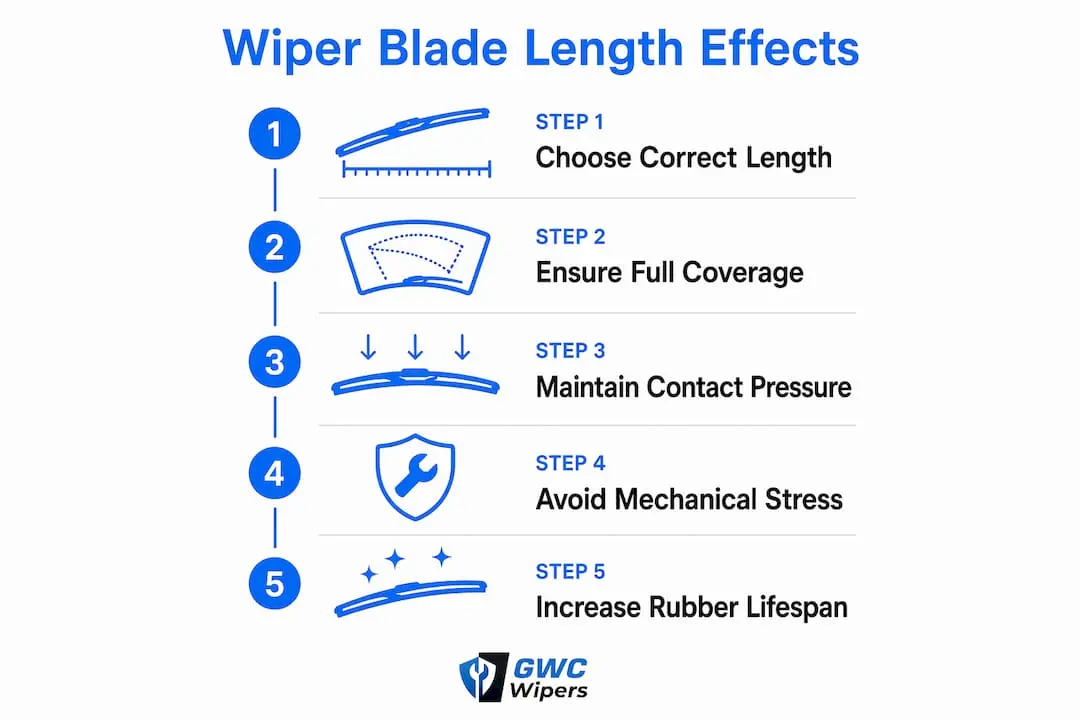
What mechanical risks come from using the wrong blade length?
Wrong blade length does not just affect what you see. It puts real stress on the mechanical components that drive your wipers. Longer blades increase the load on the wiper motor, and over time that added strain risks premature motor failure. Wiper motors are not cheap to replace, and the failure rarely happens at a convenient time.
There is also the issue of physical clearance. Wiper blades must clear their rest position without contacting trim, the A-pillar, or the bonnet. A blade that is even slightly too long can clip the scuttle panel or the base of the windscreen frame on every cycle. That repeated contact damages both the blade and the vehicle’s paintwork.
Incorrect blade sizing reduces rubber lifespan by up to 50% because uneven pressure causes the rubber to wear faster on one side than the other. You end up replacing blades far more often than you should, which costs more over time and leaves gaps in your protection between replacements.
The parking position is a detail many drivers overlook entirely. When your wipers switch off, they drop to a resting position at the base of the windscreen. Ignoring parking position clearance risks damage to the wiper motor linkage and vehicle paintwork from the blade or arm making contact with panels. This is especially relevant for Australian utes and SUVs, where bonnet profiles and A-pillar angles vary significantly between models.
Chatter is another warning sign. If your blades vibrate or skip across the glass rather than gliding smoothly, the length and curvature are likely mismatched. Left unchecked, chatter accelerates rubber degradation and can score the glass surface over time.
Pro Tip: After fitting new blades, run them through a full cycle on a wet windscreen and watch the rest position carefully. If either blade comes close to the edge of the glass or the trim, measure the blade length against your manufacturer’s specification before driving.
For context on how mechanical component fitness affects broader vehicle reliability, the team at Engine Zone outlines how motor warranty conditions relate to component sizing, which applies equally to wiper systems.
How do you find the correct wiper blade length for your car?
Correct blade length is a fit decision, not a preference. Proper blade selection requires matching manufacturer specifications, checking clearance, and avoiding the assumption that any blade fitting the arm is correct. The arm fitting and the blade length are two separate things. A blade can clip onto your arm and still be the wrong length.
Follow these steps to get it right:
- Check your owner’s manual. Your vehicle manufacturer specifies the exact blade length for the driver’s side, passenger’s side, and rear wiper where fitted. These lengths are often different from each other.
- Measure your existing blades. Use a tape measure along the rubber element from tip to tip. This confirms the current length and gives you a baseline to compare against the manual.
- Use a vehicle-specific selector tool. GWC Wipers offers a selector tool on their website that matches blades to your car’s make, model, and year. This removes the guesswork entirely.
- Check the sweep arc, not just the length. Your blade must match the curvature of your windscreen. A blade with the right length but the wrong arc profile will still leave dry spots.
- Confirm clearance at both ends of the stroke. With the blade fitted, run the wipers and watch that neither blade contacts the A-pillar, bonnet, or trim at any point in the cycle.
- Do not assume the previous owner got it right. If you bought a used car, the blades fitted may not be the correct size. Always verify against the manufacturer’s specification.
Australian drivers face some specific challenges here. Road dust from unsealed outback roads accelerates rubber wear unevenly, which can make a correctly sized blade feel wrong before it actually needs replacing. Intense UV exposure in northern Australia also degrades rubber faster, meaning the blade’s profile can change between replacements. Both factors make it worth checking blade fit and condition at the start of each wet season rather than waiting for visible failure.
Pro Tip: Write your blade lengths on a piece of tape inside your glovebox after your first correct replacement. Next time you need new blades, you have the right sizes without needing to dig out the manual.
What are the long-term benefits of correct blade length?
Consistent visibility is the most direct benefit. When your blades are the right length, they clear the full windscreen arc on every sweep. That means your reaction time stays sharp in heavy rain, and you are not straining to see around a missed patch during a sudden downpour on the Pacific Highway.
The cost savings are real too. Uneven pressure from incorrect sizing degrades rubber up to 50% faster, which means you replace blades more often than necessary. Correct sizing extends blade life and reduces how frequently you need to spend money on replacements.
Your wiper motor also benefits. A blade matched to the correct length places the right amount of load on the motor linkage. Over years of use, that difference accumulates. Drivers who consistently use correctly sized blades are less likely to face wiper motor repairs, which are far more expensive than a set of blades.
- Improved reaction time in rain and low-visibility conditions, because your full windscreen stays clear.
- Extended blade life from even pressure distribution across the rubber element.
- Reduced motor wear from appropriate mechanical load on every cycle.
- Less noise and chatter because the blade sits flush against the glass at the correct arc.
- Lower maintenance costs over the life of the vehicle from avoiding premature component failure.
Scheduling a blade check at the start of each Australian season makes sense. The transition from a dry summer to the wet season in the north, or from autumn to winter in the south, is the right time to inspect both length and rubber condition. Blades that survived a dry summer may not perform adequately once the rains arrive.
Key takeaways
Correct wiper blade length is the single most important factor in maintaining clear visibility and protecting your wiper system from premature mechanical failure.
| Point | Details |
|---|---|
| Length affects visibility directly | Blades too short or too long reduce effective windscreen coverage and cause streaking. |
| Even small errors cause big problems | A 10–20mm deviation cuts contact pressure by over 30%, producing dry spots and poor wiping. |
| Mechanical damage is a real risk | Wrong blade length strains the wiper motor and can damage trim, paintwork, and the motor linkage. |
| Manufacturer specs are the only guide | Always match blade length to your vehicle’s specification, not just the arm fitting. |
| Regular checks save money | Correct sizing extends rubber life and reduces motor wear, lowering long-term maintenance costs. |
The misconception that costs Australian drivers money
I have seen the same mistake repeated across thousands of wiper blade replacements. Drivers pick up a blade that looks about right, clip it onto the arm, and assume the job is done. The logic seems sound: if it fits the arm, it must be correct. That assumption is wrong, and it costs people money every time.
Longer blades do not clean more of your windscreen. They actually clean less effectively, because the arm’s tension is calibrated for a specific blade weight and length. Go longer and the pressure drops, the rubber lifts at speed, and you get the streaking that drivers usually blame on a cheap blade. The blade is not the problem. The length is.
What I find particularly frustrating is how avoidable this is. Your owner’s manual lists the exact blade lengths. GWC Wipers’ vehicle selector takes thirty seconds to use. There is no reason to guess. Yet the majority of DIY replacements I have seen in Australia involve someone grabbing a blade from a servo or auto parts store based on what “looks similar” to the old one.
The other thing worth saying: Australian conditions are genuinely harder on wiper blades than most drivers appreciate. UV exposure, road dust, and the extreme temperature swings between a 40-degree summer day and a cold winter morning in the highlands all accelerate rubber degradation. That means the window between “blade is fine” and “blade is failing” is shorter here than in cooler, less dusty climates. Checking your blade length and condition every six months is not overcautious. It is the right interval for Australian roads.
— Faisal
Get the right fit from a trusted Australian supplier
Clear visibility on Australian roads starts with blades that are sized exactly for your vehicle.
GWC Wipers specialises in wiper blades matched by make and model, so you never have to guess at sizing. Every blade comes with a perfect fit guarantee, free shipping across Australia, and a 12-month warranty. Whether you drive a Toyota, a Mercedes-Benz, or a Ford Laser, GWC Wipers carries model-specific blades built to manufacturer specifications. The vehicle selector on the GWC Wipers website takes the guesswork out of the process entirely. Check your car’s correct blade length today and replace with confidence.
FAQ
Why does blade length matter for windscreen visibility?
Correct blade length ensures the rubber element covers the full sweep arc of your windscreen. A blade that is too short or too long leaves uncleaned patches or causes streaking, reducing visibility by 15–25% in heavy rain.
Can a blade that fits the wiper arm still be the wrong length?
Yes. The arm attachment and the blade length are independent. A blade can clip onto your arm correctly and still be the wrong length for your windscreen’s curvature and sweep arc.
How do I find the right wiper blade length for my car?
Check your vehicle owner’s manual for the manufacturer-specified lengths, or use a vehicle-specific selector tool like the one on the GWC Wipers website, which matches blades to your car’s make, model, and year.
What happens if I use a blade that is too long?
A blade that is too long increases the load on the wiper motor, lifts off the glass at highway speeds causing streaking, and risks contacting the A-pillar or trim at the end of each stroke, which can damage both the blade and your vehicle.
How often should Australian drivers check their blade length and condition?
Check blade length and rubber condition at least every six months. The start of the wet season and the end of summer are the best times, given the UV exposure and temperature extremes that accelerate rubber wear in Australian conditions.