
The role of wiper blade curvature in clear visibility
TL;DR:
- Wiper blade curvature is essential for matching modern windshield profiles to ensure even contact and prevent streaking. Improper curvature causes edge lift, streaks, and uncleared corners, compromising visibility and safety. Using vehicle-specific, curved blades with advanced tensioning and construction improves wiping performance across complex glass geometries.
Wiper blade curvature is defined as the pre-formed arc built into a blade’s profile to match the compound curves of a modern windshield. Get this geometry wrong, and no amount of premium rubber or high-tension springs will save you from streaks, blind spots, and uncleared corners. Brands like Topex and LeLion have made curvature engineering a centrepiece of their 2026 blade designs, and for good reason. In Australian conditions, where UV exposure degrades rubber faster and summer downpours demand instant clarity, the role of wiper blade curvature is not a minor technical detail. It is the foundation of safe, reliable visibility.
How does wiper blade curvature affect wiping performance and visibility?
Wiper blade curvature determines how much of the blade’s rubber lip stays in contact with the glass throughout each sweep. A blade that matches your windshield’s arc distributes pressure evenly from centre to edge. One that does not match creates what engineers call “edge lift,” where the outer portions of the blade lose contact with the glass entirely.
The consequences of edge lift are immediate and measurable:
- Streaking along the outer thirds of the windshield, leaving water films that scatter oncoming headlights at night
- Uncleared corners that reduce the effective wipe zone, even when the blade length is technically correct
- Chattering as the blade skips across the glass instead of gliding, accelerating rubber wear
- Reduced pressure at the edges, which worsens in heavy rain when you need maximum contact most
Research confirms that incorrect blade curvature causes edge lift and streaking that fails to clear critical corners of the windshield, even when the blade length is right. This is the most common reason drivers replace blades that appear undamaged. The blade is the right size. The curvature is simply wrong.
Effective contact also has a physical minimum. Studies on wiper blade engineering show that pressing face surface area must exceed 0.25 mm² per linear millimetre to maintain stability on complex curved glass. Below that threshold, the blade cannot sustain the friction needed to clear water cleanly. This is why cheap universal blades often perform acceptably on flat or mildly curved glass but fail visibly on the steeply raked windshields of modern sedans and SUVs.
Pro Tip: If you notice streaking only on the outer edges of your windshield, the problem is almost certainly curvature mismatch rather than a worn rubber lip. Replacing with a vehicle-specific blade will resolve it where a generic replacement will not.
What design features enable wiper blades to adapt to curved windshields?
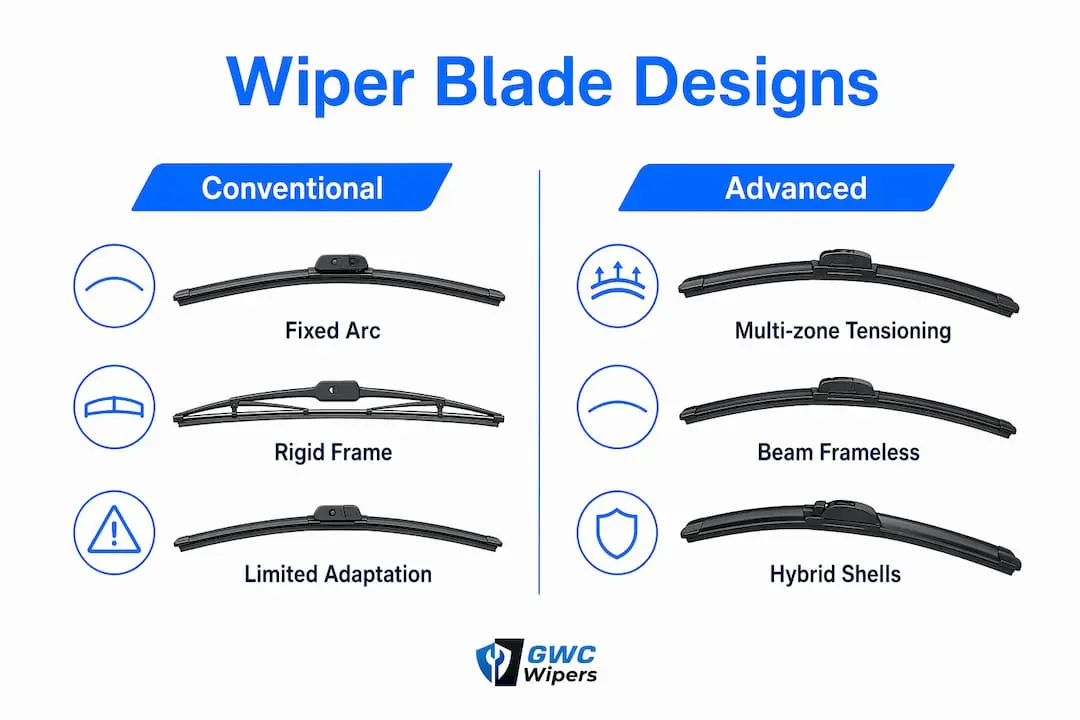
The engineering behind curvature-adaptive blades has advanced considerably in 2025 and 2026. Three core design approaches now define the premium segment: multi-zone tensioning, beam construction, and hybrid architecture.
Multi-zone tensioning
High-quality blades use multi-zone tensioning with varied pressures along the blade length, for example 2.2 lbs at the centre and 1.8 lbs at the edges, to match windshield curvature and deliver uniform contact. This matters because a windshield is not uniformly curved. The centre tends to be flatter, while the edges curve more steeply. A blade applying equal pressure everywhere will either press too hard in the middle or too lightly at the edges. Multi-zone tensioning solves this by engineering different spring rates into different sections of the blade.
Beam and frameless construction
Frameless beam blades use continuous spring steel spines that conform dynamically to the windshield’s surface, eliminating the rigid frame that limits a conventional blade’s ability to flex. The spine acts as a distributed spring across the full blade length, maintaining contact even as the windshield curvature changes through the arc of each sweep. The shift toward beam blades in 2025 and 2026 is driven by their superior conformity to curved glass and aerodynamic designs that use wind pressure to maintain contact at highway speeds.
Hybrid blades
Hybrid wiper blades combine internal support structures with aerodynamic shells to better conform to windshield curvature and resist wind lift. The internal frame provides the structural rigidity of a conventional blade, while the outer shell channels airflow to press the blade downward rather than lift it. This makes hybrids particularly effective on vehicles where aerodynamic forces at speed are a concern, such as utes and larger SUVs.
| Blade type | Curvature conformity | Best suited for |
|---|---|---|
| Conventional framed | Low, fixed arc only | Older vehicles with simple windshield curves |
| Beam (frameless) | High, dynamic flex along full length | Modern sedans, SUVs, steeply raked glass |
| Hybrid | Medium to high, structured flex with aero shell | Utes, larger vehicles, highway driving |
Pro Tip: For vehicles manufactured after 2018, a beam or hybrid blade will almost always outperform a conventional framed blade on curvature conformity. Check your vehicle’s windshield rake angle before selecting a replacement type.
Understanding flexible wiper design in more depth will help you appreciate why the spine material and tension distribution matter as much as the rubber compound itself.
How does windshield geometry variation affect blade selection?
Not all windshields are created equal, and the curvature requirements across vehicle types vary dramatically. This is where generic, one-size-fits-all blades consistently fall short.
Modern passenger vehicles, particularly European models from Mercedes-Benz and BMW, feature steeply raked windshields with compound curves that change angle across both the horizontal and vertical axes. A blade engineered for a flat or mildly curved windshield will make contact in the centre but lift at the edges within the first few sweeps. Vehicle-specific blade curvature engineering is critical for premium brands like Mercedes-Benz because interchangeable blade length alone is not sufficient for optimal visibility.
At the other end of the spectrum, buses and commercial vehicles present a different challenge entirely. Multi-pivot arms and saddle-shaped blades in bus wipers provide uniform pressure on large, highly curved windshields, preventing streaking and lift at high speeds. A standard passenger car blade placed on a bus windshield would fail to clear the glass beyond a narrow central strip.
For Australian drivers, the practical implications are clear:
- Toyota HiLux and Ranger owners need blades matched to the relatively flat, wide windshields of dual-cab utes, where blade length and moderate curvature are the primary concerns
- Mazda3 and Toyota Camry owners face more pronounced windshield rake and benefit from beam blades with dynamic flex
- Mercedes-Benz and BMW owners require vehicle-specific blades engineered for the precise curvature of European glass geometries, where a generic aftermarket blade will almost certainly underperform
Installation quality also affects how well even a correctly curved blade performs. Incorrect seating on wiper arms can render curvature-compatible blades ineffective due to uneven contact. A blade that sits at even a slight angle to the arm pivot will distribute pressure unevenly across its length, reintroducing the same edge lift problems that the correct curvature was designed to prevent.
What should you do when selecting and maintaining wiper blades?
Selecting the right blade for your vehicle’s windshield curvature is straightforward when you follow a clear process. Maintenance and replacement timing are equally important, particularly in Australian conditions where UV exposure and heat accelerate rubber degradation.
- Match blade type to windshield geometry. Use your vehicle’s make, model, and year to identify the correct blade profile. A vehicle selector tool removes the guesswork and prevents the most common mistake: buying by length alone.
- Inspect for curvature mismatch symptoms. Edge streaking, chattering, and uncleared corners are the three signs that your current blade’s arc does not match your windshield. Do not assume the rubber is simply worn out before checking the fit.
- Replace on schedule, adjusted for climate. Standard replacement intervals run 6 to 12 months, but in harsh UV environments this extends to 10 to 14 months depending on blade material and storage conditions. In Queensland and Western Australia, where UV intensity is extreme, inspect blades every six months regardless of visible wear.
- Check installation alignment after fitting. Run the wipers briefly after installation and observe the contact pattern across the full sweep. Uneven contact at the edges indicates the blade is not seated correctly on the arm. This final check catches curvature mismatch failures that are otherwise invisible until the next heavy rain.
- Consider aerodynamic performance at speed. If you regularly drive at highway speeds, prioritise beam or hybrid blades with aerodynamic spoilers. Flat blade technology uses integrated tension systems to maintain even pressure and enhance performance compared to traditional framed blades, particularly above 80 km/h where wind lift becomes a real factor.
Pro Tip: In Australian summer conditions, park in shade where possible. Direct sun on a windshield accelerates rubber hardening and causes the blade to lose its pre-formed curvature faster, which is why blades that performed well through winter often fail in the first summer storm.
For guidance on timing your next replacement around Australian seasons, the Australian weather wiper guide from GWC Wipers covers the regional variation in detail.
Key takeaways
Wiper blade curvature is the single most overlooked factor in windshield visibility, and matching it correctly to your vehicle’s glass geometry prevents streaking, edge lift, and uncleared corners that no rubber compound alone can fix.
| Point | Details |
|---|---|
| Curvature determines contact | A blade arc that matches your windshield keeps the full rubber lip on the glass through every sweep. |
| Edge lift is a curvature failure | Streaking at the outer edges signals curvature mismatch, not just worn rubber. |
| Beam blades offer the best conformity | Spring steel spines flex dynamically across the full blade length, outperforming conventional frames on modern curved glass. |
| Vehicle-specific fit matters | Generic blades matched only by length fail on steeply raked or compound-curved windshields. |
| Replace and inspect on schedule | Check blades every six months in high UV regions and run a contact check after every installation. |
Why curvature is the detail most drivers get wrong
I have seen the same mistake repeated across thousands of wiper blade purchases: drivers buy by length, fit the blade, and assume the job is done. The blade sweeps. The rubber looks fine. But the outer edges of the windshield stay wet in heavy rain, and the driver assumes it is just a bad storm. It is not. It is a curvature problem that a correct blade would have solved immediately.
The transition from conventional framed blades to beam and hybrid designs is the most significant shift in wiper technology in two decades. The reason is not marketing. It is physics. A rigid frame can only approximate one fixed arc. A spring steel spine conforms to whatever curve the glass presents at each point in the sweep. For the compound curves of a modern windshield, that difference is the gap between a clear view and a dangerous one.
My practical advice: treat blade selection the same way you treat tyre selection. You would not fit a tyre that is the right diameter but the wrong profile for your vehicle. The same logic applies here. Length is necessary but not sufficient. Curvature profile, blade construction, and installation alignment are what actually determine whether your wipers work when you need them most.
For anyone running a fleet or managing multiple vehicles, the investment in vehicle-specific premium blades pays back in reduced replacement frequency and, more importantly, in driver safety. The regular replacement guide from GWC Wipers is worth sharing with any driver who still thinks wipers are a set-and-forget item.
— Faisal
Premium blades engineered for your vehicle’s exact curvature
GWC Wipers designs and supplies premium wiper blades built to match the specific windshield geometry of Australian vehicles, from everyday Toyotas to precision-engineered European models.
If you drive a Mercedes-Benz, the curvature requirements of your windshield are among the most demanding of any passenger vehicle on Australian roads. GWC Wipers’ Mercedes-Benz B Class blades and Mercedes-Benz M Class blades are engineered specifically for those glass profiles, with a perfect fit guarantee, free shipping across Australia, and a 12-month warranty. For Toyota owners, the Toyota wiper blade range covers all popular models with the same curvature-matched precision. Use the vehicle selector tool on the GWC Wipers site to find the exact blade for your make, model, and year.
FAQ
What is wiper blade curvature and why does it matter?
Wiper blade curvature is the pre-formed arc built into a blade to match the shape of your windshield. Without the correct curvature, the blade loses contact at the edges, causing streaking and uncleared corners regardless of blade length.
How do I know if my wiper blade curvature is wrong?
Streaking along the outer edges of the windshield, chattering during each sweep, and persistent wet patches in the corners are the primary signs of curvature mismatch. These symptoms appear even when the rubber lip looks undamaged.
Are beam blades better than conventional blades for curved windshields?
Beam blades use a continuous spring steel spine that conforms dynamically to windshield curves, making them significantly better than conventional framed blades on modern vehicles with steeply raked or compound-curved glass.
How often should I replace wiper blades in Australian conditions?
Standard replacement intervals are 6 to 12 months, but in high UV regions such as Queensland and Western Australia, inspect blades every six months. Harsh UV exposure can degrade rubber and alter the blade’s pre-formed curvature faster than in cooler climates.
Do premium vehicles like Mercedes-Benz need specific wiper blade curvature?
Yes. Vehicle-specific curvature engineering is critical for Mercedes-Benz and similar European models because their windshields feature compound curves that generic blades matched only by length cannot accommodate effectively.