
Does a Wiper Spoiler Fix Highway Lift? A Four Step Check in Australia
A correctly fitted spoiler on a wiper blade reduces aerodynamic lift at highway speeds and typically improves visibility in wet weather, provided the rubber and fitment are sound. If lift or streaking continues after checking those two things, the spoiler design alone will not fix it. The sections below explain how to diagnose the problem, when an aerodynamic blade helps and when the real issue is fitment or wear.
TL;DR:
- A properly fitted spoiler reduces aerodynamic lift at highway speeds, improving contact, reducing streaking, noise, and crosswind flutter if the rubber and fitment are correct.
- Spoiler design alone cannot fix streaks caused by worn rubber, incorrect blade length, or damaged windscreens, which are the most common issues.
- Regularly inspect and replace worn rubber, ensure correct blade length and fitment, and confirm proper seating before considering aerodynamic upgrades.
- The benefit of spoilers is most noticeable at high speeds, especially in crosswinds, but they depend on proper blade condition and fitting for optimal performance.
- Upgrading to a matched, vehicle-specific blade with a spoiler is most effective after ruling out fitment or wear issues as the cause of wiping problems.
Table of Contents
- How a spoiler on a wiper blade works
- What you actually get from a spoiler-equipped blade
- When a spoiler helps, and when it won’t fix the problem
- How to check if you need one, and how to fit it correctly
- Keeping aerodynamic blades performing over time
- Behind this guide: Faisal and GWC Wipers
- The honest take on wiper spoilers
- Fit the right blade the first time with GWC Wipers
- FAQ
- Sources
How a spoiler on a wiper blade works
A wiper blade spoiler is the small raised or curved ridge running along the top of the blade’s spine. Its job is simple: as air moves over the windscreen at speed, the spoiler’s shape redirects some of that airflow downward, pressing the blade harder against the glass instead of letting wind pressure lift it away. Without that shape, a flat blade edge behaves a bit like a tiny aerofoil in reverse. At low speed the effect is negligible, but as velocity climbs, the air passing over a plain blade can create enough upward force to lift sections of it clear of the windscreen, especially near the tip.
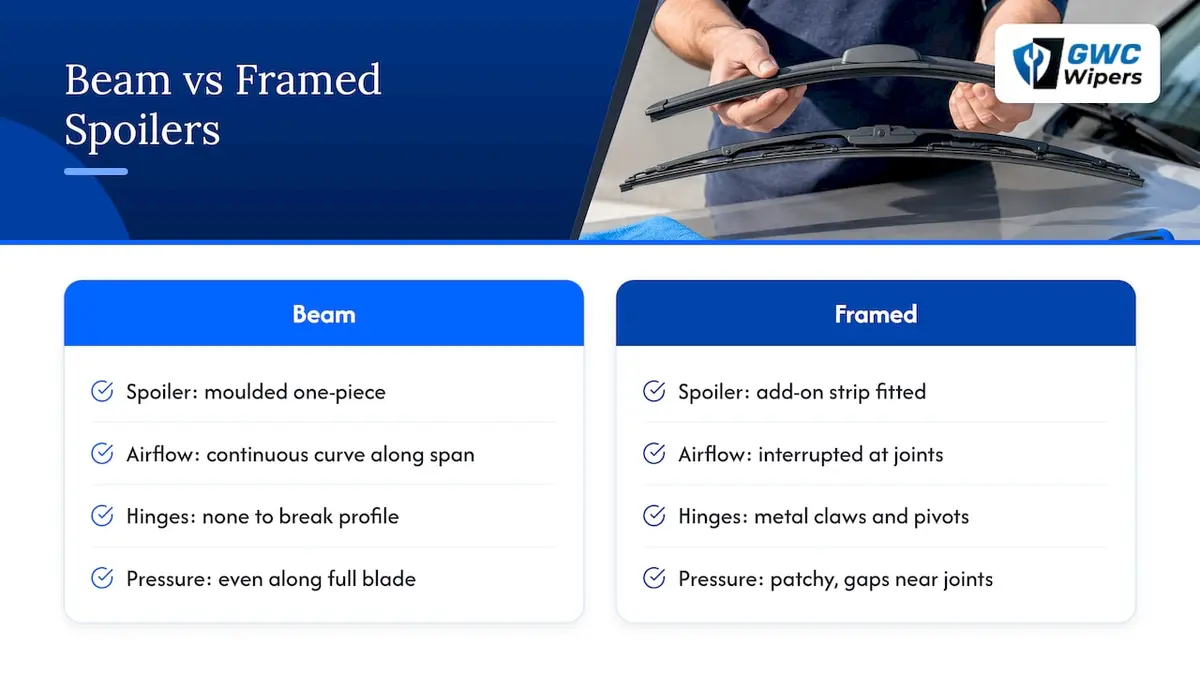
There are two common ways manufacturers build this into a blade. One-piece beam blades integrate the spoiler shape into a single moulded rubber and spine unit, so the curve is continuous along the whole length. Conventional framed blades, the type with metal claws and pivoting joints, sometimes have a separate add-on spoiler strip fitted to the top edge. Beam-style spoiler blades tend to manage airflow more evenly because there are no joints breaking up the profile, while framed blades with add-on spoilers can still lift at the hinge points even with the spoiler fitted, since the frame itself disrupts airflow.
Speed is the variable that matters most here. On suburban roads, aerodynamic lift is rarely noticeable, but out on the highway, where Australian speed limits commonly sit around highway speed limits in the low hundreds of kilometres per hour, the forces acting on a wiper blade change substantially. Crosswinds compound the effect further: a side gust hitting the blade at an angle can lift one end while the other stays planted, producing a visible flutter or a patchy, incomplete wipe. This is distinct from the blade simply being worn. A spoiler is designed to counter that specific aerodynamic force, not to compensate for a tired rubber edge or a loose arm.
Blade length matters too, since a longer driver-side blade has more surface exposed to airflow, and a well-shaped spoiler needs to maintain pressure along the full span, not just at the centre.
What you actually get from a spoiler-equipped blade
The practical payoff of a well-designed spoiler blade shows up in a handful of specific ways, and they’re worth separating out because not every driver needs all of them equally.
- Better contact at speed: with less lift, the blade stays flatter against the glass during highway driving, which cuts down on the streaky, half-cleared arcs that appear when a blade bounces or skips.
- Less chatter and noise: lift is often what causes that juddering, scraping sound at speed. A blade that stays seated glides more quietly.
- More even pressure across the blade: this reduces the chance of partial wipes, where one section clears the glass and another leaves a smear, and can help the rubber wear more evenly over its service life.
- Steadier performance in crosswinds and during overtaking: a sudden gust from a passing truck or a side wind on an open stretch of road is exactly when lift is most likely, and a properly shaped spoiler is designed for that moment.
- Potentially less washer fluid used: a blade that clears in one pass rather than several reduces how often you need to trigger the washer jets.
Pro Tip: If your blade chatters mainly above 80 to 90 km/h but is silent in town, lift is the likely cause, not blade age.
Australian regulatory guidance is a useful anchor here. The NHVIM windscreen and window standard sets out that wipers must keep the swept area clear enough that the driver’s view is not impaired, which is the baseline every blade, spoiler or not, needs to meet before anything else matters.
None of these benefits arrive automatically just because a blade has a spoiler moulded into it. The gains depend entirely on the blade being the right length for the arm, correctly seated, and in reasonable condition. A spoiler on a worn or poorly fitted blade will still underperform.
When a spoiler helps, and when it won’t fix the problem
A spoiler addresses one specific issue: aerodynamic lift caused by airflow over the blade at speed. It cannot correct other common causes of poor wiping, and spending money on an aerodynamic upgrade without ruling those out first is a common way to waste a purchase.
- Hardened or worn rubber: once the wiping edge has gone glassy, cracked or lost its square edge, no spoiler shape will restore a clean wipe. Replacement is the only fix, and this is the single most common cause of streaking mistaken for a lift problem.
- Incorrect blade length or arm geometry: a blade that’s too long or too short for the arm, or an arm with worn pivot points, creates gaps and uneven contact pressure that aerodynamics alone cannot close. Crosswind flutter that starts at one specific point along the blade is usually an arm geometry issue, not a lift issue, and needs the arm checked or the correct-length blade fitted.
- Windscreen damage in the swept area: chips, deep scratches or heavy crazing in the primary vision area disrupt contact regardless of blade design. The NHVIM section 10 standard treats this kind of damage as a visibility issue in its own right, separate from wiper performance, and it needs repair or replacement before a new blade is assessed. Products designed to protect the glass from chips in the first place, such as windscreen protection films, can reduce how often this becomes a problem.
- Vehicle-specific limits: some windscreens, particularly larger or more steeply raked ones on utes and SUVs, are simply harder to keep fully planted at speed no matter how good the spoiler profile is. The gain from upgrading is real but smaller on these shapes than on a compact sedan.
Rule of thumb: if the problem started suddenly, suspect fitment or damage. If it’s been gradual over months, suspect rubber wear.
How to check if you need one, and how to fit it correctly
Before buying anything, run through a short diagnostic. It takes a few minutes and saves you from fixing the wrong problem.
- Inspect the rubber edge: run a finger along the wiping edge, looking for cracking, flattening or a glassy shine. Any of these mean replacement regardless of spoiler design.
- Clean the glass and blade: residue, road film or wax build-up causes streaking that looks like a performance fault but isn’t.
- Run a low-speed sweep test: with the engine off and the washer on, check that the blade wipes cleanly end to end with no skipped patches.
- Do a safe highway test: on a familiar stretch of road at normal highway speed, in light rain or with the washer jets, watch for flutter, a lifting tip, or one section of the blade losing contact. That pattern points to lift, not wear.
Once you’ve confirmed lift is the actual issue, choosing the right replacement comes down to a few details:
- Length: the correct length for your specific vehicle, not just “close enough”, since an oversized blade is more prone to tip lift.
- Profile: a one-piece beam design with an integrated spoiler generally manages airflow more consistently than a framed blade with an add-on strip.
- Adapter type: the clip or hook fitting needs to match your arm exactly, which is where a vehicle-specific selector removes the guesswork. Some retailers provide vehicle lookup tools for wiper blades, and the Ford Ranger wiper blade hub is an example of how a make and model specific page may show the correct length and adapter for that vehicle.
Most of these blades are designed for tool-free DIY fitting, following the clip or pin sequence that came with the vehicle originally. If your arm has visible play, corrosion or a bent pivot, that’s worth a mechanic’s attention before you fit any new blade, since no blade design compensates for a damaged arm.
Keeping aerodynamic blades performing over time
A spoiler blade only keeps delivering its benefit if it’s looked after the same way any wiper blade needs to be.
- Check the rubber monthly: look for cracking, flattening or a dull, glassy edge, and replace at the first sign rather than waiting for streaking to get obvious.
- Clean the glass and the blade edge together: a soft cloth with glass cleaner on both removes film that causes streaking independent of blade design.
- Watch for streaking straight after fitting a new blade: this is almost always leftover manufacturing residue or dust on the glass, not a fault with the blade. Wiping both surfaces down again usually clears it within a pass or two.
- Lift blades off the glass during long parked periods in direct sun, where practical, to reduce the rubber taking a set against hot glass, which can cause uneven contact later.
Pro Tip: If a brand-new blade streaks in the same spot every time, check that it’s fully seated and clipped at both ends before assuming it’s faulty.
Transport WA’s driver safety guidance lists wiper condition and washer fluid among standard pre-drive checks, and treating it as a routine habit rather than a reactive fix is the simplest way to catch wear before it becomes a visibility problem. Roadworthiness checks under current vehicle standards also require wipers and washers to be in working order, so keeping on top of this is as much about compliance as comfort.
Behind this guide: Faisal and GWC Wipers
This guide was written by Faisal, drawing on practical knowledge of wiper blade design, aerodynamics and fitment across the vehicle range GWC Wipers supports. The focus throughout has been on distinguishing genuine aerodynamic fixes from problems that look similar but have a different cause, since that distinction is where most buying decisions go wrong.
GWC Wipers builds its product range around that same diagnostic approach. The site’s vehicle selector matches blade length and adapter type to specific makes and models, backed by a fitment guarantee so the part you order is the part your arm actually takes. Blades are designed for all-weather use rather than just wet-season performance, and every purchase carries a 12 month warranty with Australian-based after-sales support.
Readers wanting more detail on related topics can see how windscreen clarity affects overall driving safety, run through a practical pre-drive checklist, or read more on why blade quality itself matters before assuming aerodynamics is the answer.
The honest take on wiper spoilers
The aerodynamic spoiler on a wiper blade earns its place on paper, and the physics behind it is sound. The overstatement creeps in when it’s marketed as a cure-all. Most streaking and noise complaints trace back to rubber condition or a mismatched blade length, not lift, and no amount of clever profile shaping fixes a hardened edge or the wrong fitment.
The useful discipline is sequencing: rule out wear and fitment first, because those are cheaper and more common faults, and only reach for an aerodynamic upgrade once you’ve confirmed lift is genuinely the cause, typically through a flutter or patchy wipe that only appears at highway speed. Treat the spoiler as a targeted fix for a specific symptom, not a blanket upgrade, and you’ll spend less money solving the actual problem rather than the one you assumed you had.
— Faisal
Fit the right blade the first time with GWC Wipers
If lift, streaking or noise at highway speed has you second-guessing your current blades, the fastest fix is making sure you’re starting with the correct part for your vehicle. Some wiper blade brands feature aerodynamic profiles suited to local conditions and offer fit guarantees tied to the customer’s exact make, model and year.
- Browse the full wiper blades range to compare profiles and sizes.
- Use a model page such as the Ford Ranger hub to see how vehicle-specific selection works.
- Order with Australia-wide express shipping and a 30-day money-back guarantee if the fit isn’t right.
Confirm your Perfect Fit by make, model and year, then order knowing the blade on your doorstep is the one your arm was built for.
FAQ
What is a spoiler wiper blade?
A spoiler wiper blade has a small raised ridge moulded or fitted along its top edge, shaped to redirect airflow downward and press the blade against the windscreen at speed. It’s most noticeable on one-piece beam-style blades, where the spoiler profile runs continuously along the whole length.
Does a wiper blade spoiler increase horsepower?
No, a wiper blade spoiler has no effect on engine output or horsepower. It only influences the aerodynamic forces acting on the blade itself, helping it stay in contact with the glass at highway speed.
Why do some drivers flip their wipers up?
Drivers sometimes flip wiper arms up away from the glass to stop the rubber taking a set against hot windscreens during long parking periods, particularly in direct sun. It’s a storage habit rather than anything related to the spoiler or aerodynamic design.
Does a wiper blade spoiler actually help?
Yes, a correctly designed spoiler reduces aerodynamic lift and improves blade contact at highway speeds, which can cut down on streaking and chatter. The benefit only shows up fully when the blade’s rubber condition and fitment are already correct, since a spoiler can’t compensate for a worn edge or the wrong length.
Sources
- NHVIM V3.2 section 10 – Windscreens and windows
- Driving techniques for safer drivers: a guide for learner drivers (Transport WA)
- Australian vehicle standards and legislation – windscreen and wipers