
Keep Wipers Flat in Crosswinds: Fit Guaranteed Blades for Australia

An aerodynamic, low-profile blade with an integrated spoiler and a verified contact-force profile is your best defence against crosswind lift. It’s engineered to hug the glass at speed instead of fighting the airflow. Before you buy, check the spec sheet for chatter-onset speed data, or use a vehicle-fit selector to confirm the arm preload and blade curvature actually suit your windscreen.
TL;DR:
- The most effective wiper blades for crosswind stability feature a verified contact-force profile, aerodynamic spoiler, and a low-profile design tailored to your vehicle’s windscreen angle.
- Lift force peaks near a 50° wipe angle and increases rapidly above 100 km/h, especially on raked windscreens exceeding 35 degrees, causing chatter and streaking.
- Blade design elements such as a high-performance spoiler, a reinforced spine, and silicone material significantly reduce uplift and maintain consistent contact in turbulent crosswinds.
- Validated wind-tunnel or CFD test data and vehicle-specific fitment are essential to ensure real-world high-speed performance and prevent lift-related failures.
- Proper installation, including arm tension, adapter fit, and correct curvature, is crucial to maximize aerodynamic advantages and avoid early lift-off or chatter.
Table of Contents
- How crosswinds and vehicle aerodynamics create lift and chatter
- Blade design and material features that reduce uplift in crosswinds
- Checklist: what to check when buying wiper blades for crosswind stability
- Quick in-vehicle checks and installation tips to verify crosswind stability
- Why fit and design matter more than marketing claims
- Buy now: use the GWC vehicle selector to find an aerodynamic blade for your car
- The gap between spoiler marketing and real crosswind performance
- Sources
- FAQ
How crosswinds and vehicle aerodynamics create lift and chatter
A wiper blade doesn’t fail because it’s worn out. It fails because the air moving over your windscreen is pushing against it harder than the arm spring can resist. That’s the mechanism behind most crosswind wiper stability complaints, and it’s worth understanding before you shop for a replacement.
Lift builds roughly with the square of your speed, so the aerodynamic force pushing against the blade increases significantly as speed doubles. That’s why a blade that feels rock-solid around town can start chattering the moment you hit the motorway.
The angle at which the blade meets oncoming air matters just as much as speed. Experimental measurements across passenger cars, minivans and RVs found wiper lift forces peak near a 50° incidence angle, regardless of vehicle type. That’s roughly the mid-sweep position on most windscreens, which explains why streaking often shows up right in the centre of the wipe rather than at the edges.
Your windscreen’s rake angle changes how exposed the blade is to begin with. Steeper, more raked windscreens increase effective blade exposure to oncoming airflow, and windscreens angled beyond roughly 35 degrees, common on modern sedans and SUVs with sloped A-pillars, create the toughest environment for keeping a blade pinned to the glass.
Speed zones to watch for on the road:
- 60 to 100 km/h: marginal contact loss, usually shows as light streaking at highway on-ramps
- 100 to 140 km/h: critical zone where full lift and chatter become likely, especially in gusty crosswinds
- Rotation angle near 45° combined with speeds around 18 m/s (about 65 km/h) often marks peak lift for many blade geometries
Blade design and material features that reduce uplift in crosswinds
Not every blade on the shelf handles this the same way, and the differences come down to a handful of design choices you can actually check before buying.
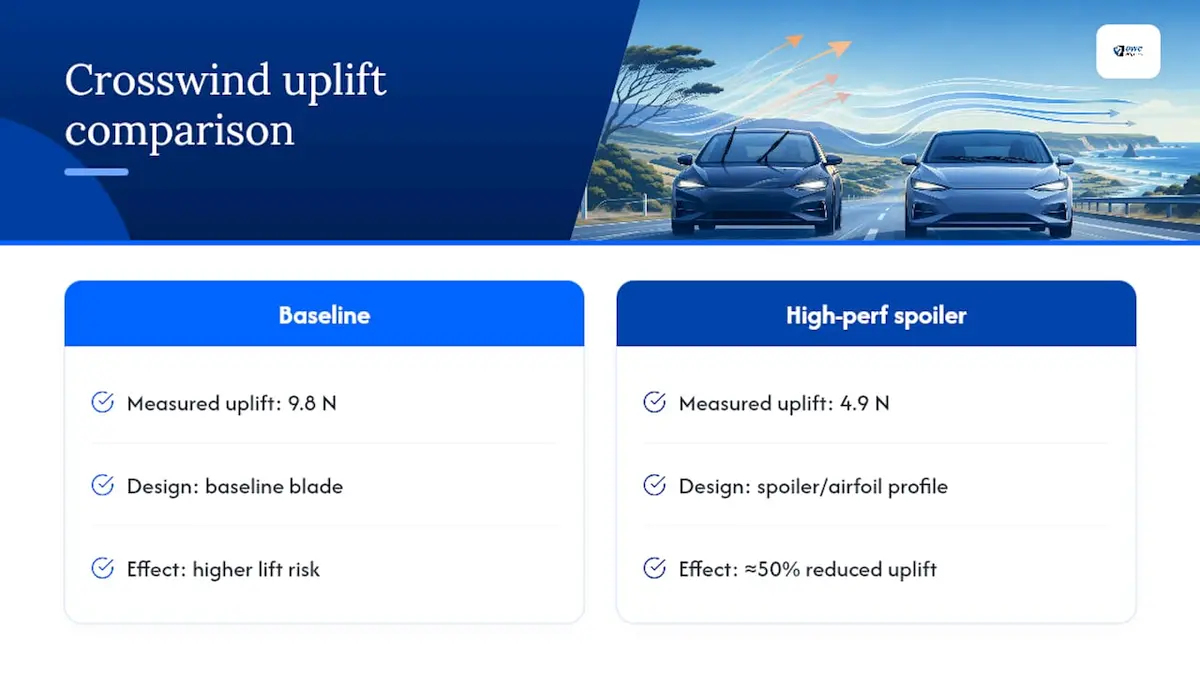
Spoiler and airfoil profiles. A well-shaped spoiler redirects airflow over the blade’s spine instead of letting it catch underneath and pry the blade off the glass. The effect is measurable: one comparative test recorded uplift dropping from 9.8 N to 4.9 N with a high-performance spoiler versus a baseline blade, roughly halving the force working against contact. The shape and height of that spoiler aren’t cosmetic. Get the curvature wrong and you can introduce turbulence instead of taming it.
Low-profile frameless versus beam-frame. Frameless, low-profile designs sit closer to the glass and present a smaller cross-section to oncoming air, which generally makes them steadier in turbulent crosswinds than older beam-frame styles with exposed joints and hinges that catch the wind.
Material choice. Silicone holds its shape and contact pressure more consistently across temperature swings, which helps it resist the fine vibration that turns into chatter. Natural rubber remains a strong performer in dusty, abrasive conditions where its self-cleaning wipe action matters more than ultimate stability at speed.

Structural features. A reinforced spine spreads pressure evenly along the blade rather than concentrating it at the pivot points, and preassembled adapters with correctly tensioned springs matter more than most drivers realise, because an under-tensioned arm will let even a well-designed blade lift.
Pro Tip: If a product page shows a contact-force curve or wind-tunnel result, that’s a stronger signal of real crosswind wiper stability than any amount of marketing copy about “aerodynamic design.”
Checklist: what to check when buying wiper blades for crosswind stability
Shopping for replacement blades online means you can’t feel the material or test the spring tension in person, so lean on the spec sheet instead.
- Look for validated test data. Wind-tunnel or CFD-tested designs that reduce lift and improve high-speed wiping performance are the gold standard. Combined geometric changes to spoiler curvature, height and connection type consistently outperform single tweaks in these studies, so a blade that’s had its whole profile engineered together is a safer bet than one with a bolt-on spoiler.
- Confirm vehicle-specific fit. A blade sized or curved wrong for your windscreen defeats any aerodynamic advantage it has on paper. Use a vehicle selector tool matched to your make, model and year rather than guessing from a generic size chart.
- Check the adapter and arm compatibility. Preassembled adapters that lock in without extra hardware reduce the chance of a loose fit introducing vibration at speed.
- Verify material and temperature specs. Confirm the rubber or silicone compound is rated for your climate, since brittle or overly soft material at temperature extremes changes how the edge sits against the glass.
- Check the warranty and return terms. A 30-day trial and 12-month warranty matter here specifically because chatter and lift often only show up on a genuine highway drive, not in the driveway.
Quick in-vehicle checks and installation tips to verify crosswind stability
A new blade is only as stable as its installation, so run through these steps before you trust it on a wet motorway.
- Inspect the arm before fitting. Check for rust, play in the pivot, or a spring that’s lost tension. A tired arm will undermine even the best blade.
- Confirm adapter seating. Push the adapter home until you hear or feel it click, and give the blade a firm tug to check it’s locked, not just resting in place.
- Match length and curvature to spec. An oversized blade catches more wind than it needs to; an undersized one leaves gaps at the edges of the sweep.
- Run an incremental speed test. On a safe stretch of road, build speed gradually and watch for intermittent streaking (early warning) versus a full visible lift-off (serious problem needing immediate attention).
- Fix minor issues before replacing. Retighten or reseat the adapter, and if your arm accepts it, fit a higher-preload insert. If chatter persists at highway speed after that, it’s time for a new blade or a chat with a professional.
Pro Tip: Test in a genuine crosswind, not just a headwind. A gusty side road near open paddocks or a bridge crossing will expose lift problems a straight motorway run might hide.
Why fit and design matter more than marketing claims
Com designs and manufactures premium wiper blades specifically for the aerodynamic and weather demands Australian drivers face, from coastal crosswinds to inland heat. The curvature and profile of a blade directly shapes how well it resists lift, which is why fit isn’t a minor detail, it’s the foundation of crosswind wiper stability.
The vehicle selector tool and detailed DIY guides help you confirm the correct blade and adapter for your exact make, model and year before you commit to a purchase. Getting that match wrong is one of the most common reasons a supposedly aerodynamic blade still lifts or rattles at speed.
Because real-world performance can differ from a spec sheet, every order carries a fit guarantee, a 30-day money-back window, a 12-month warranty and free shipping across Australia, so you can test a blade on your own roads without much financial risk.
Buy now: use the GWC vehicle selector to find an aerodynamic blade for your car
You’ve now got the technical picture: crosswind lift peaks around a 50° wipe angle, it builds fast above 100 km/h, and the fix is a low-profile blade with a validated spoiler and correct arm tension. The next step is matching that design to your actual car, and that’s what our vehicle selector at Com is built for.
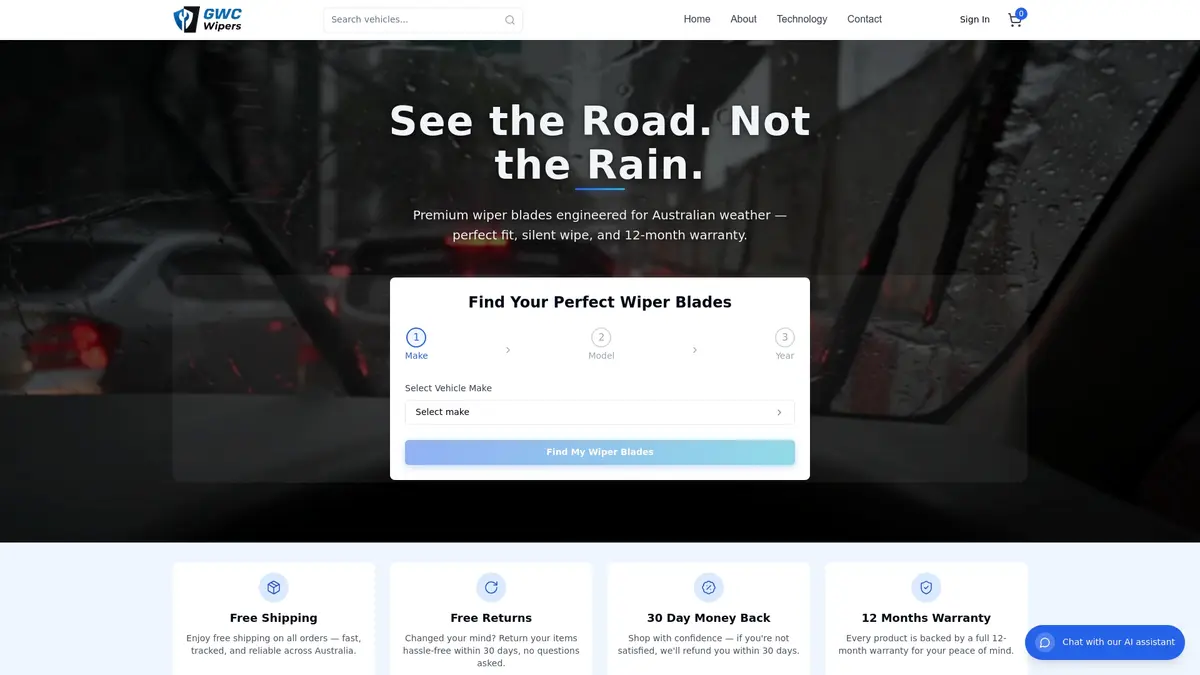
Enter your make, model and year and the tool returns the exact blade and preassembled adapter combination engineered for your windscreen, no guessing which “universal fit” option might work. Every blade ships free across Australia, backed by a 30-day money-back guarantee and a 12-month warranty, so you can run the incremental speed test from this guide with confidence. If you drive a Mercedes-Benz, our dedicated Mercedes-Benz collection covers the GLC-Class, GLE-Class and B-Class ranges, while Toyota owners will find fitment across the brand’s most common models. Start with your vehicle selector search and get a blade built to stay flat against the glass, not fight the wind above it.
The gap between spoiler marketing and real crosswind performance
Every wiper brand claims “aerodynamic design” on the packaging. Almost none show you the number that actually matters, the contact-force curve at highway speed, or the chatter-onset velocity where the blade starts losing the fight with the wind. That gap between the claim and the evidence is where most buyers get burned.
I’d argue the industry has trained drivers to shop for the wrong thing. We look at blade shape because it’s visible, and we ignore preload and adapter fit because they’re invisible until the blade is already lifting on the motorway. But the research is fairly consistent on this point: geometry changes alone rarely fix chatter, it’s the combination of spoiler curvature, connection type and uniform contact force that does the work. A gorgeous spoiler profile bolted onto a loose, under-tensioned arm will still chatter at 110 km/h.
The other underrated factor is windscreen rake. Two cars can run the identical blade and get completely different crosswind wiper stability results because one has a 30° screen and the other has a 40° screen catching far more air. That’s not something a universal-fit blade can solve, no matter how good its spoiler is. Fit-first thinking, matching the blade and adapter to the actual vehicle before worrying about brand reputation, will do more for your visibility in a storm than chasing the flashiest spoiler on the shelf.
— Faisal
Sources
The claims in this guide draw on published aerodynamic and wiper-performance research rather than marketing copy alone.
The foundational finding on peak uplift angle comes from The study of the wiper lift characteristics at high-speed, which measured lift across multiple vehicle types and found forces peaking near 50° incidence. Numerical and physical wind-tunnel testing on spoiler curvature, height and connection design appears in Numerical and experimental investigation of wiper system performance at high speeds, while the quantified 9.8 N to 4.9 N uplift reduction with a redesigned spoiler is documented in Improving aerodynamic performance for a reliable wiper system. Readers wanting broader replacement fundamentals can also consult this windshield wiper replacement guide.
- The study of the wiper lift characteristics at high-speed (1999)
- Improving aerodynamic performance for a reliable wiper system (researchgate page)
FAQ
What causes wiper blades to lift in crosswinds?
Aerodynamic lift builds as airflow passes under the blade at certain wipe angles, peaking near a 50° incidence angle, and the force increases sharply as vehicle speed rises above 100 km/h.
Do silicone wiper blades handle crosswinds better than rubber?
Silicone tends to hold its shape and contact pressure more consistently at speed and across temperature changes, which helps resist chatter, while natural rubber remains a strong choice in dusty or abrasive conditions.
What speed do wiper blades typically start chattering in wind?
Marginal contact loss often begins around 60 to 100 km/h, with the critical zone for full lift and chatter sitting between 100 and 140 km/h, depending on windscreen angle and blade design.
Does windscreen angle really affect wiper stability?
Yes. Steeper, more raked windscreens increase the blade’s exposure to oncoming airflow, making crosswind stability harder to achieve on vehicles with sloped A-pillars.
How do I know if a wiper blade is designed to resist crosswind lift?
Check for a documented spoiler profile, wind-tunnel or CFD test data, and vehicle-specific fitment. Com’s blades pair an aerodynamic profile with a vehicle selector tool to confirm the correct fit for your car before you buy.