
Best Wiper Blade Brands in Australia: How to Choose in 2026
There is no single best wiper blade brand for every car. Bosch, Valeo, Michelin, Trico and GWC all make blades that clear a windscreen well when they fit the vehicle properly, and all of them can disappoint when they don’t. For most Australian drivers, the right choice comes down to four things: exact fit for your make, model and year, construction that copes with UV and heat, a warranty you can actually claim on, and a price that makes sense over a 6 to 12 month life.
This guide compares the brands you are most likely to see, explains what to check on each, and shows where GWC Wipers sits among them. We sell wiper blades, so we say so up front, and we have tried to keep the comparison to things you can verify yourself.
TL;DR
- Correct fit matters more than the badge on the box. A premium blade that sits poorly on your arm will streak or chatter.
- Australian sun hardens rubber quickly, so plan to replace blades every 6 to 12 months whatever the brand.
- Compare brands on fitment accuracy, rubber and frame construction, warranty terms and cost per year, not on marketing claims.
- GWC blades are vehicle-specific, come with a fit guarantee, free shipping across Australia, a 30-day money-back guarantee and a 12-month warranty.
- Use a vehicle lookup by make, model and year before you buy any brand.
Table of Contents
- Why fit beats brand
- What to compare when you choose a brand
- The main wiper blade brands compared
- Bosch vs GWC wiper blades
- Why Australian conditions change the answer
- Modern cars and the camera behind the glass
- A simple way to choose in five steps
- How to tell your blades are finished
- Our perspective
- Find the right fit for your car
- FAQ
- Sources
Why fit beats brand
Ask a mechanic which wiper brand is best and the honest answer is usually a question: what are you driving? A blade is a small part of a system. The arm, its spring tension, the connector type, the curve of the glass and the length of each blade all decide how the rubber meets the windscreen.
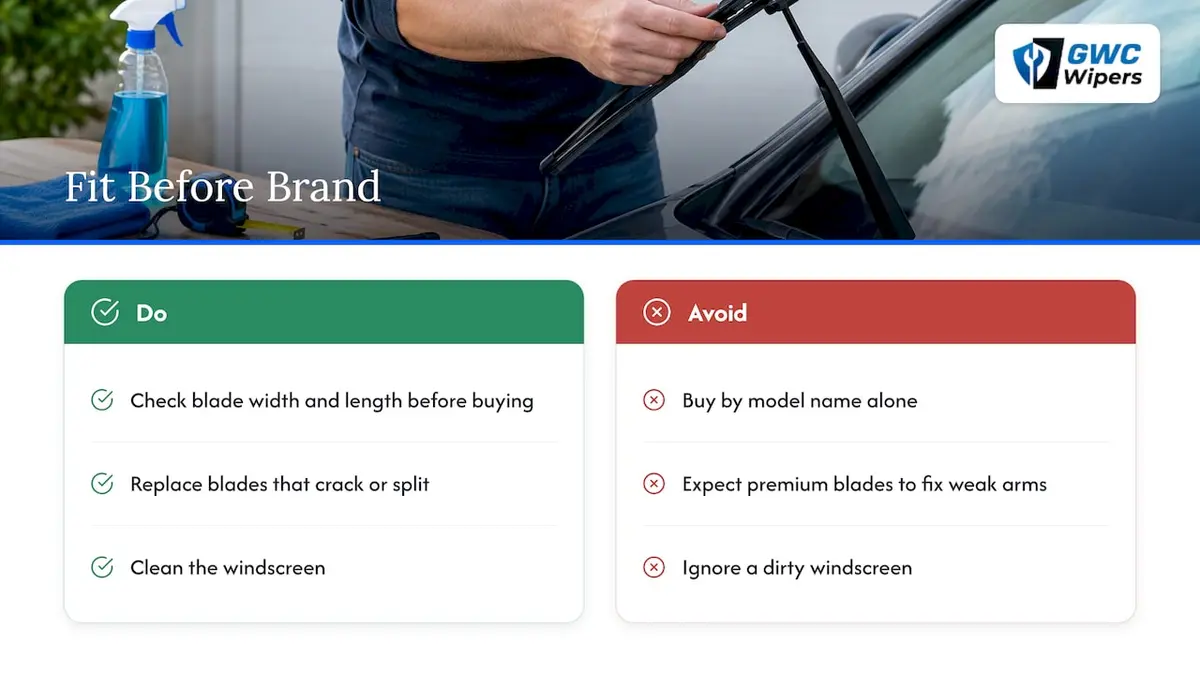
RACV makes a related point in its maintenance advice: blades wear through use and sun exposure, and cracking or splitting is a sign they need replacing. A premium blade also cannot make up for a weak arm spring or a dirty windscreen, which is why cleaning the glass belongs on the same checklist.
Fit varies more than most people expect. A Toyota Prado 120 series (2002 to 2009), a Ford Ranger from 2022 to 2025, a Mazda CX-5 from 2017 to 2025 and a Toyota RAV4 from 2019 to 2025 each have their own blade lengths and arm connections, and a change of generation within a model name can change both. Buying by model name alone is how people end up with a blade that is 50 mm too long or an adapter that doesn’t lock.
RACQ’s guide to changing wiper blades tells drivers to check the blade width and length are correct before buying. That is the step that matters, and it applies to every brand below.
What to compare when you choose a brand
Five criteria separate one wiper blade from another in practice.
Fitment accuracy
Does the brand list your exact make, model and year, and does it stand behind that listing if the blade turns out wrong? Some brands sell a small number of universal sizes with a bag of adapters. Others publish vehicle-specific lists. Universal blades can work, but you take on the job of matching length, connector and arm.
Construction
Look at the frame type (conventional with exposed brackets, beam or flat, or hybrid), how pressure is spread along the rubber, and whether metal parts are treated against corrosion. Flat designs tend to sit lower and resist lifting at speed, while conventional frames are common on older vehicles and some commercial vehicles. Your owner’s manual or a fitment lookup will tell you what your car was built for.
Rubber compound
Natural rubber, synthetic blends and silicone-treated rubber behave differently. Heat and UV harden any rubber over time. The first sign is often chatter or skipping rather than streaks, which is worth knowing when you decide whether a blade is finished.
Warranty
A warranty tells you what the maker expects, but read the terms. Check how long it runs, whether you need proof of purchase, and whether wear from sun and heat is covered. Retail listings for the same product can carry different terms, so confirm on the page you are buying from.
Value over a year
Because blades need regular replacement, compare the cost of a pair per year rather than the sticker price. If you want a primer on typical outlay, see our page on wiper blade cost in Australia.
The main wiper blade brands compared
The table below is a buyer’s checklist, not a ranking. We have not scored the brands, because performance depends on your car and conditions. Check each brand’s current range and terms before you buy.
| Brand | Where you typically find it | What to check before buying |
|---|---|---|
| Bosch | Auto parts chains, workshops, online stores | Which line suits your car (conventional or flat), and the retailer’s warranty terms |
| Valeo | Parts retailers and some workshops | Whether your vehicle appears in the fitment guide and which connector is included |
| Michelin | Parts retailers and some supermarkets | Range for your model, since lists can be narrower than for older brands |
| Trico | Parts retailers and workshops | Frame style that matches your car, and the size chart for your year |
| GWC Wipers | Online at gwcwipers.com.au | Your make, model and year in the vehicle selector |
Bosch
Bosch is probably the most recognised name on Australian shelves, and it has long been a popular recommendation in forum threads. It sells several lines, so the useful question is which one matches your car’s original design. Buying the cheapest Bosch line is not the same as buying the one that suits your arm and glass. Warranty terms differ between retailers, so read the one on your receipt.
Valeo
Valeo is a major supplier to car makers, and its blades are widely sold as replacement parts. People often ask whether Valeo or Bosch is better. On a vehicle where both brands offer a correct, listed fit, the gap is usually smaller than the gap between a correctly fitted and a poorly fitted blade. Choose the one that lists your exact vehicle and has terms you are happy with.
Michelin
Michelin is best known for tyres but also sells wiper blades. As with any brand extending beyond its core product, check that your vehicle is listed and that the style (flat or conventional) matches what your car uses.
Trico
Trico is a long-established wiper specialist. Its range covers many frame styles, so use the size chart for your year and model, and confirm the connector type before ordering.
GWC Wipers
GWC designs, manufactures and sells blades for Australian conditions. Our vehicle-specific range covers more than 2,500 models, and each blade uses natural rubber, segmented pressure distribution, an aerodynamic profile and corrosion-resistant parts. Adapters come preassembled, so installation is tool-free for most vehicles, and a guide is included.
What sets us apart is how we sell rather than a claim about being the top performer. You pick your make, model and year, and we back that match with a fit guarantee. Delivery is free across Australia, and there is a 30-day money-back guarantee and a 12-month warranty.
Bosch vs GWC wiper blades
This is one of the most common comparisons, so here it is in plain terms.
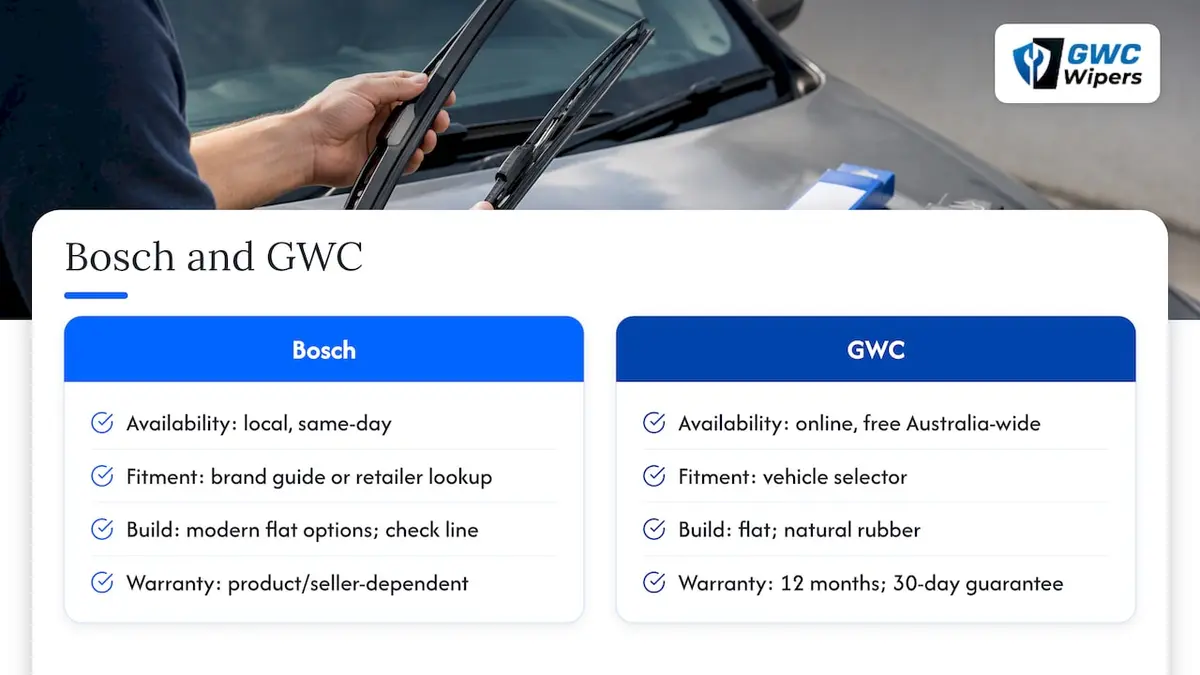
Availability. Bosch is easy to pick up on the same day from a local store if you are stuck. GWC is sold online and shipped free Australia-wide, which suits drivers who would rather order the right size than guess at a counter.
Fitment approach. Our process starts with the vehicle selector, so the blade is chosen for your make, model and year. With any Bosch product, you should do the same by checking the brand’s fitment guide or the retailer’s lookup.
Construction. Both brands offer modern flat-style options. Our blades combine natural rubber with segmented pressure distribution and corrosion-resistant parts. For Bosch, compare the specification of the exact line you are considering.
Warranty and returns. Ours is 12 months, with a 30-day money-back guarantee. Bosch terms depend on the product and the seller, so compare them side by side on the day you buy.
Value. Prices vary by vehicle and over time, so compare the pair price for your car, including delivery, at the time of purchase.
If you want a broader look at types, our guide to windscreen wiper blade types for Australian drivers explains the options in more depth.
Why Australian conditions change the answer
Blade rubber degrades faster under strong sun and heat than in cooler climates. That is why the usual advice from motoring clubs is a 6 to 12 month cycle, not a mileage figure. RACQ says blades need replacing about every six months, while RACV points to winter as a good time to replace worn wipers because rain, mist and road spray reduce visibility.
That has a practical effect on brand choice. A blade priced at a premium but replaced twice a year may cost more over time than a well-made, well-fitted blade at a fair price. It also means a long warranty matters less than a blade you will happily replace on schedule.
There is a legal side too. Under Rule 45 of the Australian Vehicle Standards Rules, a motor vehicle with a windscreen must have at least one windscreen wiper unless the driver can get an adequate view of the road ahead without one. The NSW Government also advises drivers to regularly check that wipers and washers are working. If you are unsure what your state requires, check with your state or territory transport authority.
Modern cars and the camera behind the glass
Many newer vehicles mount cameras and sensors behind the windscreen for lane-keeping and other driver-assistance features. RACV notes that worn wipers can leave streaks and miss sections of the windscreen, and a smeared patch in front of a camera is more than an annoyance. If your car has these systems, replace blades on time, and keep the glass clean.
Oily film is a common cause of smearing that no blade will fix. A good glass-cleaning routine helps, and this streak-free glass cleaning method is written for UK owners but the technique carries over. Check any product you use against your vehicle manual, and avoid putting household detergent in the washer reservoir, because RACV-sourced guidance warns it can speed up rubber wear and affect the pump.
A simple way to choose in five steps
- Find your exact vehicle. Note make, model, year and body style. A Mazda CX-5 from 2017 to 2025 and an earlier CX-5 are not the same fit.
- Check the size and connector. Use a lookup, your manual or the old blade. Measure only if you have to.
- Pick a construction style that matches your car. Flat or conventional, and how many blades the car uses.
- Compare warranty and returns. Read the terms on the page you are buying from.
- Replace as a pair. RACV advises changing blades in pairs so the sweep stays consistent across the glass.
Our guide to choosing wiper blades that fit your vehicle walks through this process with more detail, and our article on vehicle-specific wiper blades explains why a tailored fit helps.
How to tell your blades are finished
You do not need to wait for a failed roadworthy check. Watch for streaks, smears, squeaking or skipping across the glass, or a rubber edge that looks cracked or split. Chatter often shows up before streaking because the edge has hardened. Our six-step test for signs of bad wipers helps you decide whether to clean or replace.
When you test blades by hand, lift the arm gently. Letting a metal arm snap back onto the glass is an easy way to crack a windscreen, so put a folded towel under the arm as a buffer.
Our perspective
We started from a simple observation: most wiper complaints are really fit complaints. A blade that is a little too long catches the pillar. A blade with the wrong adapter wobbles on the arm. A blade that is right on paper but baked by a summer on the dash chatters in the first shower.
So we built around fit and Australian conditions. Every blade we sell is chosen by vehicle, with adapters preassembled so you can fit it without tools. We use natural rubber and segmented pressure distribution because we want even contact across the glass, and corrosion-resistant parts because coastal air and heat are hard on metal.
We will not tell you we are the best brand for every car, because that would not be honest. What we will say is that if you give us your make, model and year, we stand behind the fit, and you have 30 days to change your mind. If you are weighing us against Bosch, Valeo, Michelin or Trico, use the criteria above and pick the one that fits your car and your budget.
— Faisal
Find the right fit for your car
Our wiper blade range is organised by vehicle, and you can browse by brand, including Toyota and Mercedes-Benz. Shipping is free across Australia, and every order is covered by a 30-day money-back guarantee and a 12-month warranty. Express shipping is also available. Start on the GWC Wipers home page and enter your make, model and year.
FAQ
Which car wipers are the best?
The best wipers are the ones made for your exact vehicle and replaced on time. Brand matters less than fit, arm tension and a clean windscreen. Compare fitment accuracy, construction and warranty for your car, then buy from a seller that backs the match.
Is Valeo or Bosch better?
Neither wins on every car. Both are respected, and both sell several lines with different frame styles. Choose the line that lists your make, model and year, and compare warranty terms from the seller you are buying from.
How often should I replace wiper blades in Australia?
Motoring clubs recommend roughly every 6 to 12 months, because sun and heat harden rubber. RACQ says about every six months. Replace sooner if you notice streaks, squeaking, skipping or a cracked edge.
Do I need to replace both blades?
Yes, in most cases. RACV advises replacing them as a pair so the sweep pattern and pressure stay balanced. A new blade next to a worn one can leave the driver’s side clear and the passenger side smeared.
Can a wiper blade be too good for my car?
A premium blade will not fix a weak arm spring or a dirty windscreen, and a blade that needs forcing onto the arm is the wrong blade. Fit and condition of the arm come first.
Sources
- RACV: How to maintain your car in winter cold weather
- RACV: Easy DIY car maintenance tips and safety checks
- RACQ: How to change wiper blades
- Australian Vehicle Standards Rules, Rule 45: Windscreen wipers and washers
- NSW Government: Roadworthiness