
Honda Accord Wiper Blades Size Australia: How to Choose
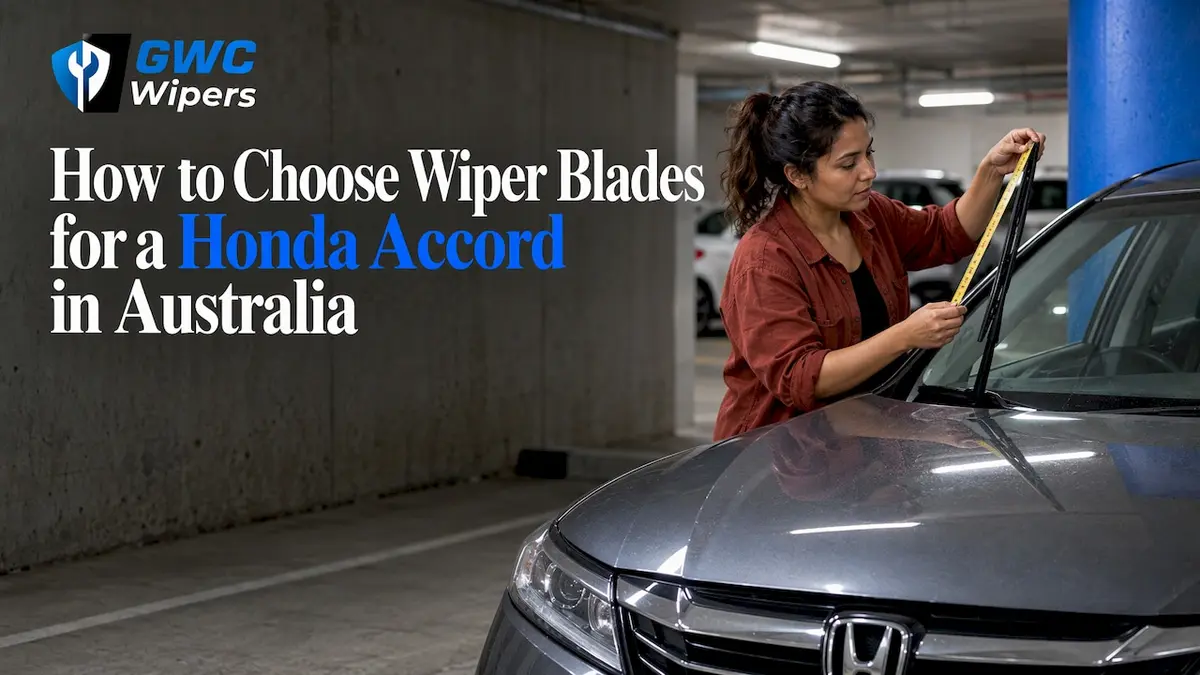
The right wiper blade size for your Honda Accord depends on the generation and body style, and the quickest way to get it right is to pick your car by make, model and year. Sizes change between Accord generations, and the driver and passenger blades are usually different lengths, so a single “Accord size” does not exist. Get the fitment right first, then choose the blade type that suits Australian sun, heat and heavy rain.
This guide walks through fitment by generation, how the main wiper options compare, what to check before you buy, and how to fit and replace them yourself. To skip straight to your car, find your car by make, model and year and order a Perfect Fit set.
TL;DR
- Accord wiper sizes differ by generation, and the driver and passenger blades are not the same length, so choose by exact model year rather than by “Accord”.
- Check the arm connector type as well as the length. A blade of the right size with the wrong adapter will not seat properly.
- Beam and aerodynamic blades suit most daily drivers. Natural rubber gives a quiet, even wipe, and heat and UV are what wear blades out fastest in Australia.
- Brands such as Bosch and Trico are common choices. Compare them on fit, noise, wipe quality and warranty, not on reputation alone.
- At GWC Wipers you select your Accord by make, model and year, and the set arrives with preassembled adapters for tool-free fitting.
Table of Contents
- Why Accord wiper sizes are not one number
- Honda Accord wiper blades by generation
- What to check before you choose replacement wipers
- Comparing your options: GWC, Bosch, Trico and others
- Wiping performance in Australian conditions
- How to install Accord wiper blades yourself
- When your Accord wipers need replacing
- Our view on choosing Accord blades
- Order a Perfect Fit set for your Accord
- FAQ
- Sources
Why Accord wiper sizes are not one number
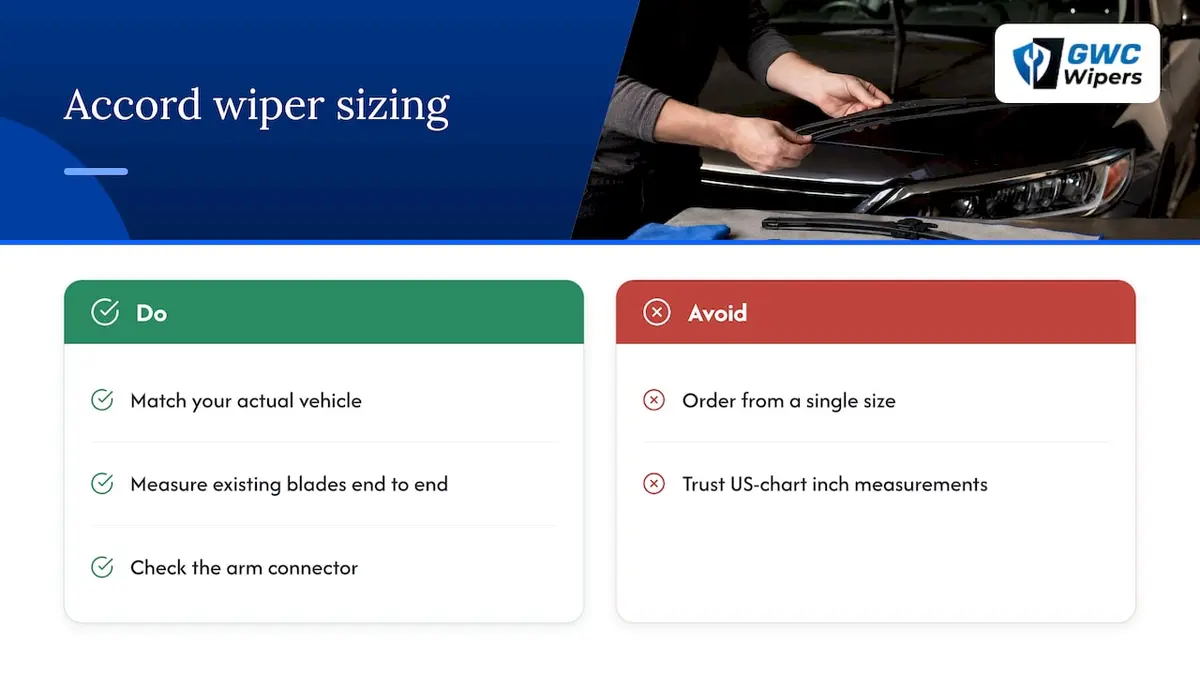
The Accord has been sold in Australia across several generations, and each one has its own windscreen shape, wiper arm layout and blade lengths. Even within a generation, a sedan and a wagon, or a facelifted car, can carry different blades. That is why searching for a single size and ordering from it often ends with a blade that is too long, too short or fitted with the wrong connector.
A blade that is too long can foul the windscreen pillar or the other blade at the top of its sweep. One that is too short leaves a wider unwiped band, which matters most on the driver’s side where your line of sight sits. A correct fit sweeps the full intended arc, parks cleanly and holds even pressure.
Be careful with size charts from overseas sites. Many list United States models, which can differ from the Accords sold here, so an inch measurement from a US chart is not a safe guide for an Australian-delivered car. The reliable method is to match your actual vehicle, or to measure your existing blades from end to end and check the connector at the arm.
Honda Accord wiper blades by generation
We list fitment by generation, so you can land on the page for your exact car. Each page below is for the model years shown in its title.
| Accord generation | Model years on our page | Fitment page |
|---|---|---|
| 6th gen | 1998 to 2002 | Accord 1998 to 2002 wiper blades |
| 7th gen | 2003 to 2007 | Accord 2003 to 2007 wiper blades |
| 8th gen | From 2008 | Accord 2008 wiper blades |
| 9th gen | 2013 to 2023 | Accord 2013 to 2023 wiper blades |
| 11th gen | 2024 to 2025 | Accord 2024 wiper blades |
If you are not sure which generation you own, the build or compliance plate and your registration papers give the year. The shape of the car helps too: the jump between the squarer early-2000s cars and the later, more swept-back windscreens is obvious once you look at the wipers parked on the glass. For all Accords in one place, see our Honda Accord wiper blades page.
What to check before you choose replacement wipers
Three checks stop most wrong orders.
1. Length of each blade
Measure the old blades from one end of the rubber and frame to the other, driver and passenger separately. Write both down. If your Accord has a rear wiper, which depends on the body style, measure that too, because it is a separate part.
2. Arm connector type
Look at where the blade meets the arm. Most modern cars use a hook or a push-button style connection, while older cars can use a different fitting. The blade needs the matching adapter. This is the part that people get wrong when they buy by length alone. Our sets come with preassembled adapters chosen for the vehicle you select, which is the point of choosing by make, model and year.
3. Blade type
The main types you will see are:
- Conventional (frame) blades: a metal frame with several pressure points. They are familiar and often the cheapest, but the frame can collect grime and can lift at speed.
- Beam (flat) blades: one piece with tensioned steel inside the blade, giving even pressure along the glass. One review of tested blades notes that beam blades use tensioned steel to apply even pressure across the windscreen.
- Hybrid blades: a frame covered by an aerodynamic shell, trying to combine the best of both.
- Silicone blades: a different rubber compound that some owners find lasts longer in sun, usually at a higher cost.
For most Accord owners who drive daily, a beam or aerodynamic design in natural rubber is a sensible default. Our blades use natural rubber with segmented pressure distribution and an aerodynamic profile, designed to keep contact even across the arc of the sweep.
Comparing your options: GWC, Bosch, Trico and others
Owners searching for the right Accord blade usually end up weighing a handful of names. Here is how they compare on the things that matter, using what is publicly known and what we claim for our own product. Check each brand’s current fitment guide for your exact car, because ranges and part numbers change.
| Option | Fitment approach | Blade design | What owners weigh up |
|---|---|---|---|
| GWC Wipers | Vehicle selector by make, model and year, with a Perfect Fit guarantee | Natural rubber, segmented pressure distribution, aerodynamic design, corrosion resistance | Free shipping across Australia, 30-day money-back guarantee, 12-month warranty, preassembled adapters |
| Bosch | Printed and online application guides | Several lines, including the ICON beam range | Widely stocked, strong reputation in tests, chosen often by owners who want a known name |
| Trico | Application guides for local models | Conventional, beam and hybrid lines | Another familiar name in Australian stores, often available over the counter |
| Generic or supermarket blades | Often a universal fit with adapters | Usually conventional or basic flat | Convenient in a pinch, but fit and pressure can be less precise |
| Refillable aero blades | Fitted by generation | Reusable frame with replaceable rubbers | Lets you swap the rubber only, and takes a little more effort at refill time |
What independent testing says about Bosch
In a 2026 test of seven blades, the Bosch ICON ranked first and was the quietest blade tested, using tension-spring technology for uniform pressure. That is one reviewer’s result from the United States, on that reviewer’s cars, and it is a useful signal about the design rather than a guarantee for your Accord on an Australian summer road. It also shows what to look for in any blade: quiet operation and even pressure.
What the Australian conditions change
An Australian review perspective on wipers is that prolonged sunlight and heat are major failure factors. According to Home Muse’s Australian wiper review, beam blades tend to hold more even contact as they age, while silicone can last longer in sun but usually costs more. That matches what we see: the rubber edge hardens, cracks and starts to chatter long before the frame fails.
Silicone versus natural rubber
Some owners on forums say silicone lasts longer and copes better with temperature swings, but those are individual experiences and not a controlled comparison. Natural rubber has a softer edge that tends to wipe cleanly and quietly when it is fresh, and it is what we use because it delivers a clear, even wipe from the first day. Whichever material you choose, the blade only performs if it is the right size and sits flat on the glass.
How to compare any two blades fairly
When you compare brands, ask the same five questions of each:
- Is the fitment confirmed for my exact year and body style?
- Does it come with the right adapter for my arm, or do I need to source one?
- Is the wipe quiet and streak-free in heavy rain?
- What is the warranty, and is there a return window if it does not fit?
- How much is delivery to my address?
Fitment and returns often decide it. If a blade is wrong for the car, the best rubber in the world does not help.
Wiping performance in Australian conditions
Australian drivers ask a lot of their wipers. In summer, windscreens can sit in strong sun for hours, and UV exposure and heat dry out rubber. In storms and tropical downpours you need blades that clear a lot of water at once without lifting at highway speed. In coastal and southern areas, salt, grit and cold mornings add their own wear, and some drivers in alpine regions face frost and snow.
Three design features matter most for the Accord.
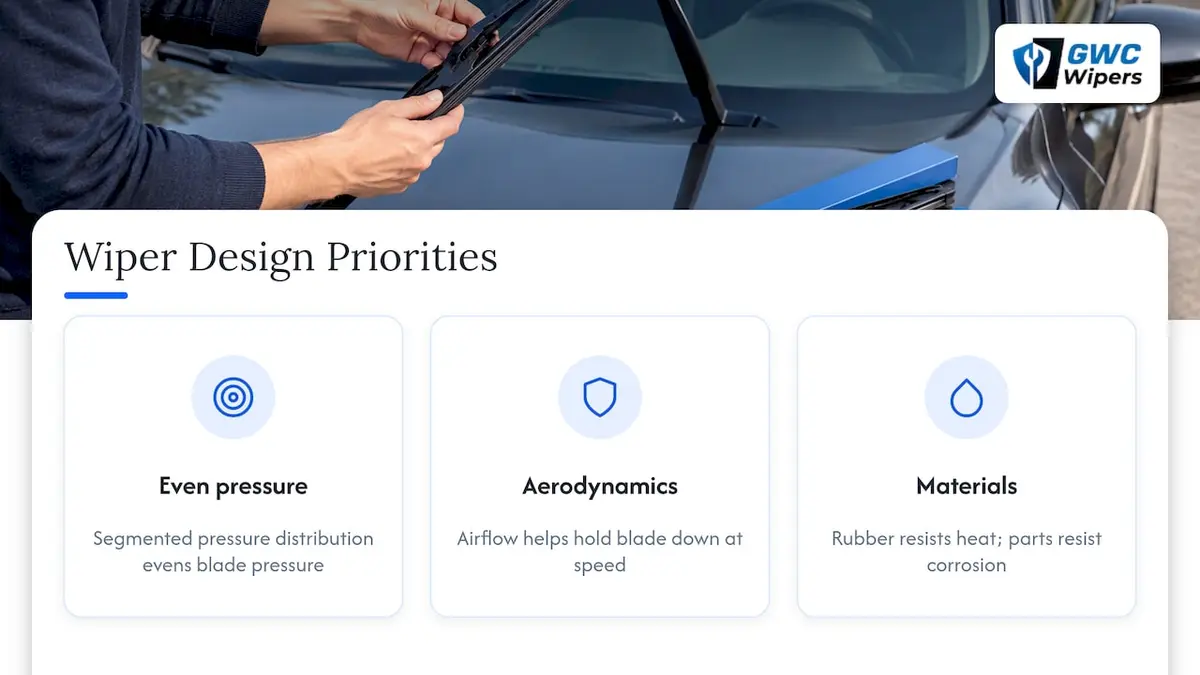
Even pressure. If the blade presses harder in the middle than at the ends, you get streaks or unwiped patches at the edge of the sweep. Segmented pressure distribution and tensioned steel in a beam blade are two ways of solving this.
Aerodynamics. At speed, air can lift a poorly shaped blade off the glass. An aerodynamic profile uses airflow to help hold the blade down, which helps in a highway downpour.
Material and corrosion resistance. Rubber that resists heat hardening wipes longer, and parts that resist corrosion keep working after seasons of rain and salt air. We design our blades for Australian weather extremes, and that is a design goal we stand behind with a 12-month warranty.
If you want to protect the rubber trims around your windscreen and keep the glass in good condition between blade changes, a dedicated product for ceramic care for rubber and vinyl is one option to consider alongside regular cleaning of the blades.
How to install Accord wiper blades yourself
Replacing blades takes a few minutes and does not need tools when the adapters are preassembled. The general method is the same for most Accords.
- Lift the arm. Pull the wiper arm away from the windscreen until it stands up on its own. Place a folded towel on the glass under it in case it springs back.
- Release the old blade. Find the release tab or button at the connector, press it and slide the blade down and off the hook.
- Compare the new blade. Hold the old and new blades side by side to confirm the length and the connector match. This is the quickest way to catch a wrong part before you fit it.
- Slide on the new blade. Line the adapter up with the hook and push until you hear or feel it click.
- Lower the arm gently. Do not let it snap back onto the glass.
- Test. Wet the windscreen, run the wipers and watch for streaks, chatter or a blade that does not park properly.
Replace the driver and passenger blades together so they wear and wipe evenly. Detailed guides come with our sets, and our Australian support team can help if a connector looks different from what you expected. For more on getting longer life from blades on this make, see our Honda wiper lifespan guide.
When your Accord wipers need replacing
Do not wait for a failed roadworthy check or a wet night to find out. Replace the blades when you notice any of these:
- Streaks or a hazy film that does not clear after cleaning the glass.
- Chattering, squeaking or skipping across the screen.
- Visible splits, cracks or a hardened, curled rubber edge.
- Unwiped bands in the same place on every sweep.
- Blades that lift off the glass at speed.
Most owners notice the change after a hot summer, when the rubber has had months of UV and heat. Wiper blades are generally treated as wear items. Honda Australia states that wiper blades are excluded from its 5 Low Price Servicing as wear-and-tear items, so you should plan to buy them yourself. The same page notes that its standard scheduled services include checks of wiper operation and condition, so ask your dealer to look at them at each service.
We have also written on why replacing Honda wipers improves your safety and on improving wiper performance for Aussie drivers if you want to fix streaking before you replace anything. Cleaning the glass and wiping the blade edge with a damp cloth sometimes clears minor smearing, but a hardened or split edge needs a new blade.
Our view on choosing Accord blades
Most wiper problems we hear about are not about the rubber at all. They are about fit. A blade that is a few centimetres out, or that has the wrong adapter, will never sit flat, and the best compound in the world will still streak.
That is why we built GWC Wipers around a vehicle selector. You choose your make, model and year, and we match the blades and adapters for that car. Our Perfect Fit guarantee exists because we would rather you spend two minutes picking your Accord than an afternoon returning the wrong set.
We design for Australian weather. Natural rubber, segmented pressure distribution and an aerodynamic shape are there to keep the wipe even, quiet and clear through summer heat and heavy rain. Fitting is tool-free for most cars, and a 30-day money-back guarantee and 12-month warranty sit behind every order.
For an Accord owner who wants a dependable daily driver with clear vision in every downpour, we think that is the combination that matters: right fit, right design, and local support if you need it.
Faisal
Order a Perfect Fit set for your Accord
If you are ready to replace your blades, go to our wiper blades range, choose Honda, then Accord, then your model year. The selector confirms the fitment for your car, and your set ships free across Australia with preassembled adapters and a guide for tool-free fitting. Express shipping is available if you need them sooner.
You are covered by a 30-day money-back guarantee and a 12-month warranty. Start from the GWC Wipers home page or go straight to the page for your Accord generation in the table above.
FAQ
What size wiper blades does a Honda Accord take in Australia?
It depends on the generation and body style, and the driver and passenger blades are different lengths. Sizes quoted on overseas charts may not match the Accords sold here. Select your car by make, model and year on our site, or measure your existing blades and check the connector before buying.
Are Bosch wiper blades the right choice for an Accord?
Bosch is a well-known name, and its ICON blade placed first in a 2026 independent test for quietness and even pressure. Whether it suits you depends on confirmed fitment for your year, the adapter and the warranty. Compare it against other options on those points before you decide.
Can I fit Accord wiper blades myself?
Yes, in most cases. You lift the arm, release the old blade at the connector, slide the new one on until it clicks and lower the arm. Our sets come with preassembled adapters and detailed guides, so you do not need tools.
How often should I replace my Accord’s wipers?
Replace them when you see streaks, chatter, splits or unwiped patches rather than on a fixed date. Strong sun and heat shorten blade life in Australia, so many owners check them after summer. Honda Australia treats blades as a wear item, so they are not covered in its capped-price servicing.
What if the blades I order do not fit?
With our Perfect Fit guarantee, we stand behind the fitment for the car you select. You also have a 30-day money-back guarantee. If something looks different at the connector, contact our Australian support team before you fit it.
Sources
- Best Wiper Blades 2026: 7 Blades Tested to Avoid Streaks
- Best Wiper Blades Australia: What Fits and What Lasts
- 5 Low Price Services at $199, Honda Australia
- Ceramic care for vinyl and rubber