
Honda wiper performance improvement guide for Aussie drivers

TL;DR:
- Maintaining and upgrading Honda wiper systems ensures clear visibility and safety in Australian weather. Regular inspections, proper tools, and seasonal preparations help prevent streaking, chatter, and failure. Using model-specific blades and inserts extends wiper life and improves performance year-round.
Improving Honda wiper performance is defined as maintaining, upgrading, and correctly fitting your wiper system to deliver clear, streak-free visibility in every Australian weather condition. Your wipers are a direct safety component, not a convenience feature. Automotive Service Excellence (ASE) guidelines recommend replacing blades every 6–12 months and inspecting them quarterly for cracking, streaking, or edge peeling. Australia’s UV intensity, summer heat, and sudden heavy downpours accelerate blade wear faster than many drivers expect. Getting this right means understanding the full system, not just the rubber on the glass.
What tools and materials do you need for Honda wiper maintenance?
Gathering the right supplies before you start saves time and prevents damage. You do not need a workshop full of equipment. Most Honda wiper maintenance and replacement tasks require only a handful of items you can source locally or online.
Tools and supplies checklist:
- Soft microfibre cloths and a clean towel to protect your bonnet and windscreen
- Automotive-grade glass cleaner or isopropyl alcohol solution (70% or higher)
- Silicone-based blade conditioner or wax to extend rubber life
- Lubricant spray rated for automotive pivot points (such as white lithium grease)
- Replacement blade inserts or full wiper blades matched to your Honda model and year
- Washer fluid rated for Australian conditions, or a cold-weather formula rated to at least -20°C for alpine or southern regions
- A small flathead screwdriver for releasing blade clips
- Needle-nose pliers for handling wiper insert rails
Blade type reference by material:
| Material | Best suited for | Typical lifespan |
|---|---|---|
| Natural rubber | Mild, temperate climates | 6–12 months |
| Silicone | UV exposure, heat, and cold | Up to 40% longer than rubber |
| Hybrid (rubber + silicone coating) | All-weather Australian conditions | 12–18 months |
One detail many Honda owners overlook is washer fluid quality. A cheap, water-based fluid leaves a film on the windscreen that causes streaking even with brand-new blades. Use a quality automotive washer fluid with a detergent formula to keep the glass clean between wipes.

How to perform regular Honda wiper maintenance and inspection
Quarterly inspections are the single most effective habit for maintaining wiper performance. Most wiper failures do not happen suddenly. They build gradually through cracked rubber, dirty blade claws, and neglected pivot points.
Using Honda’s service mode safely
Many modern Honda models park their wipers below the bonnet line. Manually lifting these arms risks scratching your paint and bending the mechanism. Honda’s service mode raises the arms to a safe, upright position for cleaning and inspection. To activate it, turn your ignition to the “on” position without starting the engine, switch the wiper stalk to the intermittent setting, then turn the ignition off while the wipers are mid-sweep. The arms will stop in the raised position. Always confirm the correct procedure in your Honda owner’s manual, as steps vary slightly between models.
Inspecting blade edges and cleaning blade claws
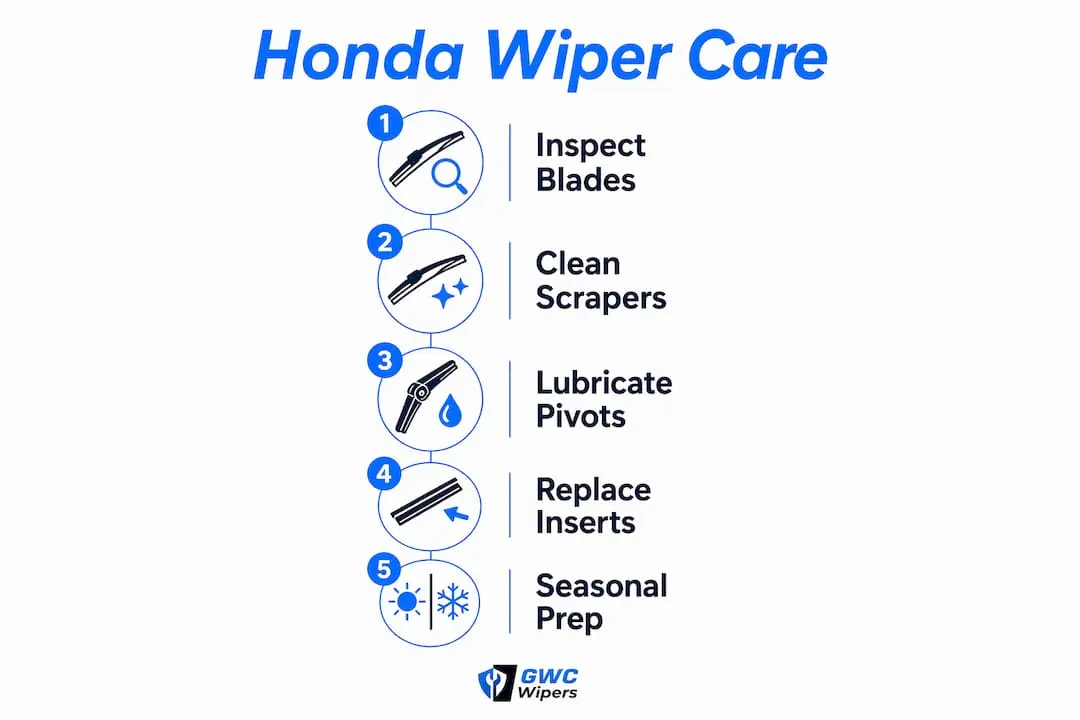
Run a clean cloth along the full length of each blade edge. You are looking for cracks, tears, peeling rubber, or a hardened, glazed surface. Any of these signs means the blade needs replacing. Dirty windscreen film and residue on blade claws are among the most common, overlooked causes of persistent chatter or streaking, even after fitting new blades. Wipe the blade claws thoroughly with isopropyl alcohol to remove built-up grime and wax residue.
Lubricating pivot points and checking linkage tension
Apply a small amount of white lithium grease to each wiper arm pivot point. Stiff or dry pivots cause uneven arm pressure, which leads to skipping and poor contact with the windscreen. Check the linkage tension by pressing each arm gently against the glass. It should spring back firmly. Loose linkage tension is a top-five visibility safety concern that reduces wiping efficiency significantly.
Pro Tip: Clear your washer nozzles every three months using a fine pin or compressed air. Blocked nozzles force you to run dry blades across a dirty windscreen, which damages the rubber edge and scratches the glass.
How to replace Honda wiper blades or blade inserts
Replacing the full blade assembly is not always necessary. Many OEM Honda wiper frames accept insert-only replacements, which take approximately 10–15 minutes per side and cost considerably less than buying complete blades. Knowing which option suits your situation saves money and reduces waste.
Confirming correct blade size for your Honda model
Universal wiper blades frequently fail to conform to Honda’s curved windscreens, causing uneven pressure and poor wiping. Always confirm the correct driver-side and passenger-side blade lengths for your specific Honda model and year before purchasing. Your owner’s manual lists these sizes, or you can use a vehicle selector tool like the one on GWC Wipers to match blades to your car.
Step-by-step blade insert replacement
- Activate Honda’s service mode to raise the wiper arms safely.
- Lay a folded towel on the windscreen beneath each arm to protect the glass.
- Lift the wiper arm away from the screen and locate the blade release tab on the connector.
- Press the tab and slide the old blade assembly off the arm hook.
- If replacing only the insert, flex the blade frame gently and slide out the rubber insert along with its metal rails.
- Transfer the metal rails to the new insert by sliding them into the grooves on each side.
- Slide the new insert into the frame until it clicks and seats fully at both ends.
- Reattach the blade assembly to the arm hook and press until you hear a firm click.
- Repeat on the other side, then deactivate service mode and test at all wiper speeds.
Pro Tip: After fitting new inserts, run the wipers on your highest speed setting with washer fluid for 30 seconds. This seats the rubber evenly and reveals any installation errors before you need the wipers in heavy rain.
Common post-replacement mistakes:
| Mistake | Result | Fix |
|---|---|---|
| Skipping windscreen cleaning | Streaking immediately after fitting | Clean glass with isopropyl alcohol before testing |
| Rails not fully seated in insert | Blade lifts at high speed | Remove insert and reseat rails from both ends |
| Wrong blade length fitted | Uneven wipe pattern | Recheck model-specific sizing and replace |
| Arm snapped back without blade | Cracked windscreen | Always hold the arm when removing the blade |
For a detailed visual walkthrough, the Aussie driver’s insert guide from GWC Wipers covers Honda-specific steps with clear instructions.
What seasonal preparation should Australian Honda owners do?
Australia’s climate swings between extremes. A Honda wiper system that performs well in a mild Sydney autumn can fail badly in a Queensland summer or a Snowy Mountains winter. Seasonal preparation is not optional for reliable visibility year-round.
Summer preparation:
- Fit silicone-based blades before the hot months. Silicone blades resist UV degradation and extreme heat far better than standard rubber, extending usable life by up to 40%.
- Park in shade or use a windscreen sunshade. Direct sun bakes rubber blades and causes them to harden and crack within weeks.
- Check your washer fluid level more frequently. Heat accelerates evaporation and increases the chance of running dry.
- Read the GWC Wipers guide on protecting wipers from heat for Honda-specific summer advice.
Winter preparation:
- Switch to a washer fluid rated to at least -20°C for areas prone to frost, such as the ACT, Victoria’s alpine regions, and Tasmania. Cold-weather washer fluid and a working defroster together prevent ice buildup that stops wiper movement entirely.
- Consider flexible, ice-resistant wiper blades for winter months. These maintain consistent contact pressure across a cold, stiff windscreen.
- Use Honda’s service mode to lift your wiper arms before overnight frosts. This prevents the blades from freezing to the glass and tearing when you switch them on in the morning.
- Check your defroster grid on the rear window and confirm the front demister works properly. A fogged or iced windscreen forces wipers to work against conditions they cannot overcome alone.
Pro Tip: Never pour hot water on a frosted windscreen. The rapid temperature change can crack the glass. Use your defroster and a rated de-icer spray instead, then run the wipers once the ice has softened.
For a full winter vehicle checklist that covers wipers, fluid, and defroster care, the winterise car checklist from Express Lube Haltom is a practical reference.
How do you troubleshoot common Honda wiper performance problems?
Most Honda wiper problems fall into a small number of categories. Identifying the symptom correctly points you to the right fix without unnecessary parts replacement.
Common symptoms and their causes:
- Streaking or smearing: Usually caused by a dirty windscreen, worn blade rubber, or wax residue on the glass. Clean the windscreen thoroughly with isopropyl alcohol and wipe the blade edge before replacing anything.
- Chattering or skipping: Often caused by a bent wiper arm, incorrect blade angle, or dirty blade claws. Check the arm angle and clean the claws. If the arm is bent, straighten it carefully or replace it.
- Squeaking: Typically indicates dry rubber or a dirty windscreen. Apply a small amount of silicone blade conditioner and clean the glass.
- Incomplete wipe pattern: Points to incorrect blade length, loose linkage, or a weak arm spring. Confirm blade sizing and check pivot nut tightness.
- Slow or incomplete sweep: Faulty motor, linkage issues, or clogged components cause slow or incomplete wiping. Lubricate the mechanical linkage and check for obstructions before suspecting the motor.
- No movement or buzzing noise: Indicates a motor or electrical fault. This requires professional diagnosis.
Pro Tip: Tighten the wiper arm pivot nut with a spanner before assuming the motor is faulty. A loose pivot nut is a common cause of weak arm pressure and incomplete sweeps, and it takes under two minutes to fix.
Automotive repair experts emphasise that inspecting the full wiper assembly, not just the blades, is the only reliable way to maintain visibility safety. Blades are the most visible component, but linkage, pivots, nozzles, and the motor all affect how well your system performs.
For a step-by-step installation reference when fitting new blades after troubleshooting, the high-performance wiper installation guide from GWC Wipers covers the full process clearly.
Key takeaways
Consistent Honda wiper maintenance, correct blade selection, and seasonal preparation are the three actions that most reliably improve visibility and safety on Australian roads.
| Point | Details |
|---|---|
| Inspect blades quarterly | Check for cracking, peeling, and streaking every three months, not just when performance drops. |
| Use service mode for maintenance | Activate Honda’s service mode before lifting wiper arms to avoid paint and mechanism damage. |
| Replace inserts, not just full blades | Swapping rubber inserts on OEM frames takes 10–15 minutes and costs significantly less than full blade replacement. |
| Match blades to your model | Universal blades cause uneven pressure on Honda’s curved windscreens; always confirm model-specific sizing. |
| Prepare for Australian seasons | Use silicone blades in summer and cold-rated washer fluid in winter to maintain performance year-round. |
Why I think most Honda owners are getting wiper care backwards
Most drivers replace their wiper blades only after the wipers fail during a downpour. That is the worst possible time to discover a problem. After years of watching this pattern, I am convinced the real issue is that people treat wipers as a reactive purchase rather than a scheduled maintenance item.
The detail that surprises most Honda owners is service mode. A significant number of people have never heard of it, yet it is the single safest way to lift modern Honda wiper arms for cleaning or replacement. Skipping it risks scratching the bonnet or bending the mechanism, which turns a five-minute job into an expensive repair.
The other habit I keep coming back to is insert replacement. Most Honda owners throw away a perfectly good wiper frame because they do not realise the rubber insert slides out and can be replaced separately. That is money left on the table every single time.
Seasonal preparation is where I see the biggest gap between what drivers know and what they do. Fitting silicone blades before summer and switching to cold-rated washer fluid before winter costs very little. The alternative is a wiper system that fails at exactly the moment you need it most. Regular inspection, the right blade material, and a bit of seasonal attention will keep your Honda’s wiper system performing reliably for years.
— Faisal
Premium Honda wiper blades, delivered across Australia
GWC Wipers supplies Honda-specific wiper blades and replacement inserts built for Australian conditions, from coastal humidity to alpine frost. Every blade is matched to your Honda’s make, model, and year for a guaranteed fit, so you are not guessing at compatibility or dealing with a blade that lifts at highway speed.
GWC Wipers offers free shipping across Australia, a 30-day money-back guarantee, and a 12-month warranty on every blade. The range includes silicone-coated and all-weather options designed to handle UV exposure, heavy rain, and cold temperatures. Browse the full Honda wiper blade range to find the right fit for your vehicle and order with confidence.
FAQ
How often should I replace Honda wiper blades?
Replace Honda wiper blades every 6–12 months and inspect them quarterly. Australia’s UV intensity and heat accelerate rubber degradation faster than in cooler climates.
Can I replace just the wiper insert instead of the full blade?
Yes. Many OEM Honda wiper frames accept insert-only replacements, which take approximately 10–15 minutes per side and cost less than full blade assemblies.
What causes wiper chatter or streaking on a Honda?
Dirty windscreen film, wax residue on blade claws, or worn rubber edges are the most common causes. Clean the glass and blade claws with isopropyl alcohol before replacing the blades.
What washer fluid should I use in cold Australian regions?
Use a washer fluid rated to at least -20°C in frost-prone areas such as Tasmania, the ACT, and Victoria’s alpine regions. Pair it with a working defroster to prevent ice buildup on the windscreen.
Why do universal wiper blades perform poorly on Honda vehicles?
Universal blades do not conform to Honda’s curved windscreen profile, which creates uneven pressure and leaves unwiped sections. Always use model-specific blades confirmed for your Honda’s make, model, and year.
Recommended
- Honda windshield wiper replacement: Australian guide | GWC Wipers
- DIY wiper install guide: high-performance wipers in 2026 | GWC Wipers
- Upgrade your windshield visibility: expert guide for Australian drivers | GWC Wipers
- Understanding wiper blade performance testing for safer driving in 2026 | GWC Wipers