
Fix Streaks in Six Steps: Exact Beam Wiper Fit for Even Pressure
Even pressure wiper blades are beam or flat blades that press continuously along the whole sweep of the glass, instead of pushing down at only a few points. Fitting the correct size for your vehicle and checking your wiper arm tension are the two actions that matter most for clear, streak-free visibility. Even pressure keeps your line of sight clear in rain, which is a basic safety requirement, not a cosmetic nicety.
TL;DR:
- Selecting the correct size and ensuring proper arm tension are essential for achieving even pressure with beam wipers on complex curved windscreens.
- Beam blades, with their pre-tensioned steel strip, conform better to multi-directional curves than framed blades, providing consistent contact and wiping performance.
- Regularly inspecting and maintaining arm tension and alignment prevents streaks caused by weak or bent arms rather than worn blades.
- Proper cleaning, correct fitment, and timely replacement every six to twelve months are crucial for sustaining streak-free, even pressure wiping.
- Avoid using generic blades; instead, choose vehicle-specific beam blades and always verify fitment for optimal performance and safety.
Table of Contents
- What even pressure means: beam blades versus framed blades
- Why even pressure matters: common failure modes and symptoms
- How to check and adjust wiper arm tension and alignment
- Choosing the right blade and fitment for even pressure
- Cleaning and maintenance to keep even pressure working
- Troubleshooting checklist: six-step diagnose-and-fix for streaks
- How we help with fitment and installation
- A wiper specialist’s take on getting this right
- Get the right fit: beam blades matched to your car
- FAQ
- Sources
What even pressure means: beam blades versus framed blades
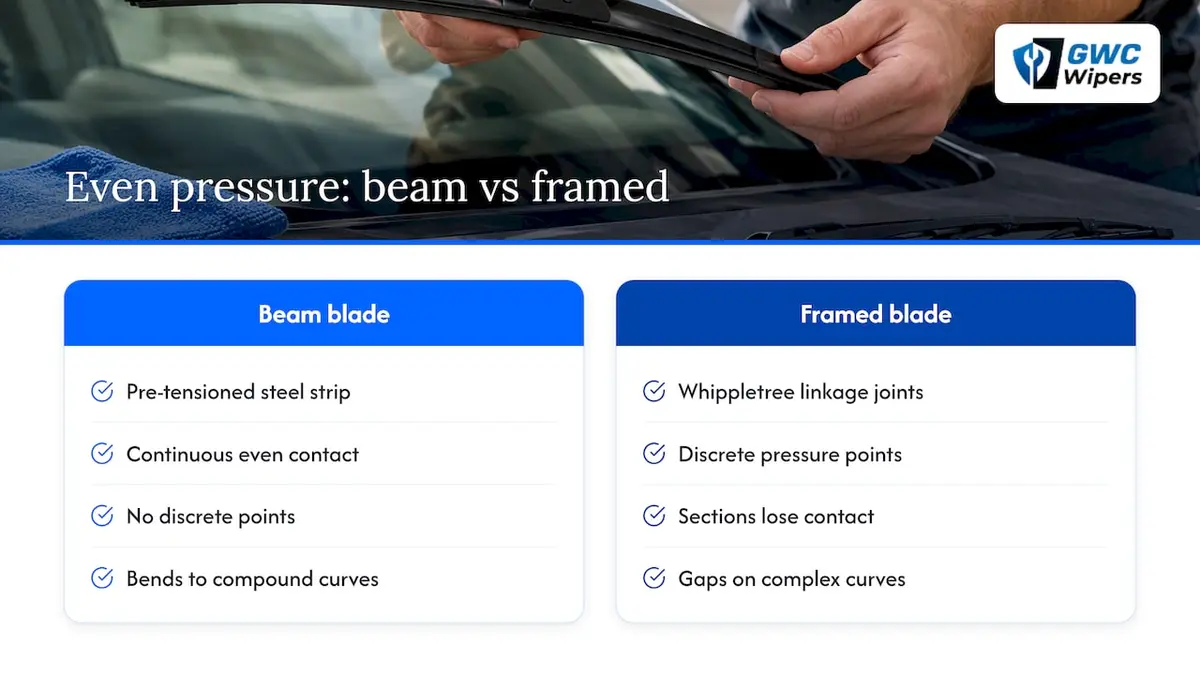
A beam or flat blade contains a pre-tensioned steel strip running the length of the rubber. That strip flexes to match the curve of your windscreen and pushes down evenly along the entire blade, which gives the wiping edge continuous, even contact with the glass rather than pressure at isolated spots.
A conventional framed blade works differently. It uses a metal frame with several small joints, called a whippletree linkage, to spread force from the arm down to the rubber. That linkage typically has only four to eight discrete pressure points along the blade, and the sections between those points get less downward force. On a flat windscreen this barely matters. On the compound curves common in modern cars, it does.
Most windscreens built in the last decade or so curve in two directions at once, not just side to side but also front to back. A whippletree mechanism) distributes load through rigid linkages tuned to a particular shape, so a framed blade designed for one curve can leave gaps, or dead zones, where the rubber barely touches the glass on a different curve. Manufacturers tune beam blade tension and curvature to specific windscreen profiles for the same reason, which is why a beam blade built for your exact model tends to outperform a generic framed blade sold as a universal fit.
This is the core mechanical reason beam wipers suit curved windscreens better than older frame designs. The steel strip inside the blade bends with the glass in real time as the wiper sweeps, so contact pressure stays close to constant from one end of the blade to the other. A framed blade can only approximate that curve through its fixed set of joints, and the approximation gets worse as the windscreen curve gets more complex.
None of this means every beam blade performs identically. An under-tensioned steel strip or the wrong curvature for your specific windscreen still produces patchy pressure, even though the underlying design principle is sound. The blade has to be built for your car, not just built as a beam blade in general.
Why even pressure matters: common failure modes and symptoms
Uneven pressure shows up as a specific set of symptoms, and recognising the pattern helps you work out what is actually wrong before you spend money. A localised streak that appears in the same spot on every pass usually means one section of the blade is not touching the glass. A judder or chatter, where the blade skips rather than glides, often points to a pressure imbalance rather than worn rubber. A squeak that gets worse as the blade dries out can be either problem, which is why isolating the cause matters.
Several issues beyond the blade itself cause patterns that look identical to a worn blade. Dirty glass with a film of road grime or wax reduces grip and causes skipping that has nothing to do with blade condition. A weakened arm spring loses the force needed to hold the blade against the glass, especially at highway speed when wind pushes back against the wiper. A bent arm, often from being clipped by a trolley or car wash brush, throws the whole geometry off. Knocked alignment from the same kind of impact can leave one end of the blade riding higher than the other.
A simple clean-and-test routine separates these causes quickly. Clean the glass and blade thoroughly with an automotive glass cleaner, run the wipers dry for a few cycles, then watch closely. If the streak disappears, it was dirt. If it persists in the same spot, the arm or the blade itself is the likely cause, and you can move on to checking arm tension before assuming you need a new blade. A clear line of sight depends on getting this diagnosis right rather than guessing.
How to check and adjust wiper arm tension and alignment
A new blade cannot fix a weak or bent arm, so this check comes before any blade purchase. Park on level ground, switch off the ignition, and lift each wiper arm away from the glass before you start so you are not working against spring tension unexpectedly.
- Lift the arm off the windscreen and let it rest at roughly 90 degrees; it should hold that position under its own spring tension without drooping.
- Press down gently on the arm near the blade and release; a healthy spring pushes back firmly, while a weak one offers little resistance.
- Lower the arm back onto the glass and check that the blade sits flat along its whole length, not tilted or lifted at one end.
- Run the wipers through a full cycle and watch for one end of the blade lifting off the glass mid-sweep, which signals uneven arm pressure.
- Check the arm visually from the side for any kink or twist compared with the opposite arm, since even a slight bend changes how the blade sits.
If the spring feels soft, you can measure it more precisely rather than relying on feel alone, and our guide on testing wiper arm spring tension walks through the expected range step by step. A visibly bent or twisted arm, or one that will not hold tension after adjustment, is a job for a mechanic rather than a DIY fix, since forcing a bent arm straight can crack the mounting point.
Pro Tip: Test arm tension with the blade removed. It is easier to feel spring resistance without the rubber dragging on the glass.
Choosing the right blade and fitment for even pressure
Length and connector type matter as much as blade design when it comes to even contact. A blade that is too long for the arm can bind against the windscreen pillar or bonnet at the end of its sweep, lifting pressure off the glass right when it is needed most. A blade that is too short leaves a strip of windscreen uncleared on every pass, which often gets misread as a pressure fault when it is really a sizing fault. The connector, the small clip or adapter that joins the blade to the arm, has to match your vehicle exactly so the arm’s force transfers straight down into the blade rather than through a loose or flexing joint.
- Beam and flat blades generally outperform framed designs on the compound curves found on most modern windscreens.
- The correct length keeps both ends of the blade in contact with the glass through the full arc of the sweep.
- The correct connector stops sideways play that causes chatter even when the blade itself is in good condition.
- A model-specific blade avoids the dead zones that generic, one-size-fits-all blades can leave on curved glass.
The fastest way to get all three right is to search by your make, model and year rather than guess from the size printed on your old blade, since arm and windscreen geometry varies even between trim levels of the same model. Our wiper blades hub lets you work through vehicle options to land on the exact part built for your windscreen’s curve, and if you drive a Ranger, the Ford Ranger fitment page shows how that lookup narrows down to the precise blade for your year and cab configuration.
Cleaning and maintenance to keep even pressure working
A beam blade engineered for even pressure still needs clean glass and clean rubber to do its job. Oil film from traffic exhaust, sap under trees, and built-up grime all sit between the blade and the glass and break the continuous contact the blade is designed to maintain, which turns a well-fitted blade into a streaky one within days.
- Use an automotive-specific glass cleaner and a microfibre cloth on both the windscreen and the blade edge.
- Avoid household glass or detergent-based cleaners, since they can accelerate rubber degradation and leave residue that causes streaking.
- Wipe the rubber edge by hand every few weeks to remove oil film and sap before it hardens.
- Check blade condition regularly and plan on replacement as a routine service item, not a reactive one.
Replace worn blades every six to 12 months, or sooner the moment they squeak, skip or leave a streak. That interval accounts for UV exposure and temperature swings, both of which harden rubber faster than mileage alone would suggest.
Automatic car washes are worth avoiding when your wipers are not stowed, since the stiff rollers used in many wash bays are a common cause of bent or misaligned arms. If your vehicle has a wiper stow or service position, use it before you go through a wash. Beyond the wash bay, keeping the method consistent matters too, and a streak-free glass cleaning technique built around automotive products rather than generic sprays protects both the glass coating and the rubber edge over time.
Troubleshooting checklist: six-step diagnose-and-fix for streaks
When a streak or chatter shows up, working through these steps in order gets you to the real cause quickly rather than replacing parts by trial and error.
- Clean the glass and blade edge thoroughly with automotive glass cleaner and a microfibre cloth.
- Test the wipers dry over several cycles and note exactly where any streak or skip occurs.
- Inspect the arm for spring tension and visible bends, using the checks described above.
- Confirm fitment, checking that blade length and connector type match your vehicle’s specification.
- Fit a beam or flat blade sized to your exact make, model and year if the old blade is worn or generic.
- Re-test after fitting, watching the full sweep for even contact at both ends of the blade.
A streak that disappears after step one was always a cleaning issue. One that persists through step two but changes position after step three points to the arm. If the blade still streaks after a correctly fitted replacement in step five, the windscreen itself may have a chip, pit or coating issue that needs a windscreen specialist rather than a wiper fix, which is the point to call in a mechanic rather than keep swapping blades.
How we help with fitment and installation
We build our vehicle selector so you can search by make, model and year rather than measure an old blade and guess at a replacement. Each listing pairs the correct beam blade with the right connector for that specific vehicle, backed by detailed installation guides that walk through fitting it without special tools.
Every blade we sell is covered by a guarantee and warranty, which gives you room to confirm the fit performs as expected through a full wet-weather cycle. For problems that sit outside the blade itself, a bent arm, a cracked windscreen or persistent misalignment, that is mechanical work for a qualified technician rather than something a new blade can resolve.
A wiper specialist’s take on getting this right
The most common mistake we see is owners replacing a blade two or three times before checking the arm underneath it. Spend the two minutes testing spring tension first.
Check your wipers properly after the first solid rain following any replacement, not just a quick glance in the driveway, since a dead zone only becomes obvious under sustained water flow. Confirm fitment against your exact year and trim, not just the model name. A worn or mismatched blade in heavy rain is a visibility problem, and visibility problems are safety problems.
— Faisal
Get the right fit: beam blades matched to your car
We built our fitment tool to remove the guesswork from buying wiper blades, because the wrong length or connector undoes even the best beam design. Search your wiper blades by make, model and year, and we show you the exact beam blade engineered for your windscreen’s curve, not a generic size that happens to clip onto your arm.
- Every blade ships free across Australia, with express shipping available at checkout.
- A 30-day money-back guarantee gives you a full wet-weather test before you commit.
- A 12-month warranty covers the blade against premature wear.
- Detailed installation guides walk you through fitting without special tools.
If you drive a Ranger, start with our Ford Ranger fitment page to see Perfect Fit by make, model and year in action, or search your own vehicle to find the blade built for it.
FAQ
What are the best wiper blades for even pressure?
Beam or flat blades generally give the most even pressure because they use a pre-tensioned steel strip that flexes with the windscreen’s curve rather than relying on a handful of fixed pivot points. The best choice for your car is the beam blade sized and shaped specifically for your make, model and year, since a generic size can still leave dead zones on a curved windscreen.
Can you adjust the pressure on windscreen wipers?
You cannot adjust the pressure built into the blade itself, but you can check and in some cases correct the arm’s spring tension, which controls how firmly the blade presses against the glass. A weak or bent arm should be tested as described above, and replaced if it will not hold tension.
What is considered the best wiper blade brand?
There is no single blade brand that suits every vehicle, since performance depends heavily on getting the correct length, connector and curvature for your specific windscreen. We design our range around vehicle-specific fitment for this reason, matching beam blade curvature to the model it is sold for rather than selling one shape as a universal fit.
What are the best windscreen wiper blades that do not squeak?
Squeaking is usually caused by a dirty or glazed rubber edge, a mismatched connector, or a blade nearing the end of its service life rather than the blade design itself. Keeping the glass and rubber clean with an automotive glass cleaner, and replacing blades every six to 12 months, prevents most squeaking before it starts.
When should I replace my wiper blades?
Plan on replacing worn blades every six to 12 months, and sooner if they squeak, skip or leave streaks during use. UV exposure and heat harden the rubber over time, so blades can fail on this schedule even with low mileage.
Sources
- Understanding how Wiper Blades Work, and Why They Fail
- How to maintain your car in winter cold weather | RACV