
UV resistance in wiper blades: why it matters
TL;DR:
- UV resistance is crucial for wiper blade longevity, especially in Australia’s extreme UV environment, as it prevents hardening and cracking caused by photodegradation and ozonolysis. Fluorosilicone wipers outperform natural rubber and EPDM in durability, lasting up to 24 months under coastal UV exposure, despite higher costs. Regular maintenance, proper sizing, and selecting blades with certified UV testing improve performance and safety in high-UV conditions.
UV resistance in wiper blades is the material’s ability to withstand ultraviolet radiation without hardening, cracking, or losing the flexibility needed for clean windscreen contact. In Australia, where UV Index readings regularly exceed 11 (classified as “extreme”), this property is not a marketing add-on. It is the single biggest factor separating a blade that lasts 18 months from one that streaks and splits within six. The materials most affected are natural rubber, EPDM (ethylene propylene diene monomer), and fluorosilicone. Understanding the role of UV resistance in wiper blades helps you choose smarter, replace less often, and keep your line of sight clear in every season.
How UV radiation degrades wiper blade materials
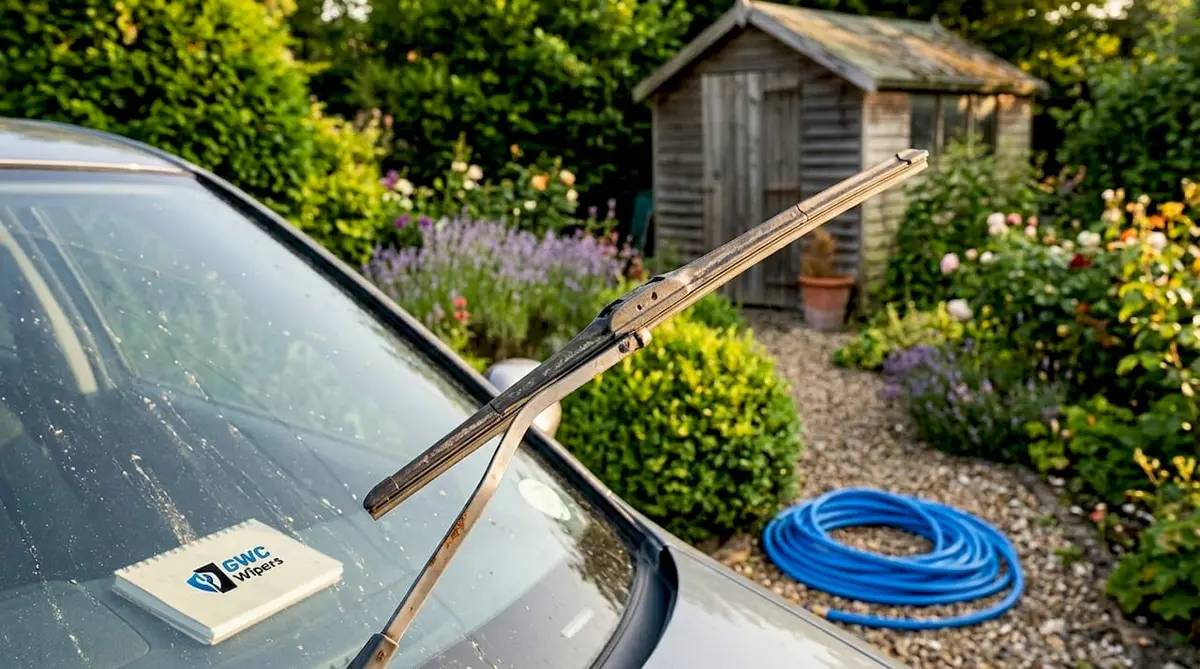
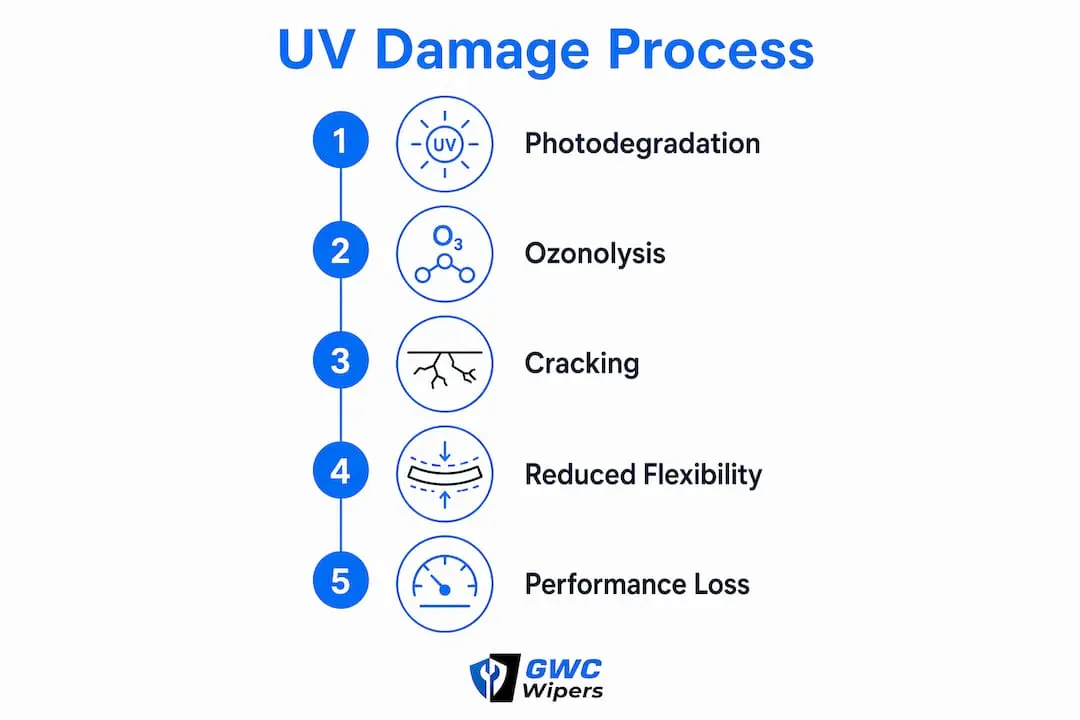
UV radiation attacks wiper blade elastomers through two chemical processes: photodegradation and ozonolysis. Photodegradation breaks polymer chains in the rubber compound when UV photons are absorbed, causing the material to harden and lose elasticity. Ozonolysis compounds the damage by reacting with double bonds in the rubber’s molecular structure, accelerating cracking at the blade’s wiping edge. Together, these processes turn a pliable, pressure-distributing blade into a rigid strip that skips, smears, and leaves dangerous blind spots on your windscreen.
The timeline is faster than most drivers expect. Tensile strength drops 35% within six months of coastal UV exposure, and exceeds 60% loss by the 12-month mark. That means a blade installed in January in Brisbane or Perth may already be structurally compromised by mid-year, even if it looks intact from the outside. The visual signs lag well behind the material reality.
You can spot early UV damage before a blade fails completely. Look for these warning signs:
- Micro-cracking along the rubber wiping edge, visible as fine lines when you flex the blade
- Streaking or smearing on a clean, dry windscreen during light rain
- Chattering or skipping as the hardened rubber loses consistent contact pressure
- Discolouration of the rubber from black to grey or brown, indicating surface oxidation
Pro Tip: Flex your wiper blades gently by hand every three months. If the rubber resists bending or shows surface cracks, UV degradation has already begun. Replace before the next wet season, not during it.
The direct link between UV exposure and loss of wiping efficiency is well established in the industry. A blade that cannot maintain even contact pressure across the full arc of the windscreen creates optical distortion, which is particularly dangerous at night or in heavy rain on Australian highways.
Comparing wiper blade materials by UV resistance
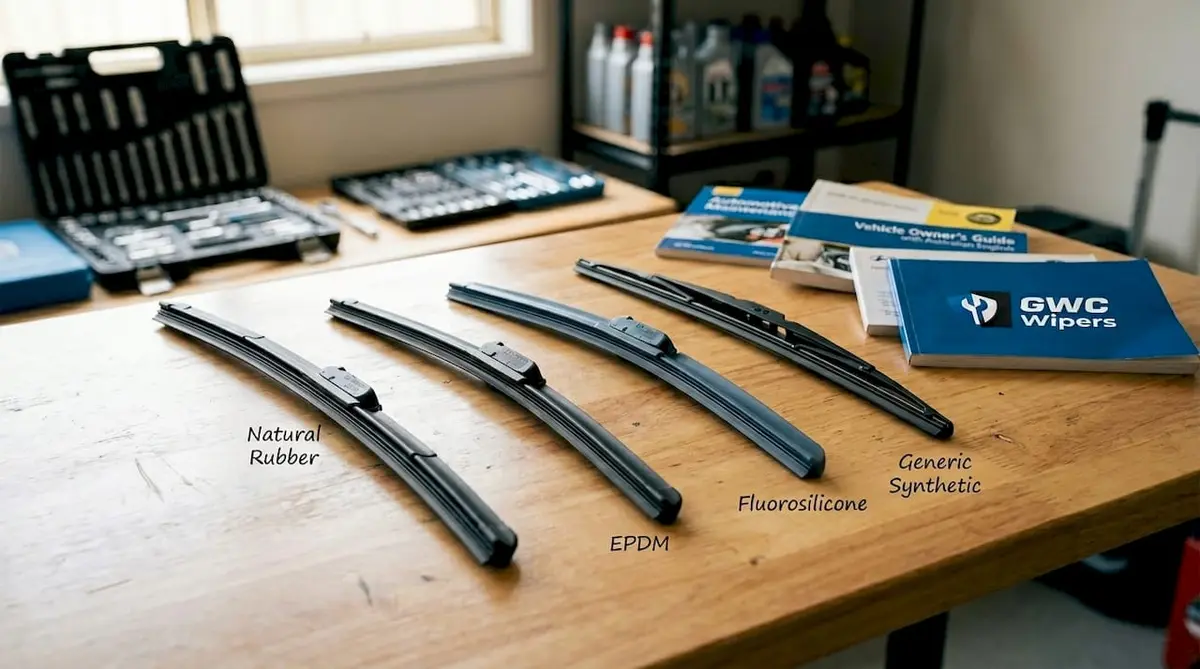
Not all wiper blade rubber is equal, and the difference shows clearly when you compare UV resistance data across the four main elastomers used in the industry.
| Material | UV resistance (hours to 50% elongation loss) | Estimated service life (coastal Australia) | Relative cost |
|---|---|---|---|
| Natural rubber | ~120 hours | 5–7 months | Low |
| EPDM | ~420 hours | 10–14 months | Moderate |
| Fluorosilicone | 1,200+ hours | 18–24 months | Premium |
| Standard silicone | ~600–800 hours | 12–18 months | Moderate-high |
Natural rubber loses 50% elongation after roughly 120 hours of UV exposure. That sounds like a long time until you consider that a car parked outdoors in Sydney or Darwin accumulates that exposure within a few months of summer. EPDM performs significantly better, reaching the same degradation threshold at around 420 hours, which translates to 10 to 14 months of realistic service life in coastal conditions.
Fluorosilicone is the standout performer. It exceeds 1,200 hours before reaching the 50% elongation loss threshold, giving it a service life of 18 to 24 months under the same coastal UV conditions. The trade-off is cost. Fluorosilicone blades carry a price premium that can be two to three times that of natural rubber options. For most Australian drivers, the maths still favours the upgrade: one fluorosilicone blade over 24 months versus three natural rubber replacements over the same period, with better visibility throughout.
A common misconception is that a thicker rubber blade will last longer. Durability depends on elastomer chemistry and the quality of UV stabilisers in the compound, not on physical thickness. Two blades that look identical on the shelf can differ enormously in UV performance based on their formulation alone. This is why SAE and ASTM testing standards exist: they measure actual UV aging performance, not just dimensions.
Pro Tip: When comparing blades, ask the supplier for UV aging test data referencing ASTM or ISO methods. A legitimate manufacturer will report hours to 50% elongation loss. If the only claim is “UV resistant,” that tells you nothing about the actual protection level.
For Australian drivers who want a cost-effective middle ground, EPDM offers solid UV protection at a reasonable price point. It is the material used in many premium wiper blade options designed specifically for local conditions.
What UV exposure means for Australian drivers specifically
Australia’s UV environment is genuinely extreme by global standards. The combination of high solar intensity, low atmospheric pollution in many regions, and long daylight hours creates UV loading that is significantly higher than drivers in Europe or North America typically experience. For wiper blades, this means the degradation timelines from international studies are often optimistic. A blade rated for 12 months in a temperate climate may reach the same degradation point in 8 months in Queensland or Western Australia.
UV resistance matters for consistent windshield contact pressure and long-term wiping performance. Firestone Auto Care identifies UV resistance as a key differentiator in wiper durability, and that assessment is even more relevant in the Australian context. The practical implication for local drivers is straightforward: replacement intervals should be shorter than the manufacturer’s general guidance if your car is parked outdoors regularly.
Recommended replacement intervals for Australian conditions, accounting for UV damage:
- Natural rubber blades: every 5 to 6 months in coastal or high-UV regions
- EPDM blades: every 10 to 12 months, inspected at 6 months
- Fluorosilicone or premium silicone blades: every 18 months, inspected at 12 months
- Any blade showing streaking or chattering: replace immediately, regardless of age
Maintenance habits also extend blade life between replacements. Cleaning your wiper blades monthly with a damp cloth removes the abrasive dust and road grime that accelerates surface wear. Lifting your blades off the windscreen when parked in direct sun reduces heat and UV contact with the rubber. Using a windscreen sunshade reduces the overall thermal and UV load on both the blades and the glass.
The combination of UV, heat, dust, and moisture drives degradation, and UV resistance alone will not compensate for neglected maintenance or an incorrect blade fitment. A UV-resistant blade that does not sit flush against your windscreen will still streak and wear unevenly. Correct sizing and fitment are as important as material quality. You can read more about how local conditions affect your blades in this Australian weather and wiper guide.
How to choose and maintain wiper blades for UV durability
Selecting the right wiper blade for UV resistance involves more than picking the most expensive option on the shelf. Follow this process to make a well-informed decision:
-
Identify your material priority. If your car is parked outdoors in a high-UV region, prioritise fluorosilicone or premium silicone. If budget is a constraint, EPDM is a reliable second choice. Avoid natural rubber for any vehicle that sits in direct sun regularly.
-
Check for UV aging certification. Look for blades that reference ASTM D4329, ISO 4892, or SAE J903 testing in their product documentation. These standards confirm that the blade has been tested under controlled UV aging conditions, not just marketed as UV resistant.
-
Match the blade to your vehicle precisely. A blade that does not conform to your windscreen’s curvature will create uneven pressure points, accelerating wear regardless of material quality. Use a vehicle-specific selector tool to confirm the correct size and attachment type.
-
Inspect and clean blades monthly. Wipe the rubber edge with a clean cloth dampened with isopropyl alcohol or a dedicated blade cleaner. This removes oxidised rubber residue and grime that reduces wiping efficiency and traps heat against the blade surface.
-
Park with blades lifted or use a sunshade. Direct UV and heat contact when the car is stationary accounts for a significant portion of cumulative UV exposure. Reducing parked exposure extends service life noticeably, particularly for natural rubber and EPDM blades.
-
Replace proactively, not reactively. Waiting until a blade fails during a downpour is a safety risk. Set a calendar reminder based on your blade material and local UV conditions, and inspect at the halfway point of the expected service life.
Investing in durable wipers pays off not just in fewer replacements but in consistently clear visibility, which is the primary safety function of the blade. The UV resistance certification that Firestone and other industry bodies recognise as a mainstream durability metric is your most reliable guide when comparing products.
Pro Tip: Do not rely on the blade’s colour or surface finish as a proxy for UV resistance. A glossy black blade may look premium but contain no UV stabilisers. Always request or look up the material specification before purchasing.
Key takeaways
UV resistance is the defining factor in wiper blade lifespan for Australian drivers, and fluorosilicone outperforms all other common materials by a significant margin under local UV conditions.
| Point | Details |
|---|---|
| UV damage is chemical, not just cosmetic | Photodegradation and ozonolysis reduce tensile strength by over 60% within 12 months of coastal exposure. |
| Material choice determines service life | Fluorosilicone lasts 18 to 24 months; natural rubber degrades within 5 to 7 months under Australian UV. |
| Thickness does not equal durability | UV resistance depends on elastomer chemistry and UV stabiliser quality, not rubber thickness. |
| Maintenance extends UV-resistant blades further | Monthly cleaning, sunshade use, and correct fitment maximise the protection UV-resistant materials provide. |
| Replace on a schedule, not on failure | Set replacement intervals based on material type and local UV intensity, not on visible blade failure. |
Why UV resistance deserves more attention than it gets
Most drivers I speak with replace their wiper blades only after they start streaking badly, which means they have already been driving with compromised visibility for weeks. The frustrating part is that UV damage is entirely predictable. You know your car sits in the sun. You know Australia has extreme UV. The only variable is whether you chose a blade material that can handle it.
The misconception I see most often is the thickness assumption. Drivers pick up a blade, feel how solid the rubber is, and assume it will last. But as the elastomer chemistry research confirms, a thin fluorosilicone blade will outlast a thick natural rubber blade by a factor of three or four under the same UV conditions. The quality is in the compound, not the cross-section.
My honest advice: treat wiper blades the same way you treat sunscreen. You would not use a low-SPF product in the Australian summer and expect full protection. The same logic applies to rubber compounds. Spend the extra money on a blade with verified UV aging test data, keep them clean, and replace them on a schedule. The cost difference between a premium blade and a budget blade is trivial compared to the cost of a bingle caused by a smeared windscreen in a sudden downpour.
One more thing worth saying: UV resistance works best as part of a broader maintenance approach. A vehicle longevity maintenance plan that includes regular wiper inspection sits alongside tyre checks and fluid top-ups as a basic safety habit. Wipers are not a set-and-forget component, even when you buy the best available.
— Faisal
Find UV-resistant wiper blades for your car at GWC Wipers
GWC Wipers stocks premium wiper blades engineered for Australian UV conditions, with options across the most popular vehicle makes on Australian roads.
Whether you drive a Toyota or a Mercedes-Benz, GWC Wipers’ vehicle selector tool matches you to the correct blade size, material, and attachment type in seconds. Every blade in the range is backed by a 12-month warranty, free shipping across Australia, and a 30-day money-back guarantee. If you are replacing blades in a high-UV region or your car parks outdoors regularly, the team can help you identify the right UV-resistant material for your specific conditions. Clear visibility starts with the right blade. Find yours at GWC Wipers.
FAQ
What does UV resistance mean in wiper blades?
UV resistance in wiper blades refers to the elastomer’s ability to withstand ultraviolet radiation without hardening, cracking, or losing flexibility. Materials like fluorosilicone and EPDM contain UV stabilisers that slow the photodegradation process and extend service life significantly compared to natural rubber.
How quickly do wiper blades degrade from UV exposure?
Tensile strength drops by 35% within six months under coastal UV conditions, and exceeds 60% loss by 12 months. In high-UV Australian regions, this degradation timeline can be even shorter for natural rubber blades.
Is a thicker wiper blade more UV resistant?
No. UV durability depends on elastomer chemistry and the quality of UV stabilisers in the rubber compound, not on physical thickness. Two blades of identical dimensions can perform very differently under UV exposure based on their formulation.
How often should I replace wiper blades in Australia?
Natural rubber blades should be replaced every 5 to 6 months in high-UV regions. EPDM blades last 10 to 14 months, and fluorosilicone blades can reach 18 to 24 months. Inspect all blades at the halfway point of their expected service life and replace immediately if streaking or chattering appears.
Does UV resistance alone guarantee long-lasting wiper blades?
UV resistance extends blade life but does not compensate for poor maintenance or incorrect fitment. UV, heat, dust, and moisture all contribute to degradation, so UV-resistant blades perform best when combined with regular cleaning and correct sizing for your vehicle.