
Weatherproof Car Accessories for Australia’s Storm Season
If you want a weatherproof car accessory list for Australia, start with the things that keep your windscreen clear, because you can’t avoid a hazard you can’t see. Exact-fit wiper blades, a working rear wiper and topped-up washer fluid come first. Floor mats, weathershields, a cover and an emergency kit come after.
This is a wet and storm season checklist for Australian drivers, from the tropical north’s cyclone season to a southern autumn downpour. We keep the non-wiper items brief and spend our time where most drivers get caught out: blades that looked fine in winter and smear in the first big storm.
TL;DR
- Fit new, correctly sized wiper blades before the wet season starts. RACQ points to roughly six-monthly replacement in Australia’s harsh UV.
- Check your rear wiper and top up washer fluid at the same time. Both are cheap, and both fail at the worst moment.
- Tyres, lights and clean glass matter as much as any accessory. Queensland guidance names 1.5 mm of tread across the whole width as the legal minimum.
- Floor mats, weathershields and covers are useful extras, but none replaces clear vision.
- Never drive through floodwater, whatever you have fitted to the car.
Table of Contents
- Why wipers lead a weatherproof accessory list
- The wet season checklist, in order of priority
- Front wiper blades: the item that does the most work
- Fitment by make, model and year
- Rear wiper: the one people forget
- Washer fluid and a clean screen
- Seeing and being seen: glass, lights and tyres
- The supporting cast: mats, weathershields, covers
- Cyclone and storm season: what changes
- Our perspective
- Get the right blades for your car
- A simple pre-season routine
- FAQ
- Find wipers guaranteed to fit
- Sources
Why wipers lead a weatherproof accessory list
Most top-ranking lists for this topic are a mix of dash cams, phone mounts and seat covers. They’re handy, but they don’t make a car weatherproof. When a storm cell hits, the things that change your risk are the ones between you and the road: glass, blades, washer spray, tyres and lights.
The Queensland Government’s wet weather guidance says to keep your vehicle well maintained for wet conditions, and names tyre tread, working exterior lights and a clean, clear windscreen. Wiper blades are the one consumable on that list that quietly wears out whether or not you drive in the rain, because sun, heat and dust age the rubber every day.
The wet season checklist, in order of priority
Here is how we would rank the items, from “do this first” to “nice to have”. The table compares the main categories on what they do for visibility and safety in a storm, and how hard they are to sort out yourself.
| Item | What it does in storms | DIY difficulty | Priority |
|---|---|---|---|
| Front wiper blades | Clears rain from the main view | Easy, 15 to 30 minutes | Highest |
| Rear wiper blade | Clears the rear view, important for reversing and wagons or SUVs | Easy | High |
| Washer fluid | Removes road film, salt and bugs | Very easy | High |
| Tyres | Grip and water clearance | Check tread, pressure; shop for replacement | Highest |
| Lights | Being seen and seeing | Easy to check | Highest |
| All-weather floor mats | Keeps water and mud off carpet | Easy | Medium |
| Weathershields | Allows a window cracked open in rain | Moderate | Low to medium |
| Car cover | Protects paint from hail or sun when parked | Easy | Situational |
| Emergency kit | Torch, first aid, charged phone lead | Easy | Medium |
Notice that three of the top four are not accessories at all. That’s deliberate. A weatherproof car is a maintained car first.
Front wiper blades: the item that does the most work
Your front blades clear the windscreen thousands of times in a storm season. Rubber that has hardened, split or curled won’t hold even contact with the glass, so it leaves streaks, hazy patches or a juddering sweep.
RACQ’s guide to changing wiper blades notes that blades typically need replacing about every six months in Australia because of UV exposure and variable climates. Waiting for chatter or streaking means you find out the blades are done during the rain. Replacing them before the season is the safer habit.
Signs your blades are done
- Streaks or smears that stay after a second pass
- Squeaking, juddering or chattering across a wet screen
- Unwiped bands, especially at the edge of the sweep
- Visible cracks, splits or rubber peeling from the frame
- A blade you can’t remember fitting
What to look for when you choose
We don’t think the right question is which blade is the best in the abstract. It is which blade suits your car, your climate and your tolerance for fiddling. These are the criteria we would use:
- Exact fit for your make, model and year. Blade length and arm connector differ between vehicles, and sometimes between the driver and passenger side. A blade that is too long or short leaves unwiped glass or fouls the arm.
- Natural rubber with even pressure. Segmented pressure distribution helps the edge follow the curve of modern windscreens instead of lifting at the ends.
- Aerodynamic design. At highway speed, a blade that lifts in the wind wipes poorly. A shaped spoiler profile helps the blade stay on the glass.
- Corrosion resistance. Coastal salt air and humid tropical conditions punish exposed metal.
- Easy installation. Preassembled adapters and clear instructions make the job realistic for a driveway.
- Returns and warranty. A fit guarantee and a clear return window take the risk out of buying online.
Well-known brands such as Bosch and Trico sell wiper blades in Australia, and plenty of drivers buy them at parts stores. We’d encourage you to compare any brand on the six criteria above, including whether the supplier will stand behind the fit. Check a brand’s own listing for your vehicle rather than trusting a generic “fits most cars” claim.
Universal blades versus vehicle-specific blades
Universal blades and refills are cheaper and flexible, but they put the fitting on you. RACQ notes that you need to measure blade width and check the arm connection, and that a refill that is too long can be trimmed carefully, leaving at least 25 mm from the end claw. That’s a fine job if you enjoy it. If you’d rather not measure and cut, vehicle-specific blades with preassembled adapters skip those steps.
Fitment by make, model and year
Fitment is where online buying goes wrong, so here are a few examples of how specific it needs to be. Each of these is a different generation with its own sizes and connectors, which is why “Toyota wipers” is not a useful search:
- Toyota Prado 120 series (2002 to 2009)
- Ford Ranger (2022 to 2025)
- Mazda CX-5 (2017 to 2025)
- Toyota RAV4 (2019 to 2025)
A 2017 CX-5 and a 2025 CX-5 can look near-identical from the street, yet we wouldn’t assume they share blade specifications. This is why our vehicle selector asks for make, model and year, and why we back it with a perfect fit guarantee. Our catalogue covers over 2,500 models. You can browse by make, for example Toyota, BMW, Mercedes-Benz, Mitsubishi and Volvo, or start from the full wiper blades range.
Rear wiper: the one people forget
Hatchbacks, wagons and SUVs often have a rear wiper that gets almost no attention. Its rubber ages in the same sun as the front blades, and a hardened rear blade smears a wet rear window into a blur right when you check your mirror or reverse in a car park.
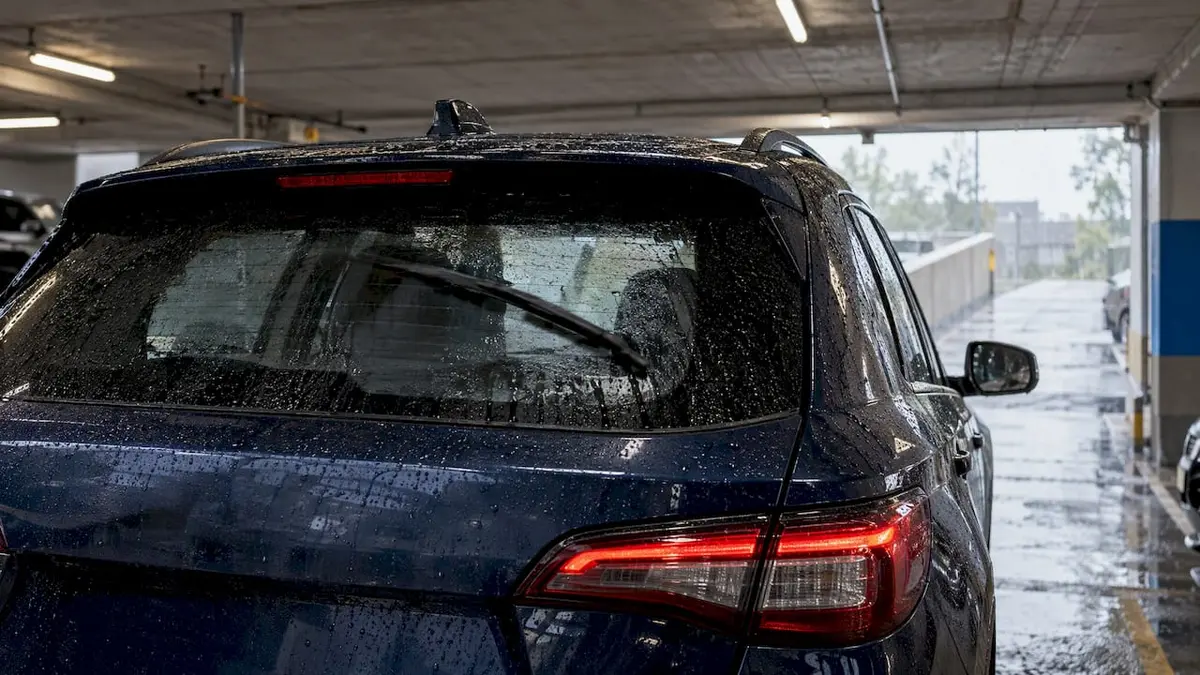
Add it to the same job as the fronts. Lift the arm, look at the rubber for cracks and stiffness, and run it with some washer fluid. If it smears, replace it. Rear blades differ by model, so use the vehicle lookup to see what is listed for your car rather than guessing from the front sizes.
Washer fluid and a clean screen
Wiper blades can only do their job on a screen that is clean. A film of road grime, insects and oily residue makes even a new blade smear, and storm spray from other vehicles adds to it. RACQ’s pre-trip checks list fluids among the essentials to check before a long drive, and washer fluid is the easiest of them.
A few habits help:
- Top up the reservoir with proper screenwash, not just water, so it can cut through film.
- Test the jets. If one is blocked, a fine pin usually clears it.
- Wipe the blade edge with a damp cloth to lift trapped grit.
- Clean the inside of the glass too. Interior haze causes glare at night in the wet.
If you want to go further on keeping glass and paint clean across changing seasons, this UK guide to how often to wash a car in wet, salty conditions explains why leaving road grime too long causes problems. The salt in it is a UK winter issue, but the principle carries over to coastal Australian driving.
Seeing and being seen: glass, lights and tyres
The RACQ DIY checklist suggests checking that headlights, indicators and brake lights work, and that glass is clean and free of chips, cracks and scratches. In a storm, working lights are how other drivers see you through the spray.
Tyres deserve a mention here even though they aren’t a wiper topic. The Queensland Government lists tread depth of at least 1.5 mm across the entire width of the tyre. Wet roads are where shallow tread shows up fastest.
On driving style, one UK driving school’s piece on habits that keep drivers safe in rain covers wiper condition, clean windscreens and visibility. It’s written for UK roads, so treat local road rules from your own state authority as the rule book, but the visibility habits are sound anywhere.
Chips and cracks before storm season
A small chip is easy to ignore. RACQ warns that chips and cracks can spread quickly with temperature swings and vibration on rough roads, potentially turning a repair into a full replacement. If you have a chip, get a windscreen specialist to look at it before the wet season.
Check your insurance PDS as well. CHOICE reports that policies differ on glass cover, and some offer nil excess on windscreen repairs or replacements. Read your own policy wording, or ask your insurer, before assuming what you are covered for.
If you do have a windscreen replaced, test the wipers afterwards. Our post on why to test wipers after windscreen replacement explains what to check.
The supporting cast: mats, weathershields, covers
These are the accessories that most “weatherproof” lists lead with. They’re worth having, but in the second tier.
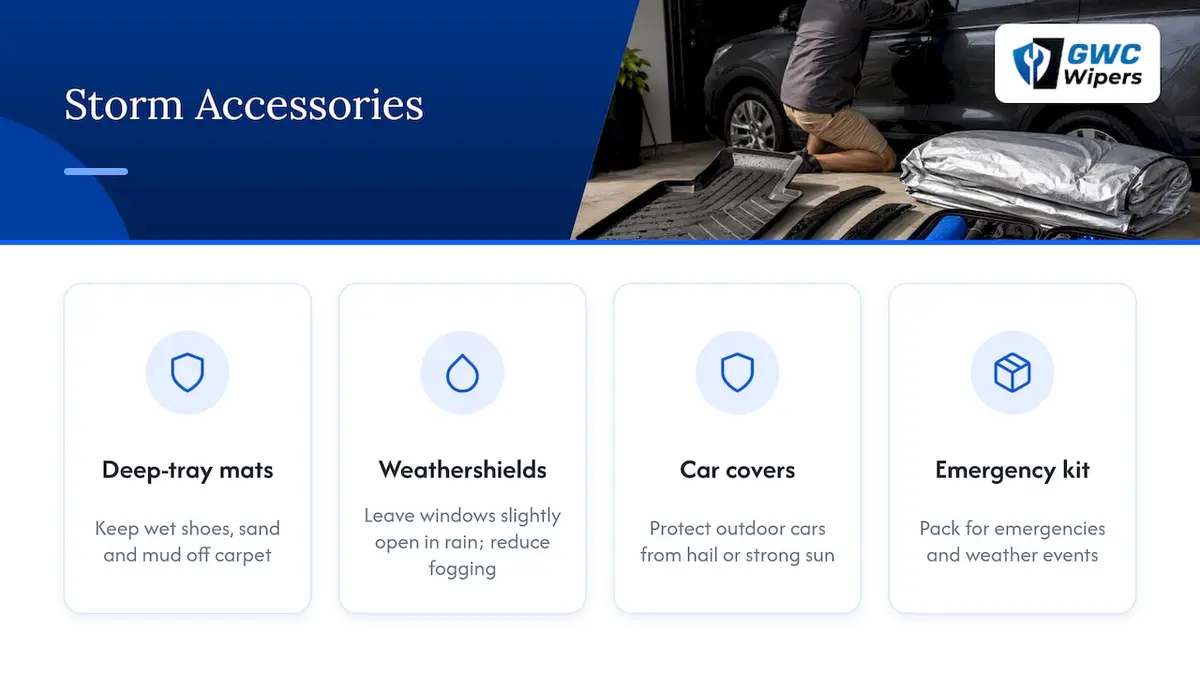
All-weather floor mats. Deep-tray mats keep wet shoes, sand and mud off the carpet, which helps prevent damp smells and fogged windows. Choose mats cut for your model so they don’t slide under the pedals.
Weathershields. These let you leave a window slightly open in the rain and reduce cabin fogging. Fit quality varies, so make sure they suit your exact model and window profile.
Car covers. Useful if you park outdoors and expect hail or strong sun. In high wind, a loose cover can flap and mark paint, so make sure it’s secured properly.
Emergency kit. Get Ready Queensland’s vehicle preparation page lists items to pack in your car for emergencies and weather events. Use it as your reference rather than a generic online list.
Cyclone and storm season: what changes
In cyclone-prone regions, the preparation window is short. Fit blades, test washers and sort the rear wiper well before a warning goes out, because stores and couriers get busy once one does. We’ve put together a separate walkthrough on cyclone season car prep, including fitting wipers in 15 to 30 minutes.
No accessory makes it safe to drive through floodwater. The Bureau of Meteorology says floodwater may be deeper or faster than it looks, and that a small car of about one tonne can be moved by just 15 cm of flowing water. Transport for NSW gives the same advice: never drive through floodwater. If the road is covered, turn around and find another route.
Snow country
If you park in the snowfields, Transport for NSW suggests lifting the wipers off the glass or wrapping them in a plastic bag so the rubber doesn’t freeze to the windscreen. It avoids damage to both blade and arm when you start the car.
Our perspective
We design and sell wiper blades for Australian conditions, so we see the same pattern every storm season. A driver buys a floor mat set or a phone mount, then discovers in the first heavy downpour that the blades have hardened over summer. The rubber has been baking for months, and nobody notices until it matters.
Our view is simple. Spend your first dollar on visibility, and do it by exact fit, not by guesswork. Put the blade change in the calendar twice a year, give your rear wiper the same attention, and keep the screen clean. The blades are a small job and a small cost compared with the value of seeing clearly at highway speed in the wet.
We also think online buying should carry less risk than a gamble on size. That is why we built the vehicle selector around make, model and year, and why we back it with a fit guarantee, a 30-day money-back guarantee and a 12-month warranty. If something isn’t right, our Australian support team is there to help.
— Faisal
Get the right blades for your car
Our premium wiper blades are made for Australian weather, with natural rubber, segmented pressure distribution, an aerodynamic profile, corrosion resistance and preassembled adapters for tool-free installation, with guides included. Shipping is free across Australia. Browse the GWC Wipers range and use the vehicle selector to see the blades listed for your car.
A simple pre-season routine
Pick a weekend in early spring or before your region’s wet season and work through this list in about an hour.
- Look up your make, model and year, and order front and rear blades.
- Clean the windscreen inside and out.
- Fit the new blades, then run the washers and wipers to test them.
- Top up screenwash and clear any blocked jets.
- Check lights, tyre tread and pressures.
- Inspect glass for chips and book a repair if needed.
- Pack an emergency kit and check your phone charger lead.
For more depth, our blog covers a monthly DIY car maintenance checklist, a car visibility checklist for Aussie weather and safe driving in heavy rain. If you’re weighing other rain add-ons, see choosing car accessories for rain.
FAQ
What are the best exterior accessories for wet weather?
Start with exact-fit front wiper blades, a working rear wiper and good washer fluid, since they protect your vision. After that, weathershields, a cover for outdoor parking and all-weather mats add comfort and protection. Choose by what your driving and parking situation needs.
How often should I change wiper blades in Australia?
RACQ says about every six months is typical because of UV and variable climates. If they streak, chatter or show cracks, replace them sooner. Changing them before the storm season is the safer approach.
What are good rain accessories for my car?
Blades that match your vehicle, a clean windscreen and screenwash do the most in the rain. Deep-tray floor mats and weathershields help keep the cabin dry and clear. None of them changes the rule on floodwater: don’t drive through it.
Can I fit wiper blades myself?
Yes, for most cars it’s a driveway job of roughly 15 to 30 minutes. Check the arm connection and blade length first, or use a vehicle-specific blade with preassembled adapters. Our blades come with installation guides.
Find wipers guaranteed to fit
Use the GWC vehicle lookup to find wipers guaranteed to fit your exact make, model and year. It takes a minute, and it’s the quickest way to be storm-ready.
Sources
- Road safety during wet weather, Queensland Government
- Prepare for floods, Bureau of Meteorology
- How to change wiper blades, RACQ
- Road trip checklist, RACQ
- Top 10 DIY car maintenance tips, RACQ
- Extreme weather, Transport for NSW
- Vehicle preparation, Get Ready Queensland
- Six things you should know to avoid getting ripped off by car insurance repairs, CHOICE