
Extreme weather wiper design: Stay safe in any Aussie climate
TL;DR:
- Extreme weather wiper blades use advanced materials like silicone and graphene to withstand harsh conditions.
- Australian climate challenges such as high heat, UV, dust, and salt air demand durable, aerodynamic wiper designs.
- Investing in premium blades enhances safety by ensuring clear visibility and longer lifespan in severe weather.
Not all wiper blades are built the same, and on Australian roads, that difference genuinely matters. A standard rubber blade might handle a light Sydney drizzle, but it can struggle badly against a Queensland downpour, a dusty outback crosswind, or the UV punishment of a Perth summer. The good news is that modern extreme weather wiper designs use advanced materials and engineering to deliver reliable, streak-free performance no matter what the sky throws at you. Beam and silicone blades excel in independent tests for noise reduction, durability, and clear wiping. This guide explains what sets these designs apart and how to choose the right blade for your vehicle.
Table of Contents
- What defines extreme weather wiper design?
- How Australian weather challenges wiper blades
- Technology and materials: The science behind high-performance wipers
- Selecting and maintaining the best wipers for your needs
- The real impact of premium wiper designs: More than just a clear screen
- Ready for any weather? Upgrade with GWC Wipers
- Frequently asked questions
Key Takeaways
| Point | Details |
|---|---|
| Engineered for extremes | Extreme weather wipers use advanced materials to perform in the toughest Australian conditions. |
| Performance proven in tests | Tests reveal top blades provide streak-free wiping, durability and quiet operation in heavy rain. |
| Better safety and visibility | Upgrading to high-performance wipers reduces risk and gives consistent clear vision in all weathers. |
| Simple maintenance matters | Regular checks and care extend the life and performance of your wiper blades. |
What defines extreme weather wiper design?
Now that you know why wiper blade performance matters, let’s break down what really makes a wiper design extreme weather ready.
Extreme weather wiper blades are engineered specifically to perform under conditions that would degrade or defeat a standard blade. Where a conventional bracket wiper relies on a metal frame to distribute pressure across the rubber edge, an extreme weather design removes that frame entirely or reinforces it with high-tension internal springs. The result is consistent, even contact with your windscreen across its full curve, even when wind pressure at highway speeds tries to lift the blade away from the glass.
The materials used in the wiping element itself are just as important as the structure. Here are the key features that define a genuinely capable extreme weather wiper:
- Aerodynamic beam design: A single-piece structure with no exposed metal frame, reducing wind lift and improving contact pressure at speed.
- Silicone wiping element: Silicone resists UV degradation, heat cracking, and ozone exposure far better than natural rubber, making it ideal for Australian summers.
- Graphene composite rubber: A newer innovation where graphene is blended into the rubber compound, significantly increasing hardness and wear resistance.
- Hydrophobic coating: A treatment applied to the wiping edge that conditions the windscreen glass, causing water to bead and roll away between wipe cycles.
- Noise-dampening construction: Precision-moulded edges and soft-set rubber reduce the chattering and squeaking common with worn or cheap blades.
The performance difference is measurable. Graphene composites improve durability by 25 to 30 percent compared to standard rubber formulations, and beam designs consistently outperform traditional bracket wipers in streak-free wiping tests. For Australian drivers, these aren’t luxury upgrades. They’re practical necessities.
Understanding wiper technology advances helps you see why older blade designs simply weren’t built to handle the combination of intense heat, heavy rain, and road dust that Australian drivers encounter regularly.
Pro Tip: If your wipers leave a film of water on the glass rather than clearing it cleanly, the wiping edge has likely hardened from UV exposure. This is a sign to upgrade to a silicone or beam blade before wet season arrives.
How Australian weather challenges wiper blades
Knowing what goes into extreme weather wiper designs, it’s clear why Australia’s environment demands more than the average blade.
Australia’s climate is genuinely one of the most demanding on the planet for automotive components. Temperatures in western and central regions regularly exceed 40°C in summer, while coastal areas experience high humidity, salt air, and sudden, intense storm events. In alpine regions like the Snowy Mountains, blades must also cope with ice and freezing temperatures. No single standard rubber blade is built to handle all of these conditions reliably.
Understanding the specific ways Australian weather attacks wiper blades helps explain why material choice is so critical.
Heat and UV exposure are the primary enemies of standard rubber blades. Prolonged exposure to direct sunlight causes the rubber compound to oxidise, harden, and crack. Once the wiping edge loses its flexibility, it can no longer conform to the curve of the windscreen, leaving streaks and dry patches even on a wet screen. This process can happen within a single Australian summer if the blade quality is poor.

Dust and debris are significant factors in inland and regional areas. Fine particles accumulate on the windscreen and the blade edge, acting as an abrasive that gradually wears down the rubber. In dusty conditions, using wipers without washer fluid accelerates this wear dramatically.
Heavy rain and storm events test the structural integrity of the blade. High-volume rainfall requires the wiper to clear large amounts of water quickly and repeatedly. A blade with uneven contact pressure will miss sections of the screen, creating dangerous blind spots at the worst possible moment.
The table below summarises how different Australian conditions affect wiper blade materials:
| Weather condition | Impact on standard rubber | Performance of silicone/beam blades |
|---|---|---|
| Extreme heat and UV | Cracking, hardening, streaking | Resistant, maintains flexibility |
| Heavy rain and storms | Uneven clearing, lift at speed | Consistent contact, aerodynamic design |
| Dust and debris | Accelerated edge wear | Harder compounds resist abrasion |
| Coastal salt air | Corrosion of metal frame parts | Frameless designs eliminate metal exposure |
| Alpine cold and ice | Brittleness, reduced flexibility | Silicone remains pliable in low temperatures |
Advanced blades tested under light, medium, and torrential rain conditions show an 18 percent reduction in motor torque demand and 25 to 30 percent greater durability compared to standard rubber designs. That means less strain on your wiper motor and fewer blade replacements over time.
Learning more about Australian weather impacts on wiper materials gives you a clearer picture of why regional drivers often go through cheap blades two or three times a year, while premium alternatives last considerably longer. For practical advice during wet conditions, our clear visibility tips cover everything from wiper speed settings to washer fluid choices.
Technology and materials: The science behind high-performance wipers
After seeing how local conditions can wear out standard wipers, let’s explore how cutting-edge science keeps extreme weather wiper blades one step ahead.
The materials used in modern high-performance wipers have advanced significantly in the past decade. Three technologies stand out as genuinely transformative for Australian drivers: silicone compounds, beam architecture, and graphene composites.
Silicone wiping elements are the most widely adopted upgrade from natural rubber. Silicone maintains its elasticity across a temperature range from below freezing to well above 100°C, making it equally effective in a Cairns wet season and a Canberra winter. It also resists ozone and UV degradation, which are the primary causes of rubber hardening. Silicone blades typically last two to three times longer than standard rubber equivalents in Australian conditions.
Beam blade architecture replaces the traditional metal bracket frame with a single curved piece of reinforced material, often a fibreglass or carbon composite spine. This design distributes pressure evenly across the full length of the blade using pre-tensioned curves rather than pressure points. The absence of exposed metal also eliminates the corrosion and ice-clogging issues that affect bracket blades in coastal and alpine environments.
Graphene composite rubber is the newest development in wiper blade materials. By blending graphene particles into the rubber matrix, manufacturers produce a wiping element that is harder, more wear-resistant, and more thermally stable than conventional silicone or rubber alone. The data is compelling.
Performance fact: Graphene composites improve wiper durability by 25 to 30 percent, with beam and silicone blades consistently delivering top results in simulated rain performance testing.
The comparison below shows how these technologies stack up against traditional rubber blades across the performance factors that matter most on Australian roads:
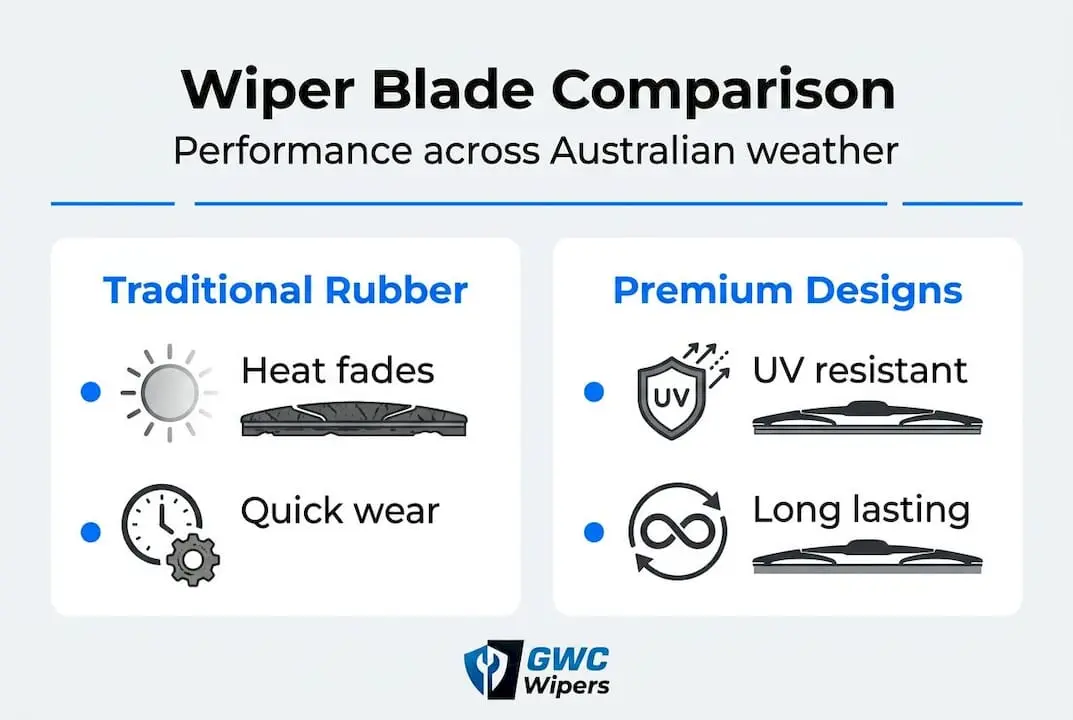
| Performance factor | Traditional rubber | Silicone blade | Beam/graphene composite |
|---|---|---|---|
| UV and heat resistance | Poor | Excellent | Excellent |
| Streak-free wiping | Moderate | Very good | Outstanding |
| Noise and chatter | Common | Minimal | Minimal |
| Durability (relative lifespan) | 1x baseline | 2 to 3x | 2.5 to 3.5x |
| Aerodynamic performance | Low | Moderate | High |
| Corrosion resistance | Low (metal frame) | High | Very high |
Advances in coating technology add another layer of performance. Hydrophobic treatments applied to the glass during wiping cause water to bead and roll away at lower speeds, reducing the number of wipe cycles needed and extending blade life. Some premium blades apply this coating passively with every stroke, effectively conditioning your windscreen over time.
For a detailed look at how these materials perform under controlled conditions, our wiper performance tests article breaks down the testing methodology and results in practical terms.
Selecting and maintaining the best wipers for your needs
Now that you know which materials and technologies lead the way, here’s how to make the right choice and keep your blades in peak condition.
Choosing the right wiper blade isn’t complicated, but it does require attention to a few key factors. The wrong size, material, or fitting type can compromise performance regardless of how advanced the blade technology is. Here is a straightforward process to guide your decision.
1. Check for signs of wear before you need to replace Run your wipers on a wet screen and watch closely. Streaking, skipping, chattering, or sections of the screen left uncleared all indicate a blade that needs replacing. Don’t wait for a storm to find out your wipers aren’t up to the task.
2. Confirm the correct size and fitting for your vehicle Wiper blades are not universal. Driver and passenger side blades are often different lengths, and the connector type varies between manufacturers. Using a vehicle selector tool ensures you get the exact fit for your make, model, and year.
3. Choose the right material for your primary driving environment If you drive mainly in high-UV, hot conditions, prioritise silicone. If you face frequent heavy rain or highway driving, a beam design with aerodynamic construction is the better choice. For the broadest coverage across Australian conditions, a silicone beam blade combines both advantages.
4. Inspect and clean your blades regularly Every few weeks, lift the blade away from the screen and wipe the rubber edge with a damp cloth. This removes accumulated dust, insect residue, and road grime that accelerate wear. Never run wipers on a dry screen.
5. Replace both blades at the same time Even if only one blade shows visible wear, the other is likely close behind. Replacing both ensures consistent visibility across the full windscreen.
6. Store your vehicle out of direct sunlight where possible Parking in shade or using a windscreen sun shade significantly slows UV degradation of the rubber edge, extending blade life between replacements.
Car and Driver test data confirms that advanced wiper designs deliver meaningful improvements in noise reduction and durability under simulated rain conditions, validating the investment in quality blades for everyday Australian driving.
Our visibility checklist covers the full range of factors affecting your view through the windscreen, while our installation guide walks you through fitting new blades yourself in just a few minutes.
Pro Tip: Set a reminder every six months to inspect your blades, ideally before the wet season begins. In Queensland and the Northern Territory, that means checking before October. In southern states, aim for April before the winter rains arrive.
The real impact of premium wiper designs: More than just a clear screen
Having explored the technical details and practical steps, let’s cut through the noise to what really matters about extreme weather wiper design.
Here’s a perspective that doesn’t get discussed enough: cheap wiper blades don’t just cost you money when they fail. They cost you confidence. There’s a particular kind of stress that comes from driving in heavy rain with blades that smear rather than clear, where you’re leaning forward, squinting, and hoping the car ahead brakes gradually. That’s not a minor inconvenience. It’s a safety risk that compounds with every kilometre.
The common argument against premium blades is that they’re expensive. But consider what you’re actually comparing. A set of cheap rubber blades might last six months in Australian conditions before UV damage and heat cracking render them ineffective. A quality silicone beam blade can last two years or more under the same conditions. The cost per kilometre of visibility is lower with the premium option, not higher.
There’s also the invisible risk factor. Standard blades that appear functional on a dry day can fail dramatically the moment a sudden storm hits. Australia’s weather can shift from clear to torrential in minutes, particularly in tropical and subtropical regions. A blade that looks fine in your driveway may leave you effectively blind on a wet motorway. That’s the scenario that technology and safety gains in modern wiper design are specifically engineered to prevent.
Premium extreme weather wipers transform rainy driving from a stressful experience into a manageable one. That’s worth more than the price difference.
Ready for any weather? Upgrade with GWC Wipers
Ultimately, the best way to put your knowledge into practice is to fit your vehicle with wipers ready for anything Australia throws your way.
At GWC Wipers Australia, we design and supply premium wiper blades built specifically for Australian conditions, from tropical downpours to outback dust and alpine cold. Our vehicle selector tool makes it simple to find the exact blade for your car, with free shipping across Australia, a 12-month warranty, and a 30-day money-back guarantee on every order. Whether you drive an Alfa Romeo Giulietta or are browsing Mercedes-Benz wiper options, we have a precision-fit solution ready. Upgrade today and drive with confidence in every season.
Frequently asked questions
What makes extreme weather wiper blades different from regular types?
Extreme weather wipers use advanced materials like silicone and innovative beam designs to resist wear and deliver streak-free wiping even in harsh rain. Beam and silicone blades consistently outperform standard rubber in independent noise reduction and durability tests.
How often should I replace my wiper blades in Australian conditions?
It’s best to check your wipers every six months, as heat, dust, and storms can accelerate wear significantly across Australia. Blades tested under torrential rain conditions show that advanced materials maintain performance far longer than standard rubber in these environments.
Is it worth spending more on premium wiper blades for my car?
Premium blades generally last longer, reduce streaks, and improve visibility, especially during severe weather, making them a sound safety investment. Graphene composites improve durability by 25 to 30 percent, meaning fewer replacements and more consistent performance over time.
Can I install extreme weather wipers myself?
Yes, most high-performance wipers are designed for easy DIY installation using basic tools, and detailed fitting guides are available to walk you through each step for your specific vehicle.