
Driver Side Wipers: Check Both Sizes With an Australian Vehicle Lookup

On right-hand-drive cars, the driver-side wiper is usually the longer one, because it sweeps the largest possible arc in front of you. Don’t guess, though: measure both blades, or use our vehicle selector to confirm the exact millimetres for your make, model and year before you order a pair.
TL;DR:
- Measure each blade from rubber tip to tip in millimeters, record the driver and passenger sides, and check the connector style before ordering.
- Old blades may already be mismatched, so confirm both lengths for your make, model, and year rather than copying the installed pair.
- An undersized blade leaves unwiped bands, while an oversized one can collide with its partner or leave the glass, adding motor strain and wear.
- Replace blades when they streak, shudder, or show cracked rubber; imported cars, rear wipers, and unusual arm layouts need separate fitment checks.
Table of Contents
- Why is the driver-side wiper usually longer?
- How do you check and measure your wiper blade sizes?
- What are typical arrangements on popular Australian models?
- Why does mixing up blade lengths cause problems?
- When should you replace your wipers, and how do you swap them?
- How do length conventions differ across brands and regions?
- What about rear wipers, rain sensors and other special cases?
- Perfect fit: use the GWC Wipers vehicle lookup
- Why do we focus on fit and measurement?
- FAQ
- Sources
Why is the driver-side wiper usually longer?
Every windscreen wiper pivots from a fixed point at the base of the glass, and the arm sweeps an arc across the screen. The blade length decides how much of that arc actually gets cleared. Manufacturers put the longest blade on the driver’s side because that is the part of the screen you look through most.
Several design factors set the final lengths:
- Arm sweep arc: The pivot position and arm length limit how far each blade can reach before it hits the edge of the glass or the A-pillar.
- Driver visibility priority: A longer blade on the driver’s side clears more of the primary vision area, which is the zone the NHVR says must stay free of anything that impairs your view, as set out in the NHVIM windscreen criteria.
- Non-overlap design: Two blades of equal length would often collide near the centre of the screen, so engineers choose different lengths and park positions to keep them apart.
- Windscreen shape: Curved and steeply raked screens change how far each blade can travel without lifting off the glass.
Exceptions exist. Some vehicles use matching blade lengths, and a few have the arms arranged so the passenger side is longer. That is why we always say to verify the fit for your specific model rather than assume a rule of thumb. If you want the background on why length matters so much, our guide on why proper blade length matters covers it in more detail.
How do you check and measure your wiper blade sizes?
You can confirm both lengths in a few minutes with a tape measure. If you would rather skip the measuring, our vehicle selector gives you the answer straight from your make, model and year.
- Lift the wiper arm away from the windscreen until it locks in the upright position.
- Run a tape measure along the rubber blade from tip to tip, not including the arm or the connector.
- Note the measurement in millimetres, then repeat on the other side of the car.
- Label the two numbers clearly as driver side and passenger side.
- Check whether your arms use a hook, pin or side-lock connector, because the arm style affects which blade will fit.
Remember to lower each arm gently afterwards. Letting it snap back can chip or crack the glass. For a fuller walkthrough with photos, see our measurement guide.
Measuring has one weakness: an old blade may already be the wrong size, because a previous owner or workshop may have fitted a mismatched pair. Our vehicle selector avoids that trap. You choose your make, model and year, and it returns the left and right blade sizes that suit your car.
Pro Tip: Write down both lengths and the arm connector style before you order, and keep the note in your phone. You will need it again at the next change.
What are typical arrangements on popular Australian models?
The pattern below is the usual one for popular Australian vehicles: the driver-side blade is the longer of the pair. Exact lengths vary by year, trim level and whether the model has a facelift screen, so treat these as a guide to the arrangement rather than a size chart.
- Toyota Hilux 2015–2024: Driver-side blade longer than the passenger side.
- Ford Ranger 2022–2025: Driver-side blade longer than the passenger side.
- Mazda CX-5 2017–2025: Driver-side blade longer than the passenger side.
- Toyota RAV4 2019–2025: Driver-side blade longer than the passenger side.
Millimetre lengths for each of these must be confirmed by measuring your own blades or by running your vehicle through the selector. A Hilux from one year can differ from another within the same generation, so the model name alone is not enough to order with confidence.
Our wiper blade sizes guide lists sizes by make and model if you want to browse. You can also see what we stock for Toyota drivers on our Toyota fitment page.
Why does mixing up blade lengths cause problems?
Swapping the two blades or fitting the wrong sizes is one of the most common mistakes we see. The result is rarely dramatic on the first wipe, but the problems build quickly.
Visibility suffers first:
- Streaks and smears: A blade that is too short leaves a band of unwiped glass at the edge of its sweep.
- Missed sweep zones: The area you rely on most can end up with a blind spot, especially in heavy rain when you need every millimetre cleared.
- Overlap and collision: A blade that is too long may strike the other blade or run off the glass and sit against the pillar.
Mechanical wear follows. An oversized blade puts extra load on the arm and motor, causes chatter and shortens the life of the rubber. Our fitment advice walks through how to choose blades that actually suit your car.
Two quick checks prevent most errors. At purchase, compare the listed lengths with your own written measurements. At fitting, hold the blade against the old one before you remove it, then confirm the pair clears the glass and each other when the wipers cycle.
When should you replace your wipers, and how do you swap them?
Replace your blades as soon as they streak, shudder or leave unwiped patches. RACQ recommends replacing worn blades that streak or judder as part of routine vehicle checks. The NHVR’s inspection criteria also reject wipers with cracked or frayed rubbers, or those that do not work at all speeds.
Look out for these signs:
- Streaks or smears across your line of sight
- Cracked, hardened, frayed or curled rubber
- Chatter or skipping as the blade crosses the glass
To swap the blades safely:
- Note how the old blade connects to the arm before you remove it.
- Lift the arm away from the screen and push any release tab.
- Slide the old blade off and fit the new one until it clicks.
- Lower the arm slowly onto the glass.
- Repeat on the other side, then run the wipers with washer fluid to check the sweep.
RACQ’s how-to guidance covers measuring and, where needed, trimming refill rubbers as the final stage. Never bend an arm to make a blade fit, and keep the arm off the glass while you work, because a bare metal arm can scratch the windscreen. Afterwards, check the park position so the blades rest neatly at the base of the screen. Our installation guide shows the same sequence with high-performance blades.
How do length conventions differ across brands and regions?
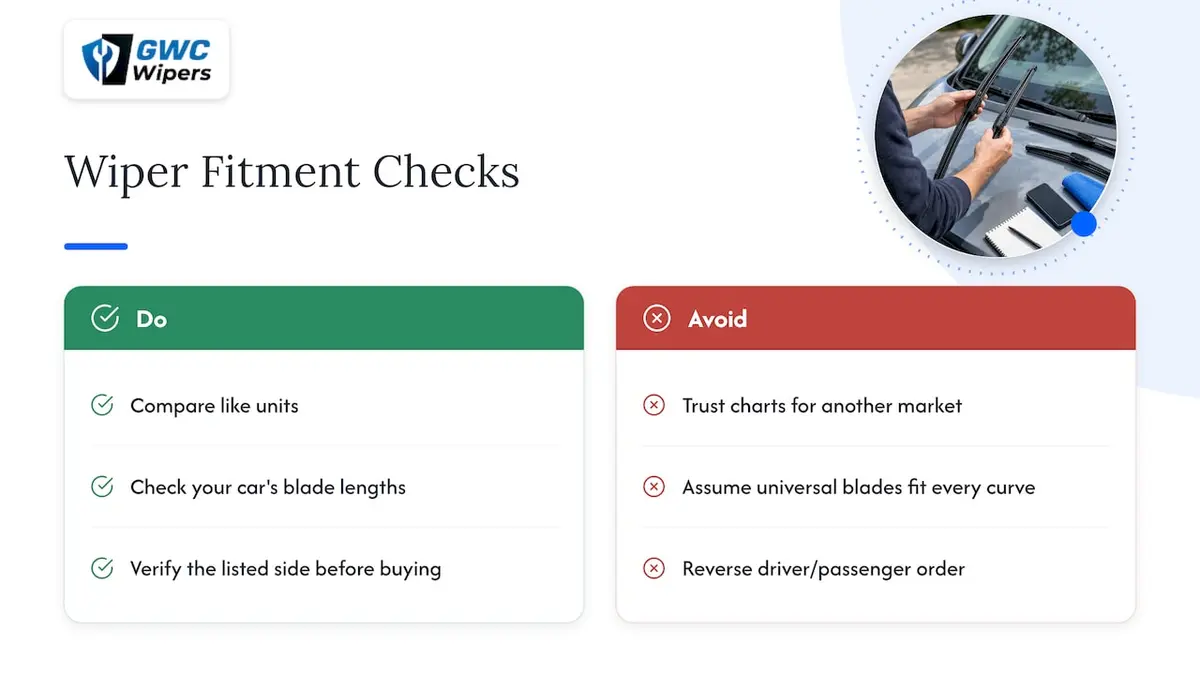
Wiper sizes are not described the same way everywhere, and this trips up many buyers. Some brands label blades in inches, others in millimetres, and a blade listed in inches may look confusing against a tape measure in millimetres, so a catalogue using one unit can look confusing against a tape measure in another. Always compare like with like.
Regional differences matter too. Vehicles built for left-hand-drive markets put the longer blade on the left, so a car sold new in Australia is engineered the other way around. If you drive an imported model, such as a Japanese-market vehicle or a car brought in from overseas, the arm layout may follow a different convention from a locally delivered one. Check the blade lengths on your own car rather than trusting a size chart written for another market.
Brand catalogues add another variable. Different makers group blades by connector type and by fitment category, and a size that suits one maker’s arm may not suit another’s. This is also why a universal blade sometimes fits poorly: it covers many arm styles but cannot match every windscreen curve. Fitment that is specific to your make, model and year removes that guesswork.
Mixed-up conventions can also affect the pair relationship. A catalogue may list the driver and passenger sizes in a fixed order, and it is easy to read them back to front. Check which side the listing refers to before you add anything to your cart.
What about rear wipers, rain sensors and other special cases?
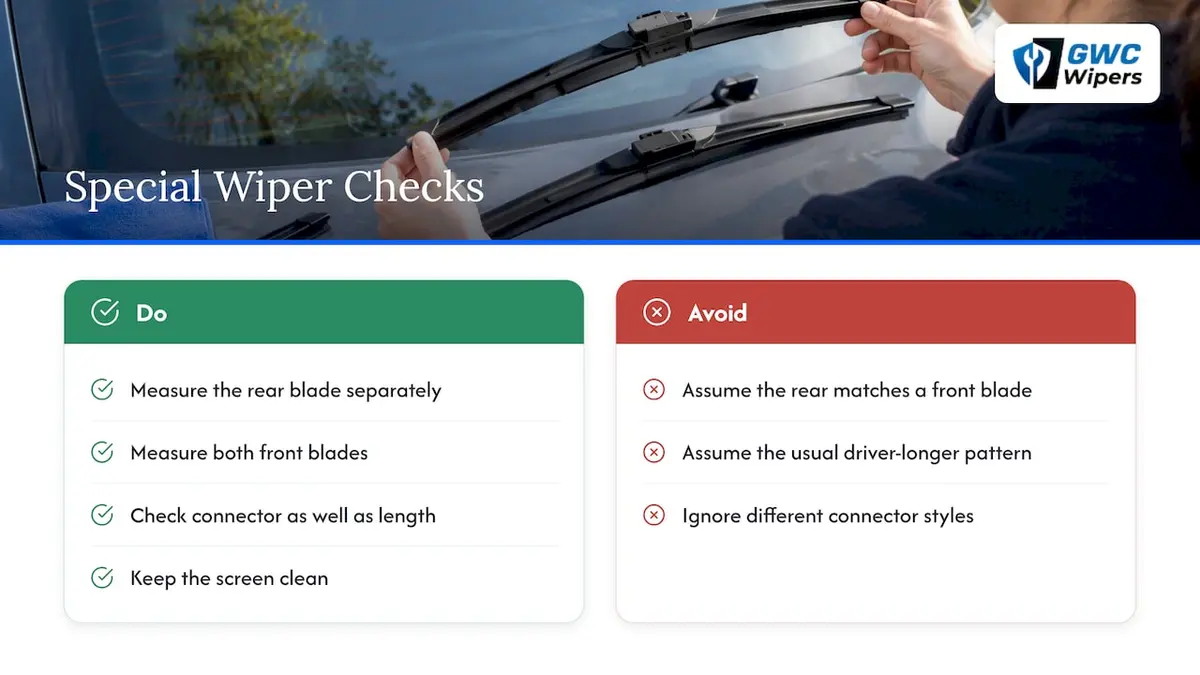
Not every wiper on your car follows the front-pair rule. A rear wiper is a single blade, often much shorter, and it usually sits on its own arm style. Hatchbacks, wagons and SUVs such as the RAV4 and CX-5 commonly have one, so remember to measure it separately and not assume it matches either front blade.
Some vehicles use a single front wiper or an unusual arm arrangement, particularly older models and certain vans. Others use pairs of equal length. If your car does not follow the usual driver-longer pattern, measuring both blades matters even more.
Rain-sensing wipers do not change the blade length, but they do depend on a clear, even sweep. A mismatched or worn blade can leave streaks that confuse the sensor’s view of the glass, so the wipers may run more or less often than you would expect. Fit blades that suit your vehicle and keep the screen clean. A good glass-cleaning routine also helps prevent streaks, and this streak-free glass cleaning method is worth following after you fit new blades.
Some blades also use different connector styles on the passenger and driver arms, even where the lengths are close. Check the connector as well as the length, and you will avoid the frustration of a blade that is the right size but will not clip on.
Perfect fit: use the GWC Wipers vehicle lookup
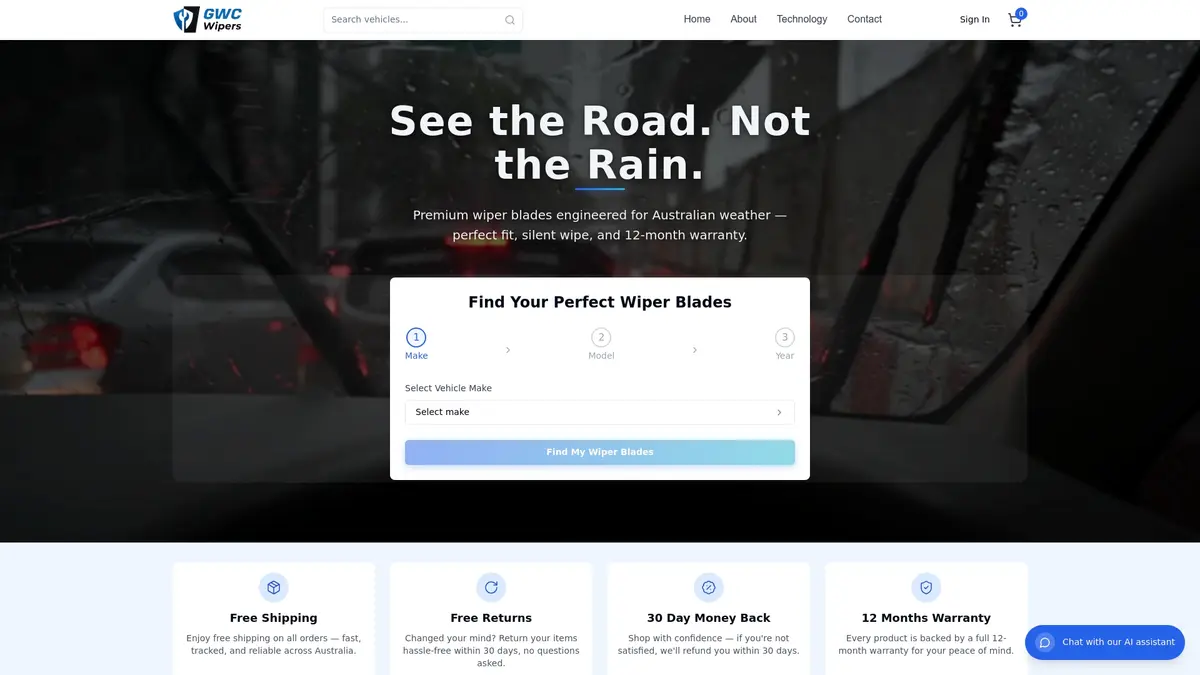
The fastest way to be sure of your driver and passenger sizes is our vehicle selector at GWC Wipers. Choose your make, model and year, and it shows the left and right blades for your vehicle, with a perfect fit guarantee behind every order.
Installation is tool-free, and each pair comes with a clear guide so you can fit the blades at home. You are also covered by our money-back guarantee and warranty, and we ship free across Australia.
Ready to order? Use the GWC vehicle lookup to find wipers guaranteed to fit your exact make, model and year, then browse our full range of wiper blades by make.
Why do we focus on fit and measurement?
I have seen too many drivers buy the right brand in the wrong length and blame the blade. Fit comes first. Confirm your sizes by measuring or by using the lookup, and fit both blades together so the sweep stays balanced. After fitting, run the wipers in the rain once and watch the edges of the sweep. If anything is off, use the fit guarantee, because clear glass is a safety matter, not a nicety.
— Faisal
FAQ
Is the driver windscreen wiper longer?
On most right-hand-drive cars, yes. The driver-side blade is usually longer so it clears more of your primary vision area. Some models use equal lengths or the reverse, so measure both blades or check your make, model and year first.
How do I know which wiper goes on the driver side?
Measure both blades from tip to tip, and the longer one normally goes on the driver’s side. The easiest check is to compare the old blades before you remove them, or to use our vehicle selector for the correct left and right sizes.
What happens if I fit the wrong length wiper?
A blade that is too short leaves unwiped bands and blind spots, while one that is too long can collide with the other blade or run off the glass. Both cause streaking, chatter and faster wear.
How often should I replace my wiper blades?
Replace them as soon as they streak, shudder or show cracked or frayed rubber. Regular checks are part of routine vehicle maintenance, so inspect them before wet weather or a long trip.