
Windscreen Wipers Not Touching? Australian Checks in 10 to 20 Minutes
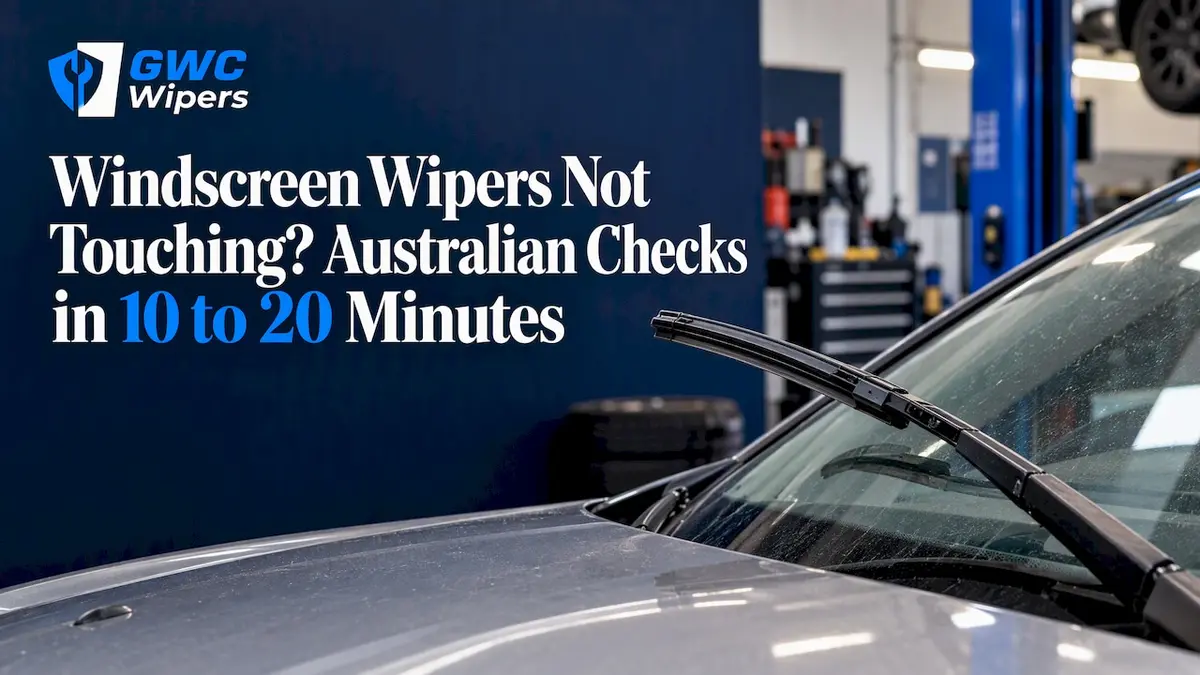
Wipers that lift off or skip across the glass usually come down to a weak or bent arm, the wrong blade size or adapter, or worn or heat-warped rubber. Park safely, switch the ignition off and look at the arm and blade first. We cover the checks below, and our vehicle lookup finds blades matched to your exact make, model and year.
TL;DR:
- With the ignition off, swap blades; if lifting follows the blade, replace it, but if it stays with the arm, inspect the arm.
- Measure each blade tip to tip because driver and passenger lengths can differ, then match the connector and confirm fitment for your vehicle’s exact year.
- Replace cracked, curled, or hardened rubber, but have a mechanic inspect wipers that stall, move unevenly, grind, or fail to return to park.
- Inspection standards can reject wipers that fail at any speed, park incorrectly, or leave damaged rubber and gaps that impair the driver’s vision.
Table of Contents
- What are the likely reasons your wipers are not touching the windscreen?
- How do you diagnose the problem in 10 to 20 minutes?
- Which fix suits each cause?
- How do you measure blade size and confirm fitment?
- When does missing contact become a roadworthy and safety issue?
- Why can you trust this fitment advice?
- What do we think matters most?
- Ready for a perfect fit?
- FAQ
- Sources
What are the likely reasons your wipers are not touching the windscreen?
Scan this list before you pick up any tools. Most faults sit in one of these areas.
- A bent or broken wiper arm, or a damaged pivot at the base
- Lost spring tension in the arm, so the blade no longer presses firmly on the glass
- The wrong blade length, or an adapter that does not suit your arm type
- A worn, hardened or heat-warped rubber insert
- Aerodynamic lift at speed, or a blade profile that has warped out of shape
- Debris or an obstruction in the hinge or along the sweep arc
- A loose mount nut or fastener at the base of the arm
Heat and UV exposure matter more than most drivers expect. Rubber that sits baking on a dashboard-hot windscreen for summer after summer loses its flexibility, and a stiff blade cannot follow the curve of the glass. Springs in the arm can also tire over the years, which is why an older car often shows lifting on one side first. Keep this list in mind as you work through the diagnosis below, because each item has its own quick test.
How do you diagnose the problem in 10 to 20 minutes?
You do not need specialist tools. You need a clear patch of driveway, a torch and a few minutes. Work through these steps in order, because each one rules out a component.
- Turn the ignition off and make sure the wipers are in their parked position. Never reach under a wiper arm while the system is live.
- Lift each arm away from the glass and look at the pivot, the spring and the overall shape. The arm should be straight, with no kinks, and it should snap back firmly when you release it.
- Press the blade against the glass with your hand. Feel for a firm, even push. If the arm gives with almost no resistance, spring tension is the problem.
- Swap the driver and passenger blades, or fit a known good blade to the suspect arm. If the lifting follows the blade, the rubber or frame is at fault. If it stays with the arm, the arm is the culprit.
- Check that the adapter clicks fully into the arm and that the blade length covers the sweep arc without hitting the windscreen edge or the other blade.
- Take a slow drive in light rain, or use the washer on a quiet street. Watch for gaps at speed and listen for rubbing, scraping or binding.
- Note any motor or linkage symptoms, such as wipers that will not park, stall mid-sweep or move unevenly. These point beyond the blades.
Pro Tip: Photograph the gap between blade and glass before you change anything. A before and after image makes it obvious whether your fix worked.
Our guide to the clean or replace test is a handy companion if you want a second opinion on the rubber itself.
Which fix suits each cause?
Match the repair to what you found, and stop when a fix is beyond your comfort level.
- Loose arm nut: lift the small cap at the base of the arm and check the nut with a socket. It should be snug, not wobbly. Tighten it gently and recheck by trying to rock the arm sideways.
- Slightly bent arm: a small bend can sometimes be eased back by hand, but check the result by pressing the blade onto the glass and looking for an even line of contact. A visibly kinked or cracked arm should be replaced, because bending metal back weakens it.
- Worn or heat-damaged rubber: wipe the blade with a damp cloth first. If the rubber is cracked, curled, frayed or hardened, cleaning will not bring it back, so replace the blade.
- Wrong blade length or adapter: fit the correct length and the adapter designed for your arm. Vehicle-specific blades arrive with the adapter preassembled, which removes the most common installation error.
- Aerodynamic lift: at highway speed, a flat or tired blade can float off the glass. A blade with segmented pressure distribution and an aerodynamic profile holds contact along its whole length.
- Weak spring tension: a tired arm often cannot be restored reliably. Replacing the arm is the dependable fix, and fresh blades alone will not cure it.
Pro Tip: Fit new blades as a pair, even if only one looks bad. A mismatched pair wears unevenly and leaves you chasing the same problem a few months later.
Some symptoms are not a blade job. If the wipers will not return to park, stall under load, sweep unevenly or make grinding noises from the base, the linkage or motor needs attention from a mechanic. Forcing the issue can strip the linkage, which turns a cheap fix into an expensive one.
How do you measure blade size and confirm fitment?
A blade that is too short leaves unswept glass, and one that is too long can foul the pillar or the other blade. Both can leave the end of the blade hovering off the glass. Our guides on measuring your wiper blades and wiper blade sizes walk through it in detail.
- Measure the blade from tip to tip along its full length, not just the rubber, and measure each side separately because driver and passenger sizes often differ.
- Look at how the blade attaches to the arm. Common styles include hook, pinch tab, bayonet and side pin, and each needs a matching adapter.
- Remember that fitment changes with the year. A Toyota Hilux 2015 to 2024 and a Ford Ranger 2022 to 2025 can each use different lengths or connectors across their production runs, and the same goes for a Mazda CX-5 2017 to 2025 or a Toyota RAV4 2019 to 2025.
- Skip the guesswork and use our vehicle lookup on the wiper blades page. Enter your make, model and year and it returns the correct sizes with adapters already attached.
Buying vehicle-specific blades is the surest way to avoid a repeat of the problem. If you want more help, our article on choosing wiper blades that fit your vehicle covers the same ground from the buyer’s side.
When does missing contact become a roadworthy and safety issue?
Wipers are a safety item, and inspectors treat them that way. The Light Vehicle Safety Check Standards list wipers that are missing, not secured or not operating, along with blade rubbers that are cracked, curled, frayed or torn, as grounds for rejection in authorised light vehicle inspections. The NHVIM guidance on windscreens and windows adds that wipers not operating at all speeds are a reason for rejection, and that defects in the swept area may impair vision and should be repaired.
The ACT inspection manual also lists wipers that do not return to the correct parked position, while the inspection manual for light vehicles requires a visual and operational check of wipers and washers. Queensland’s vehicle safety guidance states that the area swept by the blades must not be so damaged that it impairs the driver’s vision.
Treat these as reasons to act without delay:
- Visible gaps in the swept area that leave glass unwiped
- Streaking that does not clear after cleaning the blade and glass
- Wipers that fail at one or more speeds
- Rubber that is split, curled or shedding strips
Until it is fixed, slow down and avoid heavy rain. Our guide to Australian roadworthy wiper requirements goes deeper on what inspectors look for.
Why can you trust this fitment advice?
We are an Australian online specialist in vehicle-specific wiper blades, and fitment is the heart of what we do. Our vehicle selector matches blades to make, model and year, our blades ship with adapters preassembled, and we back every fit with a perfect fit guarantee. Our DIY guides walk you through installation without specialist tools.
The checks in this article follow the same inspection standards that authorised testers use, so you are working to the benchmark that decides whether a car passes. We list those references at the end so you can read them yourself.
What do we think matters most?
Most drivers reach for new blades the moment wipers misbehave, and sometimes that is exactly right. But the evidence in the inspection manuals points at a wider list: operation at every speed, correct parking, and a swept area free of damage. A fresh blade on a tired arm still lifts. That is where the usual advice falls short.
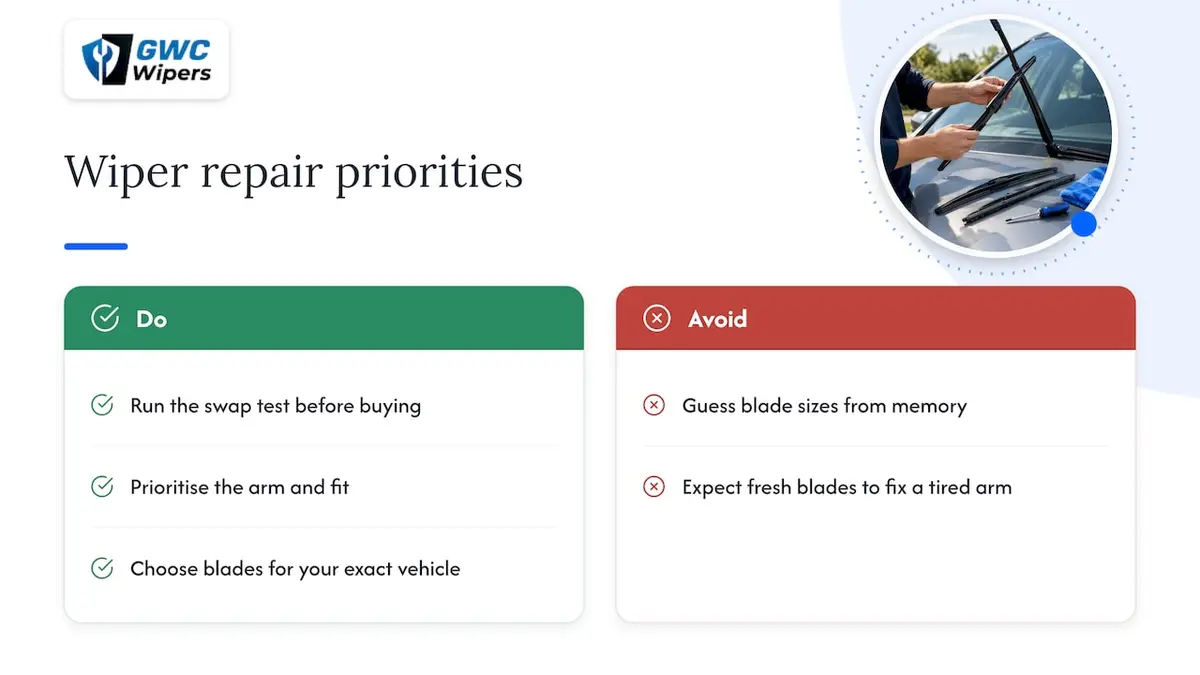
Our view is to test before you buy. The swap test tells you whether the blade or the arm is at fault, which can help you avoid paying twice. Prioritise the arm and the fit first, because a perfectly sized blade on a weak arm will not hold contact, and a strong arm with the wrong adapter will not either.
Then settle fitment once, properly, rather than guessing sizes from memory or from what the last owner fitted. A blade that suits your exact vehicle removes the most common cause of lifting in one move. Everything else is maintenance.
— Faisal
Ready for a perfect fit?
Wrong blade size or adapter is one of the most common reasons wipers lift off the glass, and the cure is blades made for your vehicle.
Use our vehicle lookup on Gwcwipers to find wipers guaranteed to fit your exact make, model and year.
- Preassembled adapters, so there is nothing to guess at fitting time
- A perfect fit guarantee on every vehicle-specific blade
- DIY installation guides included, with no special tools needed
- Money-back guarantee
Pick your vehicle and check the sizes to find the right blades.
FAQ
Why isn’t my new windshield wiper touching the glass?
The most likely causes are the wrong blade length, an adapter that does not suit your arm, or an arm that has lost spring tension. Run the swap test: if the new blade lifts on a different arm too, the blade is the problem, and if not, the arm is.
Why are my wipers not returning to park position?
Wipers that stop short of or beyond their parked position usually point to the motor or linkage rather than the blades. The ACT inspection manual lists failing to return to the correct parked position as a reason for rejection, so have a mechanic check it.
Why are my windshield wipers just smearing the water?
Smearing often comes from a dirty windscreen, contaminated rubber or a blade that no longer presses evenly. Clean the glass and the blade edge first, then replace the blade if the rubber is hardened or curled.
Why are my wipers still streaking after I replaced them?
Check that the new blades are the correct length and fully seated on the adapter, then confirm the arm presses firmly on the glass. A weak arm can make even a brand new blade streak, and an oily or waxy windscreen will do the same.
Sources
- Light Vehicle Safety Check Standards
- NHVIM V3.2 Section 10 - Windscreens and Windows
- INSPECTION MANUAL FOR LIGHT VEHICLES
- Vehicle Safety
- Light vehicle inspection manual