
Best Rear Wiper Blades in Australia: How to Choose
The best rear wiper blade for your car is the one that matches your vehicle’s exact arm and length, uses fresh rubber, and survives Australian sun. A rear blade is almost always specific to the make, model and year, so fit matters more than brand. This guide compares the main options on offer in Australia, shows where our blades sit among them, and explains how to check your size before you buy.
TL;DR
- Fit comes first. Rear blades are vehicle specific, so confirm your size by make, model and year before comparing anything else.
- Choose a blade with the right adapter for your rear arm, because many rear arms use a unique fitting.
- Expect to replace a rear blade every 6 to 12 months, and sooner if it streaks, skips or squeaks.
- Bosch, Trico and Valeo all make rear blades. Compare them on fit, rubber quality, warranty and delivery, not on reputation alone.
- Check your exact fit at gwcwipers.com.au/wiper-blades and get free shipping across Australia.
Table of Contents
- Why the rear wiper deserves the same care as the front
- How rear wiper blades differ from front blades
- Beam, conventional or hybrid: which style suits a rear window
- Comparing the main rear blade options in Australia
- How to find your rear wiper size
- SUV rear wiper replacement: what to expect
- Rear wiper streaks: clean first, then replace
- Do rear wipers matter for roadworthy checks?
- Our perspective: fit first, then rubber
- Find the right rear blade for your car
- Care tips that make a rear blade last
- FAQ
- Perfect Fit: find wipers that fit your exact car
- Sources
Why the rear wiper deserves the same care as the front
Most drivers replace the front pair and forget the back. Then they reverse out of a car park in the rain and realise the rear window is a smear.
On a hatch, wagon or SUV, the rear glass is often large, flat and close to the tailgate, so it collects road spray, dust and dirt faster than you would expect. A rear blade is also the part that lives in the hottest, most exposed position on the car. Parked outside, it bakes in the sun all day.
The rubber suffers from this. The RACV notes that wiper rubber deteriorates through use and sunlight, and recommends checking for cracking or splitting. A rear blade gets less use than a front one, but it gets just as much UV, so it often fails by age before it fails by wear.
How rear wiper blades differ from front blades
A rear blade is not a shorter front blade. Several things make it its own product.
- One blade, not two. There is a single arm, so there is no left and right, and no passenger side to fall back on.
- Short and specific length. Rear blades are usually much shorter than front blades, and the correct length depends on the car. Guessing by eye leads to a blade that either overhangs the glass or leaves a large unwiped patch.
- Different arm fittings. Many rear arms use a small plastic or metal connector that differs between manufacturers. A blade that does not include the right adapter simply will not clip on.
- Low sweep angle. The blade rests flat against the glass and sweeps a small arc, so a stiff or worn edge shows up as streaks quickly.
This is why we tell customers to start with the car, not the blade. Our guide to wiper blade sizes explains how lengths are measured, and the same logic applies at the back.
Beam, conventional or hybrid: which style suits a rear window
Three designs are common. On a rear window the choice is narrower than at the front.
| Style | How it works | Rear window suitability |
|---|---|---|
| Beam (flat) | One-piece spring steel with no external frame | Common on modern hatchbacks and SUVs, low profile, even pressure |
| Conventional (framed) | Metal frame with several pressure points | Found on older cars, can collect dirt in the joints |
| Plastic-bodied OEM style | Moulded arm and blade, often clip-in | Typical of many original rear fittings |
For front windscreens, 4WheelHouse explains that beam blades lack external frames, so they apply even pressure across curved glass, resist wind lift at highway speed and are less likely to trap mud or ice. Rear glass is flatter, so the pressure argument matters less, but the low profile and the lack of crevices still help a blade that sits in the weather every day.
The practical rule is to match what your car was built to take. If your rear arm is designed for a plastic OEM-style blade, a beam blade that does not fit that arm properly is not an upgrade. Our article on the best windshield wiper blade types for Australian drivers goes deeper on the differences.
Comparing the main rear blade options in Australia
You will see the same names on shelves and in online searches. Here is an honest look at how they compare. We have not tested every one of them side by side, so this comparison is built on what each option is designed to do and the criteria that matter to a rear window.
| Option | Strength | Watch out for |
|---|---|---|
| Bosch (such as the H352 beam style) | Widely stocked, well known, many fitment listings | Fitment lists are by vehicle, so a wrong guess means a wrong length |
| Trico | Long history in Australia, wide range | Check the adapter is included for your arm |
| Valeo | Common as an original-equipment supplier in Europe | Coverage for some Australian-market variants can be patchy |
| Dealer genuine part | Exact match to the car | Usually the highest price and a trip to the dealer |
| GWC Wipers | Vehicle-specific fit, natural rubber, preassembled adapters, free shipping, 30-day money-back guarantee, 12-month warranty | Sold online only, so you need to confirm your fit before ordering |
A few of those points deserve more detail.
Bosch
Bosch is the brand most Australian forum threads mention first. One long-running Whirlpool forum discussion has drivers recommending the Aerotwin range for front blades. Those are personal opinions, not test results, so treat them as a sign of popularity rather than proof of rear performance. The brand also publishes rear blades in several lengths, so the same rule applies: pick by vehicle, not by brand.
Trico and Valeo
Trico is a name many Australian drivers grew up with, and it sells rear blades for a wide spread of local models. Valeo is known as a supplier to car makers. Both are credible. In both cases, the question is the same as for any brand: does the listing for your exact make, model and year match the blade in the box?
Dealer genuine parts
A genuine part is a safe fit, because it is the same part the car left the factory with. You pay for that certainty and for the dealer visit. If your car is out of warranty and the original blade has simply perished, a vehicle-specific aftermarket blade does the same job for the glass.
Where we sit
We design and sell blades for Australian conditions, with vehicle-specific fitment across more than 2,500 models. The blades use natural rubber, preassembled adapters for tool-free installation, and corrosion-resistant construction. Our fitment guarantee, 30-day money-back guarantee and 12-month warranty are there so a wrong guess does not cost you. We do not claim any one blade is the best for every car. We claim that a blade chosen from a vehicle selector, with the right adapter in the box, removes the most common reason rear blades fail to work: poor fit.
How to find your rear wiper size
Because there is so much variation, the method matters more than any list of sizes. Sizes also change between generations of the same model, which is why a year-specific answer is the only safe one. Here are three ways to confirm it, from most to least reliable.
- Use a vehicle selector. Enter make, model and year at our wiper blade finder and the rear option for your car appears with its fitting.
- Check the owner’s manual. Most manuals list the wiper blade lengths in the specifications or maintenance section.
- Measure the old blade. Measure from end to end of the blade, not the arm, then check the arm connector type. Our vehicle-specific wiper blade guide shows why length alone is not enough.
We do not publish a generic size chart here. A chart that lists one number for a whole model line hides the changes between years and trims, and a blade that is a few centimetres out will either overhang or leave a gap.
Start with your make
If you drive one of these, the make pages are a quick route into the right range:
- Toyota wiper blades, including the RAV4 and Kluger style SUVs
- Mercedes-Benz wiper blades, such as the GLC-Class, GLE-Class and GLA-Class
- Mitsubishi wiper blades
- Volvo wiper blades
The same selector covers Honda, Mazda, BMW, Audi, Abarth, BYD and many other makes.
SUV rear wiper replacement: what to expect
SUVs are where rear blades matter most. The glass is upright, sits in the car’s wake and picks up a film of dust and water that the driver cannot see past without the wiper. If you drive a family SUV, the back window is also the one you use for reversing and checking what is behind you.
For most cars, replacing the blade is a few minutes of work. The RACQ’s guide to changing wiper blades covers the basic technique for front blades. The rear is a variation on it:
- Lift the rear wiper arm away from the glass until it holds upright. Some rear arms do not lock, so support the arm so it cannot snap back on the glass.
- Find the release tab or clip where the blade meets the arm. On many rear fittings, this is a small plastic tab on the underside.
- Slide or unclip the old blade. If the arm has a separate cap or nut, check whether the new blade needs it removed first.
- Fit the new blade with its adapter and make sure it clicks or seats firmly.
- Lower the arm gently onto the glass, then run a wash and wipe cycle to confirm the sweep stays on the glass.
Our SUV wiper blade change guide walks through the same process in more detail. If you drive a ute, our piece on rain wiper blades for utes is the better starting point.
Rear wiper streaks: clean first, then replace
Streaks are the most common complaint, and the cause is not always the blade.
The RACV points out that chattering or skipping often signals buildup on the glass or on the rubber edge, and that a thorough glass clean and a wipe of the rubber with a damp cloth can restore performance. So before spending money, try this:
- Clean the rear glass inside and out with an automotive glass cleaner. Do not use household detergent, which can damage rubber and leave residue.
- Wipe the blade edge along its length with a damp cloth.
- Top up the washer reservoir. The rear nozzle shares it, and a dry nozzle means the blade runs on dry glass, which speeds up wear.
- Run the rear wiper with washer fluid and look at the result.
If you want a method for the glass itself, this streak-free glass cleaning method covers the technique for getting automotive glass properly clean.
If the streaks remain, the edge is probably hardened, nicked or curled. At that point, cleaning will not save it. Our 6-step test for signs of bad wipers helps you decide quickly.
When to replace
The RACV’s winter maintenance advice says worn wipers can leave streaks, miss sections of the screen, or make it hard to see in wet weather, and the club generally suggests replacement every 6 to 12 months. For a rear blade that sits outside in summer, the earlier end of that range is realistic. Replace sooner if you see any of these:
- Streaks or smears that persist after cleaning
- Skipping or juddering across the glass
- Squeaking or chattering
- Cracked, split or curled rubber
- Visible gaps where the blade lifts away from the glass
Do rear wipers matter for roadworthy checks?
Rules differ between states and territories, and you should check with your own transport authority. The national Australian Light Vehicle Standards Rules require a vehicle with a windscreen to be fitted with a working wiper unless the driver can obtain an adequate view of the road. That wording is about the windscreen, and in practice a worn front blade is the usual concern at inspection. A failing rear blade is still a visibility problem for reversing. Our guide to passing roadworthy wiper requirements covers what inspectors look for.
Our perspective: fit first, then rubber
We see the same pattern in customer questions. Someone buys a rear blade because it was cheap or familiar, and the connector does not fit their arm. They then decide the blade is rubbish, when the real problem was a guess.
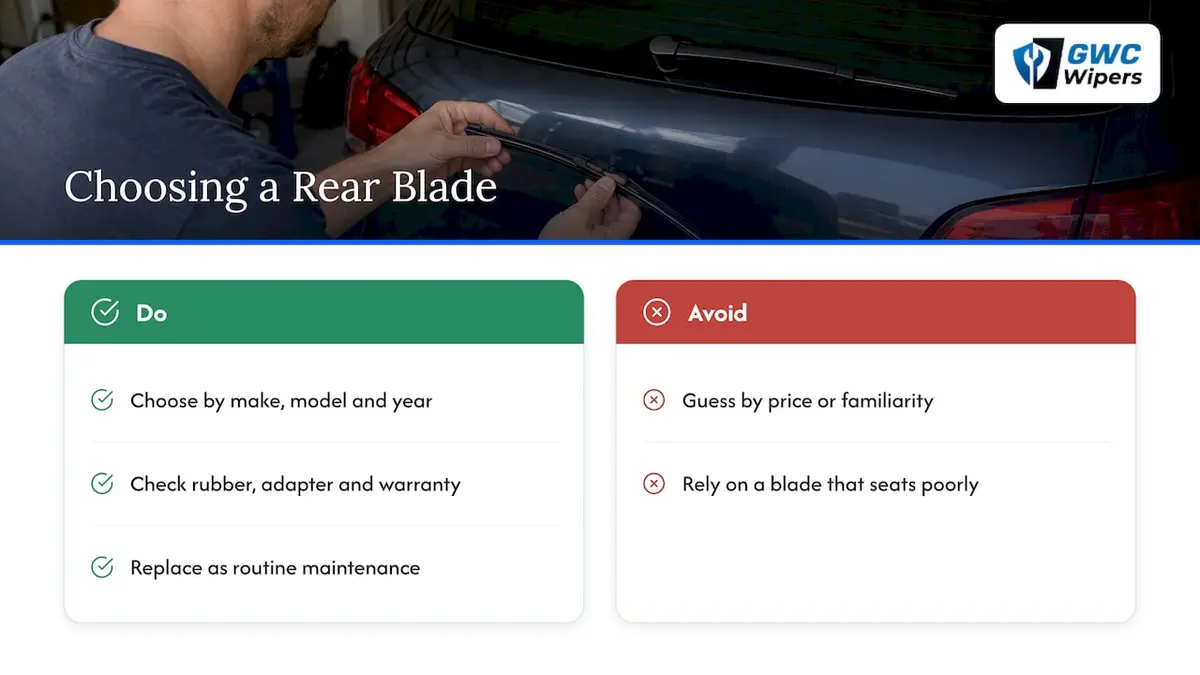
So our view is simple. Choose the blade by your car’s make, model and year. Then look at the rubber, the adapter and the warranty. A well-fitted blade of decent rubber will outperform a famous blade that does not seat properly on your arm. And because heat and UV do most of the damage in Australia, plan on replacing a rear blade as routine maintenance, not as a repair.
That is why we built our range around a vehicle selector, preassembled adapters and a fitment guarantee. If it does not fit, you should not be out of pocket.
— Faisal
Find the right rear blade for your car
Our range covers more than 2,500 vehicle models, with free shipping across Australia, a 30-day money-back guarantee and a 12-month warranty. Each blade comes with its adapters preassembled so you can fit it without tools. Browse the GWC Wipers range and enter your car’s details to see the rear blade that matches it.
Care tips that make a rear blade last
- Never run it dry. Use the washer when the glass is dusty. Dry wiping on grit scratches the glass and wears the edge.
- Lift it off the glass in extreme heat if the arm allows it and you park in the sun for long periods, so the rubber does not bake against the glass.
- Wipe the rubber with a damp cloth every few weeks.
- Keep the washer fluid topped up with an automotive product, not household detergent.
- Check it at every service. It takes ten seconds. For a wider routine, use our visibility checklist.
FAQ
Which rear wiper blade brand is best?
No single brand is best for every car. Bosch, Trico and Valeo are all established, and the right choice is the blade that matches your make, model and year with the correct adapter. Compare fit, rubber, warranty and delivery rather than reputation alone.
How often should I change my rear wiper blade?
The RACV suggests replacing wiper blades every 6 to 12 months. Rear blades sit in the sun and often age by UV before they wear out, so replace yours when it streaks, skips, squeaks or shows cracks.
Can I use a front wiper blade on the rear window?
Generally no. Rear blades are shorter and use arm connectors that differ from front fittings. Use a blade listed for the rear of your exact vehicle.
Why does my rear wiper leave streaks even though it is new?
The cause is often dirt on the glass, a dry washer nozzle or a poorly seated blade. Clean the glass with an automotive cleaner, check the washer fluid and make sure the blade sits flat. If it still streaks, check that the length and fitting match your car.
How do I find my rear wiper blade size?
Use a vehicle selector, check the owner’s manual, or measure the old blade and note the connector. For a quick answer, enter your car at gwcwipers.com.au/wiper-blades.
Perfect Fit: find wipers that fit your exact car
Don’t guess the size. Find wipers that fit your exact car at gwcwipers.com.au/wiper-blades.
Sources
- RACV: Easy DIY car maintenance tips and safety checks
- RACV: How to maintain your car in winter cold weather
- RACQ: How to change wiper blades
- 4WheelHouse: Bosch wiper blade buying guide
- Whirlpool forums: Best wiper blades in Australia
- Australian Light Vehicle Standards Rules 2015