
Best Frameless Wiper Blades in Australia: 2026 Comparison
The best frameless wiper blade for your car is the one that fits your exact make, model and year, because even pressure only works when the blade, adapter and arm suit each other. Bosch, Trico and GWC all make frameless (beam) blades for Australian cars. We recommend GWC Wipers, because every blade is matched to your vehicle through our selector, backed by a fitment guarantee, free shipping Australia-wide, a 30-day money-back guarantee and a 12-month warranty.
This guide compares the main options, explains what to look for, and shows how to confirm fitment before you buy.
TL;DR
- Frameless blades (also called beam or flat blades) use a single flexible spring beam instead of a metal frame with pivot points, which spreads pressure along the whole blade.
- Fit comes first. A premium blade on the wrong adapter or length will still streak, chatter or lift.
- Bosch Aerotwin and Icon, and Trico Tech and Force, are the established names. GWC is our pick because it is vehicle-specific across more than 2,500 models, with free shipping and a fitment guarantee.
- Replace blades about every 12 months, sooner if you see streaks, unwiped patches or chatter.
- Use the GWC vehicle selector to find the exact blades for your car by make, model and year.
Table of Contents
- What makes a wiper blade frameless
- How we compared the options
- Frameless wiper blades compared
- GWC Wipers: vehicle-specific frameless blades
- Bosch Aerotwin and Icon
- Trico Tech and Trico Force
- Beam wiper blade size: why you cannot guess
- How to check fitment by make, model and year
- Fleet owners and workshops
- Frameless, framed or hybrid
- When to replace your blades
- Streaks, chatter and noise: a quick diagnosis
- What about refills?
- Our view: fit first, brand second
- Find your exact blades
- FAQ
- Sources
What makes a wiper blade frameless
A traditional framed blade is a rubber strip held by a metal bracket with several pressure points. A frameless blade replaces the bracket with a curved spring beam running the length of the rubber. The beam holds the rubber against the glass along its whole length, which suits the curved windscreens on modern cars.
RevRated’s 2026 roundup quotes ASE Master Technician Mike Reeves explaining that continuous heel-to-toe contact pressure, rather than separate pivot points, is the difference between a uniform wipe and a central streak on curved glass. That is the core argument for frameless blades.
There are practical benefits too. With no exposed frame, there is less for wind to catch at highway speed and less to corrode. Our own guide covers the benefits of frameless wipers for everyday drivers in more detail.
How we compared the options
We compare on the points that decide whether a blade works on your car and in Australian conditions:
- Fitment: does the blade come with the right adapter and length for your vehicle?
- Pressure design: how the beam spreads force along the rubber.
- Rubber and coatings: resistance to UV, heat and hardening.
- Noise and lift: quiet wiping and stability at speed.
- Corrosion resistance: how the blade copes with salt air, humidity and rain.
- Support and guarantees: what happens if the blade does not suit.
We have deliberately left prices out of the comparison. Prices change often, and the right blade is the one that fits.
Frameless wiper blades compared
| Blade | Design | What the maker or reviewers describe | Fitment approach |
|---|---|---|---|
| GWC Wipers | Frameless, natural rubber, segmented pressure distribution, aerodynamic profile | Designed for Australian weather, corrosion resistant | Vehicle-specific for over 2,500 models, preassembled adapters, fitment guarantee, guides included |
| Bosch Aerotwin | Flat beam with graphite-coated rubber | Bosch describes Aerotwin sets as covering unique vehicle needs | Vehicle-specific sets, plus a Retrofit version for upgrading conventional and hybrid blades |
| Bosch Icon | Beam with tension spring arcing | Reviewers describe quiet, even wiping | Multiple adapter types in one pack |
| Trico Tech | Flexible-beam with memory-curve steel beam | Described as distributing pressure uniformly, with HighGlide treatment and UV-stabilised natural rubber | Sold by vehicle application |
| Trico Force | Aerofoil beam blade | Described with UV-stabilised natural rubber | Adaptors for six wiper-arm types, lengths from 350 mm to 700 mm |
The Bosch and Trico entries describe each maker’s own product claims and reviewer observations. We have not run side-by-side tests of these brands ourselves.
GWC Wipers: vehicle-specific frameless blades
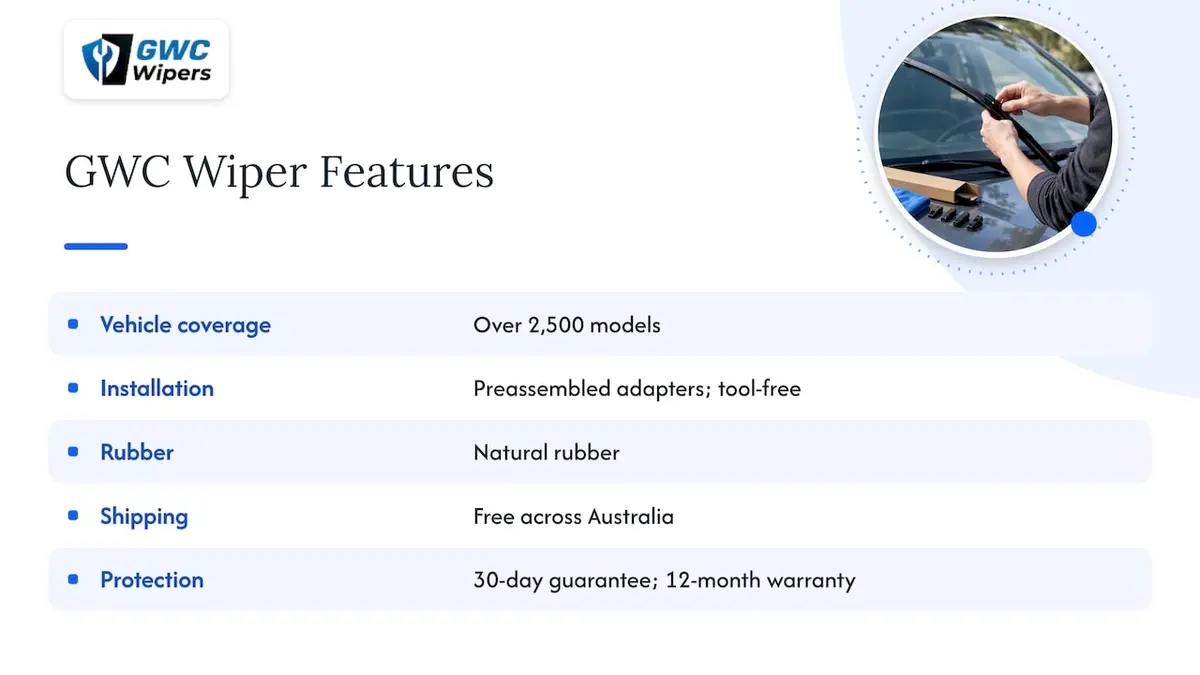
Our approach starts from the car, not the blade. Instead of selling a universal blade and hoping it fits, we match blades to your vehicle’s make, model and year, covering over 2,500 models. Blades arrive with preassembled adapters, so installation is designed to be tool-free, and detailed guides are included.
The blades use natural rubber with advanced segmented pressure distribution and an aerodynamic design. They are corrosion resistant and engineered for Australian conditions, from heavy tropical downpours to extreme summer heat and UV exposure.
The commercial terms are simple. Shipping is free across Australia, there is a 30-day money-back guarantee, and a 12-month warranty. Our local support team can help if you are unsure about your vehicle. For a closer look at the range, see our Best Beam Wiper Blades in Australia comparison and our guide to vehicle-specific wiper blades.
Bosch Aerotwin and Icon
Bosch is the best-known name in this category. Bosch describes Aerotwin sets as covering unique vehicle needs, and Aerotwin Retrofit as an upgrade for drivers moving off conventional or hybrid blades. Its published material lists vehicle-specific sets such as Mercedes-Benz Top Lock from 2014 onwards, and Denso Top Lock sets for the Mazda CX-5 and CX-9 and Toyota C-HR.
Independent testers rate Bosch highly. In a Hagerty UK test from September 2021, 22-inch blades were fitted to a Land Rover Discovery and judged on heavy-rain clearing, washer-jet use, noise, motorway-speed lift and fitting ease. Aerotwin won. Road & Track’s 2026 tested comparison, updated 8 October 2026, picked the Bosch Icon Beam as its top choice for quiet operation, even pressure and clearing rain in one pass.
These are United Kingdom and United States tests, so treat them as evidence about blade design rather than a guide to what suits your Australian car. If you are weighing Bosch against us, our Bosch vs GWC comparison and Bosch wiper blades review lay out the differences. Where fitment certainty matters most to you, GWC’s guaranteed-fit approach is the one we recommend.
Trico Tech and Trico Force
Trico is a long-established wiper brand in Australia. Australian Car Mechanic magazine describes Trico Tech as a frameless flexible-beam blade with a memory-curve steel beam meant to distribute pressure uniformly, plus HighGlide treatment and UV-stabilised natural rubber for smoother, quieter wiping. The same article describes Trico Force as an aerofoil-designed beam blade with adaptors for six wiper-arm types and lengths from 350 mm to 700 mm.
Trico’s range is broad, which helps if you drive an older or commercial vehicle. For a passenger car where you want the selection made for you, our selector narrows it to the blades that suit your vehicle. More on the brand is in our Trico wiper blades guide.
Beam wiper blade size: why you cannot guess
Beam wiper blade size is not a single number. Most cars use two different lengths, one for the driver’s side and one for the passenger’s, and some use a third for the rear. Even trucks vary: the Trico catalogue lists the Volvo FM13 HA 6x4 rigid air ride distribution (2003 onwards) with 650 mm blades on both sides, while many passenger cars use a mismatched pair.
A blade that is too long can hit the pillar or the other blade. One that is too short leaves a larger unwiped area. Either one can lift or chatter. This is why we do not publish a generic size chart: sizes only matter alongside your exact make, model and year, and we only state sizes that match our catalogue through the selector.
How to check fitment by make, model and year
There are three things to match: length, arm connection and, for some vehicles, the arm style your model year uses.
- Start with your vehicle details. Make, model and year. If your model had a facelift, check the build year.
- Identify the arm connection. Wiper arms use different attachment types, such as hook, side-pin, pinch-tab and top-lock. Bosch, for example, packs several adapter types with its Icon blades, and its range includes Top Lock sets for specific Mercedes-Benz, Mazda and Toyota models.
- Use the vehicle selector. Enter your make, model and year in the GWC selector. It returns the blades matched to your car, and our fitment guarantee backs the result.
- Check the pairing on arrival. Our blades come with preassembled adapters and guides, so you can compare the pack against your arm before fitting.
If you drive one of the makes our readers ask about most, go straight to the hub for your brand: Toyota, Mercedes-Benz, BMW, Volvo or Mitsubishi. Owners of other makes, including Honda, Mazda, Audi, Abarth and BYD, can use the selector on the main wiper blades page.
Fleet owners and workshops
For a fleet, the main risk is mixing up blade variants across similar vehicles. Matching each vehicle by make, model and year avoids ordering the wrong pair, and free shipping across Australia keeps repeat orders simple. Workshops can use the same selector to check a customer’s car before fitting.
A useful routine is to record the replacement date for each vehicle, so blades are changed on schedule rather than after a complaint about streaking.
Frameless, framed or hybrid
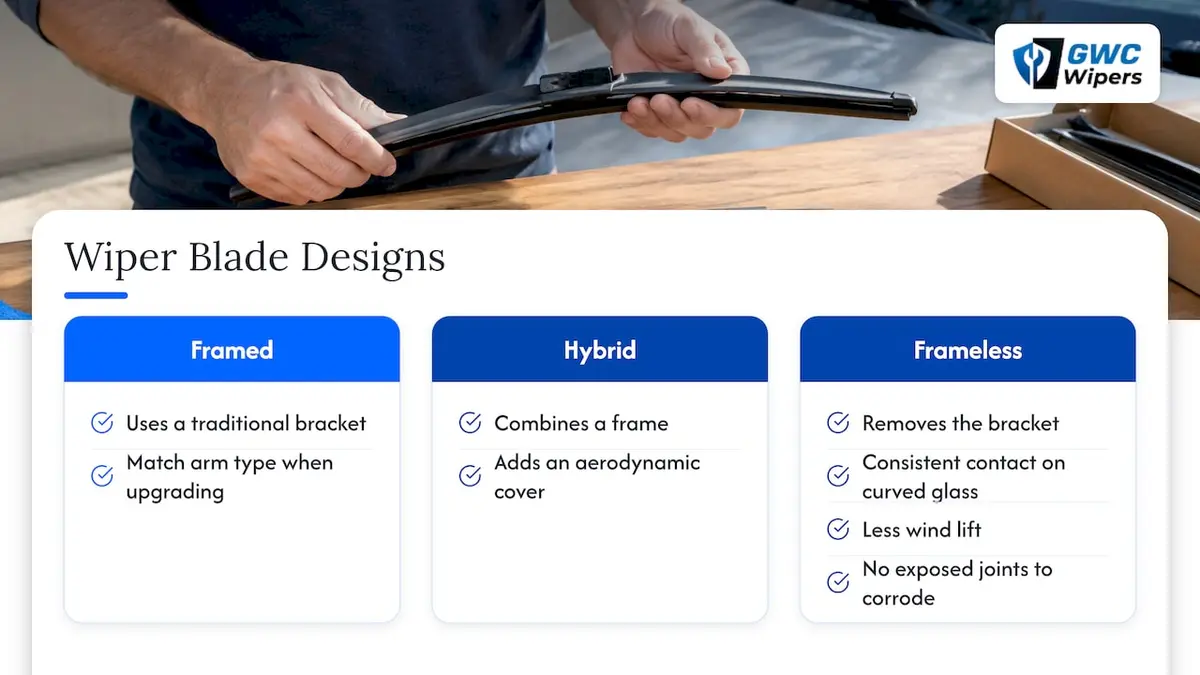
Framed blades use a traditional bracket. Hybrid blades combine a frame with an aerodynamic cover. Frameless blades remove the bracket entirely. For most modern cars with curved glass, frameless is the design that gives consistent contact with the glass, with less wind lift and no exposed frame joints to corrode.
If your car came with framed blades and you want to upgrade, make sure the new blade suits your arm type. Our selector handles this for you.
When to replace your blades
Bosch Australia recommends replacing blades at approximately 12 months, with a shorter interval where vehicles regularly face adverse conditions. Its guidance also says cleaning the blade surface during normal car washing can extend blade life.
Signs that a blade has had its day include:
- stripes or streaks across the glass
- sections the blade leaves unwiped
- a cross-beam pattern, where the blade passes over the glass unevenly
- rattle or flutter as it moves
These typically point to damaged or hardened rubber, a deformed blade, or UV and ozone damage. Our 6-step clean or replace test walks you through the check in a few minutes, and a car owner maintenance checklist is a handy reminder for wiper blade wear and replacement signs alongside your other routine checks.
Australian summers matter here. Sustained heat and UV exposure harden rubber over time, which is one reason we design our blades with natural rubber and corrosion resistance for local conditions. Our tips for protecting windscreen wipers cover parking, cleaning and heat management.
Streaks, chatter and noise: a quick diagnosis
Not every streak means the blade is faulty. Before replacing, run through this:
- Dirty glass: wax, oil film and road grime cause smearing. Clean the windscreen with a streak-free glass cleaning method and test again.
- Dirty rubber: wipe the blade edge with a damp cloth.
- Worn rubber: if streaks remain after cleaning, replace the blade.
- Wrong fit: a blade that lifts, chatters or leaves a sweep gap is often the wrong length or adapter.
The last point is where vehicle-specific fitment helps most, and it is the reason our selector is the first step rather than an afterthought.
What about refills?
Refills replace only the rubber strip, keeping the existing frame or beam. Bosch Australia’s guidance says refills can take longer to install and may need modification, and that a worn or overly flexible frame can cause smearing and accelerate refill wear. If you are curious about the trade-offs, our wiper refills explained guide goes through them. For a clean result with minimal fuss, we recommend fitting a complete vehicle-matched frameless blade.
Our view: fit first, brand second
Most wiper complaints we hear about come down to the same thing: the blade was not matched to the car. A great beam design cannot do its job if the adapter is wrong or the length is off.
That is why we built GWC around the vehicle selector. You give us your make, model and year, and we match you to blades designed for your car, with preassembled adapters so you can fit them yourself without tools. Our natural rubber blades, segmented pressure distribution and aerodynamic design are engineered for Australian weather, from storms to heat.
If the blade is not right, our 30-day money-back guarantee and 12-month warranty are there so you are covered, and our Australian support team is a message away.
Faisal
Find your exact blades
If you are ready to replace your blades, our premium frameless range ships free across Australia, with express shipping available. Enter your make, model and year and the selector shows the blades matched to your car.
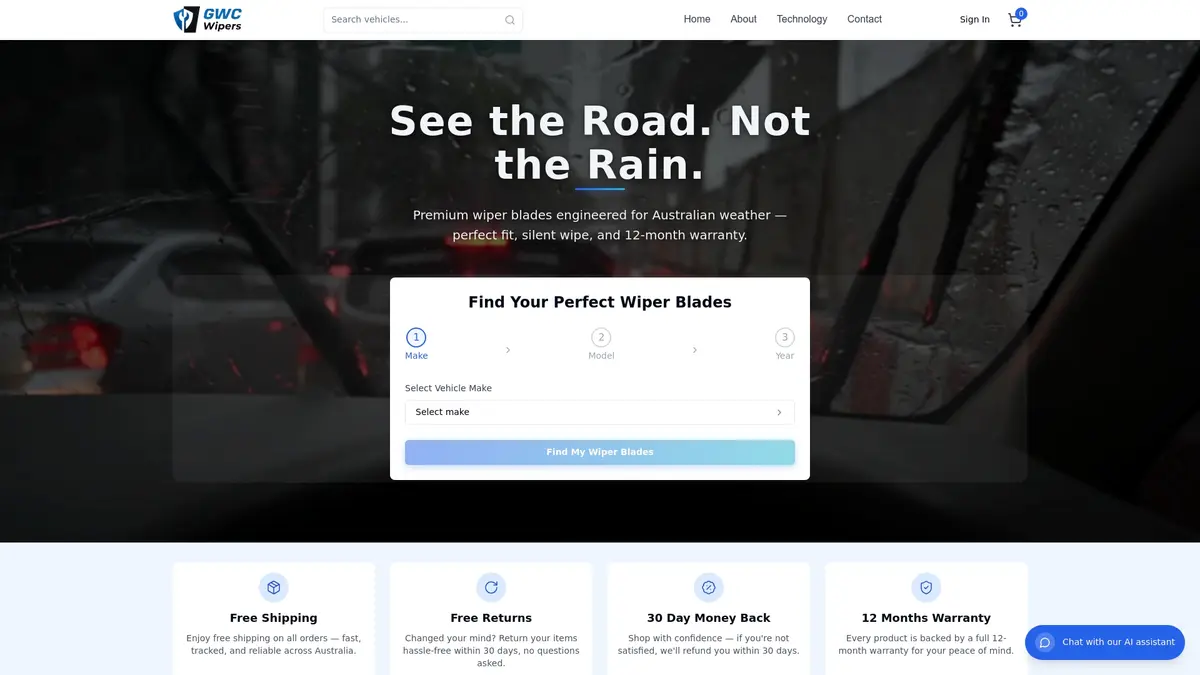
Start on the GWC Wipers homepage or go straight to the vehicle selector. If you want more help choosing, our guide to finding the best auto wiper blades in Australia is a good next read.
FAQ
Are frameless wiper blades better than framed blades?
For most modern cars, yes. A frameless blade holds the rubber against the glass along its whole length, which suits curved windscreens, and it has no exposed frame to catch wind or corrode. Make sure the blade is matched to your vehicle’s arm type and length.
How often should I replace frameless wiper blades?
Bosch Australia recommends replacing blades at about 12 months, sooner in harsh conditions. Replace earlier if you see streaks, unwiped patches or chatter. GWC blades carry a 12-month warranty.
How do I know which frameless blade fits my car?
Use your make, model and year. Enter them into the GWC vehicle selector and it returns blades matched to your vehicle, backed by our fitment guarantee. Our blades arrive with preassembled adapters and installation guides.
Can I install frameless blades myself?
Yes. GWC blades are designed for tool-free DIY installation with preassembled adapters, and the guides included walk you through each step. Fit one side at a time so you keep the other blade as a reference.
Sources
- Cooper Murray trusts Australian windscreen wipers from Trico, Australian Car Mechanic
- Reviewed and Rated: The best wiper blades for your car, Hagerty UK
- Best Car Windshield Wiper Blades of 2026, Tested, Road & Track
- 7 Best Windshield Wipers of 2026, RevRated
- Volvo FM13 HA 6x4 Rigid Air Ride Distribution, Trico Australia
- Clean car glass: streak-free method
- Car owner maintenance checklist