
Best Beam Wiper Blades in Australia: 2026 Comparison
The best beam wiper blade for you is the one that fits your exact car, holds pressure evenly along the glass and survives an Australian summer. Bosch Aerotwin and Trico Force are the two names most often compared in local retail, and GWC Wipers is a fitment-first option built for our weather. Below we compare them on price, design, fit and durability, so you can choose with confidence.
TL;DR
- Beam blades use a flexible body and a pre-tensioned steel spring to spread pressure along the whole blade, which suits curved modern windscreens.
- Repco prices read on 21 September 2026 put Trico Force at $45 to $50 per blade and Bosch Aerotwin at $65 to $75 per matched pair.
- Fit matters more than brand: confirm both blade lengths and the arm connector for your make, model and year before you buy.
- GWC Wipers offers vehicle-specific fitment, free shipping across Australia, a 30-day money-back guarantee and a 12-month warranty.
- Hybrid blades vary widely in quality, so judge the design rather than the label on the packet.
Table of Contents
- What a beam wiper blade actually is
- Beam vs conventional wiper blades
- Beam vs hybrid wiper blades
- What to compare when choosing a beam blade
- The leading beam wiper blades in Australia compared
- Rubber or silicone: the trade-off
- How beam blades cope with Australian conditions
- Check the fit before you buy
- Fitting beam blades and fixing streaks
- Our perspective on choosing a beam blade
- Get the right blades delivered
- FAQ
- Sources
What a beam wiper blade actually is
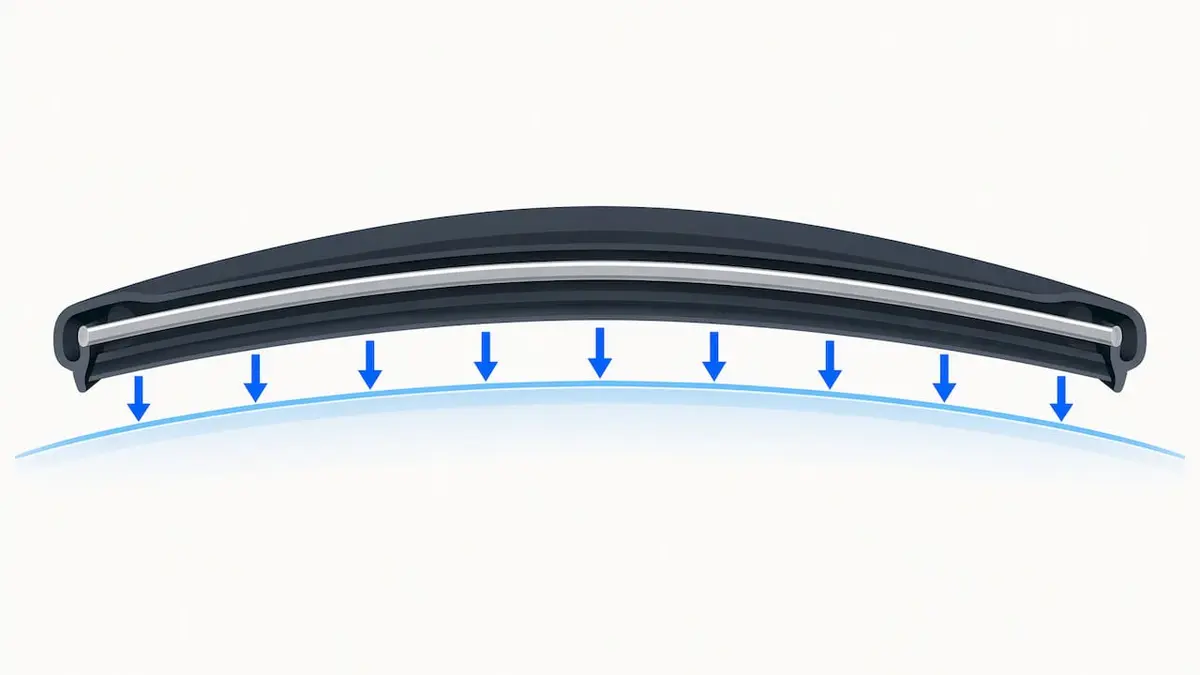
A beam blade has no external metal frame. Instead, a flexible rubber body wraps a pre-tensioned steel bar, and that bar spreads contact pressure along the length of the blade. Trade Mechanic explains that the shape and tension of that spring bar largely decide how a beam blade performs.
The design has become the norm. Trade Mechanic reported in 2019 that more than 80% of new passenger vehicles were designed with beam-style wipers, which suit highly curved modern windscreens. You will also see them called flat wiper blades, because they sit low and flat against the glass.
Three practical benefits follow from the build:
- Even contact. Pressure is spread along the blade rather than concentrated at a few frame clips, so the rubber follows the curve of the glass.
- Less wind lift. The low, smooth profile gives the airflow less to catch at highway speeds.
- Fewer weak points. With no exposed hinges and joints, there is less to corrode or seize.
Beam vs conventional wiper blades
Conventional blades use a metal frame with several pivot points to press a rubber strip onto the glass. They are cheap and work well on flatter windscreens, but the pressure sits at the clip points, and the frame can catch wind and lift at speed.
| Feature | Beam (flat) | Conventional (framed) |
|---|---|---|
| Pressure distribution | Along the whole blade via a spring bar | At the frame’s pressure points |
| Highway stability | Low profile, resists lifting | Frame can catch wind |
| Curved windscreens | Follows the curve closely | Can leave unwiped patches |
| Corrosion risk | Few exposed joints | Hinges and joints can seize |
| Typical cost | Usually higher | Usually lower |
| Winter clogging | Smoother, less trapped debris | Frame can collect debris |
If your car came from the factory with beam blades, replace them with beam blades. Fitting a conventional blade on a windscreen designed for a beam can leave streaks along the edges of the sweep.
Beam vs hybrid wiper blades
People often ask how beam and hybrid differ. A hybrid combines features of conventional and beam designs, according to Instant Windscreens. Trade Mechanic adds a caution: a hybrid may simply be a conventional frame inside a plastic shell, and some shells are mostly cosmetic.
So the question to ask of a hybrid is whether the shell adds real aerodynamic value. With a true beam, the question is simpler: is the spring bar well shaped and properly tensioned?
What to compare when choosing a beam blade
A good comparison looks past the box. These are the criteria that change how a blade behaves on your car.
- Fit. The correct length for each side (driver and passenger are often different) and the right connector for your wiper arm.
- Spring tension and profile. Higher tension and a flatter profile help at highway speeds.
- Rubber compound. Natural rubber, synthetic rubber and silicone each behave differently in heat, cold and UV.
- Price per year, not per blade. A cheaper blade replaced twice as often is not cheaper.
- Warranty and returns. These tell you how confident the seller is that the blade fits and lasts.
For a deeper look at how we think about testing, see our explainer on independent wiper blade review criteria.
The leading beam wiper blades in Australia compared
These are the options Australian drivers most often weigh up. Prices come from the Repco listings summarised by Home Muse’s Australian wiper guide, read on 21 September 2026, and they change, so treat them as a guide.
| Blade | Style | Price (read 21 Sep 2026) | Known for |
|---|---|---|---|
| Bosch Aerotwin | Beam | $65 to $75 per matched pair | Described as the best overall beam blade in that guide |
| Trico Force | Beam | $45 to $50 per blade | Higher spring tension and a flatter profile for highway speeds |
| GWC Wipers | Vehicle-specific, aerodynamic, segmented pressure | See the vehicle page for your car | Perfect fit guarantee, free shipping, 30-day returns, 12-month warranty |
Bosch Aerotwin
The Aerotwin is sold as a matched pair and is widely stocked. The Australian guide above calls it the best overall beam blade and lists it at around $69 for a pair at Repco. It is a sensible choice if you want a well-known brand from a store you can walk into the same day.
Trico Force
The Trico Force costs around $48 a blade, and its higher spring tension and flatter profile are aimed at highway speeds, where wind tries to lift the wiper off the glass. Trade Mechanic also notes that Trico beam blades have no corrosion points. Because it is priced per blade, a full set for most cars costs more than the headline figure.
Rain-X and Trico Platinum
US testing is a useful guide to the character of a blade, even though the models and prices differ from ours. Car and Driver says Rain-X Silicone Endura blades are designed to last twice as long as conventional rubber and removed water exceptionally well. The same test found Trico Platinum quiet, streak-free and effective at clearing water on all three speeds.
Automoblog’s 2025 review, which ranked Bosch ICON first, also warns that some blades suit certain vehicles better than others. That is the point to take away: no single blade wins on every car.
GWC Wipers
We design and sell blades for Australian conditions, including heavy rain, extreme heat and UV exposure. Each blade has natural rubber construction, advanced segmented pressure distribution, an aerodynamic design, corrosion resistance and preassembled adapters, so you can fit it without tools. Our fitment covers over 2,500 models, and every order is backed by a perfect fit guarantee, free shipping across Australia, a 30-day money-back guarantee and a 12-month warranty.
Where a retail-chain blade is a good option when you need one today, ours suits drivers who would rather have the correct size for their exact car delivered free than guess at a shelf.
Rubber or silicone: the trade-off
Rubber and silicone are the two common wiping edges. Natural rubber grips the glass well and is usually cheaper to replace. Silicone is marketed for longevity and water repellency, which Car and Driver’s Rain-X result reflects, but a hard silicone edge can smear on a dirty or oily windscreen until the glass is properly cleaned.
We use natural rubber because it keeps a clean wiping edge and makes sense on a replacement schedule. Our guides cover the benefits of natural rubber wipers, the EPDM versus rubber question and wiper blade materials for durability. Whatever the material, plan to replace blades about every 6 to 12 months in Australian conditions, and sooner if you park outdoors in strong sun.

How beam blades cope with Australian conditions
Heat and UV. Rubber hardens and cracks with prolonged sun, so a car parked outside in Queensland or Western Australia wears blades faster than a garaged one. A cracked edge shows up first as chatter or a dull smear.
Heavy rain. A storm in Sydney or Darwin tests clearing power. Even pressure along the blade matters most here, which is where a well-built beam shines.
Highway speed. On a long run on the Hume or the Bruce, wind lift is the real enemy. Higher spring tension and a flat profile help keep the edge on the glass.
Alpine cold. In snow country, a smooth beam design collects less ice in its joints than a framed blade.
These are design characteristics rather than lab results. Few Australian-specific head-to-head tests exist, so the fairest approach is to match the design to how and where you drive.
Check the fit before you buy
The best blade is useless if it is the wrong length or has the wrong connector. Australian chain retailers offer lookups using your registration or make, model and year, which return both blade lengths and the arm fitting, as summarised here. You can do the same with ours.
On the GWC Wipers wiper blade finder, pick your make, model and year and you will see the correct blades for your car. If you already know your brand, go straight to a make page: Toyota, BMW, Mercedes-Benz, Volvo or Mitsubishi. For specific models, we also have pages for the Mercedes-Benz GLE-Class, GLA-Class and Ford Laser.
Our guide on choosing wiper blades that fit your vehicle walks through reading your sizes if you prefer to measure.
Why the two sides differ
Most cars use a longer blade on the driver’s side and a shorter one on the passenger side, and some have a different connector on each. Always check both. A common mistake is buying two of the same length because the first one matched.
Fitting beam blades and fixing streaks
Most beam blades fit in a few minutes. Lift the arm, release the clip, slide the old blade off, slide the new one on until it clicks and lower the arm gently onto the glass. Our step-by-step installation guide covers it with photos, and our blades arrive with preassembled adapters so you do not need tools.
If you see streaks after a replacement, the cause is usually a dirty windscreen, a bent arm or a blade not fully seated. Our guide to fixing wiper streaks after replacement takes 10 to 15 minutes. Clean glass matters as much as the blade, and this streak-free glass cleaning method is a good reference for getting the windscreen properly clean before you judge the new rubber.
Our perspective on choosing a beam blade
We see the same problem again and again: drivers buy on brand or price and then discover the blade is the wrong size or the wrong connector. A premium blade that does not fit is worse than a modest one that does. That is why our whole business starts with the vehicle selector, not the product page.
We also think honesty about durability matters. Every wiper edge wears, and Australian sun is hard on rubber. Rather than promise a blade that lasts forever, we back ours with a 12-month warranty and a 30-day money-back guarantee, and we point you to a replacement rhythm of 6 to 12 months for natural rubber. If you want to know why, read our piece on natural rubber wiper blades for Australian drivers.
The right choice depends on your car, your climate and how you drive. A highway commuter in Victoria and a tradie on a Pilbara dirt road need different things from a wiper. Compare on fit, design and total cost over a year, and you will choose well.
— Faisal
Get the right blades delivered
If you want blades matched to your exact car, start at the GWC Wipers store. Enter your make, model and year, and we show the right fit with free shipping across Australia. If something is not right, our 30-day money-back guarantee and 12-month warranty apply, and our Australian support team is on hand to help. Fleet operators and workshops are welcome too.
FAQ
Are beam wiper blades better than conventional ones?
On most modern cars, yes. A beam blade spreads pressure evenly and sits low, which helps on curved windscreens and at highway speeds. On a flat windscreen designed for a framed blade, a conventional blade can still do a good job, so match what your car was built for.
How much do beam wiper blades cost in Australia?
Repco prices read on 21 September 2026 had Trico Force at $45 to $50 per blade and Bosch Aerotwin at $65 to $75 per matched pair, according to an Australian wiper guide. Prices vary by size and retailer, so check the current listing for your car.
How do I know which size beam blade my car needs?
Use a make, model and year lookup, or your registration, to get both blade lengths and the connector type. You can use the GWC Wipers finder for this. Do not assume both sides are the same length.
What is the difference between beam and hybrid wipers?
A beam blade has a flexible body with a pre-tensioned steel bar, while a hybrid usually pairs a conventional frame with a plastic shell. Hybrid quality varies, and some shells add little beyond looks, so judge the build rather than the label.
How often should I replace beam wiper blades?
Plan on every 6 to 12 months for natural rubber blades in Australian conditions, and sooner if you park in strong sun. Replace them earlier if you notice streaks, chatter or unwiped patches.
Sources
- Best Wiper Blades Australia: What Fits and What Lasts
- Best Windshield Wipers (Automoblog)
- Best Windshield Wiper Blades for 2026, Tested (Car and Driver)
- Understanding how Wiper Blades Work, and Why They Fail (Trade Mechanic)
- Wiper servicing and why it is an important part of any regular vehicle service (Trade Mechanic)
- Best Windscreen Wipers: Complete Buying Guide (Instant Windscreens)
Find wipers that fit your exact car at gwcwipers.com.au/wiper-blades, with Perfect Fit Guaranteed.