
Best Windscreen Wipers in Australia 2026: How to Choose

The best windscreen wipers for your car are the ones that fit your exact make, model and year, use a design suited to Australian sun and storms, and get replaced before they start to streak. Brand matters, but fit comes first. Independent testers in 2026 rate beam-style blades from Bosch, Trico and Rain-X highly, and we explain below how they differ, where GWC Wipers sits among them, and how to lock in the right size for your vehicle.
TL;DR
- Fit decides everything: the driver’s side length, the passenger’s side length and the arm connector matter more than the badge on the blade.
- Recent tests put Bosch Icon, Rain-X Latitude and Trico beam blades at or near the top, and each wins on different strengths.
- Australian heat, UV and dust age rubber quickly, so plan to replace blades roughly every six to twelve months.
- We design GWC blades for Australian conditions, with vehicle-specific fitment, free shipping Australia-wide, a 30-day money-back guarantee and a 12-month warranty.
- Use the make, model and year finder at gwcwipers.com.au/wiper-blades to see the exact blades for your car.
Table of Contents
- What the 2026 tests actually tell Australian drivers
- Best windscreen wipers compared
- Fit comes before brand
- Blade types: what suits Australian conditions
- When to replace your wipers
- Fitting new blades yourself
- Perspective: what we would tell a friend
- Find your exact fit with GWC Wipers
- FAQ
- Sources
What the 2026 tests actually tell Australian drivers
Most published wiper tests come from the United States and the United Kingdom. They are useful for comparing designs, but they do not test on a Prado in a Queensland summer. Read them for what they reveal about construction and performance, then match the lessons to local conditions.
Here is what the major 2026 reviews found:
- Car and Driver named the Rain-X Latitude Water Repellency as Best Overall, the Aero Voyager as Best Value, the Bosch Icon as Premium Pick and the Trico Flex as Best Budget, using simulated storm testing. Its testers said the Latitude’s built-in hydrophobic coating was the deciding factor, because water beads and slides off the glass even when the wipers are not running. They still considered the Bosch Icon the stronger blade for raw water removal.
- Road & Track picked the Bosch Icon Beam as Top Pick, Autoboo as Best Value, PIAA Si-Tech Silicone as Premium Pick and Rain-X WeatherBeater as Best All-Weather in its 2026 windscreen wiper roundup.
- MotorTrend named the Bosch Icon Best Overall in its April 2026 test, recording 95.1% wiping performance and 50.7 dB of noise.
- On the owner-review side, PartReview’s March 2026 ranking of 19 manufacturers, built on more than 1,700 reviews and 5,000 votes, placed Bosch first, PIAA second and Trico third.
The pattern is clear. Bosch Icon wins most of the controlled tests, Rain-X wins where water repellency is weighted heavily, and Trico shows up consistently in the budget and value picks. No single blade is best for every car, road and climate.
Best windscreen wipers compared
This table compares the options Australian drivers most often weigh up. The test results come from the reviews above. The GWC row describes our own design claims, not a third-party test result.
| Wiper | Type | What reviewers or the maker highlight | Suits |
|---|---|---|---|
| Bosch Icon | Beam | Top performer in MotorTrend and Road & Track tests, Premium Pick at Car and Driver | Drivers who want a proven all-rounder |
| Rain-X Latitude | Beam with water repellent | Best Overall at Car and Driver thanks to its hydrophobic coating | Drivers in frequent heavy rain |
| Trico Force | Beam | Swept-wing aerofoil designed for high-speed stability | Highway and regional drivers |
| Trico Flex | Flexible conventional | Best Budget at Car and Driver | Older vehicles and tight budgets |
| PIAA Si-Tech Silicone | Silicone beam | Premium Pick at Road & Track | Drivers who prefer silicone longevity |
| GWC Wipers | Vehicle-specific beam-style blades with natural rubber and preassembled adapters | Designed and tested for Australian weather, with a fit guarantee and 12-month warranty | Drivers who want the right size without guesswork |
We have left prices out on purpose. They shift between retailers and through the year, and the retailer listing is always the current figure.
If you want a deeper brand-by-brand view, our guides on wiper blade brands in Australia and beam wiper blades go further, and our Bosch comparison sets guaranteed fit against the Aerotwin.
Bosch or Michelin?
This is a common question. In a UK road test, Hagerty scored the Bosch Aerotwin 10/10 and the Michelin Stealth Hybrid 8/10 on a Land Rover Discovery. It praised the Bosch for staying whistle-free at motorway speeds and for a locking fitment that kept the blade at the right angle. It called the Michelin’s wiping decent despite an older bridged design. That was a single test on a single vehicle, so treat it as one data point rather than a verdict for every car.
Fit comes before brand
A wiper blade is a fitment part. Two numbers and one fitting decide whether it works on your car: the driver’s side length, the passenger’s side length (usually shorter) and the shape of the connector on the arm. A blade that is too long can hit the pillar or the other blade. One that is too short leaves a wide uncleared band of glass.
That is why the same car family can need different blades. Consider three common Australian vehicles:
- Toyota Prado 120: a tall, upright windscreen that sees plenty of dust, rural roads and bull-bar driving. Blade length and arm type vary between model years, so confirm yours.
- Mazda CX-5: one of the country’s most popular SUVs, sold across several generations with different windscreen shapes and arm fittings.
- Ford Ranger: a ute that covers everything from tradie work to outback touring. Different model years do not always share the same blade sizes.
We do not list sizes here, because guessing from a generic chart is how people end up with the wrong blade. Instead, pick your make, model and year in the GWC Wipers vehicle finder and it shows the blades that fit. We cover more than 2,500 models, from Toyota, Mazda, Honda and Audi to BMW, Mercedes-Benz, Abarth and BYD. Our guide on choosing wiper blades that actually fit your vehicle walks through the process step by step.
Some examples of the vehicle pages you can open directly include BMW, the Mercedes-Benz GLB-Class, the Suzuki Vitara 2015 to 2023 and the Holden Colorado 7 2012 to 2016.
Blade types: what suits Australian conditions
Conventional, beam and hybrid
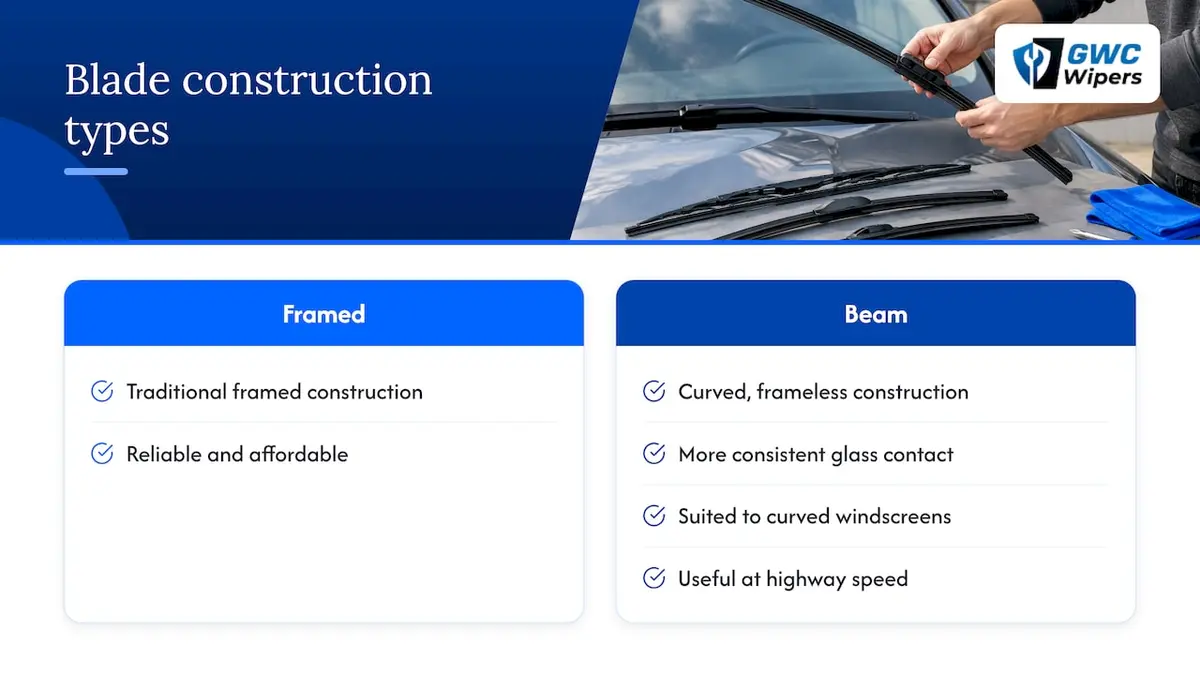
Traditional framed blades are reliable and affordable. Beam blades use a curved, frameless construction that Road & Track says helps maintain more consistent contact with the glass. That matters on the curved windscreens of modern cars and at highway speed.
The Trico Force shows how far aerodynamic design has moved. Australian Car Mechanic reports that its swept-wing VorTec aerofoil is built to handle wind forces equivalent to speeds of up to 240 km/h, working like a built-in spoiler that presses the blade against the glass. The same report says the range runs from 350 mm to 725 mm and covers more than 95% of vehicles on Australian roads.
Our own blades follow the same thinking: an aerodynamic profile, segmented pressure distribution to spread contact along the blade, and corrosion-resistant components.
Natural rubber, silicone and coatings
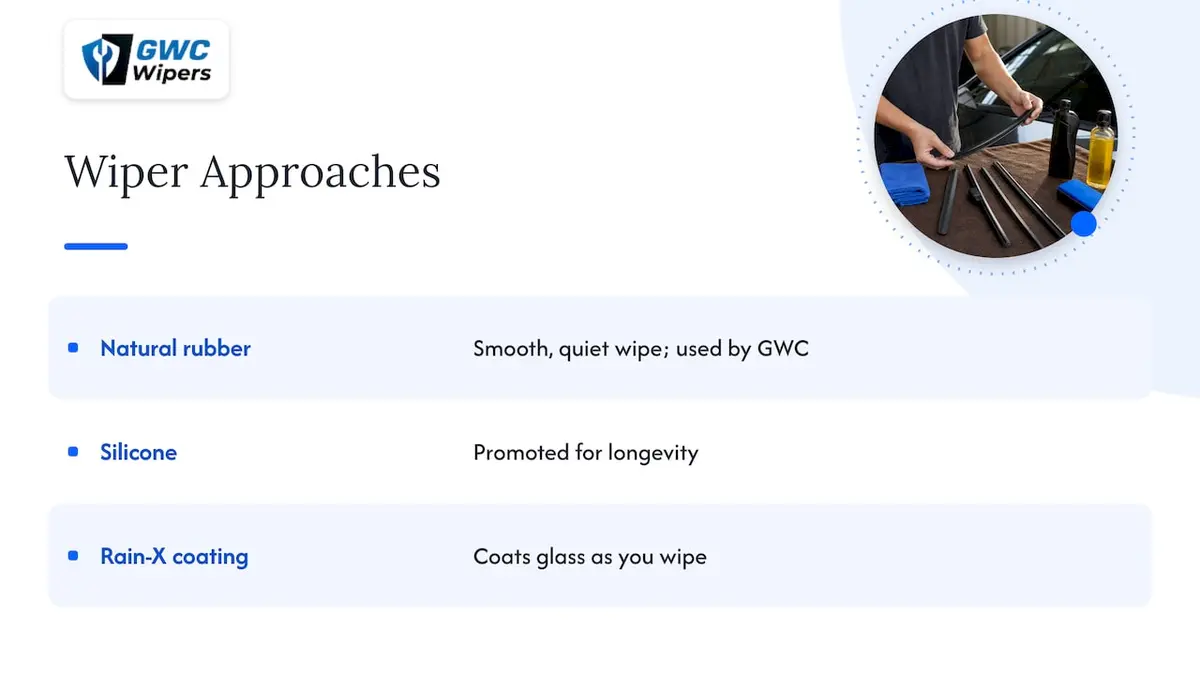
Natural rubber gives a smooth, quiet wipe, and it is the element we use at GWC. Silicone is promoted for longevity, while Rain-X’s repellent approach adds a coating to the glass as you wipe. Each has a place. What matters is that the element is matched to a well-built blade that holds even pressure from end to end.
Heat and UV
Australian summers are hard on rubber. Cars24 notes that heat, dust, road film, salt air, tree sap and bird droppings can age wipers faster than you might expect. Parked outdoors in a Perth or Brisbane summer, a windscreen gets hot enough to harden the rubber edge. See our guides to selecting wipers for heatwaves and how Australian weather affects wiper blades for practical tips, including parking in shade and lifting the arms off hot glass.
When to replace your wipers
Cars24 recommends replacing blades every six to twelve months, or sooner if they streak, squeak, shudder or leave parts of the glass unclear. Watch for these signs:
- Streaks or smears across your line of sight.
- Patches the blade misses on each pass.
- Squeaking, chattering or juddering across the glass.
- Cracked, split or hardened rubber.
- Bent or corroded frames and arms.
There is also a legal side. A Queensland roadworthy guide notes that blades that streak, skip or leave sections uncleared can fail a roadworthy inspection because they impair vision in wet conditions. Rules differ between states, so check the requirements with your state road authority if you are selling or re-registering a vehicle.
Our articles on why regular blade replacement matters and replacing wipers every 6 to 12 months explain the reasoning in more detail.
Keep the glass clean too
A clean windscreen helps new blades last and perform. Dirt and film on the glass wear the rubber edge and cause smearing that looks like a blade fault. A streak-free glass cleaning method takes a few minutes and pairs well with fresh blades. Wipe the rubber edge with a damp cloth when you wash the car, and use our windscreen clarity checklist to cover the rest.
Fitting new blades yourself
Most drivers can swap blades in the driveway in minutes. Cars24 sets out a seven-step replacement process, and a Queensland roadworthy guide says a pair can typically be fitted at home in under ten minutes. The basic sequence is the same for most cars:
- Lift the wiper arm away from the glass until it locks upright.
- Release the old blade at the connector and slide it off.
- Clip the new blade on until it seats with a click.
- Lower the arm gently back onto the glass. Do not let it snap down.
- Test with the washers on before you drive.
Our blades arrive with preassembled adapters and detailed guides, so you can fit them without special tools. If you are unsure, our local support team can help.
Perspective: what we would tell a friend
Most people choose wipers by brand name, and then they are surprised when a blade chatters or leaves a band of water on the driver’s side. In our experience the problem is nearly always fit. A blade that is a few centimetres out, or on the wrong connector, will never wipe properly, whatever it cost.
That is why we built GWC Wipers around the vehicle. You choose your make, model and year, and you see the blades made for that car. We design and test our blades for Australian weather, from heavy tropical rain to long, hot summers, and we back the fit with a guarantee, a 30-day money-back promise and a 12-month warranty.
Good wipers are a safety item. When you can see clearly, you brake earlier, you merge more confidently and you stress less on a wet highway. Replace them on time, fit the right size, and keep the glass clean.
Faisal
Find your exact fit with GWC Wipers
GWC Wipers designs, manufactures and sells premium wiper blades for Australian weather. Our natural rubber blades use segmented pressure distribution, an aerodynamic profile and corrosion-resistant construction, with preassembled adapters for easy DIY installation. Every order ships free across Australia, and express shipping is available at checkout.
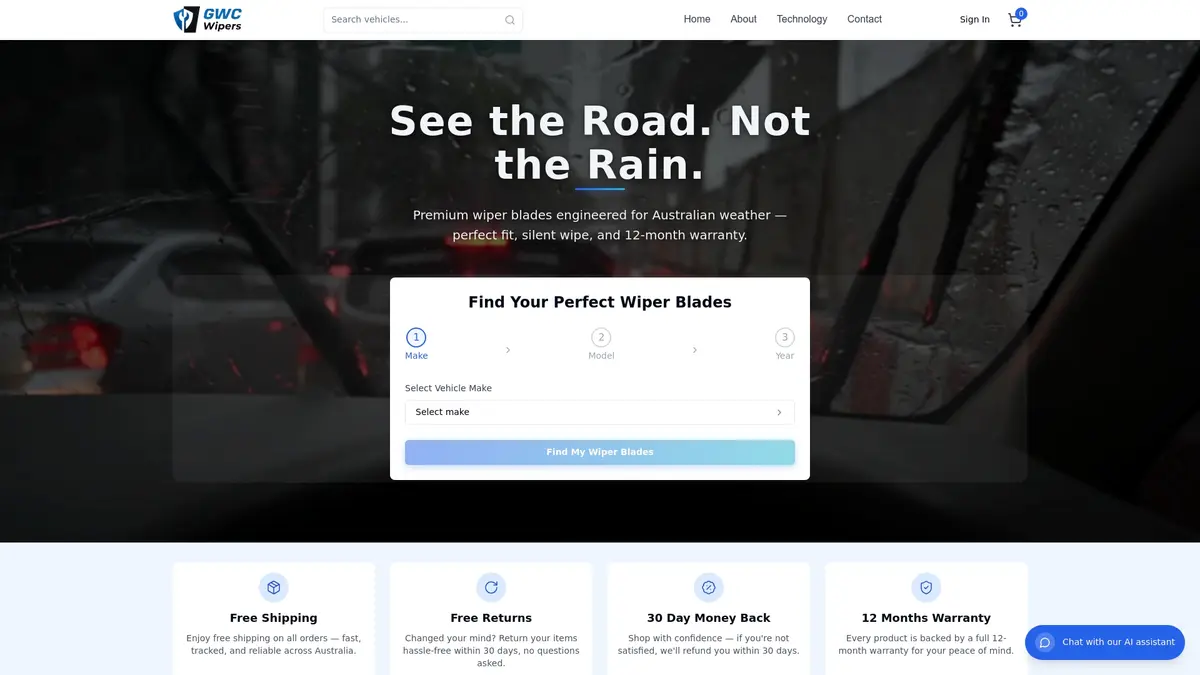
If you drive a Toyota, Mazda, Honda, Mercedes-Benz, BMW, Audi, Abarth or BYD, or a ute such as the Ranger, start with the finder and let the car decide. You can also browse the full range from the GWC Wipers home page.
FAQ
What are the best windscreen wipers in Australia?
There is no single best blade for every car. Recent tests favour beam designs such as the Bosch Icon, Rain-X Latitude and Trico Force, and the right pick depends on your vehicle and your driving. Start with a blade that fits your exact make, model and year, then choose the design that suits your climate.
How do I find my windscreen wiper size?
You need the driver’s side length, the passenger’s side length and the arm connector type. You can measure the old blades or use a vehicle finder that takes make, model and year. Our vehicle finder returns the blades made for your car, and our fit guarantee backs the result.
How often should I replace wiper blades in Australia?
Most sources suggest every six to twelve months, and sooner in hot, dusty or coastal areas. Replace them as soon as you see streaks, missed patches, chatter or damaged rubber. Fresh blades are a small cost compared with driving in the wet with poor vision.
Are expensive wiper blades worth it?
Design and materials do make a measurable difference in tests, particularly in pressure distribution, noise and durability. Even so, a correctly sized mid-range blade will outperform a premium blade that does not fit. Get the fit right first, then look at construction and warranty.
Sources
- Best Windshield Wiper Blades for 2026, Tested (Car and Driver)
- Best Car Windshield Wiper Blades of 2026, Tested (Road & Track)
- The Best Wiper Blades For 2026: Tested Picks (MotorTrend)
- Which wiper blades are best in 2026? (PartReview)
- Reviewed and Rated: The best wiper blades for your car (Hagerty)
- Trico targets high-performance visibility (Australian Car Mechanic)
- How to Replace Windshield Wipers (Cars24)
- What Will Fail A Roadworthy In QLD? (Car One)