
Best Silicone Wiper Blades in Australia: Silicone vs Rubber

Silicone wiper blades are worth considering if your car sits in the sun all summer, but they are not automatically better than a quality rubber blade. Silicone generally lasts longer and shrugs off heat, while good rubber often gives a quieter, cheaper wipe from day one. The best choice depends on where you park, how you drive and, above all, whether the blade fits your exact car.
Below we compare the two materials honestly, name the brands Australian drivers most often weigh up, explain the installation mistakes that make good blades look bad, and show you how to confirm your size before you spend a cent.
TL;DR
- Silicone resists UV, ozone and temperature swings better than conventional rubber, and it usually costs more. Road & Track notes that premium natural rubber blades are also highly rated for quiet, smooth, all-weather performance.
- Silicone does not guarantee a better wipe. Fit, tension and a clean windscreen matter as much as the material.
- Whatever you choose, plan to check or replace blades every 6 to 12 months, and sooner after a harsh Australian summer.
- Streaking or chatter right after fitting is often caused by residue on the glass, not a faulty blade.
- Check your exact size and fit for your make, model and year at gwcwipers.com.au/wiper-blades.
Table of Contents
- Are silicone wiper blades better than rubber?
- Silicone vs rubber wiper blades at a glance
- What Australian conditions do to wiper blades
- The brands Australian drivers compare
- Beam, framed or hybrid: the shape matters as much as the material
- Why silicone blades sometimes streak or haze
- How to tell if your current blades are done
- Windscreen wiper size: why getting it right matters more than the material
- Our perspective: what we would tell a friend
- Ready to order? Find your exact fit
- Frequently asked questions
- Sources
Are silicone wiper blades better than rubber?
It depends on what you value. Silicone wins on longevity and heat tolerance. Rubber wins on upfront price and, in many cases, on how quietly and cleanly it wipes when new.
The core difference is how each material ages. Conventional rubber hardens and glazes under UV, then smears or judders on wet glass. Silicone is engineered to stay flexible for longer, and according to the research we reviewed, it is more resistant to extreme temperature changes, UV rays and ozone than traditional rubber. Some silicone blades also leave a water-repelling film on the glass, which can improve visibility in rain.

That said, reviewers are not unanimous. One Australian retailer blog argues that silicone costs more without necessarily wiping better, a point we think is fair: you pay for durability, not for a magic improvement in clearing water.
Silicone vs rubber wiper blades at a glance
| Factor | Natural rubber | Silicone |
|---|---|---|
| Upfront cost | Lower | Usually higher |
| Wipe quality when new | Excellent from a quality maker | Excellent when installed on clean glass |
| UV and heat resistance | Degrades faster in strong sun | Stronger resistance |
| Typical lifespan | About 6 to 12 months in many Australian conditions | Often reported as 1.5 to 2 times longer |
| Noise | Typically quiet when new | Can chatter if the glass is not prepared |
| Glass effect | None | May leave a hydrophobic film, and occasionally minor haze |
Treat the lifespan figures as ranges, not promises. Parking in a garage versus on a Darwin driveway can change the result more than the material does.
What Australian conditions do to wiper blades
Most owners think of wipers as a wet-weather part, yet the damage usually happens in summer. One Australian buyer’s guide points out that the actual wear tends to occur during the heat of January and February, when UV causes rubber to glaze and harden. A blade that looks fine on a dry day can smear or judder the moment it meets water.
That is why Australian guidance runs shorter than you might expect. RACQ says blades should be replaced every 6 to 12 months, and that our UV levels often call for earlier replacement. Degraded blades that streak, chatter or smear reduce your view in wet weather, which is a safety issue, not just an annoyance.
If you want more detail on this side of things, our guides on how Australian weather impacts wiper blades, UV resistance in wiper blades and selecting wipers for heatwaves go further.
Where silicone makes the most sense
- You park outdoors in strong sun for most of the year, such as in Queensland, the Northern Territory or inland Western Australia.
- You would rather fit blades less often and accept a higher price per blade.
- You drive in a mix of very hot days and cold mornings, where repeated temperature swings stress rubber.
Where quality rubber is the smarter buy
- Your car lives in a garage or under cover, so UV exposure is limited.
- You replace blades on a regular schedule anyway, so extra longevity goes unused.
- You want the lowest cost per set and a quiet, predictable wipe straight out of the box.
The brands Australian drivers compare
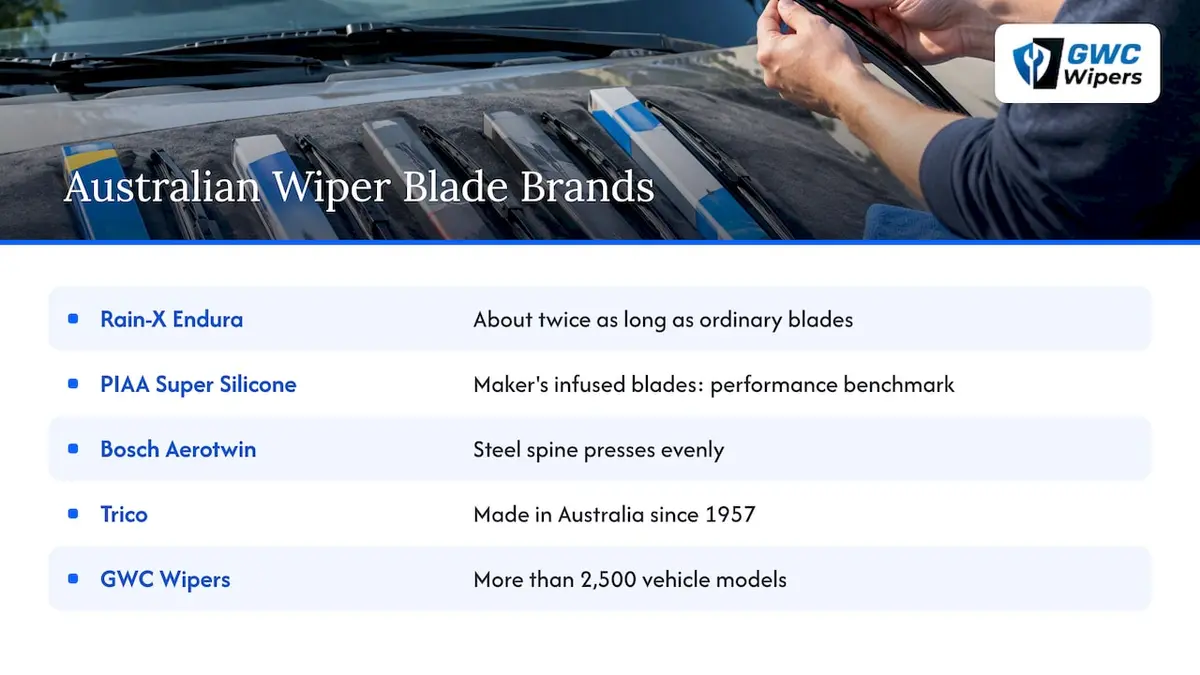
Search results for silicone blades are dominated by a handful of names. Here is how they are generally positioned, based on the sources we reviewed.
Rain-X Silicone Endura. Often the first name on silicone lists. Car and Driver singles it out as its pick for silicone blades designed to last about twice as long as ordinary ones. It is a US-led test, so check local availability and sizing for your vehicle.
PIAA Super Silicone. A long-standing name in the silicone category, with the maker describing its silicone-infused blades as a benchmark for wiper performance. That is the manufacturer’s own claim, not independent testing.
Bosch. The Aerotwin beam blade is the one a lot of European cars leave the factory with, according to an Australian blade roundup. A tensioned steel spine inside the rubber presses the blade evenly along its length. Owners do report variable results, though: one Volvo owner described Bosch replacements that cleared well but chattered on their car. That is one anecdote, but it shows that a respected brand can still be the wrong match for a particular vehicle.
Trico. Trico has a long history in wiper blades and, as one Australian article notes, has manufactured in Australia since 1957. It is generally associated with quality rubber wiping edges.
GWC Wipers. We design, manufacture and sell premium blades for Australian weather. Ours use natural rubber construction with segmented pressure distribution, an aerodynamic profile and corrosion resistance, with vehicle-specific fitment across more than 2,500 models. We are not claiming that makes us the best for everyone. We are saying that a precisely fitted, well-built rubber blade is a strong and sensible choice for many drivers, and that it is what we know how to do well.
Beam, framed or hybrid: the shape matters as much as the material
People comparing silicone and rubber often overlook blade construction. Road & Track explains that traditional framed blades remain a reliable, affordable option, while beam-style designs use a curved, frameless construction to maintain more consistent contact with the windscreen.
Beam blades suit drivers who spend time at highway speeds. Their aerodynamic profile and even pressure distribution help them stay in contact with the glass, and they are less prone to lifting or vibrating. That is why fleet operators and performance enthusiasts tend to favour them. For Australian drivers it means cleaner sweeps in heavy tropical rain and in dusty conditions.
A silicone edge on a poorly fitting frame will still perform badly. A rubber edge on a blade that matches your windscreen curvature and arm will often beat it. Our overview of the best windshield wiper blade types for Australian drivers explains how the types differ.
Why silicone blades sometimes streak or haze
This is the most common disappointment with silicone, and it is usually avoidable. Premium silicone brands often ship with a prep wipe, because old rubber residue and road grime on the glass can cause immediate streaking or chatter. Many people blame the blade when the real cause is residue on the windscreen. Reviewers also note that some silicone blades can cause minor surface haze if the glass is not properly prepared.
So before you fit any new blade:
- Wash the windscreen with car shampoo or a dedicated glass cleaner, not just water.
- Wipe the glass with a clean microfibre cloth until it squeaks lightly.
- Clean the new blade’s edge with the supplied wipe, or with a lint-free cloth and a little glass cleaner.
- If the glass already looks cloudy, deal with the haze first. This guide to windscreen haze removal covers the cleaning side in detail.
If streaks appear anyway, work through our fix for wiper streaks after replacement, which usually takes 10 to 15 minutes.
How to tell if your current blades are done
Do not wait for a storm to find out. The simplest check is to wet the screen and make a single pass. If the blade leaves lines, skips, squeals or leaves a hazy band, it is time. You can also run a fingertip along the edge: nicks, hardness or a cracked, chalky feel mean the rubber has perished.
RACQ’s summer road trip checklist makes the same point: replace blades that streak or shudder and keep the washer fluid topped up for wet, dusty or buggy conditions. Our six-step test for signs of bad wipers walks you through the check. For the legal angle, the NSW Government tells drivers to regularly check that their windscreen wipers and washers work, and roadworthiness rules in other states cover wipers as well.
Windscreen wiper size: why getting it right matters more than the material
A silicone blade that is too long can hit the pillar or the other wiper. One that is too short leaves a wider unwiped arc. Either way, the material advantage disappears.
Sizes are not universal, even within one brand. Driver and passenger blades are often different lengths, the rear wiper may be a third size, and the connector type on the arm varies. RACQ’s advice is to confirm the correct blade width and length before buying. Because sizes change between model years and body styles, we do not publish a single size for a make. We would rather you check your exact car than rely on a number that may be wrong for your year.
Here is how to do it quickly:
- Go to our wiper blade finder.
- Select your make, model and year.
- Read the driver, passenger and, if listed, rear fitment before ordering.
You can also jump straight to a make page, for example Toyota, BMW, Mercedes-Benz, Volvo or Mitsubishi. Model pages such as the Mercedes-Benz GLE-Class, GLA-Class and Ford Laser list the fitment for that vehicle. Our guide on choosing wiper blades that fit your vehicle covers measuring by hand if you prefer.
Our perspective: what we would tell a friend
We make rubber blades for Australian conditions, so you might expect us to dismiss silicone. We do not. Silicone has a real place for cars that bake outdoors, and anyone who tells you it is useless is ignoring how UV treats rubber.
But we see the same pattern again and again. A driver buys a blade based on a material headline, then has trouble because the size is slightly off, the arm connector is wrong or the glass was never cleaned. The material gets blamed. In our experience, fit comes first, installation second, material third.
That is why we built our range around vehicle-specific fitment, preassembled adapters and tool-free installation with guides included. It is also why we back the sale with a fitment guarantee, a 30-day money-back guarantee and a 12-month warranty. If you want to understand how natural rubber compares with other compounds, our piece on EPDM versus rubber wipers is a good next read.
Replace on a schedule, check after summer, and buy for your exact car. Do those three things and almost any decent blade will serve you well.
— Faisal
Ready to order? Find your exact fit
If you want blades made for Australian heat, rain and dust, start with your car. Our selector matches blades to your make, model and year across more than 2,500 models, with free shipping across Australia, express shipping available, a 30-day money-back guarantee and a 12-month warranty. Browse the range at GWC Wipers or go straight to the wiper blade finder.
Frequently asked questions
Are silicone wiper blades better?
They can be, mainly for durability. Silicone resists UV, heat and ozone better than conventional rubber, so it tends to last longer in harsh sun. It costs more, though, and a good rubber blade can wipe just as cleanly when new.
What are the disadvantages of silicone wiper blades?
The main ones are price, the chance of chatter or minor haze if the windscreen is not properly cleaned, and a wipe that is not always better than quality rubber. Most problems come from installation and fit, so prepare the glass and confirm your size first.
How often should I replace wiper blades in Australia?
RACQ recommends roughly every 6 to 12 months, and earlier if UV exposure has left them streaking, juddering or smearing. Test them after summer and before the wet season. Silicone may stretch that interval, but check by feel and by performance rather than by the calendar alone.
How do I know which wiper size my car needs?
Check your make, model and year, because driver, passenger and rear sizes often differ and change between model years. Use the GWC Wipers fitment finder or measure the existing blades. Do not rely on a size you saw for a similar car.
Sources
- Road & Track: Best Car Windshield Wiper Blades, Tested
- Car and Driver: Best Windshield Wiper Blades, Tested
- RACQ: How to change wiper blades
- RACQ: Road trip checklist
- Best Wiper Blades Australia: What Fits and What Lasts
- Silicone vs Rubber Wiper Blades: Which Is Worth It?
- PIAA Super Silicone Wiper Blades
- SwedeSpeed: MY23 T8 Wiper Replacements
- NSW Government: Roadworthiness