
Classic Car Wiper Blades in Australia: How to Choose
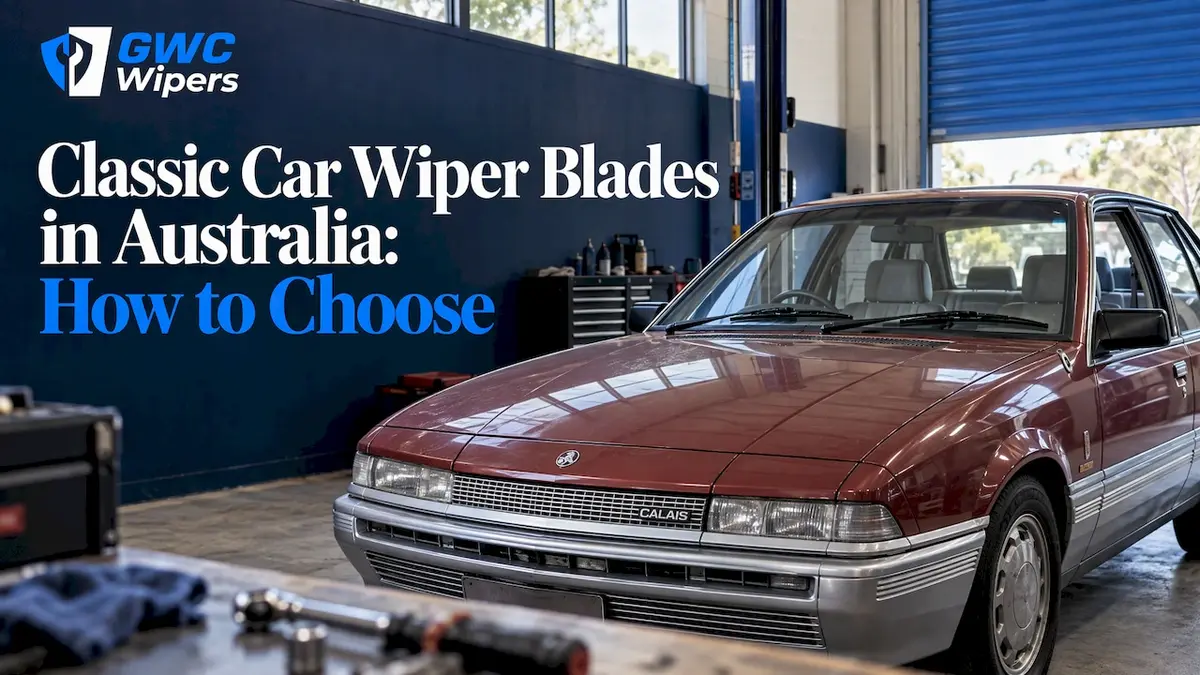
For a classic car, the right wiper blade is the one that fits your exact arm, clears the glass in a real downpour and suits the age of the car. If your classic is a 1980s or 1990s Australian-delivered model, a vehicle-specific blade from GWC Wipers is the simplest way to get all three: you pick your make, model and year, and the blade is matched to your car, not guessed from a universal chart. If you are restoring a 1940s to 1960s car and want chrome-look hardware, a period-style stainless blade is a separate category, and this guide explains how to tell which group your car belongs to.
Below you will find the main options compared, how to work out the right length and fitting, how rubber and silicone behave on older cars, and how to fit blades without damaging an old windscreen.
TL;DR
- Classic cars fall into two groups: pre-1970 cars where period looks matter, and 1970s to 1990s cars where a correct, modern-performing blade matters more.
- Always confirm length and arm fitting first. A wrong length either overhangs the glass or leaves wiped gaps.
- Natural rubber is the traditional choice for older cars and is easy to replace on a routine schedule; silicone suits owners who want a longer service life.
- For Australian models in the GWC catalogue, our fitment guarantee, free shipping across Australia, 30-day money-back guarantee and 12-month warranty make buying straightforward.
- Fit with the arm supported. Wiper arms are spring-loaded and can crack a windscreen if they snap back.
Table of Contents
- Two kinds of classic: what are you actually restoring?
- The main options compared
- How to work out the correct size for a classic
- Rubber or silicone on an older car
- Why Australian conditions matter for classics
- Fitting new blades without damaging the screen
- Buying in Australia: delivery and guarantees
- Our perspective on classic car wipers
- Find your blades
- FAQ
- Sources
Two kinds of classic: what are you actually restoring?
Search for classic wiper blades and you will see two very different products. One is the shiny, hand-polished stainless blade with a narrow profile, made to look right on a 1950s car. The other is a plain, correct-fit replacement for a car that is old but not antique: a Holden Commodore, a Ford Falcon, a Capri, a Corvette or a Japanese import from the 1980s and 1990s.
The distinction matters because the buying criteria are different.
- Pre-1970 and concours cars: appearance counts. Owners want a finish that resembles the original blade, usually chrome or polished stainless, and often a bayonet or pin-style arm fitting.
- 1970s to 1990s cars: most owners want the car to look standard but see clearly. Fitment, arm type and wiping quality matter more than a mirror finish.
Most Australian owners with a daily-driven or weekend classic are in the second group, and that is where our catalogue is strongest. You can browse by make, model and year on our wiper blades fitment pages.
The main options compared
There are four realistic routes for a classic car in Australia. The table sets them side by side on the criteria that matter to an owner.
| Option | Best for | Look | Fitment approach | Wiping performance |
|---|---|---|---|---|
| GWC vehicle-specific blades | Australian-market cars from the catalogue, 1980s onwards | Modern, low-key, correct for the car | Selected by make, model and year, with a fitment guarantee and preassembled adapters | Natural rubber with segmented pressure distribution, designed for Australian weather |
| Period-style stainless or chrome blades | Pre-1970 cars where originality is judged | Polished, narrow, vintage | Chosen by length and arm width, often bayonet or pin fittings | Varies with the arm spring and the blade design |
| Bosch and other mainstream brand blades | Owners comparing familiar brands | Modern | Chart-based fitment by vehicle | Strong in independent testing for current designs |
| Universal or generic blades | Simple arms on older cars | Modern, generic | Adapter kits, trial and error | Depends heavily on how well the adapter seats |
The sections below explain how each behaves on an older windscreen.
GWC vehicle-specific blades
We design and manufacture blades for Australian weather, and the catalogue covers more than 2,500 models. Each blade is natural rubber with segmented pressure distribution, so the rubber presses evenly along the screen, and an aerodynamic design that helps it stay in contact at highway speed. Adapters arrive preassembled, so installation is tool-free and you do not need to hunt for the right connector.
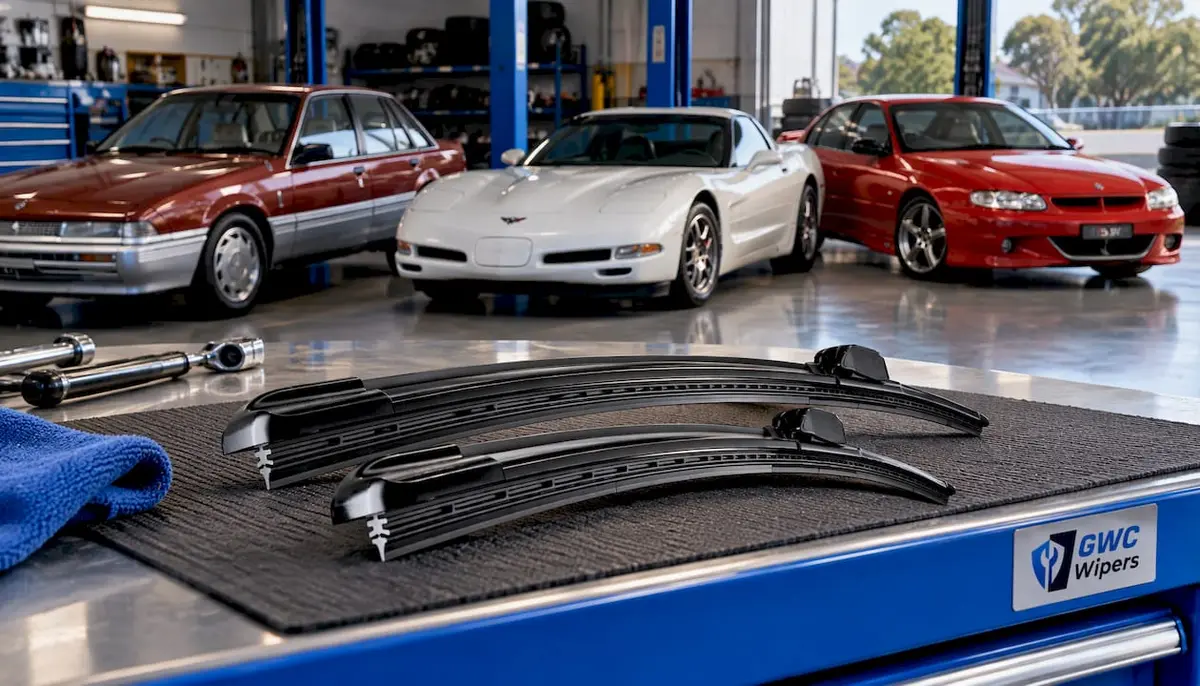
For older Australian cars this fits well. The catalogue includes models such as the Holden Calais VL sedan, the Ford Capri 1989 to 1994, the Ford TE50 from 2000 to 2002, the HSV Clubsport VT VX sedan and the Chevrolet Corvette C5 coupe. Each page lets you confirm the fit before you order.
Period-style stainless and chrome blades
These are the blades you will find sold to restorers of 1940s to 1960s cars. The Trico Classic range, for instance, is sold with a silver finish designed to resemble the original blades on classic American cars of that era. Specialist suppliers also sell polished stainless blades in short lengths, from about 8 inches (200 mm) up to 16 inches (410 mm), made for 5.2 mm and 7.2 mm wide arms.
The appeal is purely visual authenticity. If your car is judged at a concours or you are matching a 1950s interior and chrome trim, this is the category that suits you. Be aware that older arms may have weak springs or worn tips, so the blade you choose needs an arm that still presses properly. Our natural rubber blades are the daily-use option once the car is simply being driven.
Bosch and other mainstream brands
Bosch is the best-known name and often appears in independent tests. In a Hagerty UK test of 22-inch blades, the Bosch Aerotwin was the winner, with the best screen clearing and a secure locking fitment that kept the correct sweep angle. That result shows what to look for: a blade that locks firmly to the arm and keeps its angle across the glass.
The same test found an old-fashioned bridged blade, the Michelin Stealth Hybrid, coped with simulated downpours without trouble. In other words, a conventional style of blade does not have to mean poorer wiping, which is good news for classic owners who want a traditional look.
Universal blades
Universal blades suit some older cars with standard J-hook arms. As our own guide to vehicle-specific wiper blades explains, a connector has to lock securely to the arm, and the curve of the blade should mirror the windscreen. Classic windscreens often have a distinct curvature or a flatter glass than a modern car, so a blade chosen for the exact vehicle takes away the guesswork.
How to work out the correct size for a classic
Length is the first number you need. Get it wrong and the blade overhangs the glass or leaves unwiped edges. The method is simple.
- Check the catalogue by make, model and year. Our vehicle selector gives you the driver-side and passenger-side lengths separately, because the two are often different. If you are unsure which side is longer, our page on driver side wiper sizes walks through it.
- Measure the old rubber, not the arm. If your car is an unusual import or has been modified, measure the existing blade end to end. Haynes also advises measuring the blades you already have before buying.
- Identify the arm fitting. Older cars commonly use a J-hook, where a curved metal hook on the arm lets the blade clip over, or a bayonet or side-lock where the blade slides onto a flat arm tip and latches. Pin and push-button styles also appear on older models.
- Check rear wipers separately. Wagons and hatchbacks usually have a rear blade of a different length and connector from the front pair.
- Replace like for like. Haynes recommends matching the fitting of the old blade rather than forcing an incompatible one.
Owners who search for a vintage car wiper size often expect a single chart. In practice there is no universal chart for classic cars, because production changed between markets and years. This is why an exact make, model and year match is more reliable than a size list. Where a model is in our catalogue, the size and fitment shown is what we supply.
Rubber or silicone on an older car
Blade material shapes how long a set lasts and how it behaves in the Australian sun.
Hagerty Media explains that rubber degrades quickly under UV exposure, while silicone’s chemistry resists it. That article also notes that rubber blades can sometimes be revived by cleaning with isopropyl alcohol or wet-sanding with fine, 1000-plus grit paper before they need replacing. For a classic that sits in a garage and comes out on weekends, this is a useful habit: a hardened edge is the usual cause of streaking after months of storage.
We make natural rubber blades because natural rubber conforms well to the glass and is a practical, regular-replacement item. Our guides to natural rubber wiper blades and their 6 to 12 month lifespan and the value of natural rubber set out how to plan replacements. If you want to compare materials in more depth, see our guides to silicone versus rubber, EPDM versus rubber and wiper blade materials for durability.
One thing worth knowing from independent testing: Hagerty UK found that the water-repellent coating promised on some premium silicone blades was hard to detect in practice. What reliably clears the glass is good contact, correct pressure and a clean rubber edge, which are the things a correct fit delivers.

Why Australian conditions matter for classics
A classic car in Australia faces strong UV, heat that bakes rubber on parked cars, dust, and sudden heavy rain. Older cars are often parked outdoors or under thin covers, which exposes the blades for long periods. Our blades are designed and tested for Australian weather, from heavy rain to extreme heat, with corrosion resistance built in for coastal and humid regions.
A few habits protect any set of blades on a classic:
- Lift the arms off the glass if the car will sit for weeks in strong sun.
- Wipe the rubber edge with a damp cloth when you wash the car.
- Never run the wipers on a dry, dusty screen. The grit scratches glass that is often hard to replace on an old model.
- Keep the glass clean and smooth. If you are polishing, read how to polish car glass safely first, then wipe the screen completely clean of residue before fitting new blades, since leftover polish causes smearing.
Fitting new blades without damaging the screen
Fitting is a ten-minute job on most cars, but old screens and old arms need a careful hand.
- Support the arm. Wiper arms are spring-loaded. Haynes warns that letting an arm snap back can chip or crack the windscreen. Place a folded towel on the glass under the arm before you remove the old blade.
- Find the service position. Some cars park the wipers out of sight below the bonnet line or behind the pillars. Haynes notes these may need to be moved to a maintenance position first. Check the owner’s manual or workshop manual for your car.
- Release the old blade. Press the tab, slide it off the hook or bayonet, and keep it beside the new one for comparison.
- Seat the new blade. Our adapters are preassembled, so the blade clips onto the arm without tools. Listen for the click and tug gently to confirm it is locked.
- Lower the arm slowly and test with the washers before you drive.
Our step-by-step installation guide includes detailed instructions with pictures if you want to follow along.
When to replace
Signs that a classic’s blades are finished: streaks that remain after cleaning, a smear across the sweep, chatter or juddering, cracked or split rubber, a frame that has bent, or rubber that has lifted from the backing. If cleaning the edge with isopropyl alcohol does not help, replace the set.
Buying in Australia: delivery and guarantees
Many classic wiper parts are sourced from overseas, which adds waiting time and the risk of an incorrect order. Buying from us keeps it local. We ship free across Australia and offer express shipping if you need the blades before a weekend drive or a club run. Every order is covered by a 30-day money-back guarantee and a 12-month warranty, and our Australian support team can help if you are unsure about your model.
Fleet operators and workshops restoring several vehicles can order the same way: select each vehicle by make, model and year so every car gets its own matched pair.
Our perspective on classic car wipers
Owners of older cars often tell us the same thing: they do not want a gadget, they want a windscreen they can see through when the weather turns. That is the job of a wiper blade, and it does not change with the age of the car.
We build our blades around Australian conditions: UV, heat, dust and sudden downpours. Natural rubber, pressure spread along the whole blade and an aerodynamic shape are designed to give you an even wipe, and the preassembled adapter means you can fit them yourself without tools.
The most common mistake we see in the fitment process is guessing the size. A blade that is a little too long or the wrong connector will never sit properly, however good the rubber. That is why we match by make, model and year and back it with our fitment guarantee.
If your classic is in our catalogue, you can order with confidence. If you are unsure, our local team is there to help.
Faisal
Find your blades
If your classic is an Australian-market car from the 1980s onwards, start with our vehicle selector. Choose your make, model and year, confirm the front and rear lengths, and order premium wiper blades with free shipping across Australia, a 30-day money-back guarantee and a 12-month warranty. Express shipping is available at checkout when you need them quickly. Start at gwcwipers.com.au.
FAQ
What size wiper blades does a vintage car need?
It depends on the make, model and year, and the driver and passenger sides are often different lengths. Use the vehicle selector for your car, and if the model is unusual, measure the existing rubber from end to end. Do not rely on a general size chart, because lengths changed between markets and years.
Are classic car wiper blades different from modern ones?
Period-style stainless and chrome blades are made to look original on cars from the 1940s to the 1960s. For cars from the 1980s and 1990s, a correctly fitted modern blade is the better match, and it is what most owners drive with day to day. Our natural rubber blades are designed for exactly that kind of fit.
How often should I replace the blades on a car that is rarely driven?
Rubber ages in the sun even when the car is parked, so check the edges before each season. Look for cracking, splitting or streaking. Our guide to natural rubber blades covers a 6 to 12 month replacement pattern, and a stored car may suit the longer end.
Do you ship classic car wiper blades across Australia?
Yes. Shipping is free across Australia, and express shipping is available if you need your blades sooner. You also have a 30-day money-back guarantee and a 12-month warranty.
Sources
- Hagerty Media: Piston Slap, finding the right wiper blades
- Hagerty UK: Reviewed and Rated, the best wiper blades for your car
- Haynes: How to choose and fit new wiper blades
Find the exact wipers for your car with our Perfect Fit selector: find your blades at GWC.