
Long Life Wiper Blades in Australia: What Lasts and Why

Long life wiper blades come down to three things: the rubber and its protection against heat and UV, a design that spreads pressure evenly across the glass, and a correct fit for your vehicle. A blade that gets all three right keeps wiping cleanly for longer. A blade that misses one starts streaking, chattering or tearing early, whatever the packaging promises. Below you will find what independent testing shows, how the main brands compare on the points that affect lifespan, and how to look after a set so it keeps working.
TL;DR
- Durability depends on rubber quality, even pressure distribution and correct fit. A blade that fits badly wears out unevenly.
- In an independent laboratory test from October 2024, the Bosch AeroTwin and SWF Connect scored 10/10 for durability in cold conditions, and Trico Force and Hella Smarttech also scored highly.
- Australian sun is hard on natural rubber, so UV protection, parking habits and regular cleaning matter as much as the brand.
- Find your car by make, model and year in the GWC Wipers range to get a Perfect Fit set.
Table of Contents
- What actually makes a wiper blade last
- What independent testing says
- How the main options compare
- Why the same blade lasts different lengths of time
- Getting more life from any set
- Sizing: the quickest way to avoid early wear
- Our perspective
- Find your Perfect Fit set
- FAQ
- Sources
What actually makes a wiper blade last
A wiper blade is a simple part doing a hard job. The rubber edge drags across glass thousands of times in rain, dust, bird droppings and baking sun. Three factors decide how long it keeps doing that well.
The rubber and what attacks it
Natural rubber is widely used in wiper blades because of its mechanical properties, but research on blade materials notes it is susceptible to ageing from UV, ozone, oxygen and heat. That is a fair description of a Queensland car park in January. The rubber hardens, cracks at the edge and then leaves a streaky band across your line of sight.
This is why we pay attention to compound quality and corrosion resistance in the parts around the rubber. If you want the longer technical read on compounds, our guide to top wiper blade materials for durability walks through the options, and our comparison of EPDM and rubber wipers covers the trade-offs for Australian drivers.
Pressure distribution
The same research found that blade performance is shaped by cross-sectional shape and vertical load, and that improper load distribution can lead to noise, vibration and premature wear. In plain terms, if some parts of the blade press harder than others, those parts wear first. Then the blade lifts off the glass somewhere else and streaks.
That is the reason GWC blades use segmented pressure distribution and an aerodynamic profile. The aim is for the whole edge to carry its share of the load, so wear spreads out rather than concentrating on one spot. If you want to see how this works on a curved windscreen, read about flexible wiper design and how to fix streaks with even pressure.
Fit
Fit is the factor most people overlook. A blade that is slightly too long can foul the pillar or the other blade. One that is too short leaves a wider unwiped area. A wrong connector can leave the blade sitting at a bad angle. Each of these shortens the working life. When you choose wiper blades that actually fit your vehicle, you protect the rubber as well as your visibility.
What independent testing says
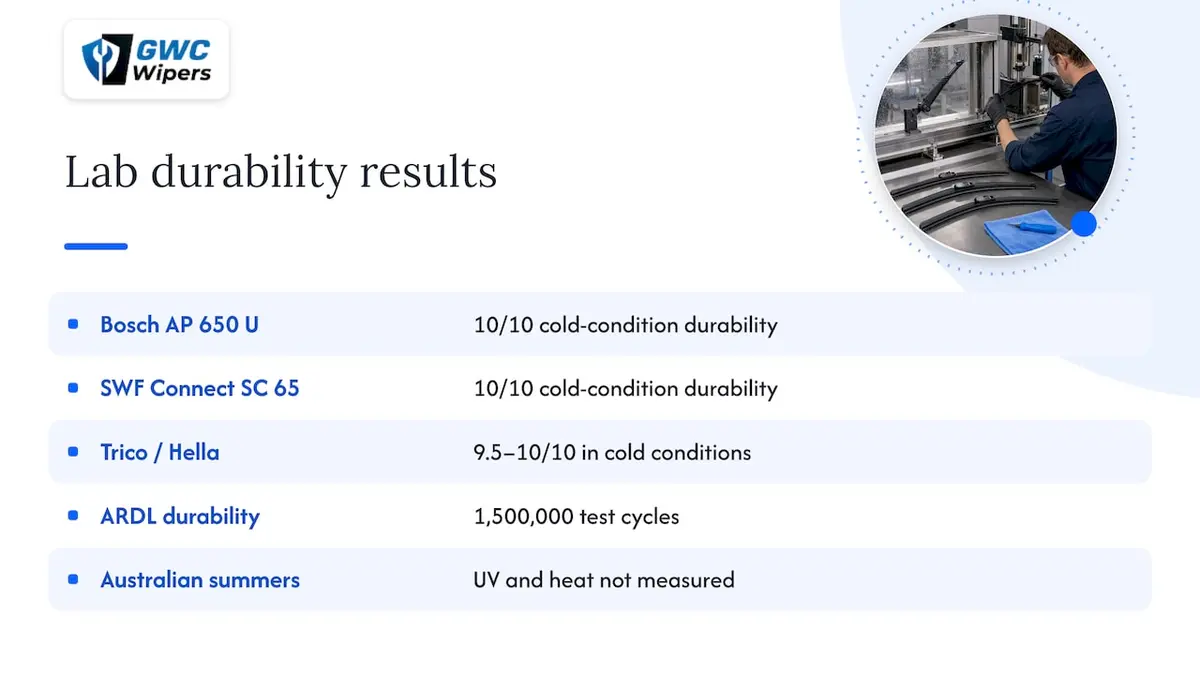
Brand claims about lifespan are hard to compare, because every maker tests differently. One of the few neutral reference points is a laboratory comparison published by Testfakta in October 2024. In it, the Bosch AeroTwin AP 650 U and SWF Connect SC 65 were top-performing flatblades, both scoring 10/10 for durability in cold conditions. The same study had Trico Force and Hella Smarttech scoring 9.5 to 10 out of 10.
Two things are worth taking from this. First, several established flat blades cleared a high durability bar, so a reputable flat blade is a sound starting point. Second, the test was run in cold conditions. Australian summers add UV and heat that a cold test does not measure, so it tells you about build quality rather than a guaranteed number of years on a hot dashboard-facing windscreen.
Industry testing labs also show how much effort goes into this. ARDL, for example, runs durability testing to 1,500,000 cycles and salt spray testing to check coatings, clips, paint and rubber integrity. Coastal drivers in Perth, Sydney or Brisbane will recognise why corrosion resistance belongs on that list.
How the main options compare
The table below compares the brands Australian drivers most often weigh up, on the points that bear on lifespan. It leaves prices out on purpose, because they move with sales and size. Check current pricing on each seller’s page.
| Blade | Type and rubber | Lifespan features | Fit and support |
|---|---|---|---|
| GWC Wipers | Premium beam-style blade, natural rubber, segmented pressure distribution, aerodynamic design | Corrosion resistance, built for Australian weather extremes | Vehicle-specific fitment for over 2,500 models, preassembled adapters, free shipping Australia-wide, 30-day money-back guarantee, 12-month warranty |
| Bosch (Evolution, AeroTwin) | Beam design, natural rubber, steel spring | AeroTwin scored 10/10 for cold-condition durability in the October 2024 Testfakta test | Wide range of sizes and arm adapters, sold through many retailers |
| Trico (Force) | Flat blade | Scored in the 9.5 to 10 out of 10 range in the same test | Sold through automotive retailers |
| Valeo (First) | Conventional frame blade, graphite-coated natural rubber | Valeo describes it as longer-lasting for everyday use | Universal adaptor, compact range of sizes |
| Rain-X (Latitude) | Beam blade with water repellent function | Designed to apply a water repellent while wiping | Universal adapter |
Where each one fits
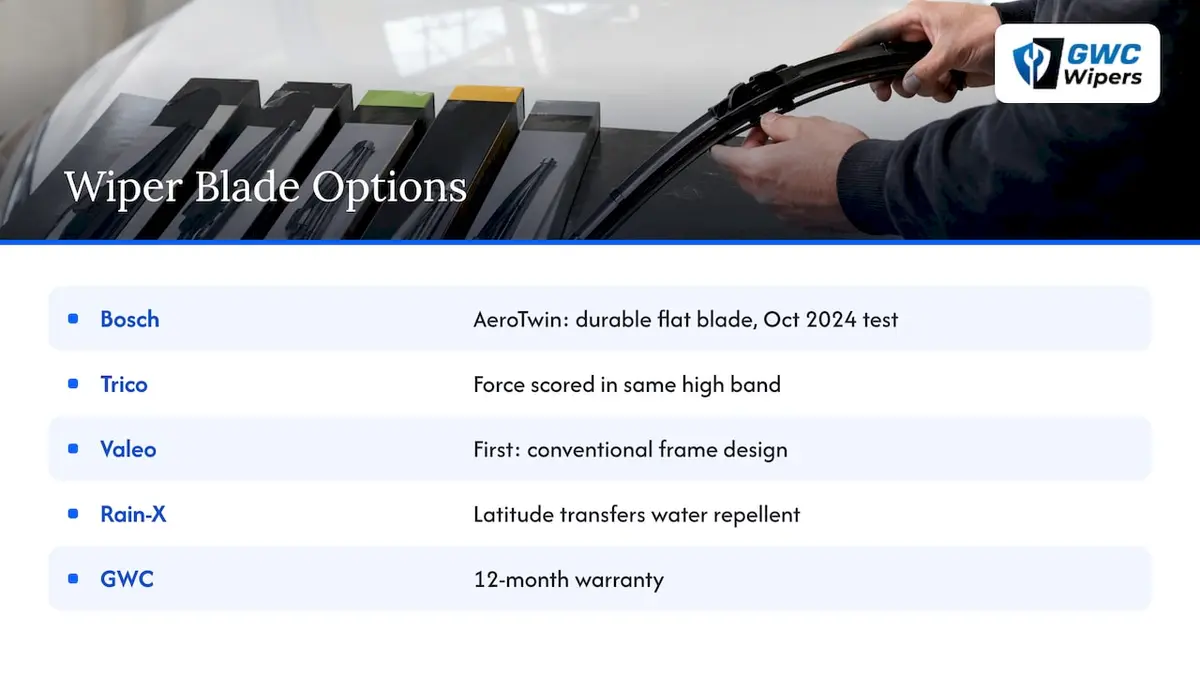
Bosch. Bosch is the name most Australians know, and the October 2024 test supports its AeroTwin as a durable flat blade. If you drive a common car and want a well-known option, it is a reasonable shortlist entry.
Trico. Trico’s Force scored in the same high band in that test. Trico is another established option with a long history in Australia, and a sensible comparison point.
Valeo. Valeo’s First blade is a conventional frame design. Frame blades are a simple, familiar style, though a beam or flat design generally spreads pressure more evenly across a curved windscreen.
Rain-X. The Latitude takes a different approach: a blade that also transfers a water repellent to the glass. That suits drivers who want beading in rain. It is a different idea from a blade built purely around long wear.
GWC. Our case rests on the whole package. The blades are designed for Australian weather extremes, matched to your exact vehicle through the selector, and backed by a perfect fit guarantee, a 30-day money-back guarantee and a 12-month warranty. For a car you rely on every day, a blade that fits exactly and carries a warranty is a practical way to get long life. For a deeper look at the ownership side, see why investing in durable wipers pays off.
Why the same blade lasts different lengths of time
If two neighbours buy identical blades and one needs replacements a year before the other, the blade is rarely the reason. Three things usually explain it.
Where the car is parked. A car parked in the open all day takes the full UV load. Parking in shade or a garage, or using a windscreen cover, slows rubber ageing. Our 9 tips to protect your windscreen wipers cover this in more detail.
How dirty the glass is. Shell Australia points out that built-up dirt, bird droppings, pollen or wax residue make it harder for the rubber to glide smoothly. Gritty glass acts like sandpaper on the blade edge.
How often you use them. A commuter in Melbourne’s wet months runs wipers far more than a weekend driver in Adelaide. Replacement once or twice a year is a common guideline, but timing varies with blade type, vehicle use and weather. Our guide on how long wipers last for Australian drivers explains how to judge it for your own driving, and there is a model-specific read in the Honda wiper lifespan guide.
Getting more life from any set
These habits cost almost nothing and apply to every brand in the table.
- Clean the glass properly. Wash the windscreen regularly and wipe the blade edge with a damp, lint-free cloth. A streak-free glass cleaning method helps remove film that otherwise gets dragged across the glass by the blade.
- Never run blades on a dry windscreen. Use the washer first. Dry wiping wears the edge quickly and can scratch the glass if grit is present.
- Lift the arms off the glass in extreme sun. If you park outdoors for days, for example at an airport, this reduces the time the rubber is pressed hot against the glass.
- Clear leaves, ice and debris before you start the wipers. Anything stuck under the blade can nick the edge.
- Replace at the first sign of chatter or streaks. Replacing early protects the glass and your visibility. Noise and skipping often point to worn rubber or an uneven fit.
A word on WD-40: it is a solvent-based lubricant, not a windscreen product, and we do not recommend putting it on blade rubber. Clean rubber with water and a mild detergent, or a glass cleaner made for the job.
Sizing: the quickest way to avoid early wear
The correct windscreen wiper size for your car is not always the same on both sides. Drivers’ and passengers’ blades often differ, and the rear may be different again. The usual ways to check are a vehicle lookup tool using make, model and year, or measuring your existing blades and checking the owner’s manual. You should confirm both the blade length and the connector type, because both vary by vehicle.
The simplest route is our selector. Pick your make, model and year and it shows the blades that fit, with guides for tool-free installation. Larger four-wheel-drives show why this matters: a Toyota Prado 120 and a Ford Everest have long blades and different arm setups, and a near-enough size is not good enough on glass that big. You can browse by brand too, such as BMW wiper blades or Suzuki Vitara wiper blades.
If you are comparing blade styles before you buy, our overview of hybrid wiper blades is a good next step.
Our perspective
Most drivers ask which blade lasts longest. We think the better question is which blade lasts longest on your car, in your climate.
We design GWC blades for Australian conditions: strong sun, sudden heavy rain, dust and salt air. We use natural rubber with segmented pressure distribution so the load is spread along the whole edge, and we build in corrosion resistance so the frame does not fail before the rubber does.
The other half is fit. That is why we built the vehicle selector around more than 2,500 models and back it with a perfect fit guarantee. A blade that sits right on the glass wears evenly, and that is how you get long life in practice.
We also stand behind the blades with a 30-day money-back guarantee and a 12-month warranty, and our local support team is there if you are unsure about anything.
Faisal
Find your Perfect Fit set
We make it simple to get blades that suit your car. Choose your vehicle by make, model and year in the GWC Wipers range, and the selector shows the right sizes and adapters. Blades arrive with preassembled adapters and a clear guide, so most people fit them without tools. Shipping is free across Australia, and express shipping is available if you need them sooner.
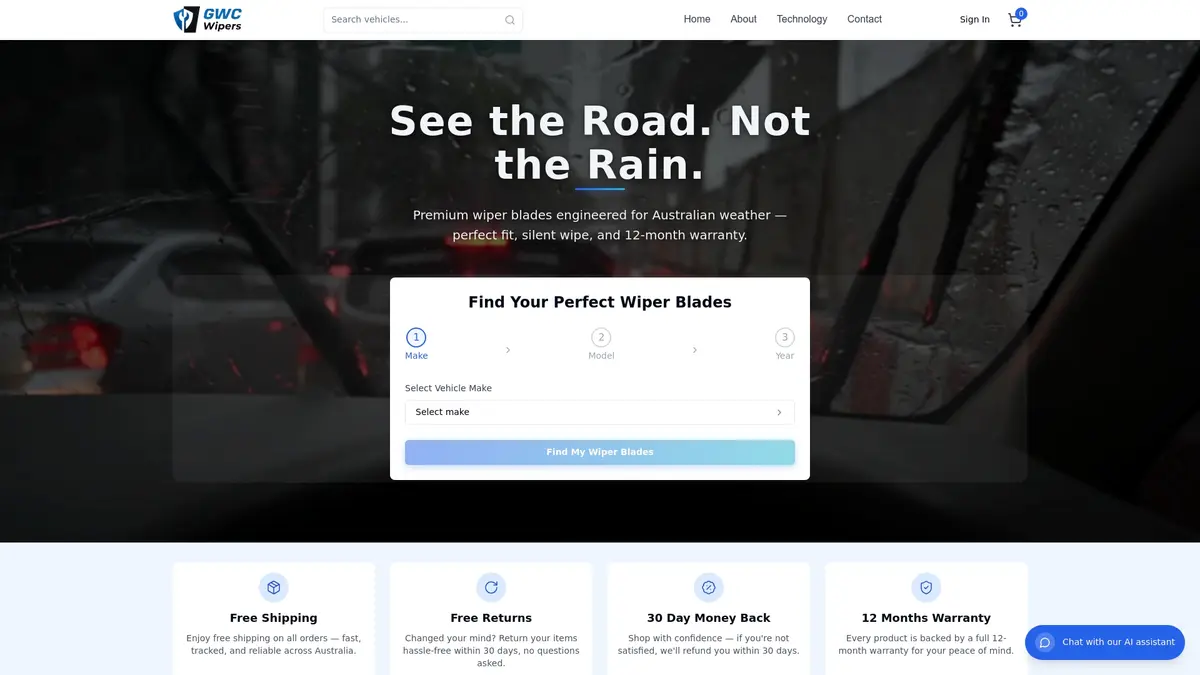
If you drive for work, our fleet and workshop customers use the same selector to order for several vehicles. Start on the GWC Wipers home page and search by make, model and year.
FAQ
How long should long life wiper blades last?
A common guideline is to replace blades once or twice a year, but the real figure depends on blade type, how often you drive in rain and how much sun the car sees. In strong Australian sun, rubber can age faster than the calendar suggests. Replace them when you notice streaks, chatter or a cracked edge, not just by date.
Are silicone blades more durable than rubber?
Silicone compounds are one of the materials that can affect durability and streak reduction, as can natural and synthetic rubber. No single material wins in every situation. Design, pressure distribution and fit matter just as much. Our materials guide covers the differences.
Is WD-40 good for cleaning wiper blades?
We do not recommend it. It is a solvent-based lubricant and not designed for wiper rubber or glass. Wipe the blade edge with a damp lint-free cloth and clean the windscreen with a proper glass cleaner.
Are Bosch or Trico blades more durable?
In the October 2024 Testfakta test, the Bosch AeroTwin scored 10/10 for cold-condition durability and Trico Force scored in the 9.5 to 10 out of 10 range, so both performed strongly. Fit and care will affect how either lasts on your car.
Sources
- Testfakta wiper blade test, October 2024
- Analysis of the Cross-Sectional Shape and Wiping Angle of a Wiper Blade (Lee, 2020)
- ARDL wiper blade testing and development
- Shell Australia: troubleshooting noisy wipers
- The Important (and Overlooked) Components for Vehicle Visibility and Safety
- Wiper blade size chart for cars, utes and SUVs
- Streak-free car glass cleaning method